Things to Do in Puebla, Mexico: Walking Guide
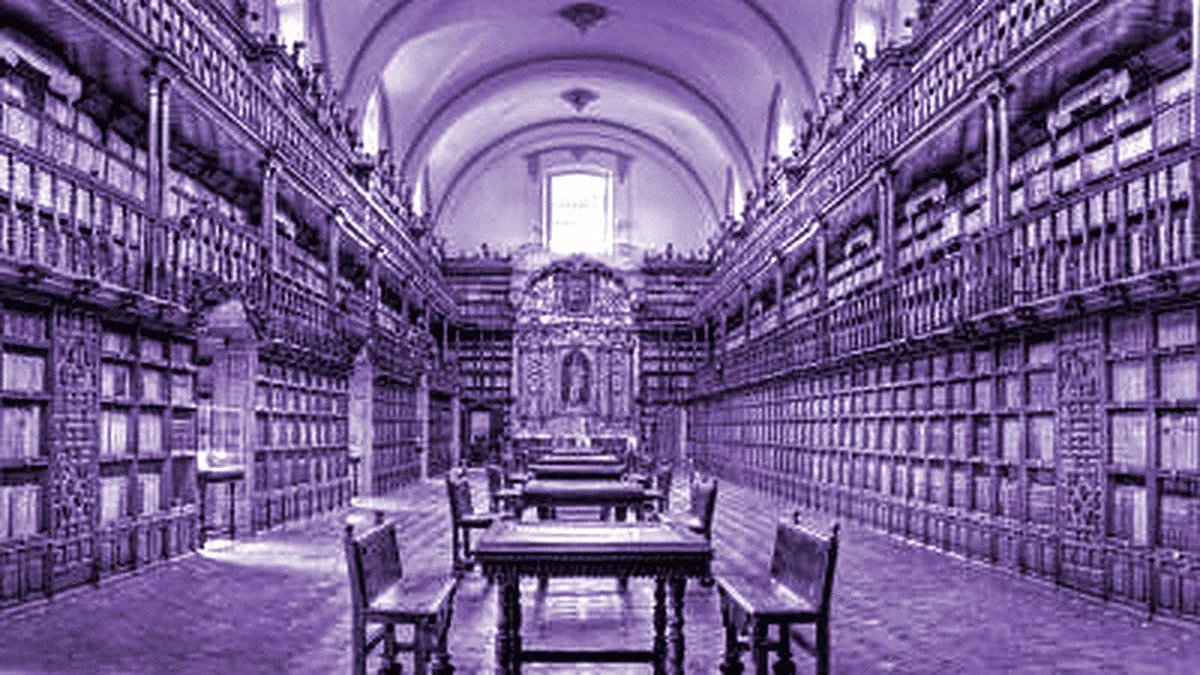
Things to Do in Puebla: A Guide to the City’s Historic Center
Puebla is a historic city in Mexico known for its colonial architecture, Talavera tiles, Baroque churches, museums, and distinctive cuisine. Founded in 1531 in the Cuetlaxcoapan Valley, it is especially rewarding to explore on foot, with major monuments and cultural attractions concentrated in and around its UNESCO-listed Historic Centre. Neywo has a free audio guide for Puebla with 48 narrated places.
Part of the appeal is Puebla’s architectural variety: Renaissance planning, Mexican Baroque decoration, red brick, colourful azulejos, and white-mortar reliefs create a visual identity found throughout the centre. Puebla is also closely associated with mole poblano, cemitas, traditional sweets, and regional crafts.
Puebla is one of the destinations covered by Neywo’s free audio guides for Mexico, making it easy to combine a visit here with other cities across the country.
What to see in Puebla
The best way to discover Puebla is to explore its Historic Centre and follow its streets from major civic buildings to churches, mansions, museums, and markets. These are some of the most important places to include.
Historic Centre of Puebla
Puebla’s Historic Centre covers nearly nine square kilometres and includes 391 blocks and more than 2,600 registered monuments. The area was declared a Historic Monuments Zone in 1977 and recognised by UNESCO as a World Heritage Site in 1987.
The centre was founded in 1531 at the foot of Popocatépetl. Its streets preserve a distinctive combination of red brick, colourful Talavera tiles, and white argamasa reliefs. Religious and civil buildings reflect successive Renaissance, Baroque, French, and neoclassical influences, making the centre feel like an open-air architectural museum.
Puebla Cathedral
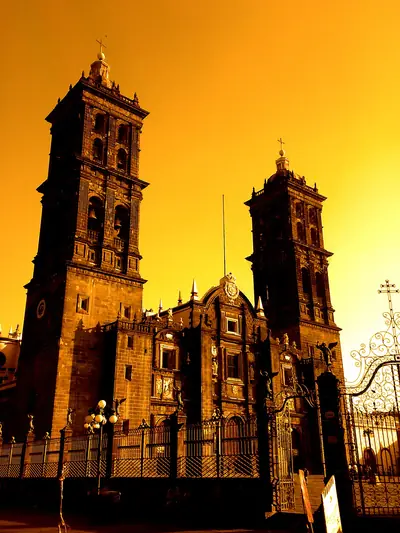
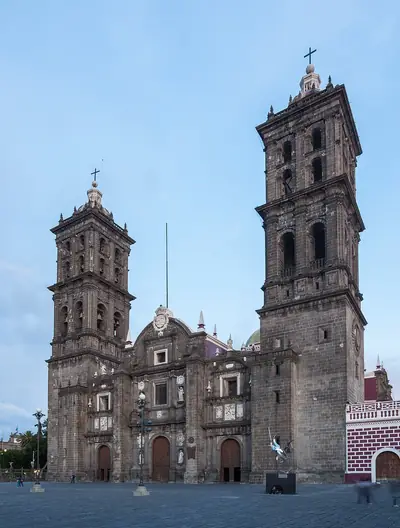
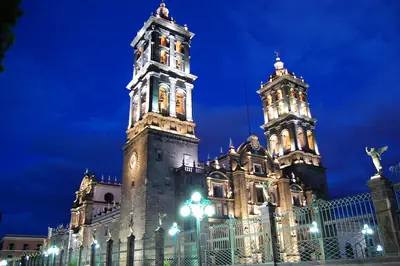
Puebla Cathedral, also known as the Basilica Cathedral of Puebla, stands beside the Zócalo and is the seat of the Archdiocese of Puebla de los Ángeles. Construction began in 1575 and continued for 74 years before the cathedral was consecrated in 1649.
The building has a broad atrium and five naves: a central nave flanked by processional naves and additional side spaces. Bishop Juan de Palafox y Mendoza played an important role in the later stages of construction, including raising the central nave to bring more natural light into the interior. Its sober exterior and imposing scale make it one of the defining landmarks of Puebla.
Amparo Museum
The Amparo Museum occupies two colonial-era buildings in the heart of Puebla’s Historic Centre. The older building began as the Hospital de Nuestra Señora y San Juan de Letrán, founded in 1534. In the mid-18th century, Bishop Juan de Palafox y Mendoza transformed it into a college for women.
The neighbouring building was once part of the hospital complex, later became a refuge for married women, and eventually served as the private home of the Espinosa family. Both buildings were restored and adapted during the 1980s, and the museum opened in 1991. Its setting makes the visit as interesting as the collections: the museum combines an important cultural institution with several centuries of Puebla’s urban history.
Casa del Deán
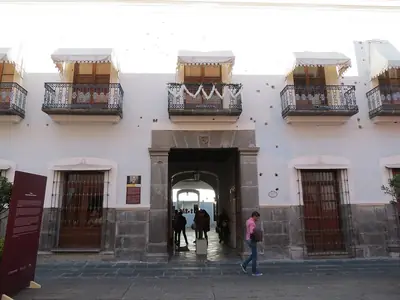
Casa del Deán is one of Puebla’s oldest surviving mansions. The house dates from 1563, although it was not occupied until 1580, a date carved into the lintel of an upper-floor window.
Only part of the original building survives today, including the Mannerist façade, vestibule, entrance hall, central patio, staircase, and four rooms. Even in this reduced form, Casa del Deán offers a glimpse of the homes occupied by Puebla’s early colonial elite. Its historic murals have also earned it the nickname “the Sistine Chapel of the New World.”
Casa del Alfeñique
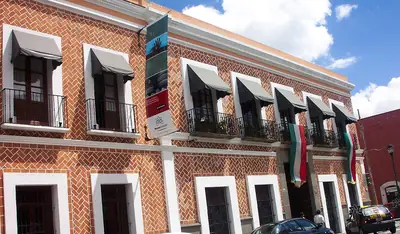
Casa del Alfeñique is one of Puebla’s most recognisable Baroque buildings and was the city’s first museum when it opened in 1926. Its name refers to a traditional sugar candy, an apt comparison for the elaborate white stucco decoration covering the red-brick façade.
The building stands at the corner of 4 Oriente and 6 Norte. Its ornamentation is a particularly clear example of Puebla’s characteristic Baroque style, in which brick, tiles, and pale decorative reliefs work together to create a highly detailed façade.
Museo de la Revolución Mexicana, Casa de los Hermanos Serdán
The Museo de la Revolución Mexicana is housed in the Casa de los Hermanos Serdán, the former home of Carmen, Máximo, and Aquiles Serdán Alatriste. Aquiles Serdán was an important precursor of the Mexican Revolution of 1910, and the events connected with this house helped spark the uprising against the Díaz dictatorship.
The building itself dates from the 17th century, although its present appearance largely reflects the late 19th-century period when the Serdán family lived there. The museum connects Puebla’s colonial architecture with one of the decisive political movements in modern Mexican history.
Capilla del Arte
Capilla del Arte is a cultural space belonging to the Universidad de las Américas Puebla. It opened to the public in October 2009 inside the former Las Fábricas de Francia building.
The space includes a contemporary-art gallery, an arts forum, and a small reading area. Its opening exhibition presented more than 80 works by Mexican and international artists, while a later anniversary exhibition brought together the Generación de la Ruptura with works by Diego Rivera, José Clemente Orozco, and David Alfaro Siqueiros. It is a useful stop for visitors who want to see Puebla’s cultural life extend beyond its colonial heritage.
Casa de los Muñecos
Casa de los Muñecos stands on the first block northeast of Puebla’s Zócalo. This 18th-century building is considered one of the finest examples of Puebla’s civil architecture.
Since 1983, it has belonged to the Benemérita Universidad Autónoma de Puebla and houses the Museo Universitario Casa de los Muñecos. The building therefore continues to serve as both an architectural landmark and a university cultural space.
El Parián
El Parián is Puebla’s largest and only traditional handcraft market. It occupies a building with 112 stalls, lined with brick and decorated with Talavera tiles, at 6 Norte and 2 Oriente in the Historic Centre.
The market is a good place to see Puebla’s artisan traditions in one setting. Stalls offer textiles, pottery, Talavera pieces, and other handmade goods from the region. Caricaturists also work inside the market, sketching portraits for visitors. El Parián is included in the city’s Day of the Dead altar route, adding another connection between the market and Puebla’s traditions.
Conventual Temple of Our Lady of Mount Carmel
The Conventual Temple of Our Lady of Mount Carmel, also known as the Church of the Virgin of Carmen, is an early example of Puebla Baroque architecture from the 1600s.
The main nave contains two richly decorated side chapels and a painting of the Holy Trinity by Cristóbal de Villalpando, one of colonial Mexico’s celebrated painters. At the front, a neoclassical altarpiece frames a sculpture of the Virgin carved by José Antonio Villegas Cora. The contrast between the ornate Baroque surroundings and the cleaner neoclassical lines of the altarpiece is one of the church’s notable details.
Capilla de San Ildefonso and Templo de San Marcos
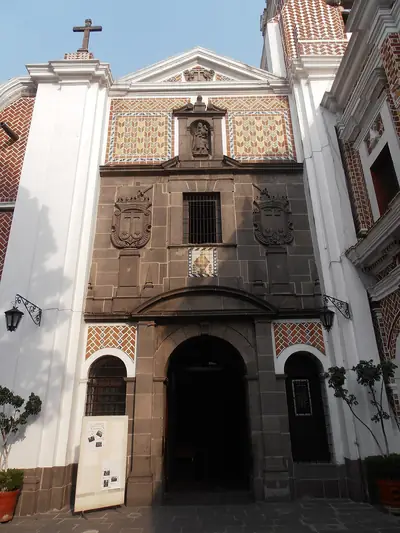
Capilla de San Ildefonso, on Avenida Reforma, dates from the middle of the 17th century and is one of the older religious structures on the avenue. Nearby, Templo de San Marcos provides a striking architectural contrast with its Baroque façade of red brick and Talavera ceramic.
Together, the two buildings show how Puebla’s churches vary in scale and decoration while sharing the city’s characteristic use of brick and ceramic ornament.
Other places to include
Puebla’s historic streets also lead to smaller religious and cultural landmarks. The Chapel of Nuestra Señora de los Dolores del Puente takes its name from its location near the former San Francisco Bridge. Auditorio de la Reforma is a concert and multi-purpose hall, while Centro Cultural Espacio 1900 combines a cultural centre with a theatre.
For more church architecture and colonial history, look for the churches and chapels included in Neywo’s walks, including Santo Domingo, San Francisco, San Cristóbal, and the churches around the Zócalo.
Puebla cuisine, crafts, and everyday culture
Puebla’s identity is also expressed through food. The city is closely associated with mole poblano, while cemitas, traditional sweets, and regional dishes can be found in its markets and food districts. Calle de los Dulces and the Market of Poblano Flavors are particularly connected with Puebla’s culinary traditions.
The city’s crafts are just as distinctive. Talavera pottery, ceramics, textiles, and painting remain visible in markets and artisan areas, especially around El Parián and the Artist Quarter. Callejón de los Sapos adds another colourful stop to a walk through the centre.
Explore Puebla with Neywo’s free audio guide
Download Neywo and explore Puebla with four walking tours and one bus route, covering 48 narrated places in total:
- The Angels’ City: Cathedral, Jesuits and the First Convent — 2.19 km, 81 minutes, 10 stops.
- Eighth Wonder of the World: Talavera Churches and Baroque Gold — 2.42 km, 80 minutes, 9 stops.
- Silent Convents and Ancient Treasures South of the Zócalo — 2.8 km, 85 minutes, 9 stops.
- North of the Zócalo: San José, San Antonio and the churches of the east — 3.27 km, 82 minutes, 7 stops.
- Ruta 2: from the Chapel of San Ildefonso to the Serdán house and San José — a 9.4 km bus route lasting 40 minutes, with 6 stops.
Neywo tells the story of each place as you reach it, at your own pace, with no group and no schedule. Narration is available in 11 languages, so you can explore Puebla independently while understanding the history behind its churches, museums, streets, and monuments.
Places with an audio guide in Puebla
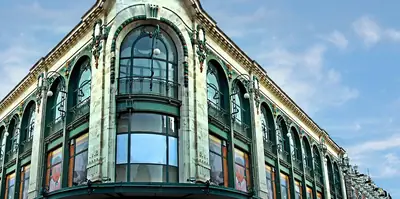
8 places in Puebla with a Neywo audio guide. Each one starts telling its story as you reach it.
Self-guided tours in Puebla
5 tours in Puebla, free in the Neywo app. Each stop tells its story as you reach it.
- Bus ride
Ruta 2: from the Chapel of San Ildefonso to the Serdán house and San José
Ride the local Ruta 2 from the Chapel of San Ildefonso past the railway museum into the old centre. It passes the Serdán house where the 1910 Revolution began, the Capilla del Arte and the Baroque church of San José, and ends at the church of San Juan del Río, for the price of a city fare.
Capilla de San Ildefonso · National Museum of Mexican Railways · Museo de la Revolución Mexicana, Casa de los Hermanos Serdán · Capilla del Arte · Parroquia de San José in Puebla · Templo de San Juan del Río
Open this tour: Ruta 2: from the Chapel of San Ildefonso to the Serdán house and San José - Walk
The Angels' City: Cathedral, Jesuits and the First Convent
Start at the oldest surviving mansion in Puebla, then climb to the 70-metre cathedral that once towered over every church in the colonies. Walk east past a contemporary-art chapel, Jesuit and Baroque churches, the house where the Mexican Revolution first fired a shot and one of the oldest active theatres in the Americas, and end at the city's first convent.
Casa del Deán · Puebla Cathedral · Capilla del Arte · La Compañia Church · Museo Poblano de Arte Virreinal · Museo de la Revolución Mexicana, Casa de los Hermanos Serdán …
Open this tour: The Angels' City: Cathedral, Jesuits and the First Convent - Walk
Eighth Wonder of the World: Talavera Churches and Baroque Gold
Walk north-west from Santo Domingo, whose Rosary Chapel was once called the eighth wonder of the world. Visit a quiet Dominican church, a collector's house museum, and Baroque fronts dressed in red brick and Talavera tile along Avenida Reforma.
Parish of Santa Clara · Church of Santo Domingo, Puebla · Church of Santa Catalina de Siena, Puebla · Santísima Trinidad Church, Puebla · Museo Bello · Church of San Marcos Evangelista, Puebla …
Open this tour: Eighth Wonder of the World: Talavera Churches and Baroque Gold - Walk
Silent Convents and Ancient Treasures South of the Zócalo
A calm loop through the southern streets of the old town: the historic indigenous quarter of Analco, the Amparo Museum with its pre-Hispanic collection, and convent churches built between the 1600s and the 1700s.
Iglesia de Nuestra Señora de la Luz · Templo del Santo Ángel Custodio de Analco · Templo del Ex-Hospital de San Roque · Saint Jerome Church · Amparo Museum · Iglesia de las Capuchinas …
Open this tour: Silent Convents and Ancient Treasures South of the Zócalo - Walk
North of the Zócalo: San José, San Antonio and the churches of the east
A quieter circuit through the northern and eastern barrios: the churches of Our Lady of Mercy, San Juan de Dios and San José, the convent of San Antonio de Padua, and the old neighbourhood churches of Santa Inés, San Juan del Río and Santa Cruz.
Our Lady of Mercy Church, Puebla, Mexico · Iglesia de San Juan de Dios · Parroquia de San José in Puebla · Saint Anthony of Padua Convent, Puebla city, Puebla state, Mexico · Templo de Santa Inés · Templo de San Juan del Río …
Open this tour: North of the Zócalo: San José, San Antonio and the churches of the east
Walk Puebla with Neywo
Neywo turns Puebla into a self-guided audio tour. Stories arrive as you reach the place they belong to, and the route reshapes when you wander off it.

