Visiting Bergen, Norway: Top Sights on Foot
Things to Do in Bergen: What to See in Norway’s Gateway to the Fjords
Bergen is a Norwegian city shaped by the sea, medieval trade, and the mountains around it. Its historic churches, fortress buildings, museums, and waterfront make it one of the most rewarding places to explore on foot. Neywo has a free audio guide for Bergen with 60 narrated places, available in 11 languages.
What to See in Bergen
Bryggen
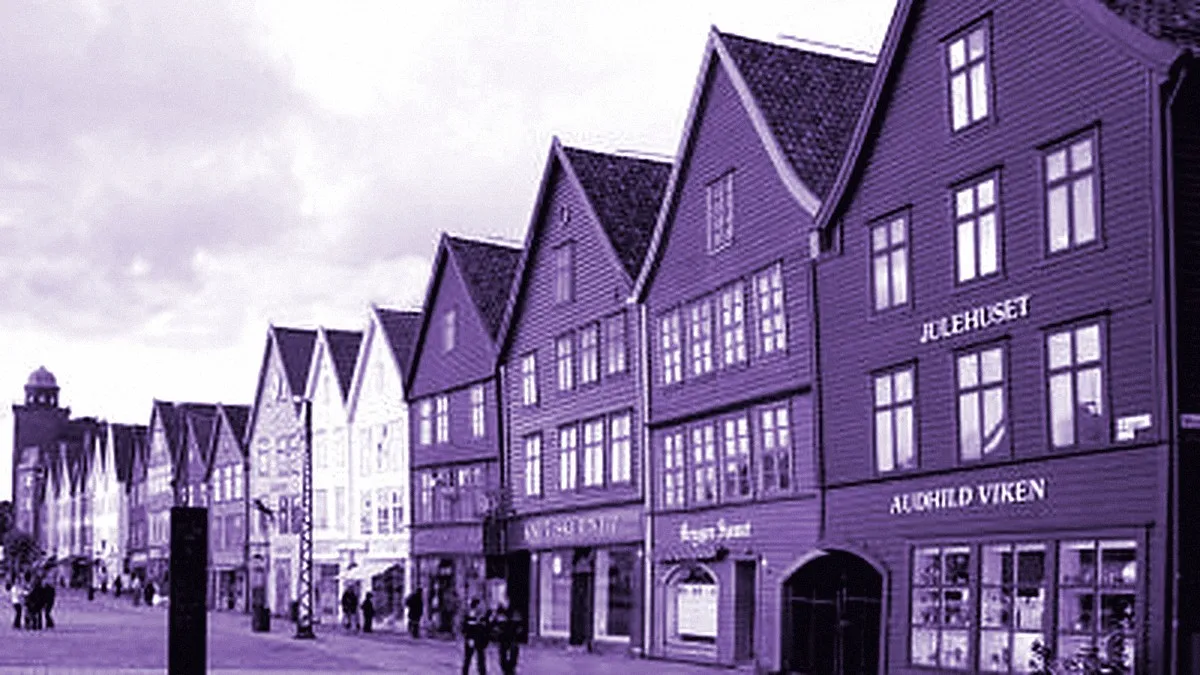
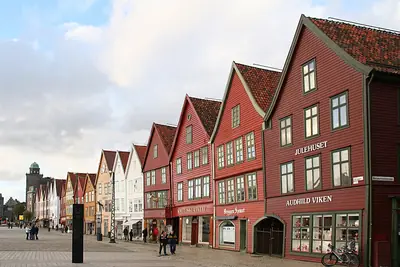
Bryggen is Bergen’s famous Hanseatic wharf on the eastern side of Vågen harbour and a UNESCO World Cultural Heritage site since 1979. Its heritage buildings stand in rows along narrow lanes that run inland from the quay, while fire-safe stone cellars form part of the historic city core.
Also known as Tyskebryggen, or the German dock, Bryggen was the centre of Hanseatic commercial activity in Norway. The Hanseatic League established itself in Bergen in 1350, and the wharf served as the seat of the German office in the city from 1360 to 1754. The area’s layout was established by Olav Kyrre around 1070.
Nonneseter Abbey and Nonneseter Chapel
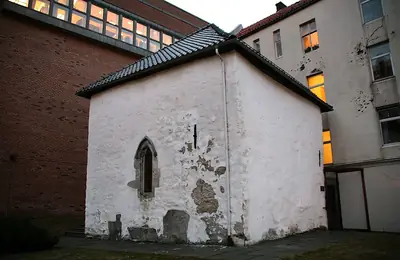
Nonneseter Abbey was a Cistercian nunnery for women during Bergen’s Middle Ages. The monastery was arranged around a square, with a single-nave church to the north. Only parts of the complex survive today: the west tower base, known as Tårnfoten, and the southern choir chapel, Nonneseter Chapel.
Tårnfoten contains a Romanesque room with cross vaulting and now serves as Minnehallen, a memorial hall for those who fell in the Second World War. The chapel, at Kaigaten 3, has a Gothic vaulted interior and pointed-arch windows. It was used as a church for deaf people from 1951 to 1989.
Korskirken
Korskirken, or Holy Cross Church, is one of Bergen’s oldest surviving medieval churches. Built in stone in Vågsbunnen, it may have been started around 1130 and was completed around 1150. The church was first mentioned in 1181 in the saga of Sverre Sigurdsson.
Repeated fires have changed the building over time. Major additions between about 1615 and 1623 gave it the cruciform shape visible today. Its dedication to the Holy Cross is linked to the tradition that the church possessed an authentic relic of the cross.
Bergenhus Fortress and its museums
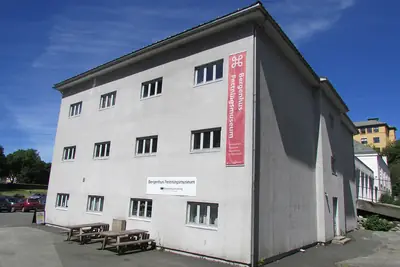
Bergenhus Fortress brings together several important sites connected with the city’s military and royal history. The Bergenhus Fortress Museum, also known as Magasinbygget, provides a place to connect the fortress setting with its past.
Rosenkrantztårnet is the fortress’s dominant tower. Its medieval core, the “keep by the Sea”, was built in 1270 by King Magnus the Lawmaker. The tower served defensive purposes, contained a chapel, and was also a residence for the lensherren. In the 1560s, Erik Rosenkrantz rebuilt and extended it after damage caused by fire and an explosion, adding a cannon battery.
The fortress played a role in the Battle of Vagen in 1665, when English warships attacked Dutch vessels sheltered in neutral Bergen Harbor. The attack failed, and no ships were sunk.
Håkonshallen
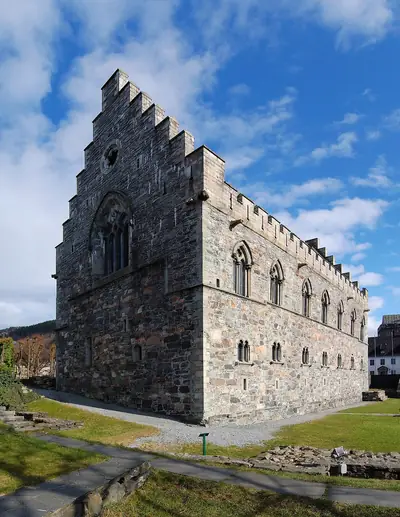
Håkonshallen is a medieval stone hall within Bergenhus Fortress. It was built in the mid-13th century during the reign of King Håkon Håkonsson, who ruled Norway from 1217 to 1263. The hall’s first recorded use was the wedding of Håkon’s son Magnus, later known as Magnus Lagabøte, on September 11, 1261.
The building originally contained a large festive hall on the upper level, with the king’s high seat by the north end wall. The middle storey provided living space, while the cellar was used for storage. After falling into disrepair, the hall was used as a grain store from 1683 before being rediscovered and restored as a royal hall in the 19th century.
St Mary’s Church
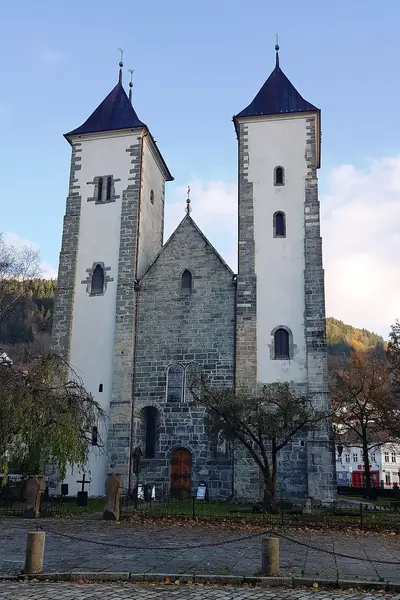
St Mary’s Church, or Mariakirken, is the oldest intact building in Bergen. Its oldest masonry dates from the middle of the 1100s, and the church retains an unusually strong medieval character.
The building combines a Romanesque nave with a Gothic choir. It has two west towers, four portals, and a basilica plan with a high central nave and lower side aisles. The southern portal is particularly notable for its late Romanesque character. Inside, the pulpit from 1677 and the altarpiece from the 1400s are among its significant features.
Bergen Cathedral
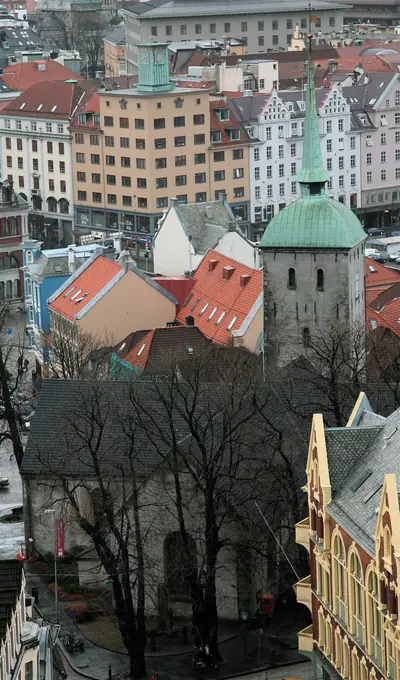
Bergen Cathedral, or Bergen domkirke, has been a place of worship for centuries and remains dedicated to Saint Olaf. The church was first mentioned in 1181, when it was known as Olavskirken in Vågsbunnen.
The stone church has side aisles and a long-church layout. It has been damaged by fire repeatedly: it burned in 1248, and a new stone church built afterward caught fire again in 1270. The building was fully reconstructed in 1537, when it became the cathedral of the Protestant diocese.
Den Nationale Scene
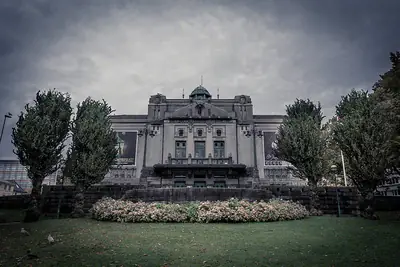
Den Nationale Scene is one of Bergen’s most important theatre landmarks and one of Norway’s oldest permanent theatres. Its history began in the mid-1800s, when Ole Bull established Det norske Theater. Henrik Ibsen worked there from 1852 to 1857.
Den Nationale Scene was founded in 1876 as a continuation of that tradition. The present Art Nouveau building at Engen was designed by Einar Oscar Schou and opened on 19 February 1909 with Ludvig Holberg’s Erasmus Montanus. Statues of the authors Nordahl Grieg and Bjørnstjerne Bjørnson stand outside.
Bergen’s university museums
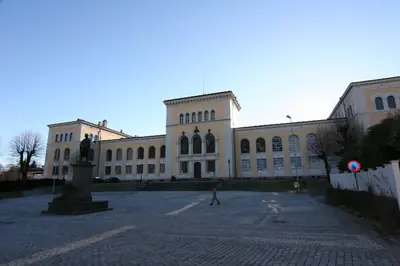
The University Museum of Bergen’s Department of Natural History grew from Norway’s early natural-science collections. Its holdings reach back to the 1800s and include more than two million specimens, including fossils, minerals, preserved fauna, and botanical preparations. The collections support research into taxonomy, paleoecology, and natural-history processes.
The Cultural History Collections at the University Museum explore Norwegian history and wider cultural traditions, from Inuit and Aleut culture to modern Norwegian eras. The collections include church art, Viking Age archaeological objects, and artefacts from medieval Bergen. The department is housed in a protected building erected in 1927, surrounded by botanical gardens.
Fantoft Stave Church
Fantoft Stave Church is a replica of the original church that stood on the site. The original burned down completely on June 6, 1992; a copy was built in the same place and reopened in 1997.
Before its move to Fantoft, the church was Fortun stave church, first erected in Luster in Sogn around 1170. Consul F. G. Gade bought much of its timber in 1883 and moved it to Bergen, where it was reconstructed using Borgund stave church as a model. A medieval stone cross from Tjora in Sola, Rogaland, also stands on the grounds.
Other museums beyond the centre
Alvøen is an old manor house connected with one of Norway’s earliest and best-preserved industrial sites in Bergen. Paper production began there in 1797 and continued until the machines stopped in 1981. Alvøen Manor opened as a museum in 1983.
Siljustøl preserves the home and surroundings of composer Harald Sæverud and his wife, Marie Hvoslef. The main building dates from 1939 and was designed by Ludolf Eide Parr in collaboration with Sæverud. The property was protected by Riksantikvaren in 2005 and opened as a museum in connection with Sæverud’s 100th birthday in 1997.
Explore Bergen with a self-guided audio tour
Neywo offers six walking tours, one bus route, and one bike route in Bergen. The walks range from 0.69 km and 55 minutes for “Bryggen and the fortress” to 4.2 km and 204 minutes for “The Ultimate Bergen: university museums to Håkon’s Hall”. Together, the walking routes include between 4 and 15 narrated stops.
The bus route from Bergenhus to the Museum Quarter and the Abbey covers 6.7 km in 29 minutes and has 7 stops. The bike route from Sandviken’s waterfront to Håkonshallen covers 2.7 km in 14 minutes and has 3 stops.
The app tells the story of each place as you reach it, at your own pace, with no group and no schedule. Download Neywo and explore Bergen’s waterfront, medieval buildings, museums, and fortress with a free audio guide.
Bergen is part of Norway, and you can continue your journey to Oslo, Stavanger, or Tromsø.
Places with an audio guide in Bergen
8 places in Bergen with a Neywo audio guide. Each one starts telling its story as you reach it.
Self-guided tours in Bergen
8 tours in Bergen, free in the Neywo app. Each stop tells its story as you reach it.
- Bike ride
Sandviken Waterfront Ride: Old Wooden Bergen to Håkonshallen
Pedal along the cycle path that hugs the Sandviken shore, from the open-air Old Bergen museum of 19th-century wooden houses, past the white Sandvik Church, to the royal banqueting hall of Håkonshallen inside Bergenhus Fortress.
Gamle Bergen Museum · Sandvik Church · Håkonshallen
Open this tour: Sandviken Waterfront Ride: Old Wooden Bergen to Håkonshallen - Bus ride
Bus 18: Bergenhus to the Museum Quarter and the Abbey
Ride Tide's city line 18 from the royal hall of Håkonshallen along the harbour past the UNESCO timber wharf of Bryggen and the Hanseatic Museum, through Torgallmenningen and the green Byparken to the museums beside Lille Lungegårdsvannet, and on to the surviving tower of medieval Nonneseter Abbey.
Håkonshallen · Bryggen · Hanseatic Museum and Schøtstuene · Sjømannsmonumentet · Byparken · Bergen Kunsthall …
Open this tour: Bus 18: Bergenhus to the Museum Quarter and the Abbey - Walk
Bergen's museum row and the medieval abbey
From the leprosy museum — a subject Bergen has a real claim on — past the ruins of Nonneseter Abbey to the lake, the Grieg Hall and the Rasmus Meyer collection of Norwegian painting.
Kong Oscars gate · St George's Church · Lepramuseet · Bergen station · Nonneseter klosterkapell · Nonneseter Abbey …
Open this tour: Bergen's museum row and the medieval abbey - Walk
Torget, the Hanseatic Museum and Torgallmenningen
The harbour end of the city: the fish market, the merchant's house kept exactly as the Hanseatic traders left it, the sailors' monument, and the broad square Bergen rebuilt after the 1916 fire.
Korskirken · Hanseatic Museum and Schøtstuene · Torget · Sjømannsmonumentet · Torgallmenningen · Byparken …
Open this tour: Torget, the Hanseatic Museum and Torgallmenningen - Walk
Bryggen and the fortress
Seven hundred metres, and the reason Bergen is on the UNESCO list. The leaning wooden warehouses of the Hanseatic wharf, the museum built over the excavation beneath them, St Mary's Church, and the Rosenkrantz tower at the harbour mouth.
Bryggen · Bryggens Museum · St Mary's Church · Bergenhus Fortress Museum · Rosenkrantztårnet
Open this tour: Bryggen and the fortress - Walk
Sandviken, Håkon's Hall and the cathedral
North along the water to the medieval royal hall inside the fortress — restored after a munitions ship exploded in the harbour in 1944 — and back through the cathedral quarter.
Sandvik Church · Bergenhus Fortress · Håkonshallen · Bergen Cathedral
Open this tour: Sandviken, Håkon's Hall and the cathedral - Walk
Nordnes: the university museums and the maritime museum
Under a kilometre on the western peninsula: the maritime museum's Viking ships and the university's natural history and cultural history collections, in buildings that are worth the walk on their own.
St John's Church · Bergen Maritime Museum · De kulturhistoriske samlinger (Universitetsmuseet – Kulturhistorie) · University Museum of Bergen, Department of Natural History · Hulen
Open this tour: Nordnes: the university museums and the maritime museum - Walk
The Ultimate Bergen: university museums to Håkon's Hall
Right across the city, from the museum quarter through the cathedral and the fish market to Bryggen and the fortress. Four kilometres, and it covers everything except the funicular.
De kulturhistoriske samlinger (Universitetsmuseet – Kulturhistorie) · University Museum of Bergen, Department of Natural History · Nonneseter klosterkapell · Nonneseter Abbey · St George's Church · Bergen Cathedral …
Open this tour: The Ultimate Bergen: university museums to Håkon's Hall
Walk Bergen with Neywo
Neywo turns Bergen into a self-guided audio tour. Stories arrive as you reach the place they belong to, and the route reshapes when you wander off it.

