Visiting Longyearbyen, Norway: Top Sights on Foot
Things to Do in Longyearbyen: Museums, Mining and Arctic History
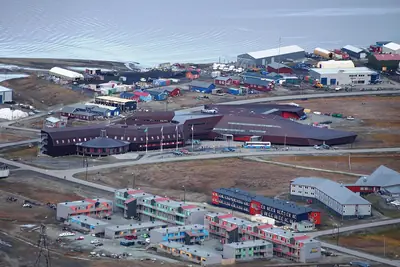
Longyearbyen is the largest town in Svalbard, Norway’s Arctic archipelago, and a fascinating place to explore on foot. Its museums, church and former mine tell the story of polar exploration, coal mining and the communities that developed in one of the world’s harshest environments. Neywo has a free audio guide for Longyearbyen with 4 narrated places, available in 11 languages.
What to See in Longyearbyen
The best way to understand Longyearbyen is to move through its places in sequence: from the town’s mining origins to its religious and community life, then into the history of exploration and the wider Arctic.
Mine No. 1, Adventdalen
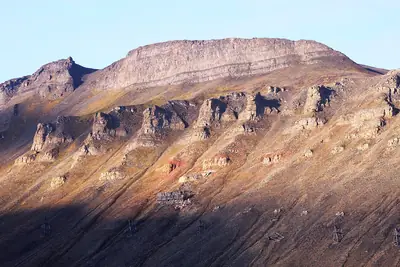
Mine No. 1, also known as the American Mine, was the first coal mine in Longyearbyen. Extraction began in 1906 after John Munroe Longyear bought the operation and founded the Arctic Coal Company, establishing Longyear City.
The mine’s coal seam lies 230 metres above sea level and is about one metre thick. Coal was carried along the mountainside by cableway to Skjæringa, then transported by rail down to the loading quay. Traces of the old cableway can still be seen in the valley.
The site also reflects the dangers of mining. On 3 January 1920, a dam explosion killed 26 miners. The mine was subsequently closed, and extraction moved to Mine 2 at Sukkertoppen.
Svalbard Church
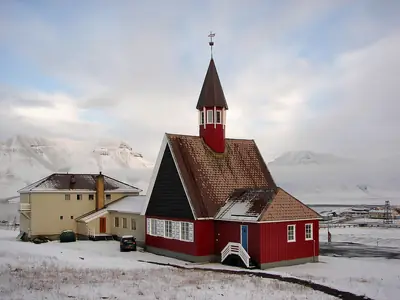
Svalbard Church is a red wooden building in the centre of Longyearbyen and an important meeting place for the local community. Designed by architect Hans Magnus, it was built in 1957 and consecrated on 24 August 1958. The church has seating for about 140 people.
The present building replaced the first church on Svalbard, which was built in 1921 and destroyed by the German navy in September 1943 during the Second World War. The church was renovated in 2004 and connected to Longyearbyen’s district heating network.
Although it is a place of worship, Svalbard Church also serves as a gathering place for people throughout the town. It is open around the clock.
Svalbard Museum
The Svalbard Museum is the main place to visit if you want to understand the archipelago’s natural and cultural history. Its core exhibition, Life in Light and Ice, follows Svalbard’s story from the first whalers to today’s society, shaped by mining, research and tourism.
The displays combine settlement history with exhibits about local plants and animals. They also explore the close relationship between human activity and the Arctic environment, including the conditions that make life possible in such a demanding setting.
The museum’s collections contain more than 40,000 objects, photographs, archival materials, works of art and books, with around 7,000 formally registered items. Founded in 1979, it opened in 1981 and spent many years in an old pig shed. In April 2006, it moved to its current location inside the Svalbard Science Park at the University Centre.
Spitsbergen Airship Museum
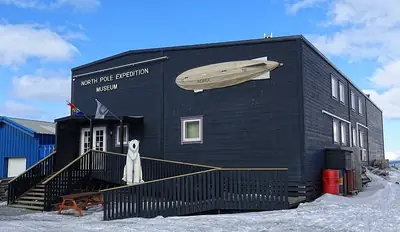
The Spitsbergen Airship Museum, also known as the North Pole Expedition Museum, focuses on the early twentieth-century airship expeditions that departed from Svalbard in search of the North Pole.
The museum was created through an Italian-Norwegian collaboration led by Svalbard residents Stefano Poli and Ingunn Løyning. Planning began in 2005, and the museum opened in 2008. That year marked the International Polar Year, the eightieth anniversary of the Italia airship crash and thirty years since the death of polar explorer and aviator Umberto Nobile.
The opening ceremony took place on 15 November 2008 and was attended by descendants of Nobile and Roald Amundsen. The museum originally opened in Longyearbyen’s former pig farm before moving to its current building.
Longyearbyen’s Mining and Arctic Identity
Longyearbyen’s streets and buildings reveal how closely the settlement’s identity is connected to coal mining. Mine No. 1 represents the beginning of the town’s industrial history, while the museums place that story within the broader history of Svalbard, from whaling and polar expeditions to research and tourism.
The town’s community institutions are equally important. Svalbard Church is not simply a historic building: it remains a place where local life takes place. Together, these sites show Longyearbyen as both an Arctic settlement and a gateway to the wider history of polar exploration.
For travellers comparing destinations in Norway, Longyearbyen offers a very different experience from mainland cities such as Tromsø, Narvik or Oslo.
Explore Longyearbyen with Neywo
Download Neywo and follow a self-guided walking tour through Longyearbyen’s founding story. The app has 1 walking tour covering 1.88 km in 47 minutes, with 4 narrated stops: Mine No. 1, Adventdalen, Svalbard Church, Svalbard Museum and Spitsbergen Airship Museum.
Each story plays as you reach the place, at your own pace, with no group and no schedule. It is a simple way to discover Longyearbyen’s coal-mining heritage, religious life and polar history while walking through the town.
Places with an audio guide in Longyearbyen
4 places in Longyearbyen with a Neywo audio guide. Each one starts telling its story as you reach it.
Self-guided tours in Longyearbyen
1 tour in Longyearbyen, free in the Neywo app. Each stop tells its story as you reach it.
- Walk
Coal, Faith and Polar Dreams: Longyearbyen's Founding Story
Start at the ruins of the American Mine that created Longyear City, then walk down to the world's northernmost church once open round the clock. Finish at the Svalbard Museum and the Airship Museum, where the great race to the North Pole by balloon and airship comes alive.
Mine No 1, Adventdalen · Svalbard Church · Svalbard Museum · Spitsbergen Airship Museum
Open this tour: Coal, Faith and Polar Dreams: Longyearbyen's Founding Story
Walk Longyearbyen with Neywo
Neywo turns Longyearbyen into a self-guided audio tour. Stories arrive as you reach the place they belong to, and the route reshapes when you wander off it.

