Things to Do in Levanger, Norway: Walking Guide
Things to Do in Levanger: Historic Churches, Museums and Rural Heritage
Looking for things to do in Levanger? This town in Trøndelag combines a preserved wooden centre with medieval ruins, historic churches, wartime memorials and open countryside. Levanger developed as a port and market centre where the Levanger River meets an ice-free branch of Trondheimsfjorden, and its streets still reflect that long history.
Neywo has a free audio guide for Levanger with 13 narrated places, available in 11 languages. Each story plays as you reach the place, so you can explore at your own pace.
What to See in Levanger
Levanger’s historic wooden centre
The centre is the best place to begin exploring Levanger. Fires in 1692 and 1846 influenced the town’s planning, while the 1897 fire established much of the street pattern visible today. Many of the wooden homes and commercial buildings that survive were built between the 1897 fire and Norway’s 1904 restrictions on wooden construction in urban areas.
The protected cultural environment includes houses, businesses, courtyards, leafy spaces, streets and squares. In 2018, 157 properties received full or partial preservation status. The character of the centre comes from the continuity of the whole streetscape rather than from one isolated monument.
Levanger Church
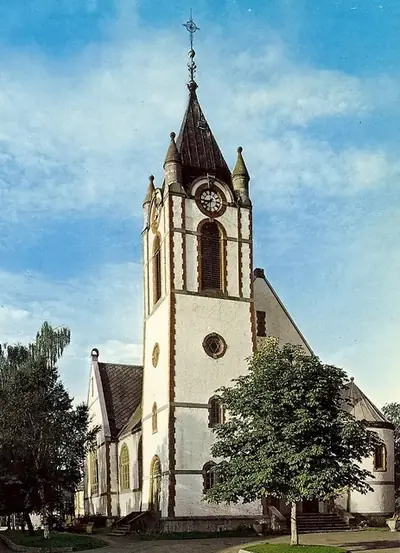
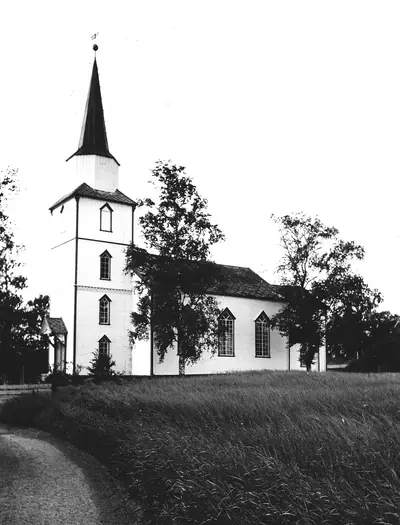
Levanger Church is the town’s main parish church. Inaugurated in 1902, it is a long church, with the building arranged along a central axis. Its stone walls are finished with white plaster, while the overall design follows the Art Nouveau style.
Levanger Museum of Photography
Levanger Museum of Photography, or Levanger Fotomuseum, explores the history of photography in Levanger and the surrounding area. Its collection contains around six hundred thousand negatives and photography-related objects, much of it drawn from the personal archives of local photographers.
The museum also represents studio photographers including Sverre Bjerkan, Lars Larsen Ingulfsvand, Martin Knoph and Olga Davidson. It was formerly called Levanger Museum and changed its name in 2016. Since 2004, it has been consolidated with Stiklestad National Cultural Centre and other museums in the southern part of the county.
Munkeby Abbey
A few kilometres east of Levanger, the ruins of Munkeby Abbey offer a glimpse into the area’s medieval religious history. The Cistercian monastery was probably founded in the second half of the twelfth century, possibly by monks from England, and was already in use before 1180.
Only the church building remains visible today. The ruin measures about thirty metres by seven metres inside, with chapel arms about twenty-three metres wide. The monastery may have declined after Tautra Abbey was established and consecrated in 1207, although its active life may have ended as early as the thirteenth century. The building later served as a parish church until 1589 and was subsequently used as a source of stone.
Alstadhaug Church
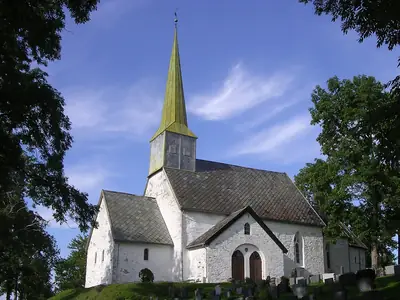
Alstadhaug Church is a stone church from around 1180, built during the transition between Romanesque and Gothic architecture. Its thick walls and relatively small windows reflect the Romanesque style, while the pointed apse arch shows the influence of Gothic design.
The church contains several unusual details. A very low doorway leads into the sacristy, which was probably used to store church books or other important documents. The building is also richly decorated, including a large wall painting on the apse arch. Dedicated to Saint Peter, it has relics associated with him in the altar, as well as an octagon described as one of its important elements.
Falstad Centre and Falstad Forest
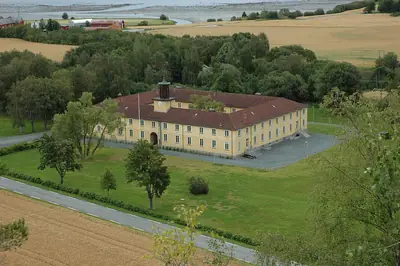
The Falstad Centre in Ekne is a memorial site focused on imprisonment during the Second World War, humanitarian international law and human rights. The site includes the former Falstad prison camp and Falstad Forest.
During the occupation, the forest was used as an execution site by the occupying power. It is now a war cemetery and protected cultural heritage site. The Falstad Museum occupies the basement of the former main building of the SS camp Falstad. Its collection began with the first Falstad museum in 1985, and the centre moved into the former camp building in 2006 while developing the wider area as a memorial landscape.
Ekne Church
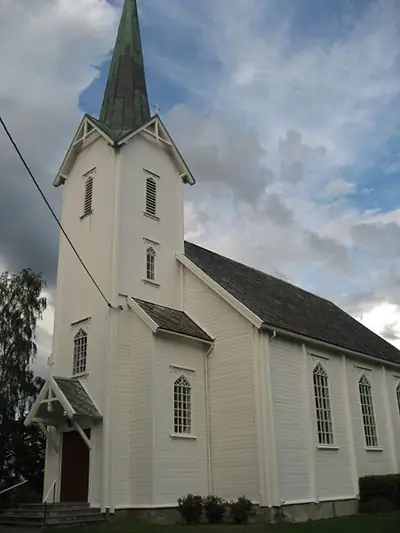
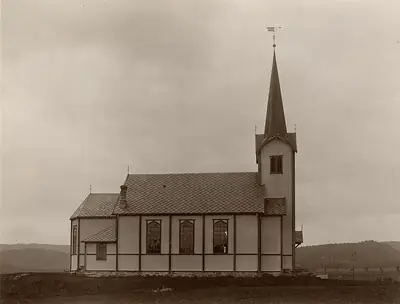
Ekne Church is a white wooden church that has served the Ekne parish since 1893. It follows the long-church design, known in Norwegian as a langkirke, and has space for about 220 people.
Skånes skanse
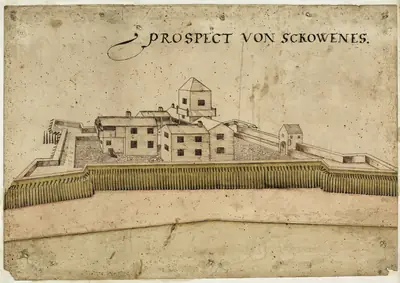
At Skånes, the remains of a former fortification can still be seen around the farmyard at Skånes vestre. The site stood on a headland by the Trondheimsfjord, outside Levanger. Its surviving earthworks and bastion foundations are connected with fortifications from the wars between Denmark and Sweden.
The main fort was probably built in the 1670s, although an earlier forward position may have been started during the Hannibal War of 1643–1645. One feature to look for is Stjerneredutt, or Stjerneskansen, an elevated redoubt with a star-shaped plan. It may have served as a lookout or defensive position facing the road. Maps from around 1683 and 1824 show both the main fort and the redoubt, while an account from 1675 records that fifty men guarded a provisions store at the site.
Ytterøy Church
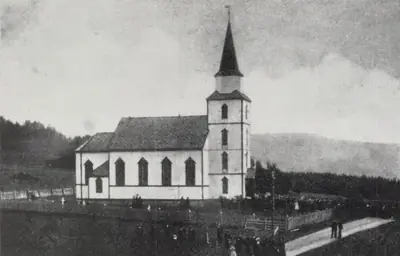
On Ytterøya, north of the village of Hokstad, Ytterøy Church is a white wooden parish church built in 1890. Its long-church design and neo-Gothic architecture give it a distinctive appearance. The timber building has space for about 350 people and belongs to the Church of Norway.
Markabygda Church
Markabygda Church stands in the village east of Movatnet. Built in 1887, this simple white wooden church is another example of the long-church tradition in the area. It has space for about 170 people.
Okkenhaug Church
Okkenhaug Church, formerly known as Okkenhaug Chapel, is a timber parish church in the Frol area of Levanger Municipality. Built in 1893, it combines a long-church layout with Neo-Gothic design and has space for about 220 people.
Åsen Church
Åsen Church is a white wooden church built in 1904, replacing an earlier building that burned down in 1902. Its long-church form follows the Swiss chalet style, based on plans by architect Ole Røising. The church serves the Åsen parish and has space for about 400 people.
Bamberg Church
Bamberg Church is a modern parish church in the Neset area, built in 1998 and consecrated on 30 August of that year. It was the first arbeidskirke, or work church, in Nord-Trøndelag. Rather than serving only as a place of worship, the building is multifunctional, with meeting and event spaces. It stands on Bamberg farm, where a foundation established by Sverre Gustav and Anna Elvida Bamberg helped make the church possible.
Bokkhaugen
For a change of scenery, Bokkhaugen is a hill in Levanger municipality rising to 420 metres above sea level. Its setting is shaped by rolling terrain and open natural surroundings. The highest point in the surrounding area reaches 568 metres and lies about three kilometres southeast of the hill.
Explore Levanger with Neywo
There are no scheduled group departures or fixed meeting times with Neywo. The free Levanger audio guide includes 13 narrated places, with stories available in 11 languages. The app tells the story of each place as you reach it, at your own pace, with no group and no schedule.
Download Neywo and discover Levanger’s wooden streets, churches, museums and historic landscapes while you walk. After Levanger, continue exploring Norway, from nearby Trondheim to Røros.
Places with an audio guide in Levanger
8 places in Levanger with a Neywo audio guide. Each one starts telling its story as you reach it.
Walk Levanger with Neywo
Neywo turns Levanger into a self-guided audio tour. Stories arrive as you reach the place they belong to, and the route reshapes when you wander off it.

