What to See in Daegu, South Korea: Free Audio Guide
Things to Do in Daegu: What to See in South Korea’s Heritage City
Looking for things to do in Daegu? This inland South Korean city brings together Catholic and Protestant landmarks, Buddhist heritage, historic government buildings, museums, and the traditional medicine district of Daegu Yangnyeongsi. Neywo has a free audio guide for Daegu with 16 narrated places, helping you explore the city while its stories play as you arrive.
What to See in Daegu
The best way to understand Daegu is to move through its different layers of history. Religious sites, public parks, museums, and cultural institutions reveal how the city developed from a Joseon administrative centre into a modern regional capital.
Daegu Holy Mother’s Shrine
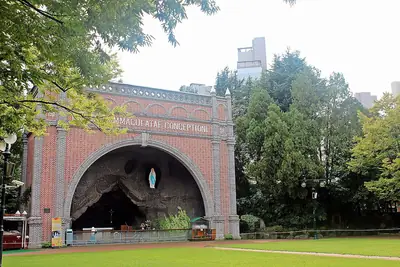
Within the Daegu Archdiocesan offices, Daegu Holy Mother’s Shrine is a quiet Catholic site modelled on the Massabielle Grotto at Lourdes in France. Bishop Florian Demange, the first bishop of the Daegu Archdiocese, commissioned it after choosing Our Lady of Lourdes as the archdiocese’s patron saint.
Construction began in July 1917, and the shrine was completed on August 15, 1918. Its interior is arranged like a rocky grotto, with a statue of the Virgin Mary above it. The granite foundation, red-brick walls, and darker brickwork at the corners have preserved much of the building’s original appearance.
Daegu First Church
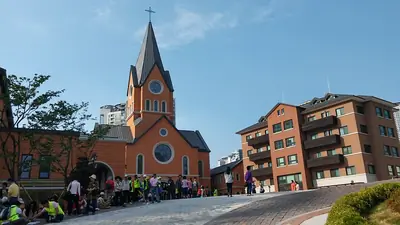
Known in Korean as Daegu Jeil Church, Daegu First Church is a Presbyterian church in Daegu’s Jung-gu district. It forms part of the city’s Christian heritage and sits close to several other historic religious landmarks in the old quarter.
Gyesan Cathedral
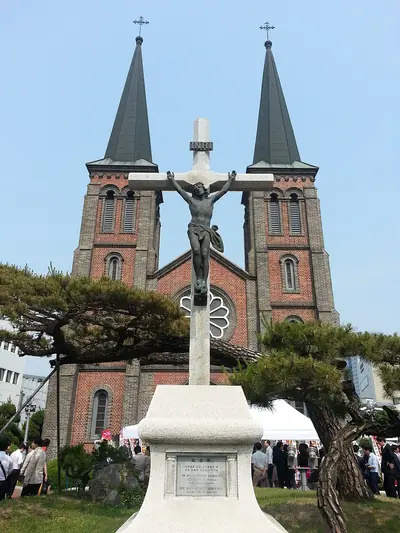
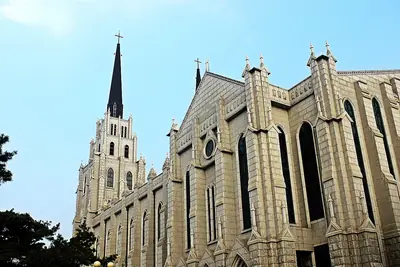
Gyesan Cathedral, also known as Our Lady of Lourdes Cathedral, is the cathedral of the Archdiocese of Daegu and one of the city’s most important Catholic landmarks. Its story began with a wooden church built in 1891, but that structure was destroyed by fire in 1899.
The present cathedral was constructed between 1902 and 1903 and remodelled in 1911, when Gyesan became a cathedral. The building represents more than a century of Catholic history in Daegu, from the first wooden church to the landmark that stands today.
Daegu Yangnyeongsi Oriental Medicine Museum
The Daegu Yangnyeongsi Oriental Medicine Museum introduces the traditional medicine heritage associated with one of Daegu’s defining districts. Its focus is the city’s long-standing relationship with medicinal ingredients, healing practices, and the trade in traditional medicine.
For travellers interested in the cultural side of Korean wellness traditions, the museum adds context to the surrounding Yangnyeongsi area and explains why traditional medicine remains an important part of Daegu’s identity.
Gyeongsang-gamyeong Park
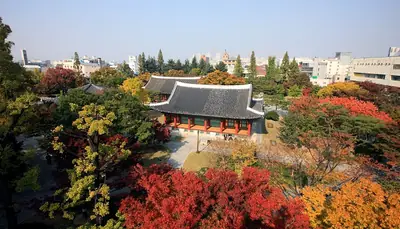
Gyeongsang-gamyeong Park occupies the former site of Gyeongsang Gamyeong, the regional government headquarters of the Joseon Dynasty. The provincial administration was transferred to Daegu in 1601, during the reign of King Seonjo, and remained an important centre of government.
The site later served as the North Gyeongsang government office from 1910 to 1965. After the office moved, the park was created in 1970. Two historic buildings survive inside it: Seonhwadang, where the governor worked, and Jingcheonggak, the governor’s residence. In 2017, the site was designated Daegu Gyeongsang Gamyeong Site, Historic Site Number 538 of the Republic of Korea.
National Debt Redemption Movement Memorial Park
National Debt Redemption Movement Memorial Park, also called National Debt Park or Gukchae Park, commemorates a movement that began in Daegu in 1907 and 1908. The campaign sought to address Korea’s national debt and later became associated with the country’s independence movement.
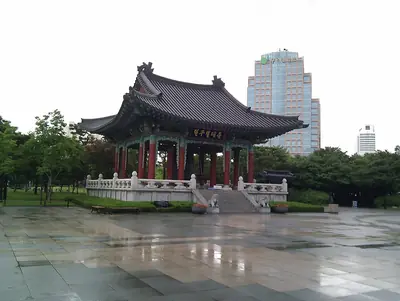
The park also recalls the gold-collecting campaign of 1998, launched during the Asian financial crisis. Originally known as Dongin Park, it received its current name in April 1999. It covers about 42,500 square metres and includes walking areas, green spaces, memorials, and a pavilion containing the Dalgubeol Grand Bell, installed in December 1998.
Beomeo Cathedral
Beomeo Cathedral is another important Catholic landmark in Daegu. Its presence adds to the city’s unusually rich concentration of Christian religious sites, alongside Gyesan Cathedral, Daegu First Church, and Daegu Holy Mother’s Shrine.
Donghwasa
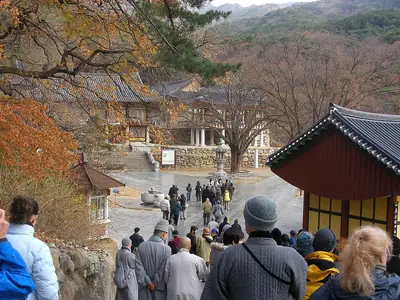
On the southern side of Palgongsan Mountain, Donghwasa is a Buddhist temple in Daegu’s Dong District and an important temple of the Jogye Order. Its name means “Temple of Paulownia Blossoms.”
The temple’s most striking landmark is the Donghwasa Unification Medicine Buddha, a 33-metre stone statue created in 1992. It is known as the world’s largest stone Medicine Buddha. The temple grounds combine religious heritage with the setting of Palgongsan Mountain.
Daegu National Museum
Daegu National Museum explores the cultural heritage of Daegu and North Gyeongsang Province. The museum opened in 1994 and brings archaeology, history, and regional culture together.
Three galleries opened in 2010: the Ancient Culture Hall, the Medieval Culture Hall, and the Textiles and Clothing Hall. Together, they offer different perspectives on the region’s past. The museum is in Hwanggeum-dong, in Daegu’s Suseong District, and is affiliated with the National Museum of Korea.
Daegu Opera House
Opened on August 7, 2003, Daegu Opera House is a major centre for opera and South Korea’s only theatre dedicated to producing opera. The six-storey building combines concrete with steel trusses and has seating for 1,490 people.
Its facilities include an accessible elevator, designated parking spaces, wheelchair rental, and a step-free main entrance. The building was constructed between 2000 and 2003.
Daegu Stadium
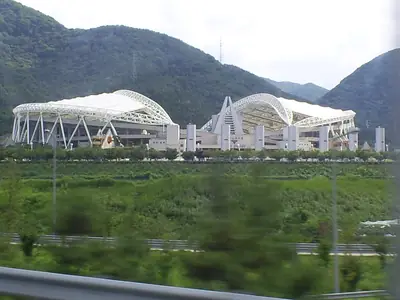
Daegu Stadium, also known as the Blue Arc, is a large multi-purpose sports venue with a natural-grass field and a Mondo track. It has seating for 66,422 people and was originally called Daegu World Cup Stadium.
The stadium hosted matches during the 2002 FIFA World Cup and was the main stadium for the 2003 Summer Universiade. It also hosted the 2011 World Championships in Athletics, held from August 27 to September 4 that year. Before the event, it received IAAF Class One certification on May 4, 2011.
More Museums to Explore
Daegu’s museum landscape extends beyond its national institution and traditional medicine collection.
The Songgwangmae Memorial Museum, also known as Songgwang Maewon or Songgwangmae Memorial Hall, presents artefacts connected with traditional Korean arts and industry. It was founded by Kwon Byeongtak and Song Suhee, with its establishment approved in March 2002.
At Keimyung University, the Hengso Museum opened in May 1978 and was rebuilt in May 2004. The Museum for Daegu National University of Education, in Nam-gu, contains historical, archaeological, and folkloric materials, as well as textbooks and other educational resources. It opened on October 29, 1975, with a focus on collecting, preserving, and researching materials connected with teacher education.
Daegu Metropolitan Subway
The Daegu Metropolitan Subway is central to the city’s public transport network. It includes Daegu Transportation Corporation’s Lines 1, 2, and 3, as well as the Daegu Gyeongbuk Line, a commuter railway operated by Korail.
Explore Daegu with Neywo
A Daegu self-guided walking tour is an easy way to connect the city’s historic landmarks without joining a group. Neywo’s walking tour, “Lourdes on the Korean Peninsula: Daegu’s Old Quarter,” covers 3.69 km, takes about 86 minutes, and includes six narrated stops: Daegu Holy Mother’s Shrine, Daegu First Church, Gyesan Cathedral, Daegu Yangnyeongsi Oriental Medicine Museum, Gyeongsang-gamyeong Park, and National Debt Redemption Movement Memorial Park.
Download Neywo and explore Daegu at your own pace. The app tells the story of each place as you reach it, with no group and no schedule. The narration is available in 11 languages, so you can follow the route independently while discovering the city’s religious, medical, and civic history. If you are continuing through South Korea, you can also explore destinations such as Busan and Gyeongju.
Places with an audio guide in Daegu
8 places in Daegu with a Neywo audio guide. Each one starts telling its story as you reach it.
Self-guided tours in Daegu
1 tour in Daegu, free in the Neywo app. Each stop tells its story as you reach it.
- Walk
Lourdes on the Korean Peninsula: Daegu's Old Quarter
Daegu's historic core packs a French-style Lourdes grotto, a century-old cathedral and the former seat of the Joseon governors into one easy stroll through the centre. Finish in the park where a 1907 campaign to repay a national debt began. A flat walk through the story of faith and resistance in old Daegu.
Daegu Holy Mother's Shrine · Daegu first church · Gyesan Cathedral · Daegu Yangnyeongsi Oriental Medicine Museum · Gyeongsang-gamyeong Park · National Debt Redemption Movement Memorial Park
Open this tour: Lourdes on the Korean Peninsula: Daegu's Old Quarter
Walk Daegu with Neywo
Neywo turns Daegu into a self-guided audio tour. Stories arrive as you reach the place they belong to, and the route reshapes when you wander off it.

