Visiting Gyeongju, South Korea: Top Sights on Foot
Things to Do in Gyeongju: South Korea’s Silla Capital
The best things to do in Gyeongju revolve around the remains of the Silla kingdom, from royal tombs and an ancient astronomical observatory to Buddhist temples, palace ruins, and traditional villages. Once the capital of Silla, Gyeongju brings centuries of Korean history together in a landscape of burial mounds, wooded sites, ponds, and historic buildings. Neywo has a free audio guide for Gyeongju with 16 narrated places, available in 11 languages.
What to See in Gyeongju
Daereungwon’s royal tombs
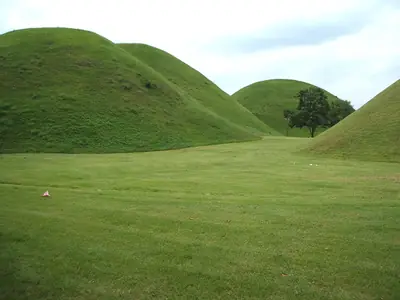
Daereungwon is a broad complex of rounded burial mounds from the Silla period. It brings together tomb groups in the Nodong-dong, Noseo-dong, and Hwangnam-dong districts, including Cheonmachong, Geomchong, Hwangnamdaechong Tomb, and the Tomb of King Michu.
The mounds remain visible across the Gyeongju plain, making the scale of the ancient royal landscape easy to appreciate. Daereungwon was brought together as a single historic site in 2011 because of the close relationship between these Silla tomb groups.
Cheomseongdae, the star-gazing tower
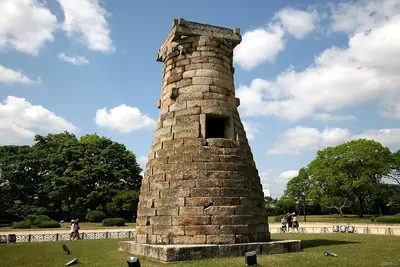
Cheomseongdae is a stone astronomical observatory from the Silla period. Its name means “star-gazing tower,” and it was built during the reign of Queen Seondeok, between 632 and 647.
The tower stands northeast of Banwolseong and is widely regarded as the oldest surviving astronomical observatory in Asia, and possibly the oldest in the world. It became South Korea’s National Treasure Number 31 in 1962 and forms part of the UNESCO-listed Gyeongju Historic Areas.
Gyeongju Hyanggyo
Gyeongju Hyanggyo was a government-run provincial academy during the Goryeo and Joseon periods. It combined education with the Confucian tradition of honoring respected scholars.
The exact date of its foundation is unknown, but the site has an even older connection with Silla: Gukhak, the kingdom’s national academy, was established here in 682 during the reign of King Sinmun. The academy offers another perspective on Gyeongju’s history beyond its royal tombs and Buddhist monuments.
Gyeongju National Museum and the Bell of King Seongdeok
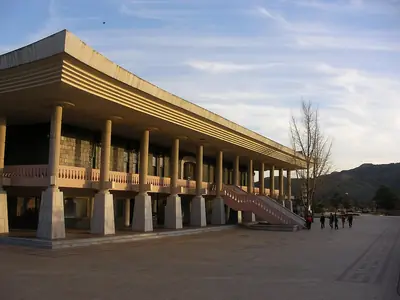
The Gyeongju National Museum is devoted largely to relics of the Silla kingdom, making it a useful stop for understanding the city’s archaeological remains. Gyeongju was Silla’s capital, and the museum’s collections reflect that connection.
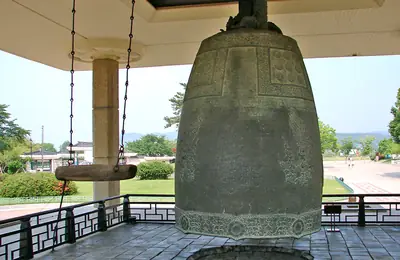
One of its remarkable objects is the Bell of King Seongdeok, also called the Sacred Bell of Great King Seongdeok or the Bell of Bongdeoksa. Cast in Gyeongju in 771, it stands 3.75 metres high and measures 2.27 metres across at the rim. Weighing 18.9 tons according to a 1997 measurement, it is regarded as the largest surviving bronze bell in Korea. Its decoration includes a dragon-shaped suspension fitting, floral and lotus motifs, heavenly figures, and a distinctive diamond shape at the base.
Donggung Palace and Wolji Pond
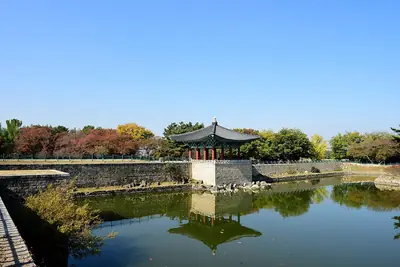
Donggung Palace and Wolji Pond are the remains of a Silla-era palace complex and artificial pond at the northeastern edge of Wolseong Palace. King Munmu ordered the complex’s construction in 674 CE.
The pond measures about 200 metres from east to west and 180 metres from north to south, with three small islands set within it. It was formerly known as Anapji, a name associated with the geese and ducks said to have visited after the fall of Silla. Archaeological discoveries confirmed that the pond was known as Wolji during the Silla period, and the official name changed to Donggung Palace and Wolji Pond in 2011.
Bunhwangsa
Founded in 634 under Queen Seondeok, Bunhwangsa is one of Gyeongju’s historic Buddhist sites. The nearby ruins of Hwangnyongsa connect the temple with the wider history of the Silla capital.
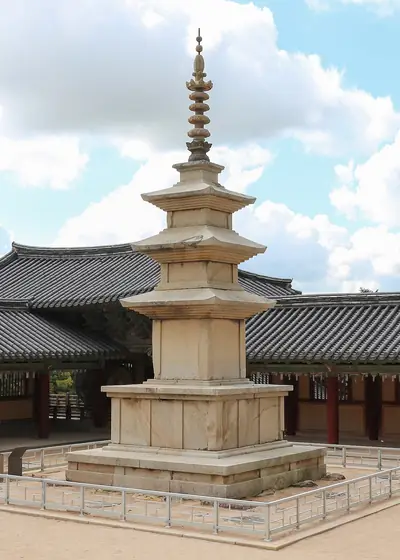
The most distinctive surviving feature is Bunhwangsa Pagoda, also called the Stone Brick Pagoda. It was originally nine stories tall, although the upper levels collapsed; the remaining structure is three stories high. The present complex also includes Bogwangjeon, a hall dedicated to the Medicine Buddha, and several other temple buildings.
Bulguksa and Seokgatap
Bulguksa is a Buddhist temple on Mount Tohamsan and a head temple of the Jogye Order of Korean Buddhism. It is regarded as a masterpiece of the golden age of Buddhist art in the Silla kingdom. The temple also preserves an important early example of woodblock printing: a version of the Dharani sutra dated between 704 and 751 was found here in 1966.
In the temple courtyard, Seokgatap stands in front of Daeungjeon Hall, directly across from the more elaborate Dabotap pagoda. This three-story stone pagoda is about 10.75 metres high and is known for its simple, balanced form. It probably dates from around 751, when Bulguksa was completed. Its traditional name is connected with the preaching of Shakyamuni Buddha, while the name “Shadowless Pagoda” refers to the legend of Asadal and Asanyeo.
Seokguram Grotto
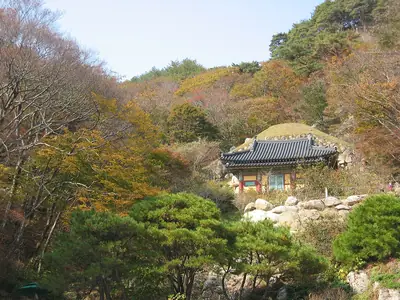
Seokguram, also known as the Seokguram Grotto, is a Buddhist hermitage belonging to the Bulguksa temple complex. It rests on Mount Tohamsan at about 750 metres above sea level, overlooking the East Sea.
The grotto is an artificial granite structure and is considered the only artificial granite grotto in the world. Inside, a carefully crafted seated Buddha forms the central work. Construction began in 751, during the cultural peak of Unified Silla, and was completed in 774, shortly after the death of Kim Daeseong, who is said to have begun the project.
From near the seated Buddha, the sea can be seen, and sunrise over the East Sea is one of the site’s especially popular experiences. Photography is not permitted inside to help protect the interior.
Oreung
Oreung is a quiet wooded site containing five royal tombs from the early Silla period. Its name means “five tombs,” referring to the five rounded mounds rising among the trees.
The tombs are traditionally associated with Silla’s founding monarch Hyeokgeose, his wife Lady Aryeong, and three early kings: Namhae, Yuri, and Pasa. Their identities are not known with complete certainty, and the tombs have not been excavated. The mounds vary in size, with the tallest rising about ten metres and the shortest about 1.8 metres.
The site is also known as Sareung, meaning “snake tombs.” A founding legend tells that Hyeokgeose’s body ascended to heaven and returned seven days later in five separate places, which were then used for burial.
Yangdong Folk Village
Yangdong Folk Village is one of Korea’s best-preserved traditional villages from the Joseon period. It lies between Seolchang Mountain and the Hyeongsan River and preserves the landscape and way of life associated with the yangban, Korea’s upper class.
For more than six hundred years, the Gyeongju Son clan and the Yeoju Yi clan built their lives here. The village became an important centre of the Yeongnam scholar tradition and contains traditional buildings, cultural treasures, and a large number of officially designated tiled-roof houses. Yangdong was designated an Important Folklore Material in 1984 and became a UNESCO World Heritage Site in 2010 together with Hahoe Folk Village.
Gameunsa
Gameunsa preserves the foundations of a Silla-era Buddhist temple as well as its twin stone pagodas. Construction began during the reign of King Munmu and was completed in 682 under his son, King Sinmun.
The two pagodas are known together as the Three-story Stone Pagodas in Gameunsaji. They were designated National Treasures of South Korea Number 112 in 1962, while the temple site became a Historic Site in 1963.
Silla Art and Science Museum
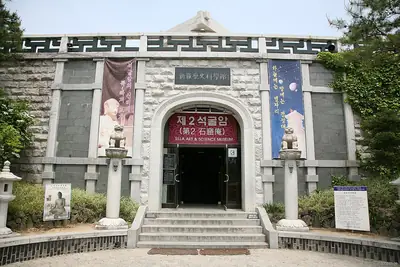
The private Silla Art and Science Museum, located in Gyeongju Folk Craft Village, explores the history of Korean science, with particular attention to Silla and the period leading to the reign of King Sejong.
Its exhibits use models to reconstruct traditional technologies and explain how they worked. The museum contains six themed exhibition halls, including a full-size model of the bronze bell at Sangwonsa Temple and a dedicated exhibition hall with models of the Seokguram grotto.
K Pop Museum
At Bomun Lake Resort, the K Pop Museum traces Korean popular music from the early twentieth century to the present. It opened in 2015 and is described as Korea’s first K Pop museum, with a collection of around 70,000 items.
Its exhibitions cover the beginnings of Korean popular music, dance singers, film soundtracks, and K Pop. The building also includes a music café, performance room, sound room, galleries, and spaces for instrument experiences and children’s activities.
Explore Gyeongju with Neywo
Neywo’s free audio guide lets you explore Gyeongju independently, with 16 narrated places and one walking tour. The walk, Silla Capital on Foot: Royal Tombs, Star Tower and Moon Pond, covers 5.13 km in 118 minutes and includes seven narrated stops: Daereungwon, Gyeongju Hyanggyo, Cheomseongdae, Gyeongju National Museum, the Bell of King Seongdeok, Donggung Palace and Wolji Pond, and Bunhwangsa.
Download Neywo and explore at your own pace. The app tells the story of each place as you reach it, with no group and no schedule. Gyeongju is one of the historic highlights of South Korea, and Neywo gives you the freedom to experience its Silla heritage walk by walk.
Places with an audio guide in Gyeongju
8 places in Gyeongju with a Neywo audio guide. Each one starts telling its story as you reach it.
Self-guided tours in Gyeongju
1 tour in Gyeongju, free in the Neywo app. Each stop tells its story as you reach it.
- Walk
Silla Capital on Foot: Royal Tombs, Star Tower and Moon Pond
Gyeongju was the capital of the Silla kingdom for almost a thousand years. Walk from the grassy royal tomb mounds to the oldest surviving observatory in Asia, then past the national museum and its giant bronze bell to the palace pond and an ancient brick pagoda.
Daereungwon · Gyeongju Hyanggyo · Cheomseongdae · Gyeongju National Museum · Bell of King Seongdeok · Donggung Palace and Wolji Pond …
Open this tour: Silla Capital on Foot: Royal Tombs, Star Tower and Moon Pond
Walk Gyeongju with Neywo
Neywo turns Gyeongju into a self-guided audio tour. Stories arrive as you reach the place they belong to, and the route reshapes when you wander off it.

