What to See in Seoul, South Korea: Free Audio Guide
Things to Do in Seoul: A Self-Guided Guide to the City
Looking for things to do in Seoul? South Korea’s capital brings together Joseon royal palaces, Confucian traditions, museums, restored urban spaces, and modern city life. The most rewarding way to explore is to move between its historic districts and cultural landmarks, noticing how the past remains part of the city’s everyday landscape. Neywo offers a free audio guide for Seoul with 278 narrated places.
What to See in Seoul
Gyeongbokgung and Geunjeongjeon
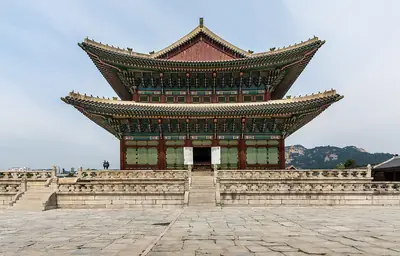
Gyeongbokgung was established in 1395 by King Taejo as the principal palace of Joseon. At its heart, Geunjeongjeon served as the grand central hall for the dynasty’s most important occasions, including royal enthronements and civil-service ceremonies.
The present Geunjeongjeon was rebuilt in 1868 after the palace was destroyed during the Imjin War. Its two-story wooden structure, multi-bracket hip-and-gable roof, and imposing scale express the authority of the main royal palace. It is designated National Treasure No. 223.
National Folk Museum of Korea
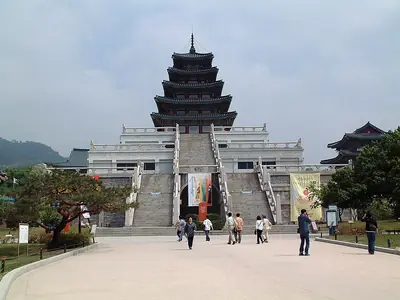
Within the grounds of Gyeongbokgung, the National Folk Museum of Korea explores everyday life, customs, tools, and traditions connected with Korea. Its displays use replicas of historical objects to make traditional life easier to understand, while the museum also collects, preserves, researches, and teaches about cultural practices.
The building itself draws inspiration from several traditional Korean structures, including Palsangjeon at Beopjusa Temple, Mireukjeon at Geumsansa Temple, and Gakhwangjeon at Hwaeomsa Temple.
Changdeokgung and Donhwamun
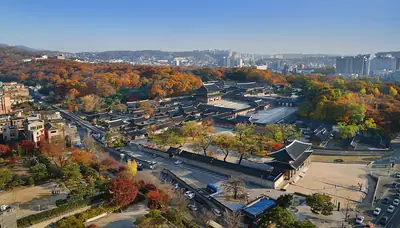
Changdeokgung is one of Seoul’s best-preserved royal palaces. Built in 1405 on the slopes of Eungbong, a peak of Mount Bugaksan, it is particularly notable for the close relationship between its buildings and the surrounding landscape. Together with nearby Changgyeonggung, it was known during the Joseon period as the East Palace, or Donggweol.
Many kings preferred to live here, and after the Imjin War, Changdeokgung became Joseon’s main palace for several centuries. Its rear garden, often called the Secret Garden, is regarded as Korea’s only royal palace garden and a representative example of Korean garden tradition. Some parts are open to visitors, while others can be entered only through booked tours.
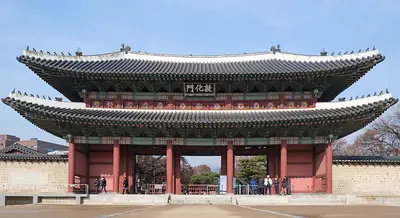
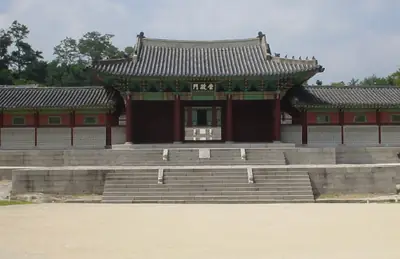
The palace’s southern entrance, Donhwamun, is the oldest surviving main gate of a Joseon palace. The first gate was built in 1412, destroyed in 1592, and replaced by the structure completed in 1608. Its five-bay façade is unusually broad and unique among surviving palace main gates.
Jongmyo
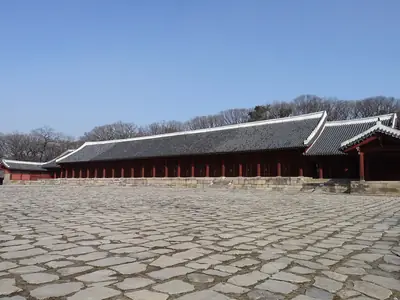
Jongmyo is a royal Confucian shrine dedicated to the spirit tablets of Joseon kings and queens. Established when King Taejo moved the capital to present-day Seoul, it was destroyed during the Japanese invasions of Korea in the late sixteenth century and rebuilt in the early 1600s.
The shrine’s two principal halls have different roles. Jeongjeon housed the spirit tablets of kings who had formally occupied the throne and their queens. Yeongnyeongjeon was used for the parents of kings later honored as ancestors, as well as kings whose status was restored. The ceremonies held here preserve a tradition of royal ancestral rites that has continued for centuries.
Unhyeongung
Unhyeongung was the home of Heungseon Daewongun, father of Emperor Gojong. Gojong lived here until he was twelve, when he became king. Although the residence was not technically a royal palace, it became an important political centre after Gojong’s accession, while his father served as regent.
The former residence is now a public museum. The site also includes a Western-style building constructed in the 1910s, once used as the main building of Duksung Women’s University. Unhyeongung offers a more intimate perspective on Korea’s royal history than the grand ceremonial palaces.
Gyeonghuigung
Gyeonghuigung, or Gyeonghui Palace, was one of Joseon’s Five Grand Palaces. Its surviving grounds are much smaller than the original complex, which once contained ninety-eight buildings, including court halls, royal quarters, and detached structures.
Among the remaining features are Heunghwamun, the former main gate; Sungjeongjeon, the former throne hall; and Hwanghakjeong, a pavilion from the rear garden. Foundations, stone platforms, and woodland also preserve traces of the palace’s former scale. Gyeonghuigung was severely damaged when many buildings were dismantled during the rebuilding of Gyeongbokgung and the site was later reduced during the period of Japanese rule.
Tteok Museum
The Tteok Museum in Jongno focuses on traditional Korean rice cakes and the kitchen tools used to prepare and serve food. Founded by Yoon Sookja, director of the Institute of Traditional Korean Food, it opened in December 2002 and adopted its current name in 2008.
Its collection includes around 2,000 old Korean kitchen utensils, from ancient maetdol grinding stones to kitchenware from the early twentieth century. The objects reveal the practical knowledge behind traditional food preparation and place tteok within the wider context of everyday life.
Cheonggyecheon
Cheonggyecheon is a restored stream running through central Seoul. Its water and walking paths create an open public space in the traditional heart of the city, surrounded by dense urban development.
The stream was covered with concrete during the rapid development after the Korean War, and the elevated Cheonggye Expressway was built above it. Seoul began removing the expressway and restoring the stream in 2003; the project was completed in 2005. Today, the water is carefully maintained, with around 40,000 cubic metres released at Cheonggye Plaza each day.
National Museum of Korea
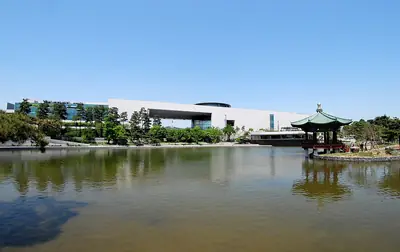
The National Museum of Korea traces Korean history and art from the Paleolithic period to the early twentieth century. Its collection contains more than 400,000 cultural objects spanning archaeology, history, and art.
The institution’s history reaches back to an imperial museum opened at Changgyeonggung Palace in 1909. The present main building opened in Seoul’s Yongsan District in 2005. It stretches 404 metres and includes East and West wings, six floors above ground, one basement level, special exhibition galleries, an outdoor exhibition area, a children’s museum, Mirror Pond, and the Yong Theater.
Namsan Seoul Tower
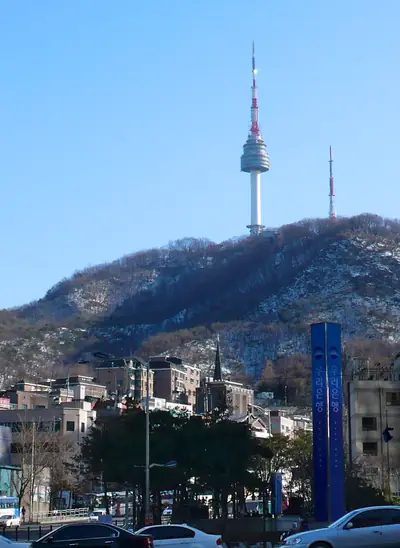
Near the summit of Namsan, Namsan Seoul Tower combines a working communications tower with observation levels overlooking Seoul. The tower stands 236.7 metres high, while its summit reaches 479.7 metres above sea level.
Construction began in 1969, and the tower was completed on July 30, 1975. It was the nation’s first tower serving multiple television and radio broadcasters, and broadcasters in the Seoul metropolitan area still use it to transmit signals. Observation areas, shops, restaurants, a café, and a rotating restaurant make it one of the city’s best-known landmarks.
More places to explore
Seoul’s historic and cultural landscape extends beyond its major palaces. Salgot Bridge is a surviving Joseon-era stone bridge that once formed part of an important route between Hanseongbu and southeastern Korea. The National Children’s Science Center uses experiments, practical equipment, virtual reality, videophone experiences, and other immersive displays to encourage scientific curiosity. Yonsei University, whose roots reach back to 1885, is one of South Korea’s historic private Christian universities.
For a broader trip through South Korea, Seoul also makes a useful starting point for visiting cities such as Suwon, Incheon, and Jeonju.
Explore Seoul with Neywo
Neywo turns a visit into a Seoul self-guided walking tour. The app has six walking tours, one bus route, and one bike route in the city. Together, they cover routes from 2.47 to 3.88 km on foot, a 6.6 km bus route, and a 3.5 km bike route. The walking tours last from 89 to 117 minutes, the bus route lasts 28 minutes, and the bike route lasts 18 minutes. Across these tours, there are 66 narrated stops.
Choose a walk through Gyeongbokgung and the palace of the Joseon kings, follow old Jongno past temples, a regent’s home, and two palaces, or explore Bukchon and Changdeokgung from hanok lanes to the Secret Garden. Other routes connect Jeongdong, Namdaemun, Myeongdong, Dongdaemun, Naksan, Yeouido, and the city wall.
Download Neywo and explore Seoul at your own pace. The app tells the story of each place as you reach it, with no group and no schedule. Narration is available in 11 languages.
Places with an audio guide in Seoul
8 places in Seoul with a Neywo audio guide. Each one starts telling its story as you reach it.
Self-guided tours in Seoul
8 tours in Seoul, free in the Neywo app. Each stop tells its story as you reach it.
- Bike ride
Yeouido: Island Park by Bike
Ride the flat bike paths of Yeouido and its Han River park, from KBS Hall and the National Assembly's library and museum through Yeouido Park and past the giant Yoido Full Gospel Church to the 63 Building. Bikes can be rented near Yeouinaru Station.
KBS Hall · National Assembly Library of Korea · National Assembly Museum · Yeouido Park · Yoido Full Gospel Church · 63 Building
Open this tour: Yeouido: Island Park by Bike - Bus ride
Bus 01B: Namdaemun to the Dongdaemun City Wall
A city bus across the old walled capital, from Namdaemun gate past the Bank of Korea Museum, the K-culture centre beside Cheonggyecheon, Jongno's Cheondogyo hall and Changdeokgung's Donhwamun gate to the Seoul City Wall Museum, Heunginjimun, the east gate, and the Dongdaemun History & Culture Park.
Namdaemun · Bank of Korea Museum · HiKR Ground · Art Center Nabi · Cheondogyo Jungangdaegyodang · Donhwamun …
Open this tour: Bus 01B: Namdaemun to the Dongdaemun City Wall - Walk
Gyeongbokgung: The Palace of the Joseon Kings
Begin at Sejong Center, then enter the first royal palace of the Joseon dynasty through Gwanghwamun Plaza and its statues of Admiral Yi and King Sejong. Visit the palace museum, cross the ceremonial gates to the throne hall, see the building where Hangul was devised, and finish with the folk museum and the blue-tiled presidential Blue House behind the palace.
Sejong Center · Gwanghwamun Plaza · National Palace Museum of Korea · Gyeongbokgung · Geunjeongjeon · Sujeongjeon Hall of Gyeongbokgung Palace …
Open this tour: Gyeongbokgung: The Palace of the Joseon Kings - Walk
Old Jongno: Temples, a Regent's Home and Two Palaces
A walk through the historic lanes of Jongno: the chief temple of Korean Zen, a museum of wooden folk figures, the red-brick cathedral of a home-grown religion, the house where a king grew up, and the gates of Changdeokgung and Changgyeonggung, palaces of the Joseon court. End with a rice-cake museum and Jongmyo, the royal ancestral shrine.
Jogyesa · Mokin Museum · Cheondogyo Jungangdaegyodang · Seoul Museum of Craft Art · Unhyeongung · Donhwamun …
Open this tour: Old Jongno: Temples, a Regent's Home and Two Palaces - Walk
Gate, Gothic Spire and Imperial Altar: Namdaemun to Myeongdong
Start at Seoul's great south gate, a National Treasure rebuilt after a fire. Continue past Korea's first modern bank building, the altar where a king declared himself emperor, an art museum in an old newspaper office and the start of the Cheonggyecheon stream. Then on to the Gothic cathedral of Myeongdong, ending at Korea's first megachurch.
Namdaemun · Bank of Korea Museum · Hwangudan · Ilmin Museum of Art · Cheonggye Plaza · HiKR Ground …
Open this tour: Gate, Gothic Spire and Imperial Altar: Namdaemun to Myeongdong - Walk
Jeongdong: Where Modern Korea Began
Stroll the quiet Jeongdong quarter, where foreign missionaries and the last emperor left their mark. Visit the western palace of Gyeonghuigung, the city history museum, the site of the lost West Gate, the old Russian legation where Korea's fate was sealed, Korea's oldest surviving church, an early girls' school, City Hall's plaza and the Deoksugung palace with its Western-style halls.
Gyeonghuigung · Seoul Museum of History · Donuimun · Simpson Memorial Hall of Ewha Girls' High School · Chungdong First Methodist Church · Seosomun Main Branch, Seoul Museum of Art …
Open this tour: Jeongdong: Where Modern Korea Began - Walk
Bukchon and Changdeokgung: Hanok Lanes to the Secret Garden
From a memorial to the comfort women and a national art museum in a former security compound, wander the quiet museum streets of Sogyeok-dong and Gahoe-dong, with folk charms, jewellery and contemporary art. Cross the old school grounds of the Jeongdok Library, then enter Changdeokgung, the UNESCO palace with its Secret Garden, and end at the children's science centre by the palace wall.
Statue of Peace · National Museum of Modern and Contemporary Art, South Korea · Art Sonje Center · World Jewellery Museum · Bukchon Art Museum · Jeongdok Public Library …
Open this tour: Bukchon and Changdeokgung: Hanok Lanes to the Secret Garden - Walk
Dongdaemun to Naksan: Walking the City Wall
Follow the line of Seoul's fortress wall from the History & Culture Park and the great East Gate, through the City Wall Museum, up the Naksan trail to a lock museum in a cafe and the former home of Korea's first president, then down to Marronnier Park and the little East Gate of Hyehwamun.
Dongdaemun History & Culture Park · Heunginjimun · Seoul City Wall Museum · Lock Museum · Ihwajang House, Seoul · Marronnier Park …
Open this tour: Dongdaemun to Naksan: Walking the City Wall
Walk Seoul with Neywo
Neywo turns Seoul into a self-guided audio tour. Stories arrive as you reach the place they belong to, and the route reshapes when you wander off it.

