Things to Do in Jeonju, South Korea: Walking Guide
Things to do in Jeonju: a self-guided walk through the city’s heritage
The best things to do in Jeonju include exploring Jeonju Hanok Village, discovering royal history, visiting Jeondong Cathedral, and learning about the region’s cultural traditions. Jeonju brings together traditional architecture, historic landmarks, museums, and places of worship in a compact urban setting. Neywo offers a free audio guide for Jeonju with 11 narrated places, available in 11 languages.
What to see in Jeonju
Jeonju Hanok Village
Jeonju Hanok Village is the city’s central historic district and a natural starting point for exploring Jeonju. Its closely arranged traditional homes, tiled roofs, craft workshops, and cultural spaces preserve the character of an earlier Korea while remaining part of an active city.
The village is also connected with traditions such as paper-making, calligraphy, food, tea, and crafts. These elements give the neighborhood a broader cultural identity beyond its architecture.
Jeondong Cathedral
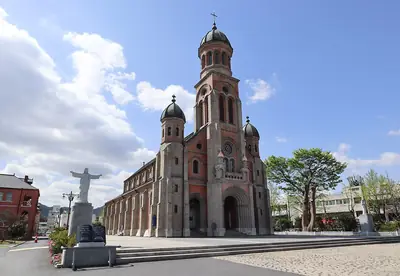
Near Jeonju Hanok Village, Jeondong Cathedral is one of Jeonju’s important Catholic landmarks. Also known as the Old Cathedral of Jeondong, it was built between 1908 and 1914 in the Roman Byzantine style.
Victor Louis Poisnel carried out its construction while the church was under the supervision of the French priest François Xavier Baudounet. The cathedral became Historic Site of South Korea number 288 on September 25, 1981, and today serves as a parish church belonging to the Diocese of Jeonju.
Gyeonggijeon Shrine and the Royal Portrait Museum
Gyeonggijeon Shrine was established to honor King Taejo and is closely associated with Jeonju’s Joseon Dynasty heritage. Its grounds contain the Royal Portrait Museum, a traditional museum located in Jeonju Hanok Village, in Wansan-gu, Jeonbuk Special Self-Governing Province.
The museum adds historical context to the shrine complex, whose buildings were used for royal ceremonies and the preservation of royal portraits. Together, Gyeonggijeon and the museum show how Jeonju’s royal history remains present within the city’s traditional center.
Pungnammun
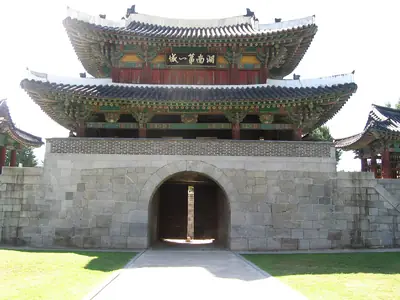
Pungnammun was the southern entrance through the fortress that surrounded Jeonju, which served as the seat of the Jeolla Provincial Government during the Joseon period. After the fortress walls were demolished, it became the only remaining gate.
In 1963, Pungnammun was designated Treasure Number 308 of the Republic of Korea. Its survival makes it an important link between Jeonju’s former fortified city and the streets that now surround the historic district.
Omokdae Terrace
Omokdae Terrace recalls a pivotal moment in King Taejo’s rise and offers broad views across Jeonju. From here, the traditional hanok district can be seen alongside newer urban neighborhoods.
The terrace helps place Jeonju’s historic center within the wider city. It is also a reminder that the city’s heritage is not isolated from contemporary life but forms part of its modern identity.
Jeonju National Museum
The Jeonju National Museum, also known as the National Jeonju Museum, explores the archaeology, fine art, and folklore of the region through its permanent exhibitions. It was established on August 9, 1978, and opened to the public on October 26, 1990.
The museum became the ninth national museum in South Korea and is affiliated with the National Museum of Korea. Its Main Building contains three permanent exhibition rooms devoted to archaeology, fine art, and folklore, as well as a room for special exhibitions.
Jeonjugongyepum Exhibition Hall
Goryeohanjisuui, also known as the Jeonjugongyepum Exhibition Hall, is identified as a Korean cultural heritage item. Its inclusion in a walk through Jeonju’s historic center adds another perspective on the city’s connection with traditional Korean culture and craft.
Dongmun Old Book Library
Dongmun Old Book Library, known in Korean as 동문헌책도서관, is another destination in Jeonju’s historic area. The library’s name points to its connection with old books and offers a quieter cultural stop among the district’s heritage sites.
Jeonju World Cup Stadium
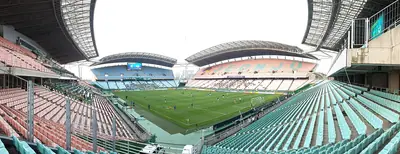
Jeonju World Cup Stadium is a major football venue and the home ground of Jeonbuk Hyundai Motors. Known in Korean as 전주월드컵경기장, it was built from 1999 for the 2002 FIFA World Cup and officially opened on November 8, 2001.
During the tournament, the stadium hosted three matches: two group-stage games and one round-of-16 match. Since then, Jeonbuk Hyundai Motors has continued to use it as its home. In 2011, the venue hosted the AFC Champions League final, where Jeonbuk lost to Qatar’s Al-Sadd after a penalty shootout.
Jeonju Abu Bakr Al-Seddiq Mosque
In Deokjin-gu, Jeonju Abu Bakr Al-Seddiq Mosque, also known as Jeonju Mosque, is an important place of Islamic worship and cultural exchange in the city. Its presence adds to the range of religious and cultural institutions found in Jeonju.
Jeonju University
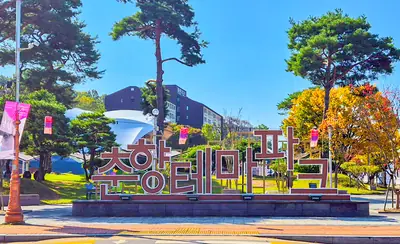
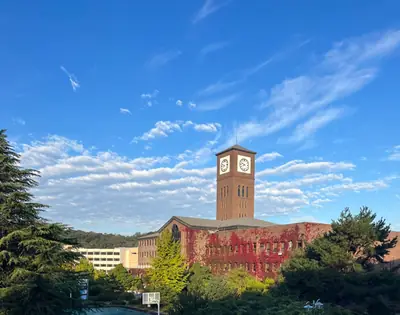
Jeonju University is a private Christian university in Jeonju and one of the city’s four-year institutions of higher education. Its campus is in Wansan-gu.
Jeonju’s place in Korean history
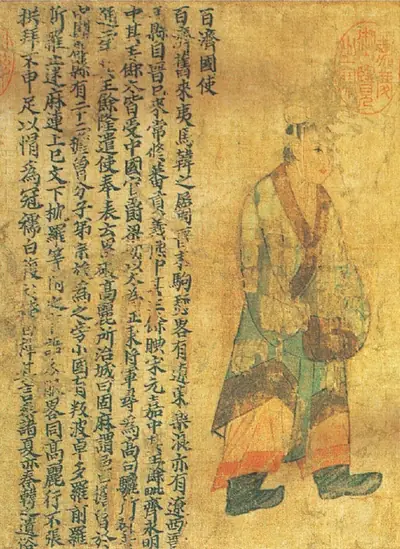
Jeonju’s story is connected with the wider history of the Korean Peninsula. The ancient kingdom of Baekje existed in southwestern Korea from 18 BCE to 660 CE, alongside Goguryeo and Silla during Korea’s Three Kingdoms period.
Baekje began with Onjo, who came south from Goguryeo and established the kingdom at Wiryeseong. It was first called Sipje and later became known as Baekje. During the reign of King Seong, it was also called Nambuyeo.
The kingdom grew from one of the small states of Mahan. Under King Goi, it introduced a legal code, strengthened central government, and adopted Buddhism. In the fourth century, under King Geunchogo, Baekje reached its height, extending its power toward the west and north, subduing Gaya, and fighting Goguryeo near Pyeongyang.
Jeonju is also the capital and largest city of North Jeolla — officially Jeonbuk State — in the southwest of the Korean Peninsula. The province forms part of the Honam region and includes cities such as Iksan, Gunsan, and Jeongeup, offering a broader sense of the area beyond Jeonju.
A free Jeonju self-guided walking tour
Neywo’s walking tour, Hanok Village: Royal Portraits and a Hilltop Cathedral, covers 1.38 km in 55 minutes and includes five narrated stops:
- Jeondong Cathedral
- Gyeonggijeon Main Hall
- Royal Portrait Museum
- Jeonjugongyepum Exhibition Hall
- Dongmun Old Book Library
This is a Jeonju audio guide designed for independent exploration. The app tells the story of each place as you reach it, at your own pace, with no group and no schedule. Download Neywo and explore Jeonju’s historic center while walking from the cathedral to the royal sites and cultural landmarks. When planning a wider journey through South Korea, you can also continue to cities such as Gyeongju, Gongju, or Seoul.
Places with an audio guide in Jeonju
6 places in Jeonju with a Neywo audio guide. Each one starts telling its story as you reach it.
Self-guided tours in Jeonju
1 tour in Jeonju, free in the Neywo app. Each stop tells its story as you reach it.
- Walk
Hanok Village: Royal Portraits and a Hilltop Cathedral
A short stroll through the heart of Jeonju's hanok quarter, the old seat of the Joseon dynasty's ancestral home. See the Roman Byzantine brick cathedral of Jeondong, enter the Gyeonggijeon shrine grounds with the Royal Portrait Museum, then wander on to a traditional hanji paper hall and a quiet book library.
Jeondong Cathedral · Royal Portrait Museum
Open this tour: Hanok Village: Royal Portraits and a Hilltop Cathedral
Walk Jeonju with Neywo
Neywo turns Jeonju into a self-guided audio tour. Stories arrive as you reach the place they belong to, and the route reshapes when you wander off it.

