Visiting Santa Cruz de Tenerife, Spain: Top Sights on Foot
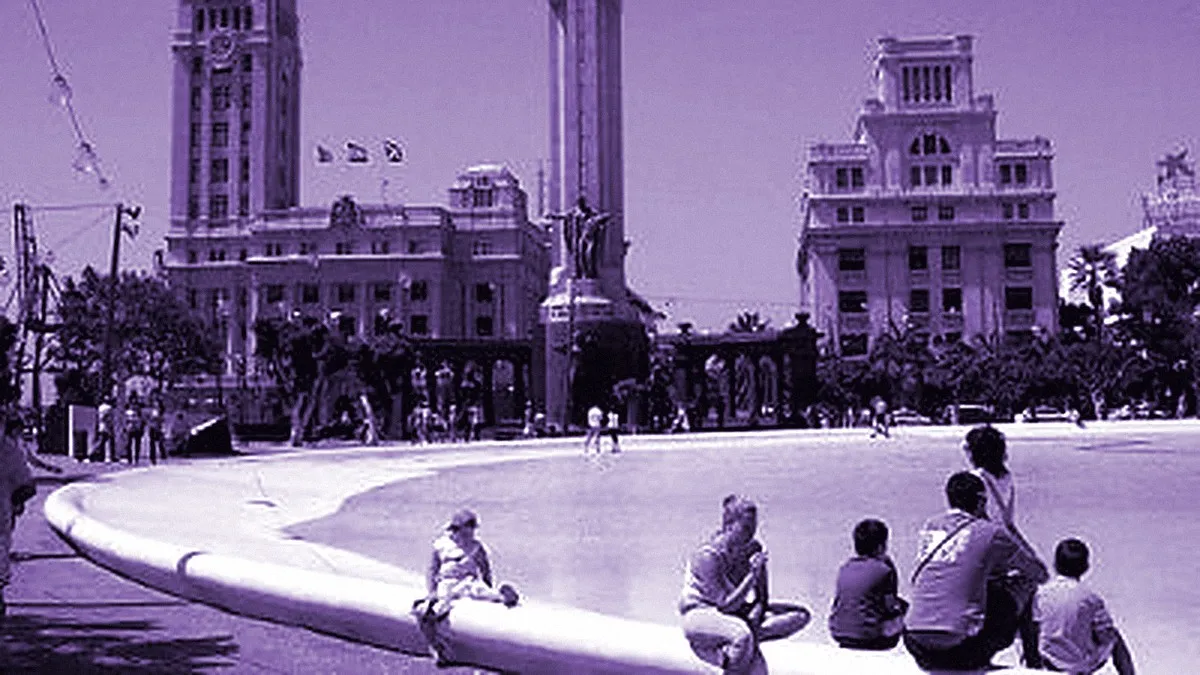
Things to Do in Santa Cruz de Tenerife: A Self-Guided City Walk
The best things to do in Santa Cruz de Tenerife range from historic churches and military landmarks to museums, theatres and striking waterfront architecture. The city rewards exploration on foot, with layers of religious, maritime, artistic and Guanche heritage appearing across its streets and squares. Neywo has a free audio guide for Santa Cruz de Tenerife with 96 narrated places.
What to See in Santa Cruz de Tenerife
Iglesia de la Concepción
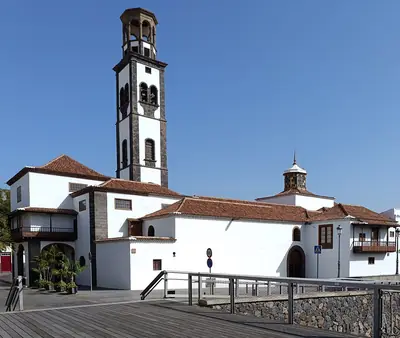
The Iglesia de la Concepción is Santa Cruz de Tenerife’s principal church and main centre of worship, although it is sometimes called the city’s cathedral. Tenerife’s cathedral is in San Cristóbal de La Laguna.
The church is distinctive for its five naves, an arrangement unique among churches in the Canary Islands. Its architecture combines Baroque and Tuscan elements, while the bell tower has a recognizable minaret-like appearance. The building stands on the site of the first chapel erected by the Spanish conquistadors after their landing on Tenerife. Inside, it contains an image of Saint James, the patron saint of Santa Cruz de Tenerife, as well as the cross associated with the city’s foundation.
Hospital Civil de la Misericordia and the Museum of Nature and Archaeology
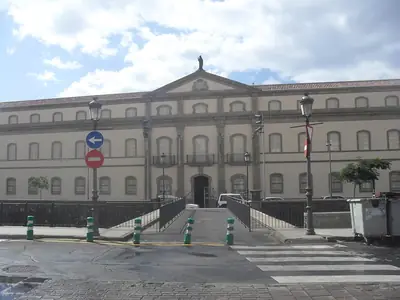
The former Hospital Civil de la Misericordia is a Canarian neoclassical building that now houses the Museum of Nature and Archaeology. The museum brings together the Archaeological Museum of Tenerife, the Canary Institute of Bioanthropology and the Museum of Natural Sciences of Tenerife.
Its collections explore both the natural environment and the human history of the Canary Islands. Archaeological displays include pottery, ornaments, tools, weapons and an extensive collection connected with Guanche culture, including mummies. Fossils, plants, insects and marine and land vertebrates provide a further introduction to the islands’ natural heritage. The building was declared a monument of cultural interest in 1983.
Carta Palace
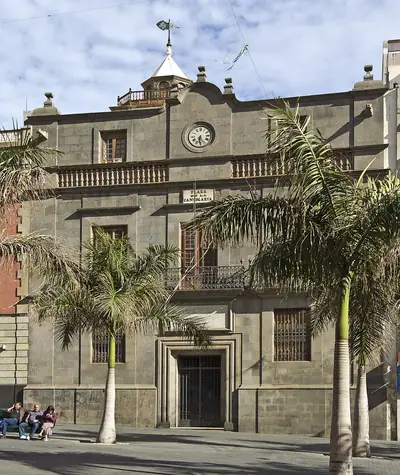
In Plaza de la Candelaria, Carta Palace is one of the city’s finest examples of civil Canarian Baroque, with Neoclassical touches. Built as a family residence for Captain Matías Rodríguez Carta, it was commissioned in 1721 and completed in 1752.
The stone façade features balconies and a clock, while the interior is arranged around two traditional Canarian courtyards. The main patio is especially notable for its carved wooden galleries. Over time, the building served as the headquarters of the Captaincy General of the Canary Islands, the Civil Government and a bank. After restoration completed in early 2023, it became a tourist information office and the home of the Santa Cruz History Museum.
Museo Municipal de Bellas Artes
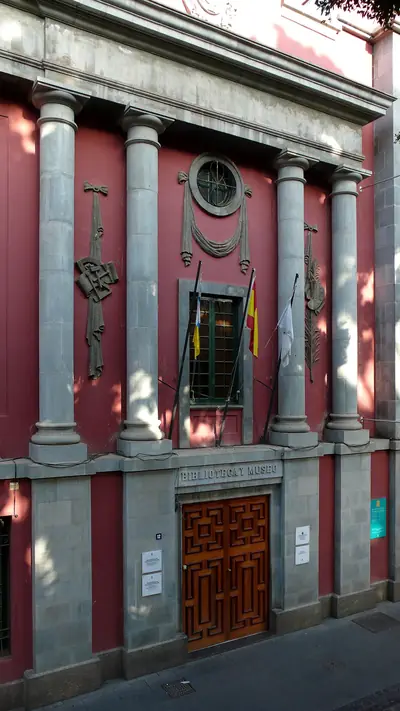
Behind the Church of Saint Francis of Assisi, beneath Plaza del Príncipe, the Municipal Museum of Fine Arts presents centuries of Iberian and Flemish art. The building combines parts of a former Franciscan convent with an elegant classical structure designed by Eladio Laredo in the early twentieth century.
Its façade is decorated with ten busts of distinguished figures from Tenerife. Inside, fourteen exhibition rooms display works ranging from sixteenth-century Flemish painting to Spanish and Canarian art from the early twentieth century. The building also incorporates mosaic flooring reclaimed from the 1929 Seville Expo. It was declared a historic-artistic monument and recognized as a cultural asset in 1962.
Teatro Guimerá
Teatro Guimerá is the oldest theatre in the Canary Islands. It opened in January 1851 on the site of a former Dominican convent, with a neoclassical and Romantic façade designed by Canarian architect Manuel de Oraá. The crest of Queen Isabel II appears above the entrance.
Inside, the auditorium is known as “The Chocolate Box”, a nickname inspired by its gilded mouldings, velvet, frescoed ceilings and sweeping balconies. The theatre was named after the playwright Ángel Guimerá in 1923 and remains one of Santa Cruz de Tenerife’s important cultural venues. Its main hall holds roughly eight hundred to nine hundred seats, and the building also includes the flexible Guimerá Space.
La Recova Art Centre
La Recova Art Centre occupies a restored nineteenth-century market designed by Manuel de Oraá and opened in 1851. Its symmetrical entrances, covered gallery and central courtyard preserve the character of the original building.
Since becoming a cultural venue in 1992, it has hosted exhibitions and performances. The centre also contains administrative offices connected with the City School of Graphic Arts, giving the former market a continuing role in artistic development and cultural exchange.
Castillo de San Juan Bautista
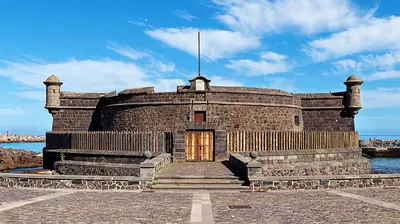
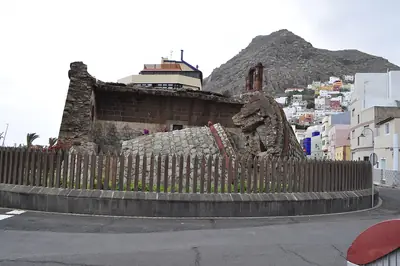
The Castillo de San Juan Bautista, commonly known as the Castillo Negro or Black Castle, stands near Parque Marítimo César Manrique and behind the Auditorio de Tenerife. Its compact, rounded form and dark volcanic stone make it one of the waterfront’s most distinctive landmarks.
Built between 1641 and 1644, it was the second most important stronghold in the defence of Santa Cruz de Tenerife. A cylindrical tower facing the sea was added in 1765. The fortress served as a military fort until 1924 and was later converted into a military museum. Although its interior is currently closed to visits, the castle remains closely associated with the failed 1797 attack led by Admiral Horatio Nelson. It has been recognized as a cultural property and monument since 1993.
Auditorio de Tenerife
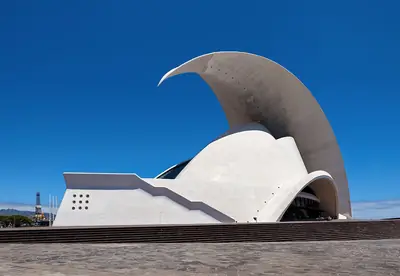
The waterfront Auditorio de Tenerife, also known as the Auditorio de Tenerife Adán Martín, is one of Santa Cruz de Tenerife’s defining modern landmarks. Designed by Santiago Calatrava, its sweeping profile places it within the late twentieth-century neo-futurist tradition.
Construction began in 1997 and was completed in 2003. The building is home to the Tenerife Symphony Orchestra and has become one of the island’s major cultural attractions. Its distinctive form has also appeared on Spanish postage stamps and commemorative coins.
Círculo de Amistad XII de Enero
Founded in 1855, the Círculo de Amistad XII de Enero is a historic social club and an important part of Santa Cruz’s sociocultural heritage. Its present building dates from 1904 and was designed by Mariano Estanga y Arias Girón.
The Second Empire façade features symmetrical forms, ornate balconies and corner towers with mansard roofs. Inside are a marble staircase, a five-hundred-seat theatre, a historic ballroom and a library containing more than fifteen thousand volumes. The club was declared an Asset of Cultural Interest on December 15, 1985.
More historic landmarks beyond the centre
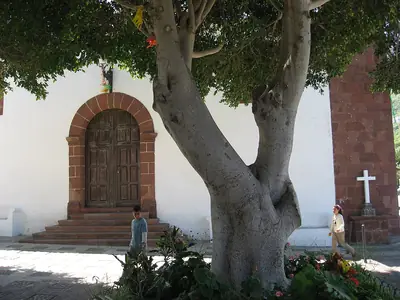
Santa Cruz de Tenerife’s heritage extends into its surrounding neighbourhoods and villages. The Capilla de San Telmo in El Cabo is one of the oldest religious buildings in Santa Cruz de Tenerife and dates from the sixteenth century. The Building of the old Colegio de la Asunción, also known as the Centro Cultural Viera y Clavijo, is another protected cultural property.
In San Andrés, the circular San Andrés Castle formed part of the island’s smaller defensive fortifications and helped protect Tenerife from pirate attacks. In Taganana, the Iglesia de Nuestra Señora de las Nieves began as a chapel around 1505 before being rebuilt and expanded; the present church was completed in 1728.
Explore Santa Cruz with Neywo
Neywo offers a free audio guide with 96 narrated places in Santa Cruz de Tenerife. It includes 3 walking tours, 1 bus route and 1 bike route, with narration available in 11 languages.
The walking routes include Holy Cross to Nelson’s Cannon: The Old Town of Santa Cruz, covering 1.44 km in 90 minutes with 8 stops; Duck Square, Sphinxes and Street Sculpture, covering 2.56 km in 83 minutes with 8 stops; and Black Castle to Calatrava: The Waterfront and its Faces, covering 1.73 km in 68 minutes with 6 stops.
There is also Line 920: Plaza de Espana, the Marina and the Rambla Sculptures, a 3.3 km bus route lasting 14 minutes with 6 stops, and Waterfront Cycle Lane: From the Rambla to the Black Castle, a 2.1 km bike route lasting 11 minutes with 5 stops.
Download Neywo and explore Santa Cruz de Tenerife with stories that play as you reach each place, at your own pace, with no group and no schedule. The city is part of the Canary Islands, an ideal starting point for discovering more of Spain.
Places with an audio guide in Santa Cruz de Tenerife
8 places in Santa Cruz de Tenerife with a Neywo audio guide. Each one starts telling its story as you reach it.
Self-guided tours in Santa Cruz de Tenerife
5 tours in Santa Cruz de Tenerife, free in the Neywo app. Each stop tells its story as you reach it.
- Bike ride
Waterfront Cycle Lane: From the Rambla to the Black Castle
A flat ride on the segregated cycle lane along the port edge of Santa Cruz. Start by the Arborea sculpture, pass the buried San Cristobal fortress and the old San Telmo chapel, then reach the Black Castle and finish at Edgar Negret's red sculpture by the sea.
Arbórea · Castillo de San Cristóbal · Capilla de San Telmo Santa Cruz de Tenerife · Castillo de San Juan Bautista · Sol Rojo
Open this tour: Waterfront Cycle Lane: From the Rambla to the Black Castle - Bus ride
Line 920: Plaza de Espana, the Marina and the Rambla Sculptures
TITSA's circular line 920 runs the heart of Santa Cruz in about 25 minutes. Ride past the art centre, the old town church and the buried castle at Plaza de Espana, then up the Rambla, the open-air sculpture street that grew out of the 1970s street sculpture exhibitions.
Instituto Óscar Domínguez · Iglesia de la Concepción · Castillo de San Cristóbal · Arbórea · Lorea · Executors and executed
Open this tour: Line 920: Plaza de Espana, the Marina and the Rambla Sculptures - Walk
Holy Cross to Nelson's Cannon: The Old Town of Santa Cruz
Santa Cruz began as a landing beach and a wooden cross. Walk from a neoclassical hospital that now holds Guanche mummies to the church that grew on that first chapel, the buried fortress that fired at Admiral Nelson and the 'Chocolate Box' theatre, ending in a restored market hall.
Hospital Civil de la Misericordia · Iglesia de la Concepción · Castillo de San Cristóbal · Carta Palace · Iglesia de San Francisco de Asís · Museo Municipal de Bellas Artes de Santa Cruz de Tenerife …
Open this tour: Holy Cross to Nelson's Cannon: The Old Town of Santa Cruz - Walk
Duck Square, Sphinxes and Street Sculpture
A leafy walk through the Santa Cruz of parks, plazas and public art: the island's largest garden with its floral clock, a Henry Moore warrior on the Rambla, a tiled square with a Seville-inspired fountain, a modernist palace, a Carrara marble fountain and an Egyptian-style Masonic temple with four stone sphinxes.
Parque García Sanabria · Goslar Warrior · Plaza de 25 de Julio · Palacete Martí Dehesa · Plaza Weyler · Casa del Carnaval …
Open this tour: Duck Square, Sphinxes and Street Sculpture - Walk
Black Castle to Calatrava: The Waterfront and its Faces
Follow the sea edge from the sculptural Auditorio de Tenerife and a rock wall painted with a hundred musicians to the Black Castle built of volcanic stone, a garrison chapel and the oldest chapel in town. End at the Herzog & de Meuron arts centre that holds the world's largest Oscar Dominguez collection.
Auditorio de Tenerife · 100 Faces of the Tenerife Auditorium · Castillo de San Juan Bautista · Ermita de Regla · Capilla de San Telmo Santa Cruz de Tenerife · Instituto Óscar Domínguez
Open this tour: Black Castle to Calatrava: The Waterfront and its Faces
Walk Santa Cruz de Tenerife with Neywo
Neywo turns Santa Cruz de Tenerife into a self-guided audio tour. Stories arrive as you reach the place they belong to, and the route reshapes when you wander off it.

