Salamanca, Spain: Self-Guided Walking Tour
Things to do in Salamanca: a self-guided tour of the golden city
Salamanca is a historic university city in Castile and León, Spain, known for its golden sandstone architecture, monumental squares and rich academic heritage. The compact centre brings together palaces, convents, museums and legendary sites, making it especially rewarding to explore on foot. Neywo offers a free audio guide for Salamanca with 76 narrated places.
What to see in Salamanca’s historic centre
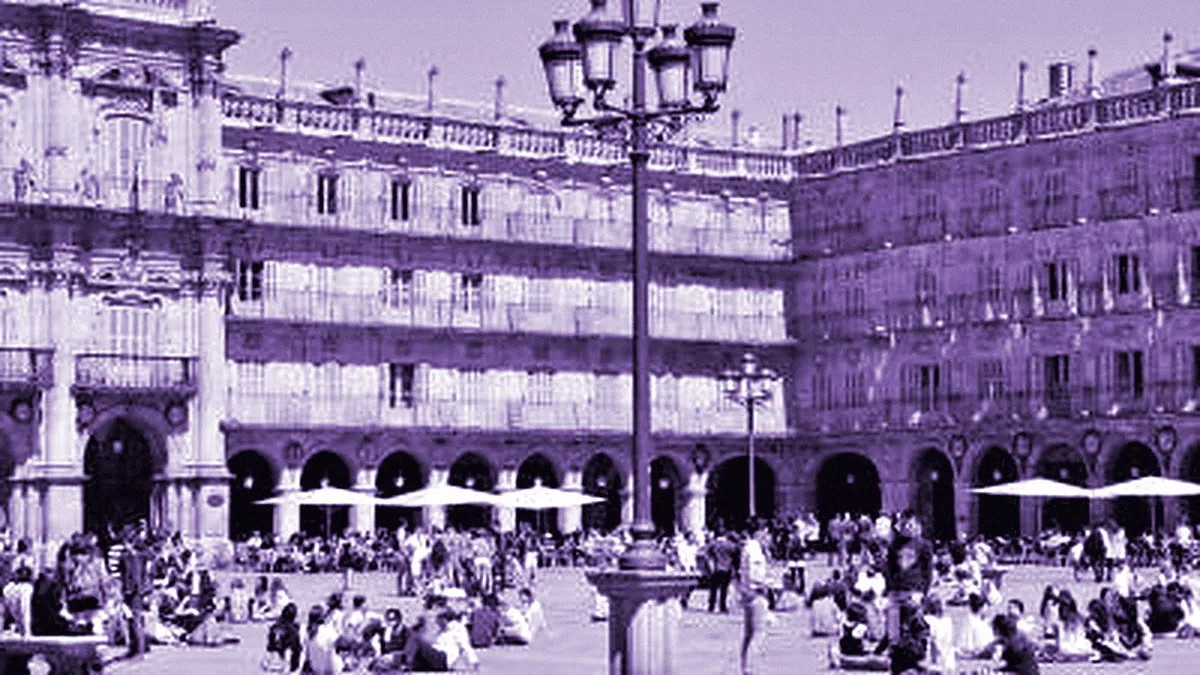
Plaza Mayor
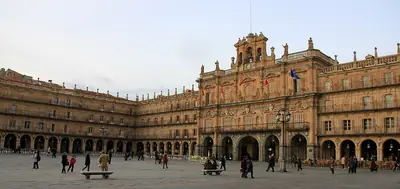
Begin with Plaza Mayor, the social heart of Salamanca. Built between 1729 and 1756 in the Baroque style, the square has an almost trapezoidal form surrounded by arcades with semicircular arches. Its 186 medallions depict figures including the Catholic Monarchs, Christopher Columbus, Miguel de Cervantes, El Cid and Franco.
The square was created to reward Salamanca for its loyalty during the War of the Spanish Succession. Later urban changes removed its central gardens, music kiosk and public urinals, leaving the open space visible today.
Casa de las Conchas
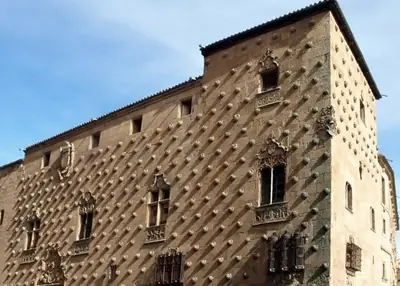
The Casa de las Conchas is one of Salamanca’s most distinctive buildings. This Gothic-Plateresque palace has a façade decorated with more than three hundred shells, the emblem of the Order of Santiago and a symbol associated with pilgrims on the Way of St James.
Construction began in 1493 under Rodrigo Arias de Maldonado, a knight of the Order of Santiago and a University of Salamanca professor, and ended in 1517. Look for the coat of arms of the Catholic Monarchs, four differently shaped Gothic windows and the Maldonado crest above the entrance. The courtyard features mixtilinear arches, Carrara marble columns, a graceful staircase and an ornate coffered ceiling. The building now houses a public state library and is a protected cultural monument.
Palacio de Anaya
The Palacio de Anaya is a neoclassical former college that now houses the University of Salamanca’s Faculty of Philology. Its current building was begun in 1760 to replace an earlier college badly damaged by the 1755 Lisbon earthquake.
Inside, the grand imperial staircase is particularly notable. It also contains a 1930 bust of Miguel de Unamuno, sculpted by Victorio Macho.
The University of Salamanca and Casa-Museo de Unamuno
The University of Salamanca is central to the city’s identity. Its Escuelas Mayores complex was begun in 1411 by order of Pope Luna and completed in 1533. For more than five centuries, it has served as the university’s academic heart.
The building is arranged around a central cloister, with galleries opening onto the old Paraninfo, the library and a chapel dedicated to San Jerónimo. Its façades reveal different stages of construction, including the Fachada de las Cadenas facing the cathedral and the later Plateresque façade overlooking the Patio de Escuelas.
Nearby, the Casa-Museo de Unamuno occupies the former home of writer Miguel de Unamuno. The museum preserves the rooms where he lived during his first period as rector of the university, from 1900 to 1914. The building is an 18th-century university residence belonging to the historic Escuelas Mayores complex.
Palacio de Orellana
On Calle San Pablo, at the corner with Calle de Jesús, the Palacio de Orellana illustrates Salamanca’s late Renaissance architecture. Commissioned in 1576 by the canon Francisco Pereira de Anaya, it was built with the participation of Cantabrian master builder Juan Ribero de Rada.
Its classicist design includes Mannerist influences, combining classical forms with more expressive details. The palace has also been known as the Palace of the Marquis of the Conquest and the Palace of the Marquis of Albaida, reflecting the changing titles of its noble owners.
Casa de las Muertes
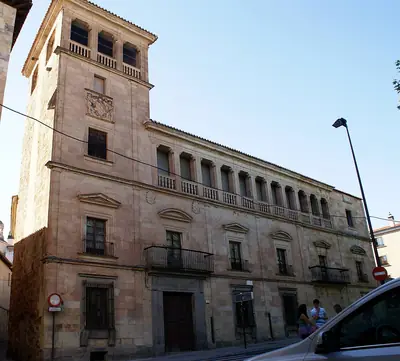
The Casa de las Muertes takes its name from four stone skulls carved as corbels on the façade and from a tragic event at the beginning of the nineteenth century, when four inhabitants were murdered in the house.
Designed by Juan de Álava, the residence stands in Salamanca’s old quarter. Its unusual decoration makes it one of the city’s more intriguing historic houses, where architectural detail and local history are closely entwined.
Convent of Las Dueñas
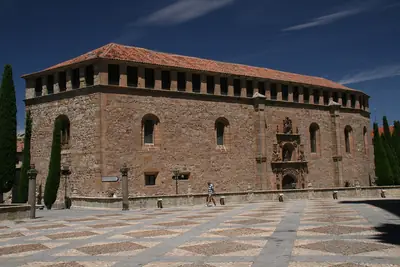
The Convent of Las Dueñas is an active Dominican convent tucked into Salamanca’s historic streets. It has been a spiritual and architectural landmark since the fifteenth century, while its construction continued over the fifteenth and sixteenth centuries.
The highlight is the cloister, designed by Rodrigo Gil de Hontañón and richly decorated in the Plateresque style. The convent was declared a Bien de Interés Cultural in 1921 and remains home to a community of Dominican sisters.
La Salina Palace
La Salina Palace is a notable example of Salamanca’s Plateresque heritage, with Italian influences in its design. Erected in 1538, it combines an airy façade with an arched patio. Its capitals and corbels are among the details that reveal the building’s architectural character.
The Cueva de Salamanca
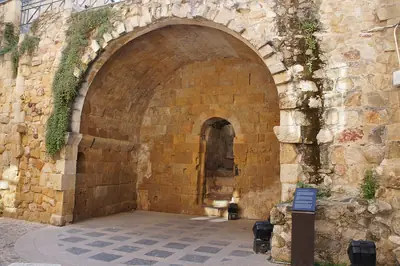
The Cueva de Salamanca is a legendary site connected to the former church of San Cebrián. According to folklore, the Devil once held classes in the cave. The story became part of European literature, inspiring Miguel de Cervantes’ 1615 entremés La cueva de Salamanca, a comedy by Juan Ruiz de Alarcón, a poem by Walter Scott and works by Martín del Río and Washington Irving.
The cave brings together a real trace of Salamanca’s past and one of the city’s most enduring legends.
General Archive of the Spanish Civil War
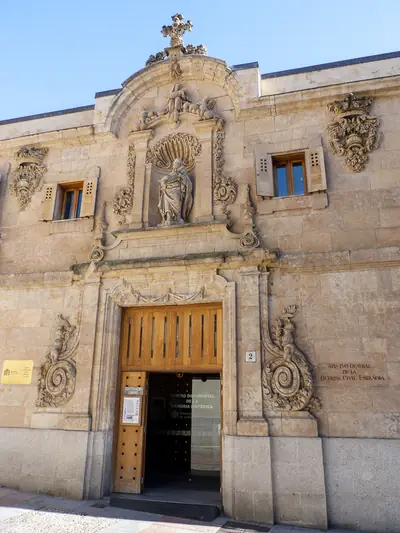
Housed in the former Colegio de San Ambrosio, the General Archive of the Spanish Civil War is a specialist repository forming part of Spain’s National Historical Archive. It focuses on the country’s recent past, particularly the Civil War and the Franco era.
The building was an eighteenth-century hospice designed by Joaquín de Churriguera in 1715. The archive originated during the Civil War, when documents belonging to opposing political groups and Freemason lodges were seized by the State. Its collections have also helped former Republican soldiers obtain pensions or compensation for time spent in prison.
Museums in Salamanca
Salamanca also offers several museums that broaden the city’s cultural story:
- The Casa-Convento de Santa Teresa dates from the end of the fifteenth century. Saint Teresa of Jesus lived there for nearly four years.
- The Casa Museo de Zacarías González occupies the home and studio of the Spanish painter Zacarías González.
- The Museo de Art Nouveau y Art Déco is housed in Casa Lis and presents furniture and decorative objects from both styles. Its collection grew from collector Manuel Ramos Andrade’s donation.
- The Museo de Historia de la Automoción de Salamanca was Spain’s first public museum devoted to the automobile. It contains more than two hundred historic cars and thousands of automobile-related accessories, inside Salamanca’s first electricity-generating plant.
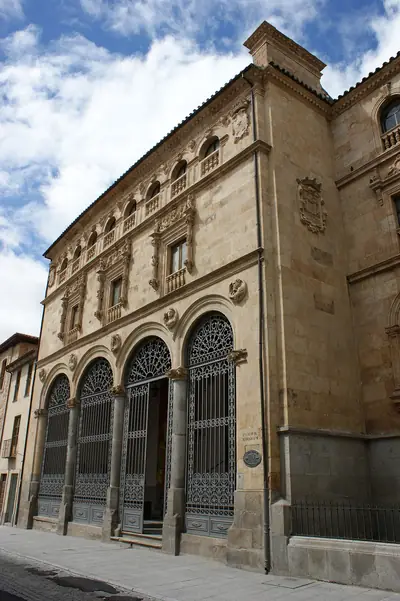
- DA2 Domus Artium 2002 is a contemporary art centre installed in a former provincial prison. The 1930 building retains features including cell doors and its historic iron grille.
Explore Salamanca with Neywo
A Salamanca self-guided walking tour lets you discover the city’s landmarks while moving at your own pace. Neywo has five walking tours, one bus route and one bike route in Salamanca. The walks range from 1.35 to 1.82 km and take 71 to 88 minutes, with between 9 and 12 narrated stops. The bus route covers 4.2 km in 18 minutes and has 8 stops, while the bike route covers 3.4 km in 17 minutes and has 3 stops.
Choose a walk through the golden stone, university and twin cathedrals; follow a route focused on shells, skulls and Plaza Mayor; discover Salamanca’s devils, Dominicans and medieval tower; explore Saint Teresa and the northern palaces; or visit Romanesque towers and quieter eastern churches. The bus and bike routes add other perspectives, including the General Archive of the Spanish Civil War and DA2 Domus Artium 2002.
The app tells the story of each place as you reach it, at your own pace, with no group and no schedule. Narration is available in 11 languages.
Download Neywo and explore Salamanca
Download Neywo’s free audio guide to explore Salamanca independently, with 76 narrated places and seven routes across the city. Walk from the Roman bridge to the university, trace the legends around the Cueva de Salamanca, or move between museums, palaces and convents while the app explains what you are seeing.
Salamanca is also a natural starting point for discovering more of Spain, with other destinations in the region including Ávila, Segovia, Burgos and Tordesillas.
Places with an audio guide in Salamanca
8 places in Salamanca with a Neywo audio guide. Each one starts telling its story as you reach it.
Self-guided tours in Salamanca
7 tours in Salamanca, free in the Neywo app. Each stop tells its story as you reach it.
- Bike ride
Cycle Lane from Contemporary Art to the Civil War Archive
A flat ride on Salamanca's cycle lanes from the modern art centre in a former prison, past the sculpture Mirando al cielo, to the historic Archive of the Civil War near the old town.
Mirando al cielo · DA2 Domus Artium 2002 · General Archive of the Spanish Civil War
Open this tour: Cycle Lane from Contemporary Art to the Civil War Archive - Bus ride
Line 4: Across Salamanca by Local Bus
A regular city line that runs across Salamanca from the east side to the river. Ride past the Museum of Commerce and Industry, the Dueñas convent and the Civil War Archive, and step off at the Roman bridge and its ancient stone bull. Cheap, frequent and a good way to see the city beyond the historic centre.
Museo del Comercio y la Industria · Monumento al empresario, Salamanca · Plaza de la Constitución · Convent of Las Dueñas · Church of Saint Polo · General Archive of the Spanish Civil War …
Open this tour: Line 4: Across Salamanca by Local Bus - Walk
The Golden Stone: Bridge, University and Twin Cathedrals
Cross from the Roman bridge over the Tormes into the oldest university town in Spain. Meet the Iron Age bull at the bridge, pass the Art Nouveau museum of Casa Lis, follow the student streets of the Escuelas Menores and the Hospital del Estudio, stand before Unamuno's house and the carved university façade, and end beside the bishop's palace and the two cathedrals that define Salamanca's skyline.
Roman bridge of Salamanca · Verraco del puente · Church of Saint James · Museo de Historia de la Automoción de Salamanca · Museo de Art Nouveau y Art Déco · Casa-museo de Unamuno …
Open this tour: The Golden Stone: Bridge, University and Twin Cathedrals - Walk
Shells, Skulls and the Great Square
A walk through Salamanca's most photogenic stone: the Casa de las Conchas with its hundreds of shells, the baroque towers of La Clerecía, plateresque palaces, the convent whose Maldonado coats of arms were chiseled away, the house where Unamuno spent his last years, the grim House of the Dead with its four carved skulls, and the Romanesque church of San Martín beside the Plaza Mayor.
Palacio de Anaya · Casa de las Conchas · La Clerecía · Palacio de Orellana · Convento de la Madre de Dios · Casa de Diego Maldonado …
Open this tour: Shells, Skulls and the Great Square - Walk
Devils, Dominicans and a Medieval Tower
Head into the quieter east side of the old town. Peek into the cave where the Devil is said to have held classes, walk through the Dominican cloisters of Las Dueñas and San Esteban, pass the plateresque Salina Palace and finish at the Gothic Torre del Clavero and the monument to Columbus.
Cueva de Salamanca · Iglesia del Carmen de Abajo · Monumento a Francisco de Vitoria · Convent of Las Dueñas · Convento de Sant Esteban · Church of Saint Paul …
Open this tour: Devils, Dominicans and a Medieval Tower - Walk
Saint Teresa and the Northern Palaces
Wander north of the Plaza Mayor through convents, Romanesque churches and noble houses. See the unfinished plateresque Monterrey Palace, the house where Saint Teresa lived for nearly four years, the square named for the feuding families of medieval Salamanca and the palaces with sgraffito façades and a Hispano-Japanese patio.
Monterrey Palace · Convento de las Úrsulas, Salamanca · Church of John of Barbalos · Casa-Convento de Santa Teresa · Convent of Santa Isabel, Salamanca · Casa de María la Brava …
Open this tour: Saint Teresa and the Northern Palaces - Walk
Romanesque Towers and Quiet Churches of the East
Leave the crowds behind and follow a loop of twelfth-century churches, a fifteenth-century tower-house and quiet squares east of the Plaza Mayor: Saint Julian and Saint Basilissa, the Torre del Aire, Sancti Spiritus and the church of Saint Christopher, ending at the late Romanesque church of Saint Thomas Becket.
Church of Saint Julian and Saint Basilissa · Convent of San Antonio el Real, Salamanca · Church of Saint John of Sahagún · Torre del Aire, Salamanca · Plaza de la Constitución · Church of Sancti Spiritus …
Open this tour: Romanesque Towers and Quiet Churches of the East
Walk Salamanca with Neywo
Neywo turns Salamanca into a self-guided audio tour. Stories arrive as you reach the place they belong to, and the route reshapes when you wander off it.

