Ávila, Spain: Self-Guided Walking Tour
Things to do in Ávila: a self-guided walk through its palaces and churches
The best things to do in Ávila are concentrated around its medieval walls, fortress-like cathedral, Renaissance palaces and historic churches. This Castilian city offers a remarkably rich journey through religious and military history, with noble residences and convents appearing along its streets. Neywo’s free audio guide to Ávila tells the stories of 54 narrated places as you explore.
Located in Castile and León, Ávila is especially rewarding on foot. Its historic centre brings together imposing stone architecture, the legacy of powerful families and the spiritual world associated with Saint Teresa of Ávila.
What to see in Ávila
Ávila Cathedral
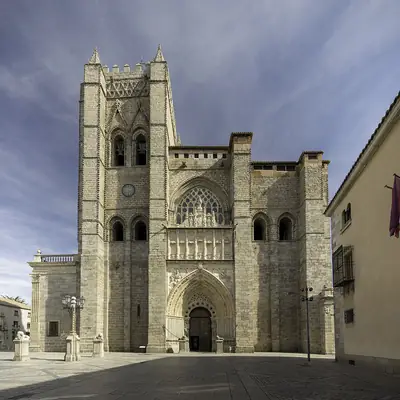
Ávila Cathedral is one of the city’s defining landmarks and one of Spain’s most unusual cathedrals. Its massive apse forms part of the medieval fortifications, so the building serves both as a place of worship and as a defensive structure.
Construction began in the twelfth century and continued across several hundred years. The exterior combines Romanesque and Gothic characteristics, with a sober, fortress-like appearance, while the interior rises into pointed arches and ribbed vaults. It is considered the first Gothic cathedral in Spain. Stained-glass windows, chapels and altarpieces add a more luminous character inside, contrasting with the heavy stone exterior.
Palacio de Polentinos
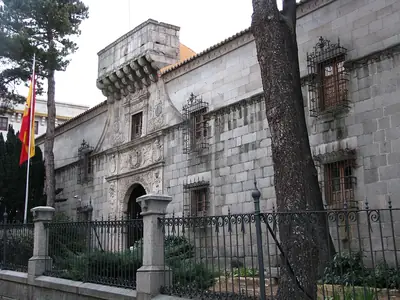
The Palacio de Polentinos is a Renaissance mansion in the centre of Ávila. Also called the Mansión de los Polentinos, it houses the Museo de Intendencia del Ejército, or Army Quartermaster Museum.
Its presence helps explain the importance of military life in the city, where noble residences and defensive architecture often stood closely together.
Palace of Superunda
The Palace of Superunda is a historic building protected as a Bien de Interés Cultural, a designation recognising its importance to Spain’s cultural heritage. It forms part of the group of palaces that give Ávila’s old town its distinctive aristocratic character.
Palacio de Bracamonte
The Palacio de Bracamonte is also known as the Palacio de la Santa Cruz and the House of Diego Álvarez de Bracamonte. It belonged to the Casa de Dávila, one of the most distinguished lineages in Castile.
The building is a reminder of how influential noble families shaped Ávila’s streets and reinforced the city’s connection with aristocratic power.
Palacio de los Águila
The Palacio de los Águila, also known as the Palace of the Duchess of Valencia, is one of Ávila’s recognised cultural heritage sites. Its historic identity adds another layer to the city’s collection of noble residences.
Palacio de los Almarza
The Palacio de los Almarza is another notable historic building in Ávila. It is protected as a Bien de Interés Cultural, Spain’s highest level of heritage protection.
Palacio de los Dávila
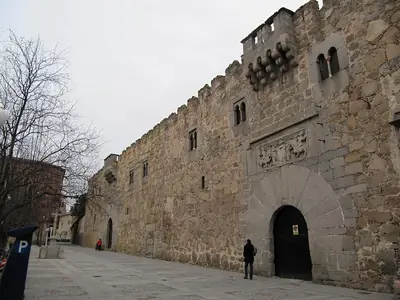
The Palacio de los Dávila, also called the Palacio de los Abrantes, is closely connected with Ávila’s walls. Rather than being only a noble residence, it formed part of a second defensive line alongside other palaces inhabited by nobles and clergy.
The north front still shows machicolations and merlons. The palace developed between the thirteenth and sixteenth centuries, creating a mixture of architectural styles. Among its oldest features are the Gate of the Rastro, a thirteenth-century relic, geminate windows and a pointed Gothic porch on the west front. Later doors and reliefs reveal how the residence changed over time.
Church of San Juan Bautista
The Church of San Juan Bautista is a Catholic church in the heart of Ávila. Known locally as the Iglesia de San Juan Bautista, it is one of the historic religious buildings encountered while exploring the old town.
The church also connects naturally with the city’s wider story of faith, particularly the religious heritage associated with Saint Teresa.
Royal Monastery of St. Thomas
The Royal Monastery of St. Thomas is one of Ávila’s major Gothic landmarks. Founded in the early 1480s by Hernán Núñez de Arnalte, it was entrusted to María Dávila and the Dominican friar Tomás de Torquemada. Dedicated to Saint Thomas Aquinas, the monastery enjoyed the direct patronage of the Crown.
The monastery became a royal sanctuary, and John, Prince of Asturias, the only son of Isabella and Ferdinand, was buried here. His tomb remains one of the site’s most poignant features.
Architecturally, the building combines Gothic and Plateresque styles. The soaring Gothic forms and rose window contrast with the more ornate decoration of the façades, while the entrance and stone carvings reflect the monastery’s royal status.
Palacio de los Verdugo
The Palacio de los Verdugo is a Renaissance mansion on Calle de Lope Núñez. Built in 1531 for Suero de Águila, it has a sober Plateresque façade with a defensive character. The absence of ground-floor windows and the two broad towers flanking the entrance suggest that even wealthy homes required protection.
A particularly distinctive detail stands beside the main doorway: a verraco, or stone bull, carved by the Vettones, the Celtic people who lived in the area before the Romans. These ancient sculptures are scattered across Ávila and connect the Renaissance building with a much older past.
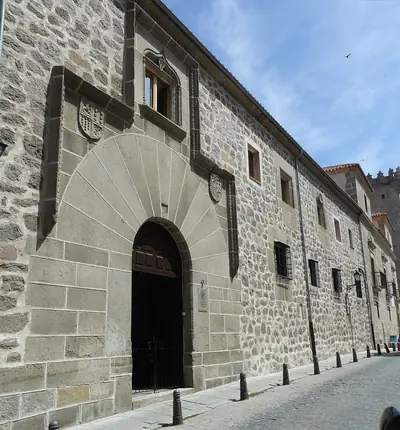
Palacio de Blasco Núñez Vela
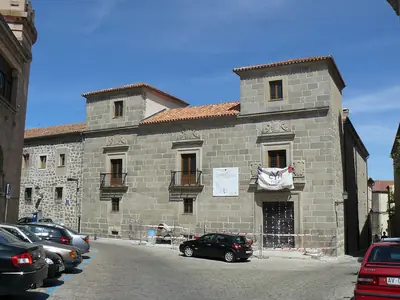
The Palacio de Blasco Núñez Vela is a historic Renaissance palace within Ávila’s ancient walls. Protected as a Bien de Interés Cultural, it offers a glimpse of the noble residences that once lined the city’s streets.
The palace is not open to the public, but its stone façade and Renaissance details remain part of the architectural experience of the old town.
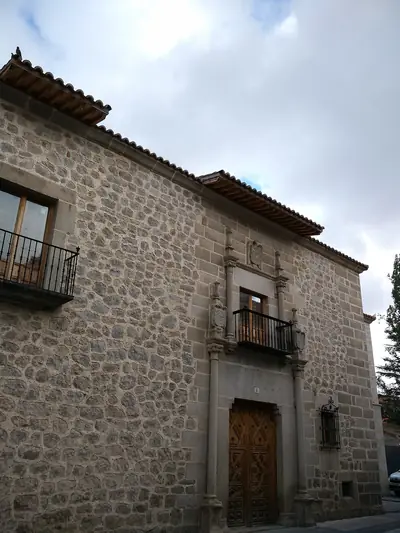
Palacio de los Serrano
Built in the mid-sixteenth century, the Palacio de los Serrano is one of Ávila’s most striking Renaissance mansions. Its façade combines rough masonry with smooth ashlar around the windows, doorway and corners, creating a contrast in the local granite.
The palace is now home to the Fundación Ávila and continues to serve as a cultural centre.
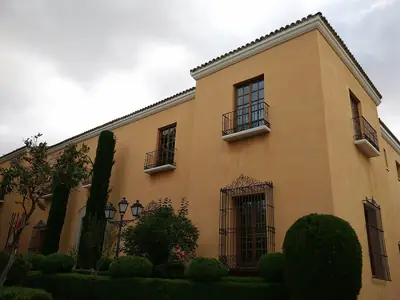
Palacio del Marqués de Velada
The Palacio del Marqués de Velada is a Renaissance palace also known as the Palace of the Velada family. Its most distinctive feature is a solid masonry tower, called the Torre de los Aboín.
Built during the first third of the sixteenth century, the palace has survived into the present with a new purpose: it now serves as a hotel.
Torreón de los Guzmanes
The Torreón de los Guzmanes is a solid Renaissance tower that once belonged to the Guzmán family. Today, it has a civic role as the headquarters of the Provincial Council of Ávila.
Its scale and stone construction recall the power of the family that originally owned it, while its current use shows how historic buildings remain part of the city’s public life.
Convent of Saint Joseph
The Convent of Saint Joseph was the first monastery founded by Saint Teresa of Ávila. Teresa established it in 1562, with the support of Bishop Álvaro de Mendoza, beginning the reform of the Carmelite order.
The convent became the model for the Discalced Carmelite houses that followed. The church was built later, beginning in 1607 according to designs by Francisco de Mora. Its sober façade reflects the early Carmelite style, while the statue above the entrance was commissioned by King Philip III and carved by Giraldo de Merlo.
More ways to explore Ávila
Ávila’s main sights can be connected through several walking routes. The city’s walls, palaces, churches and convents are close enough to form a coherent journey, while places outside the fortifications add further context to the historic centre.
For a wider trip through the region, you can continue to Salamanca, Segovia, Burgos or Tordesillas.
Explore Ávila with Neywo
Download Neywo’s free Ávila audio guide and choose from four walking tours and one bus route. The walks range from 1.22 to 2.95 km and last between 99 and 115 minutes, with 10 to 12 narrated stops each. The bus route covers 2.2 km, lasts 9 minutes and includes 6 stops.
Neywo also offers narration in 11 languages. Each story plays as you reach the place, at your own pace, with no group and no schedule. It is a simple way to follow an Ávila self-guided walking tour while learning the history of its cathedral, palaces, churches and convents.
Places with an audio guide in Ávila
8 places in Ávila with a Neywo audio guide. Each one starts telling its story as you reach it.
Self-guided tours in Ávila
5 tours in Ávila, free in the Neywo app. Each stop tells its story as you reach it.
- Bus ride
Línea 1 Around the Walls: San Vicente to San Nicolás
Ávila's municipal Línea 1 skirts the old town: ride from the basilica of San Vicente past the cathedral and the Dávila palace at the Puerta del Rastro to the churches of the south, a cheap way to see the walls from outside.
San Vicente, Ávila · Ávila Cathedral · Verraco de las Cogotas · Palacio de los Dávila · Palacio de Blasco Núñez Vela · Church of San Nicolás
Open this tour: Línea 1 Around the Walls: San Vicente to San Nicolás - Walk
Fortress Cathedral and Palaces of the Old Town
Ávila's cathedral is also a fortress, its apse forming a turret of the city walls. Walk the streets around it, past the palaces whose lords once had to defend its gates, a Romanesque basilica with three apses and a Renaissance mansion guarded by a Celtic stone bull.
Ávila Cathedral · Palacio de Valderrábanos · Palacio del Marqués de Velada · Palacio del Rey Niño · Gate of Peso de la Harina · Palacio de los Serrano …
Open this tour: Fortress Cathedral and Palaces of the Old Town - Walk
Saint Teresa's Birthplace and the Western Palaces
From the arcaded Plaza del Mercado Chico to the convent built over Teresa de Ávila's birthplace, this walk follows the great walls through the western old town, past the Dávila palace that doubled as a second line of defence and a string of noble towers and mansions.
Plaza del Mercado Chico · Church of San Juan Bautista · Chapel of Nuestra Señora de los Nieves, Ávila · Palacio de los Dávila · Palacio de los Almarza · Palace of Superunda …
Open this tour: Saint Teresa's Birthplace and the Western Palaces - Walk
Romanesque Churches, Convents and the Royal Monastery
Wander the southern and eastern old town: the Puerta del Alcázar gate and its prehistoric stone bull, Plaza de Santa Teresa and the Romanesque churches of San Pedro and Santiago, then the first convent Teresa founded, and finally the Royal Monastery of Santo Tomás, a favourite of the Catholic Monarchs.
Church of Santiago · Convent of Nuestra Señora de Gracia · Convent of La Magdalena · Verraco de las Cogotas · Puerta del Alcázar · Plaza de Santa Teresa …
Open this tour: Romanesque Churches, Convents and the Royal Monastery - Walk
Outside the Walls: Cuatro Postes, Churches and Convents
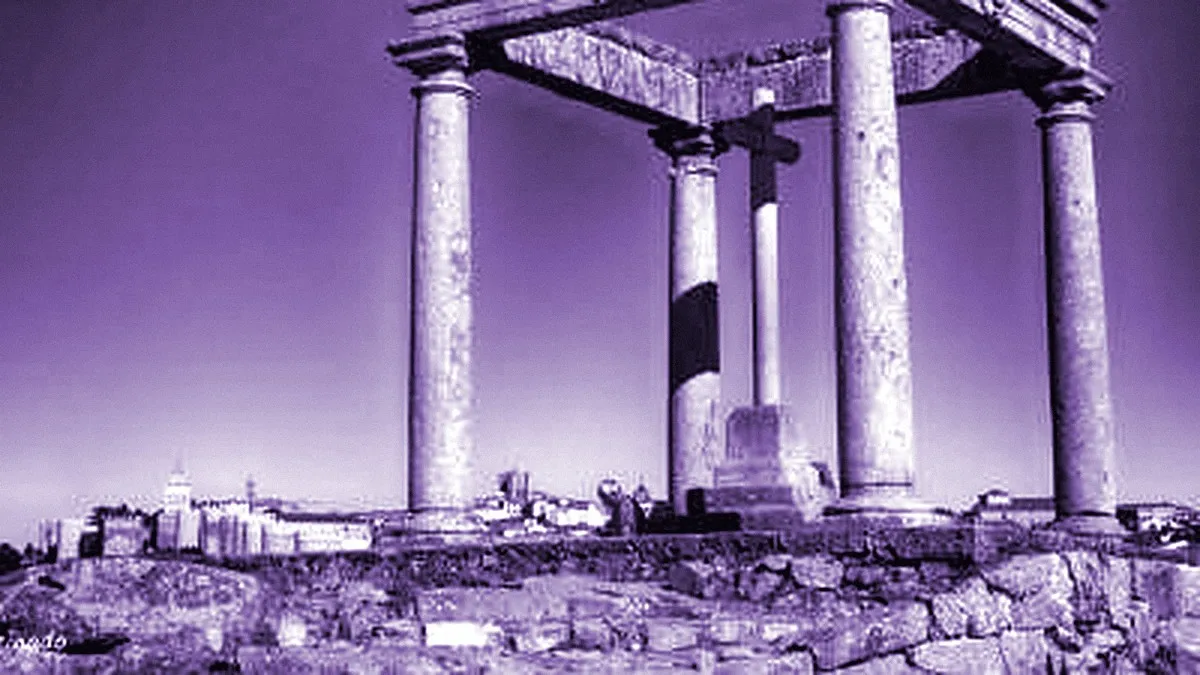
Leave the walled city for the churches and convents that ring it, from the Cuatro Postes viewpoint, where the whole wall is spread out before you, and the old tanneries by the river, to the Monastery of the Encarnación and the church of San Andrés.
Cuatro Postes in Ávila · Hermitage of San Segundo, Ávila · Old tanneries in Ávila · Church of San Esteban · Palacio de Juan de Henao, Ávila · Las Bóvedas del Carmen, Ávila …
Open this tour: Outside the Walls: Cuatro Postes, Churches and Convents
Walk Ávila with Neywo
Neywo turns Ávila into a self-guided audio tour. Stories arrive as you reach the place they belong to, and the route reshapes when you wander off it.

