What to See in Burgos, Spain: Free Audio Guide
Things to Do in Burgos: What to See in Spain’s Gothic City
Burgos is a historic city in Castile and León, known for its Gothic architecture, royal monasteries, medieval buildings, and close connection with the Camino de Santiago. Its compact historic centre brings together major monuments, museums, churches, and castle ruins, making it a rewarding destination to explore on foot. Neywo has a free audio guide for Burgos with 77 narrated places.
What to See in Burgos
Burgos Cathedral
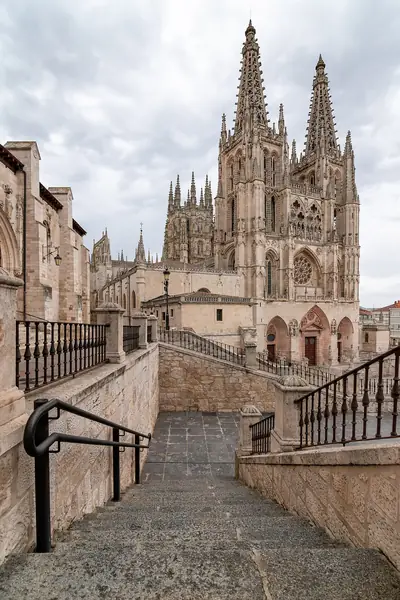
Burgos Cathedral is the city’s defining monument and one of its most important Gothic buildings. Dedicated to Saint Mary, it has been recognized as a UNESCO World Heritage Site. Construction began in 1221 in the French Gothic tradition, while later centuries added the openwork spires, the Chapel of the Constable, the crossing dome, the sacristy, and the Chapel of Saint Thecla.
The cathedral’s main façade rises in three levels between two square towers. Its fifteenth-century spires, designed by Juan de Colonia, give Burgos one of its most recognizable silhouettes. The Sarmental and Coronería portals belong to the thirteenth-century Gothic period, while the Pellejería portal shows Renaissance and Plateresque influences.
Arco de Santa María
The Arco de Santa María connects Santa María Bridge over the Arlanzón River with the square in front of the cathedral. It began as one of the twelve entrances in Burgos’s medieval walls, but its present appearance mainly dates from a transformation carried out between 1536 and 1553.
Its façade presents figures from Burgos and Castile’s history, including Count Fernán González, El Cid, Emperor Charles the Fifth, and Count Diego Rodríguez Porcelos, regarded as the founder of Burgos in 884. The interior is open to the public and includes temporary art exhibitions and a large mural.
Casa del Cordón
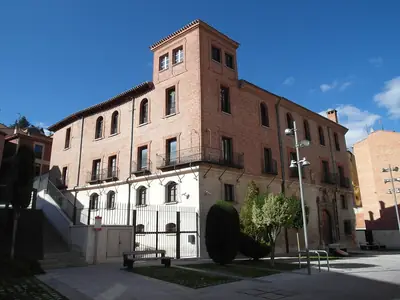
Casa del Cordón is a fifteenth-century Gothic palace that once stood beside the old Mercado Mayor, the market square formed by today’s Plaza de la Libertad and Plaza de Santo Domingo de Guzmán. Pedro Fernández de Velasco, Constable of Castile, and his wife, Mencía de Mendoza y Figueroa, commissioned the building.
The entrance is marked by the couple’s heraldic shields, joined by a Franciscan cord carved in stone. This detail explains the palace’s popular name, House of the Cord. According to tradition, a cord or chain above a house indicated that a king had slept there.
Universidad de Mercaderes y Consulado de Burgos
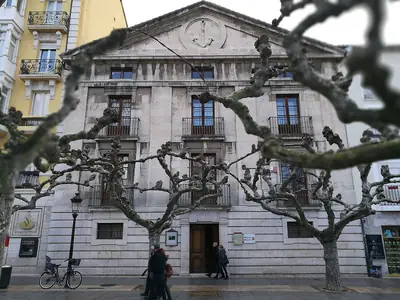
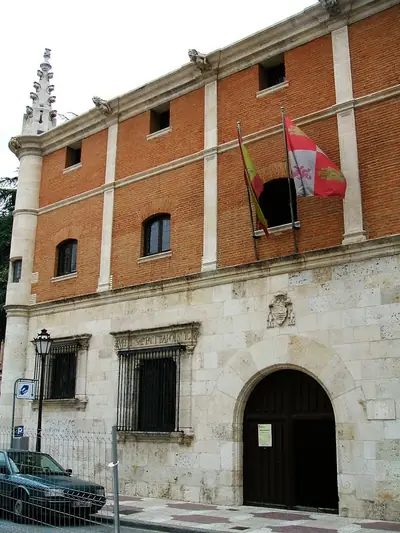
Near the cathedral, on the Paseo del Espolón, stands the building known as the Consulado del Mar, or University of Merchants and Consulate of Burgos. It occupies a central position in the historic centre and forms part of the city’s commercial and civic heritage.
Church of San Nicolás de Bari
Beside the Camino de Santiago and only a few steps from the cathedral, the Church of San Nicolás de Bari is especially notable for its interior. Its altarpiece is one of the largest in Spain and is described as the only altarpiece in the country carved in limestone.
Church of San Lesmes Abad
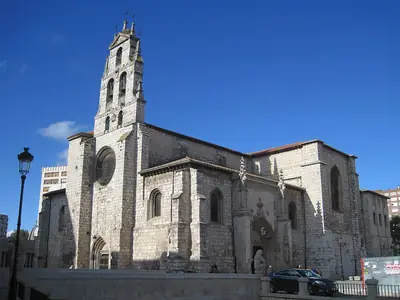
The Church of San Lesmes Abad stands in Plaza de San Juan, beside the Camino de Santiago and opposite the Public Library. Built in the fourteenth-century Gothic style, it is closely associated with San Lesmes Abad, also known as Adelelmus of Burgos and the city’s patron saint.
The church contains his burial. A restoration took place in 2012 and 2013, while one account records that his complete remains were found in 1968.
San Gil Abad
San Gil Abad was incorporated into the city wall, which helps explain its austere exterior. Inside, however, it is considered the most valuable Gothic ensemble in Burgos after the Cathedral. The church stands beside the San Gil Gate, near the eastern slope of Castle Hill, and dates from the fourteenth and fifteenth centuries.
It was declared a historic and artistic monument in 1931 and is now recognized as a site of cultural interest.
Iglesia de San Esteban and the Altarpiece Museum
The former Iglesia de San Esteban stands along the eastern perimeter of Burgos Castle. Built mainly between the late thirteenth and early fourteenth centuries, it is no longer used for worship but remains an important Gothic monument.
The building houses the Museo del Retablo, or Altarpiece Museum, belonging to the Archdiocese of Burgos. Its collection includes altarpieces dating from the fifteenth to the eighteenth centuries, many of them brought from towns across Burgos province.
Castle of Burgos
The ruins of the Castle of Burgos crown Castle Hill, which rises seventy-five metres above the city. The site became an important defensive stronghold during the Reconquista. Count Diego Porcelos built the first tower here in 884, and the original structure later grew into a larger castle and a residence of the kings of Castile.
The castle lost its importance as a royal residence after the Habsburgs came to power. Its final destruction took place during the French occupation: on 15 June 1813, the French army left Burgos and blew up the fortress with explosives. Archaeological surveys carried out in 1925 and 1926 suggested that the hill may have older origins, including evidence attributed to the Visigoths.
Museo de Burgos
The Museo de Burgos is dedicated entirely to the history and culture of Burgos province. Its collections come from the province either by origin or by destination, creating a focused introduction to the region’s historical development.
The museum occupies two adjoining sixteenth-century palaces, the Casa de Miranda and the Casa de Íñigo Angulo. Together, they form a single block between Calera Street and Miranda Street.
Abbey of Santa María la Real de Las Huelgas
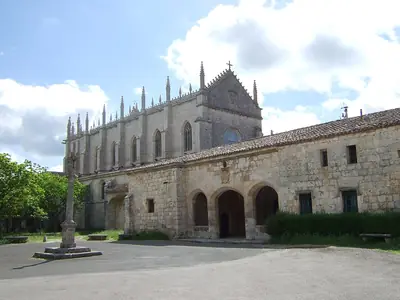
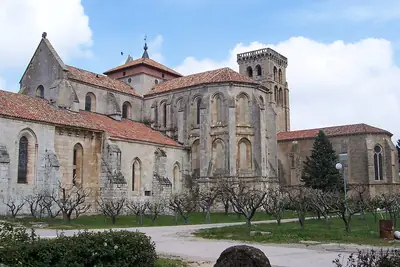
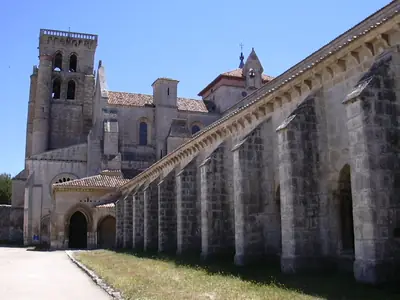
West of the city, the Abbey of Santa María la Real de Las Huelgas is a living Cistercian monastery of nuns and one of Burgos’s most significant historic landmarks. It was founded in the late twelfth century by King Alfonso the Eighth of Castile and Eleanor of Plantagenet; the supplied accounts give both 1187 and 1189 as the foundation date.
The abbey has strong royal connections and hosted weddings involving Spanish and foreign royal families, including the marriage of Edward the First of England and Eleanor of Castile in 1254. It also preserves historic works, including some of the oldest stained-glass windows in Spain.
Museo de Telas Medievales de Burgos
At the Monastery of Las Huelgas Reales, the Museum of Medieval Textiles of Burgos presents civil clothing for women, men, and children from the eleventh, twelfth, and thirteenth centuries. The collection contains around three hundred objects, with fifty-one carefully restored and cleaned pieces displayed in the exhibition.
The textiles survived in remarkable condition despite the deterioration of the tomb interiors where they were found. Their preservation is attributed to the high quality of the silk. One of the best-known pieces is traditionally called the Banner of Las Navas de Tolosa, although that name is considered inaccurate. It is a thirteenth-century Almohad tapestry decorated with Arabic inscriptions and imagery.
Teatro Principal and La Casa de los Gigantillos
At the beginning of the Paseo del Espolón, the Teatro Principal faces the Provincial Palace. Designed by Bernardino Martínez de Velasco under the direction of Francisco de Angoitia, it began to rise in 1843 and opened in 1858.
The building has hosted concerts, theatre, dance, and music. A major renovation in 1997 returned it to active use, and the complex now also contains a public library, an exhibition room, conference rooms, administrative offices, and a café with a terrace overlooking the Paseo del Espolón.
Inside is La Casa de los Gigantillos, where the gigantones and gigantillos associated with Burgos’s festive traditions are displayed.
Explore Burgos with Neywo
Neywo turns a visit into a self-guided experience. The app tells the story of each place as you reach it, at your own pace, with no group and no schedule. Narration is available in 11 languages.
In Burgos, Neywo includes four walking tours, one bus route, and one bike route:
- In the Footsteps of El Cid: 1.28 km, 97 minutes, 9 narrated stops.
- Castle Hill and the Gothic Heights: 1.77 km, 82 minutes, 9 narrated stops.
- Pilgrims, Painters and Early Humans: 2.89 km, 101 minutes, 10 narrated stops.
- Gates, Palaces and the Royal Abbey: 2.05 km, 82 minutes, 8 narrated stops.
- Line L15: Burgos’s Historic Centre by Bus: 7.5 km, 32 minutes, 11 narrated stops.
- Along the Arlanzón: From the Espolón to the Atapuerca Museum: a 2.6 km bike route taking 13 minutes, with 7 narrated stops.
Download Neywo and explore Burgos with a free audio guide that accompanies you through its cathedral, medieval streets, churches, museums, palaces, and castle hill. You can also continue discovering Salamanca, Ávila, Segovia, or Tordesillas in Spain.
Places with an audio guide in Burgos
8 places in Burgos with a Neywo audio guide. Each one starts telling its story as you reach it.
Self-guided tours in Burgos
6 tours in Burgos, free in the Neywo app. Each stop tells its story as you reach it.
- Bike ride
Along the Arlanzón: From the Espolón to the Atapuerca Museum
A gentle ride on the cycle lanes beside the Arlanzón river. Pass the merchants' consulate and the Teatro Principal at the Espolón, then the Museum of Human Evolution, and finish at the Carmelite convent founded by Saint Teresa and the painter Marceliano Santa María's museum.
La Merced Church · Universidad de Mercaderes y Consulado de Burgos · Teatro Principal · Museum of Human Evolution · Convento Carmelita de San José y Santa Ana · Museo Marceliano Santa María …
Open this tour: Along the Arlanzón: From the Espolón to the Atapuerca Museum - Bus ride
Line L15: Burgos's Historic Centre by Bus
Burgos's city bus L15 links the old town's sights. Ride from the Casa del Cordón past the Captaincy General, San Gil, the Trinitarian ruins and Gothic San Esteban, through the Arch of Fernán González and past El Empecinado and the Arch of San Martín, then along the river to La Merced and the equestrian statue of El Cid. A cheap, easy way to see the old town with a seat.
Casa del Cordón · Palacio de Capitanía General · San Gil Abad · Monasterio de la Trinidad de Burgos · Puerta de San Esteban · Iglesia de San Esteban …
Open this tour: Line L15: Burgos's Historic Centre by Bus - Walk
In the Footsteps of El Cid
Start at a triumphal arch for Burgos's founding count and walk to the church where El Cid is said to have made a king swear an oath. Then stand before the Gothic spires of the cathedral, pass through the old city gate, find the hero on horseback and end at a palace marked with a carved Franciscan cord.
Arch of Fernán González · Santa Gadea · Iglesia de San Nicolás de Bari · Burgos Cathedral · Arco de Santa María · Universidad de Mercaderes y Consulado de Burgos …
Open this tour: In the Footsteps of El Cid - Walk
Castle Hill and the Gothic Heights
Climb from the monument of a Peninsular War hero to the ruined castle blown up by the French in 1813. Then wander down through Gothic San Esteban and fortified San Gil, past the Trinitarian ruins and the palace where Franco was named head of the armies, to a Jesuit Baroque church.
El Empecinado · Castle of Burgos · Iglesia de San Esteban · Puerta de San Esteban · San Gil Abad · Monasterio de la Trinidad de Burgos …
Open this tour: Castle Hill and the Gothic Heights - Walk
Pilgrims, Painters and Early Humans
Follow the Camino de Santiago to the tomb of Burgos's patron saint, then visit a painter's museum in the ruins of a monastery and the Poor Clares' medieval convent. Cross the river to the museum that brings the Atapuerca fossils to life, then end at the province's museum and a late Gothic church.
Church of San Lesmes Abad · Walls of Burgos · Museo Marceliano Santa María · Convento Carmelita de San José y Santa Ana · Museum of Human Evolution · Convent of Saint Clare …
Open this tour: Pilgrims, Painters and Early Humans - Walk
Gates, Palaces and the Royal Abbey
Leave the cathedral behind for the western edge of old Burgos. Pass the Salesas convent and the Neo-Gothic Palace of La Isla, step through the medieval gates of San Martín and the Jewish Quarter, then follow the Camino to Las Huelgas, a living Cistercian abbey of queens and kings, and its museum of medieval textiles.
Church-Convent of the Salesas · Palace of La Isla, Burgos · Solar del Cid, Burgos · Arco de San Martín · Puerta de la Judería, Burgos · Church of San Pedro de la Fuente …
Open this tour: Gates, Palaces and the Royal Abbey
Walk Burgos with Neywo
Neywo turns Burgos into a self-guided audio tour. Stories arrive as you reach the place they belong to, and the route reshapes when you wander off it.

