Things to Do in La Pineda, Spain: Walking Guide
Things to Do in La Pineda: Historic Chapels and Churches
Looking for things to do in La Pineda? Neywo’s free audio guide for La Pineda includes 12 narrated places, helping you explore the historic churches and chapels connected with the wider area at your own pace. The route brings together Romanesque buildings, private farmhouse chapels and landmarks shaped by the history of Bigues i Riells and its neighbouring villages.
La Pineda is in Catalonia, a region known for a rich architectural heritage. To place the destination in context, see the wider guide to Catalonia or the country overview for Spain.
What to see in La Pineda
The places covered by the guide are mainly in and around Bigues i Riells, Riells del Fai and nearby settlements. Together, they reveal a quieter side of Catalan heritage, from medieval parish churches to small chapels associated with rural estates.
Castell de Montbui and Sant Mateu de Montbui
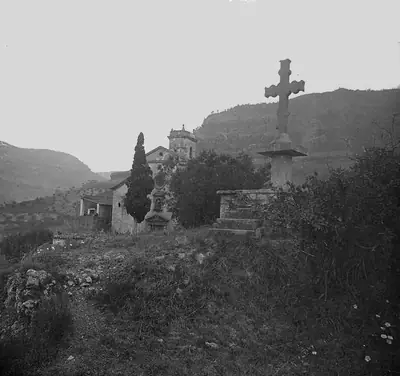
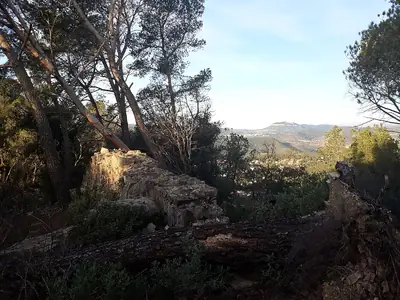
At the summit of the mountain named after it, Castell de Montbui shares its setting with Sant Mateu de Montbui. The castle and the Romanesque church form a distinctive historic pair. Sant Mateu was once a parish church and is now an ermita beside the eastern side of the castle summit.
Capella de Can Carreres
The Capella de Can Carreres is a chapel in Bigues i Riells and part of Catalonia’s recognised architectural heritage. It is officially included in the region’s Architectural Heritage Inventory.
La Immaculada Concepció de la Pineda
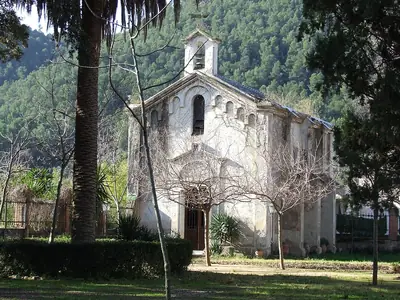
This small private chapel belongs to the La Pineda farmhouse in Riells del Fai, within the municipality of Bigues i Riells. Its compact design is a modest example of popular Baroque architecture. The chapel has no separate apse and forms part of the wider farmhouse complex.
La Mare de Déu de Montserrat de Can Noguera
Connected with the Can Noguera farmhouse, this private chapel is notable for its substantial scale. It stands separately from the farmhouse, to the southeast of the principal façade, giving the rural complex a distinct architectural presence.
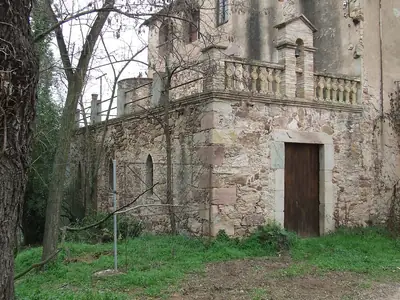
The chapel has a single nave and considerable height. Like the present Can Noguera farmhouse, it was built within the orbit of Modernisme. It is located in Bigues i Riells, in the Vallès Oriental, in the area of the village of Bigues.
Mare de Déu del Pilar de Can Masponç
This small private chapel belongs to the Can Masponç farmhouse. It has a simple single-nave form and stands directly beside the farmhouse on its southern side. Along its western side, it reaches the Torrent Masponç.
Sant Bartomeu de Mont-ras
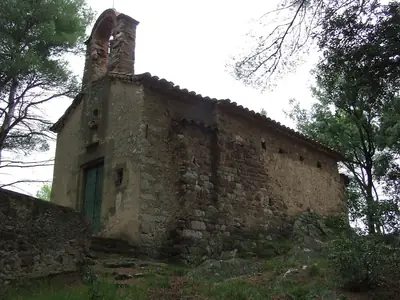
Also known as Sant Bartomeu de les Vespes, this small Romanesque chapel stands on the south-western slope of Puiggraciós, near the Serrat de l’Ametlla development. Although it belongs to Bigues i Riells, access is from l’Ametlla del Vallès.
The site of Mont-ras was recorded as early as 932, while the church was mentioned in 1156 in the consecration document of Sant Pere de Bigues. It served as a parish within the barony of Montbui during the late Middle Ages, but by 1404 only three houses depended on it. It later became a subsidiary church and eventually a simple chapel.
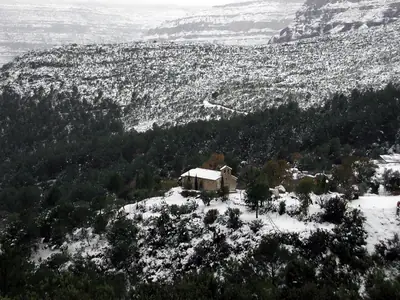
Its structure is straightforward: a rectangular single nave divided by transverse arches into four sections. A later renovation created a new entrance in the former presbytery and added a bell gable and round window to the eastern façade.
Sant Ferran de Can Mas de Dalt
Sant Ferran de Can Mas de Dalt is a small chapel belonging to the Can Mas de Dalt farmhouse in Bigues. Its modest building has a single nave, a low roof and no separate apse. It stands beside the eastern side of the farmhouse.
Sant Jordi de Can Ribes
This private chapel belongs to the Can Ribes farmhouse and forms part of its main building. Rather than standing separately, Sant Jordi is integrated into the larger rural residence, creating a single architectural ensemble in the former village area of Bigues.
Sant Pere de Bigues
Sant Pere de Bigues stands at the Turó, the highest point of the old scattered village of Bigues. Its history reaches back to the eleventh century: the church was documented in 1054 and consecrated in 1156 by Ramon de Torroja, Bishop of Barcelona.
For centuries, it served as the centre of a parish that included Sant Bartomeu de Mont-ras, Sant Mateu de Montbui and Sant Vicenç de Riells. Only part of the original Romanesque church survives, including the western façade and southern wall, which now lie within the old cemetery. The former entrance and other early elements can still be seen.
The building was enlarged between the sixteenth and eighteenth centuries, and its bell tower was added in the eighteenth century. Inside, an important Baroque altarpiece has been preserved.
Sant Vicenç de Riells
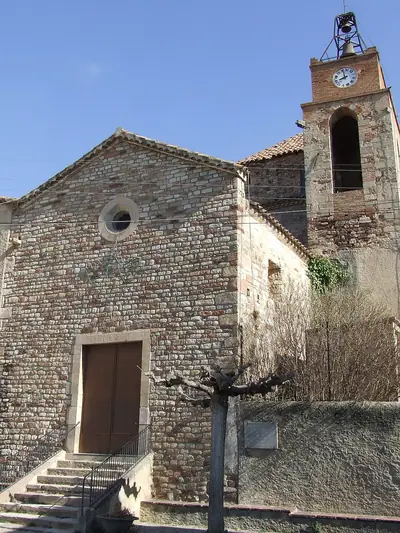
In the small village of Riells del Fai, Sant Vicenç de Riells occupies a central position at the end of the BV-1483 road. This Romanesque-origin church is the village’s parish church and belongs to the municipality of Bigues i Riells del Fai, in the Vallès Oriental.
Santa Maria de la Creu
Santa Maria de la Creu is a modest Romanesque chapel near the boundary with l’Ametlla del Vallès. It was first mentioned in documents from the thirteenth century and was also known as Santa Maria de la Santa Creu, Santa Maria del Bosc and la Santa Creu del Bosc.
The chapel never grew beyond a small religious building and was already recorded as being in ruins by the sixteenth century. There is also an uncertain possibility that a small religious community lived at the site during the fourteenth century.
Santa Maria del Villar
Santa Maria del Villar stands beside the historic Villar farmhouse. The boundary between Bigues i Riells and Sant Feliu de Codines passes between the farmhouse and the chapel, giving the site an unusual connection to both municipalities.
Villar was documented as early as 1007, while the church was recorded from 1195. The small building has a rectangular nave and a semicircular east-facing apse, following a typical Romanesque arrangement. The apse retains its original quarter-sphere Romanesque vault, while the nave has a later Baroque roof. Later work also extended the nave westward and rebuilt the northern and western façades.
Explore La Pineda with Neywo
Neywo offers a free audio guide for La Pineda with 12 narrated places. The stories are available in 11 languages and play as you reach each place, at your own pace. There is no group and no schedule: the app simply tells the story when you arrive, making it a practical La Pineda self-guided walking tour for discovering the area independently.
Download Neywo and explore La Pineda with an audio guide that lets you stop, listen and continue whenever you choose.
Places with an audio guide in La Pineda
8 places in La Pineda with a Neywo audio guide. Each one starts telling its story as you reach it.

Walk La Pineda with Neywo
Neywo turns La Pineda into a self-guided audio tour. Stories arrive as you reach the place they belong to, and the route reshapes when you wander off it.

