Visiting Canterbury, United Kingdom: Top Sights on Foot
Things to Do in Canterbury: What to See in England’s Historic Cathedral City
Canterbury is a historic cathedral city in Kent, England, where Roman remains, medieval gates, religious landmarks and museums tell the story of one of the oldest cities in England. It is best known for Canterbury Cathedral and its connection with pilgrimage, but the city offers much more to explore on foot. Neywo’s free audio guide for Canterbury brings 87 narrated places to life as you walk.
What to See in Canterbury
Canterbury Cathedral
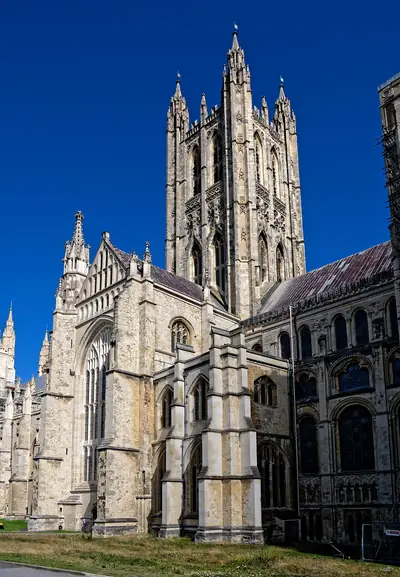
Canterbury Cathedral is the city’s defining landmark and one of England’s oldest Christian buildings. Founded in 597, it remains the cathedral of the Archbishop of Canterbury and forms part of a World Heritage Site.
Its history is closely connected with Thomas Becket, the archbishop murdered here in 1170. Becket’s shrine attracted pilgrims, helping make Canterbury a major destination on the medieval pilgrimage route later immortalised by Geoffrey Chaucer in The Canterbury Tales.
The building reflects centuries of change. It was reconstructed between 1070 and 1077, while the east end was rebuilt and extended in the Gothic style after a major fire in 1174. The cathedral therefore brings Romanesque and Gothic architecture together in a particularly concentrated setting.
Westgate
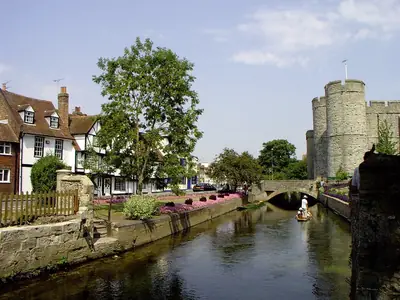
Westgate is one of Canterbury’s most recognisable landmarks. Built around 1379 from Kentish ragstone, the medieval gatehouse rises about 18 metres above the road and is the largest surviving city gate in England.
It is also the last remaining survivor of Canterbury’s seven medieval gates. The road passes between its two drum towers, while the building itself contains the West Gate Towers Museum and historically themed escape rooms. Westgate is both a scheduled monument and a Grade I listed building.
Canterbury Roman Museum
The Canterbury Roman Museum offers a look beneath the modern city, with the remains of Roman Canterbury preserved below the building. Its Roman courtyard house contains a remarkable pavement that has been open to the public since its discovery after bombing during the Second World War.
The museum also displays excavated objects and reconstructions of the Roman town. Its collection includes the Canterbury Treasure, an important late Roman silver hoard.
Christchurch Gateway
Also known as Christchurch Gate, this Grade I listed building is a notable part of Canterbury’s historic centre. Its position helps connect the city’s medieval streets with the cathedral precinct.
St Augustine’s Abbey
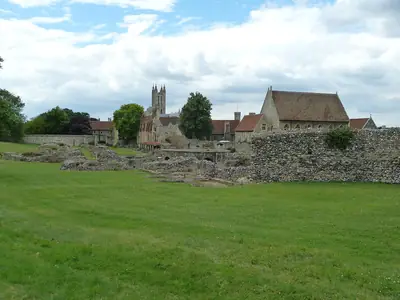
The ruins of St Augustine’s Abbey preserve the site of one of Canterbury’s most important early religious foundations. Augustine of Canterbury founded the monastery in 598, originally under the name Monastery of Saints Peter and Paul.
The abbey became a Benedictine monastery and remained in use until 1538, when it was dissolved during the English Reformation. Its buildings were gradually dismantled afterwards, with the process continuing until 1848. Today, the ruins offer a tangible connection with the beginnings of Canterbury’s Christian history.
St Martin’s Church
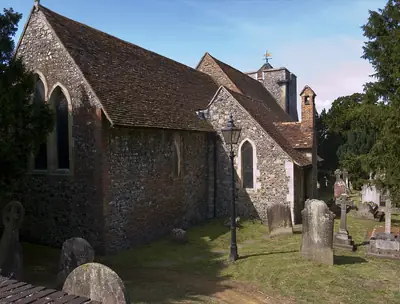
St Martin’s Church is known as the oldest existing church in the English-speaking world and the oldest English church building still in ecclesiastical use. It is a Church of England parish church dedicated to Saint Martin of Tours, with services continuing each week.
Its fabric combines Roman, medieval, Anglo-Saxon and English Gothic elements. Along with Canterbury Cathedral and St Augustine’s Abbey, St Martin’s forms part of the Canterbury World Heritage Site.
The Beaney House of Art and Knowledge
The Beaney House of Art and Knowledge brings together Canterbury’s central museum, library and art gallery. It is a place to explore the city’s cultural life alongside its historic landmarks.
The Museum of Canterbury site
The former Museum of Canterbury occupied the twelfth-century Poor Priests’ Hospital beside the River Stour on Stour Street. Although the museum closed in 2018, the site has since reopened as The Marlowe Kit, combining an escape room, an exhibition and a creative space.
The former museum’s collections explored Canterbury’s history and included the Canterbury Cross. Its location in a medieval building remains part of the city’s historic character.
Canterbury Castle
Canterbury Castle is now a ruin, but it began as one of three original royal castles in Kent, alongside Rochester Castle and Dover Castle. All three were built soon after the Battle of Hastings along the main Roman road between Dover and London.
The remaining walls are the clearest reminder of the castle’s role in the chain of royal strongholds established after the Norman conquest.
Kent Museum of Freemasonry
The Kent Museum of Freemasonry explores the Freemasonry heritage of Kent. It is a local history and masonic museum in Canterbury, administered by the Freemasonry Province of East Kent.
The wider story of Canterbury and Kent
Canterbury became an important Christian centre after Augustine converted the city and King Æthelberht of Kent in 597. It soon became the seat of the Archbishop of Canterbury, and its religious importance helped turn the city into a major medieval pilgrimage destination.
The surrounding county takes its name from the Kingdom of Kent, one of the seven traditional Anglo-Saxon kingdoms. Established in the fifth or sixth century, the kingdom was eventually absorbed into Wessex by the middle of the ninth century and became part of the unified Kingdom of England in the tenth century.
For more destinations in the region, explore England. Canterbury is also a useful starting point for discovering other historic cities across the United Kingdom, including Cambridge, Bury St Edmunds and Chichester.
Explore Canterbury with Neywo
Neywo turns a visit into a Canterbury self-guided walking tour, with stories that play as you reach each place. The app offers 3 walking tours, 1 bus route and 1 bike route:
- Pilgrims’ Canterbury: from Westgate to Becket’s cathedral — 1.76 km, 95 minutes and 11 narrated stops.
- Saints, abbey ruins and a Norman castle — 2.45 km, 95 minutes and 6 narrated stops.
- The Pilgrims’ Way in: from Harbledown to Westgate — 2.11 km, 50 minutes and 4 narrated stops.
- Bus route from St Dunstan’s to the University — 6.6 km, 28 minutes and 6 narrated stops.
- Bike route from Chartham to Canterbury Castle — 5.1 km, 26 minutes and 2 narrated stops.
The app tells the story of each place as you reach it, at your own pace, with no group and no schedule. With 87 narrated places and narration available in 11 languages, Neywo is a free way to explore Canterbury beyond the main sights.
Places with an audio guide in Canterbury
8 places in Canterbury with a Neywo audio guide. Each one starts telling its story as you reach it.
Self-guided tours in Canterbury
5 tours in Canterbury, free in the Neywo app. Each stop tells its story as you reach it.
- Bike ride
Great Stour Way: from Chartham to Canterbury Castle
Ride the traffic-free Great Stour Way (National Cycle Route 18) along the river Stour from the village church of Chartham into Canterbury, about 5 km on a surfaced shared path through meadows to the Norman castle.
Church of St Mary, Chartham · Canterbury Castle
Open this tour: Great Stour Way: from Chartham to Canterbury Castle - Bus ride
Bus 6: round the walls from St Dunstan's to the University
Stagecoach's regular city bus 6 loops through Canterbury from St Dunstan's past the Norman castle and the Dane John Mound, down Stour Street and out through Westgate to the University of Kent. A cheap way to see the walled city's edge.
St. Dunstan's, Canterbury · Canterbury Castle · Dane John Mound Pinnacle · Museum of Canterbury · Westgate · University of Kent
Open this tour: Bus 6: round the walls from St Dunstan's to the University - Walk
Pilgrims' Canterbury: from Westgate to Becket's cathedral
Follow the pilgrim road into the walled city. Pass England's largest surviving city gate, the Guildhall that was once a church, the theatre named after Christopher Marlowe, a rare Egyptian Revival synagogue and the floor of a Roman house, then enter the gate to the cathedral where Thomas Becket was murdered in 1170.
Westgate · Church of the Holy Cross · Kent Museum of Freemasonry · Marlowe Theatre · The Beaney · Old Synagogue …
Open this tour: Pilgrims' Canterbury: from Westgate to Becket's cathedral - Walk
Saints, abbey ruins and a Norman castle
Walk back to the beginning of English Christianity. Start at the oldest church still in use in the English-speaking world, see the ruins of the abbey Augustine founded in 598, then climb the Dane John Mound to the stump of a Norman castle and an Anglo-Saxon church.
St Martin's Church · St Augustine's Abbey · Museum of Canterbury · Dane John Mound Pinnacle · Canterbury Castle · Church of St Mildred
Open this tour: Saints, abbey ruins and a Norman castle - Walk
The Pilgrims' Way in: from Harbledown to Westgate
Walk the last stretch of the road the medieval pilgrims took from London. Start at the leper hospital church and the Norman church on Harbledown hill, where they got their first view of the cathedral, then pass St Dunstan's, where Thomas More's head was buried, and enter the city through Westgate.
The Old Leper Church of St Nicholas · St Michael and All Angels Church · St. Dunstan's, Canterbury · Westgate
Open this tour: The Pilgrims' Way in: from Harbledown to Westgate
Walk Canterbury with Neywo
Neywo turns Canterbury into a self-guided audio tour. Stories arrive as you reach the place they belong to, and the route reshapes when you wander off it.

