Visiting West Palm Beach, United States: Top Sights on Foot
Things to Do in West Palm Beach: Museums, History and Culture
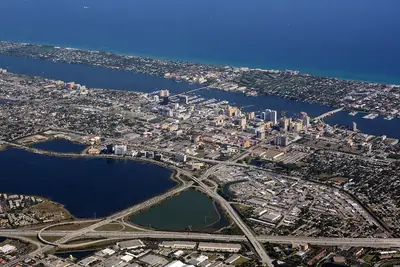
Looking for things to do in West Palm Beach? The city combines Palm Beach County history, major museums, historic churches and buildings, public art, and wildlife attractions in a distinctly South Florida setting. It is also a useful starting point for discovering Florida and the wider United States. Neywo has a free audio guide for West Palm Beach with 25 narrated places, available in 11 languages.
What to See in West Palm Beach
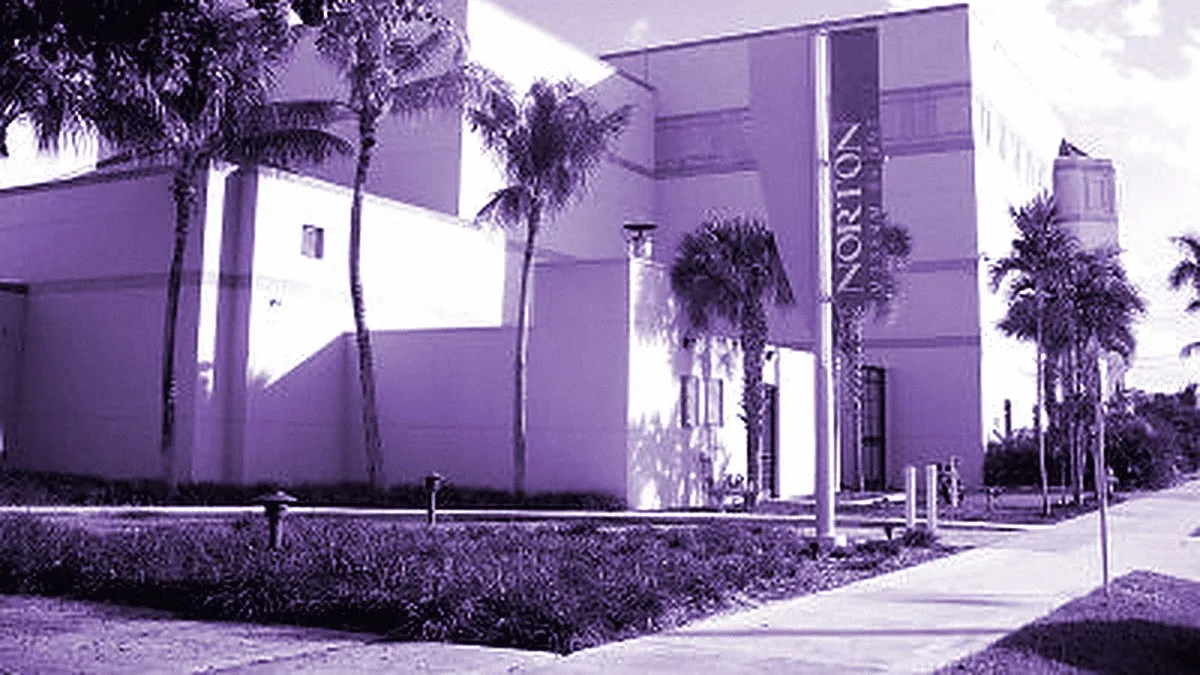
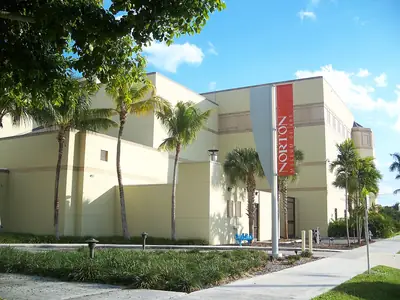
Norton Museum of Art
The Norton Museum of Art is the largest art museum in Florida’s Palm Beaches and holds more than 8,200 works. Its collection focuses on European, American, and Chinese art, with contemporary pieces and photography also represented.
Founded in 1941, the museum was reshaped by a major expansion in 2019. The redesigned campus added galleries, a sculpture garden, and an entrance pavilion by architect Lord Norman Foster. Inside, a soaring glass atrium anchors the lobby, while a preserved banyan tree stands just outside. The permanent collection galleries begin beside the atrium, with American and European paintings arranged chronologically.
Cox Science Center and Aquarium
In Dreher Park, beside the Palm Beach Zoo, the Cox Science Center and Aquarium offers more than 50 hands-on exhibits, a planetarium, a rotating exhibition hall, and a miniature golf course. The center has encouraged curiosity since 1959.
The aquariums are a highlight. The Aquariums of the Atlantic showcase native Florida species, while Shipwreck Cove is a 3,500-gallon tank containing moray eels, lobsters, and barracudas around a sunken scene. A six-foot coral reef tank allows visitors to step inside an underwater environment. Other exhibits explore the Florida Everglades, including alligators and turtles.
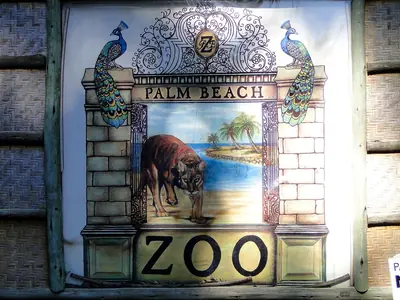
Palm Beach Zoo
Also in Dreher Park, the Palm Beach Zoo covers 23 acres and is home to more than 700 animals from around the world, including endangered species. Its shaded paths lead through habitats for big cats, primates, birds, reptiles, and other wildlife.
The experience also includes a carousel, a small train, and an interactive water play fountain. The daily Wings Over Water bird show adds another way to see the animals in action. The zoo is a nonprofit member of both the Association of Zoos and Aquariums and the World Association of Zoos and Aquariums.
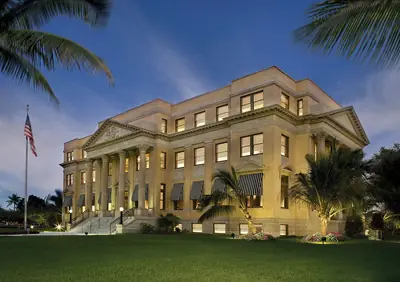
Richard and Pat Johnson Palm Beach County History Museum
The Richard and Pat Johnson Palm Beach County History Museum occupies a restored 1916 courthouse on North Dixie Highway. The museum, which opened in 2008, presents more than 12,000 years of Palm Beach County and Florida history.
The permanent People and Places galleries trace the region from its earliest Native American settlements to the present-day community. On the third floor, the historic Courtroom Gallery hosts rotating special exhibitions, including an annual Grand Exhibition. The collection includes Native American artifacts, pioneer memorabilia, photographs, documents, and modern objects.
Mandel Public Library of West Palm Beach
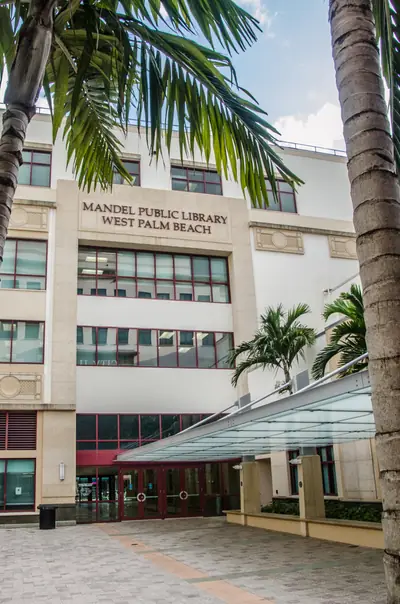
The Mandel Public Library stands at West Palm Beach City Center, near Clematis Street and the waterfront. Its history began in 1895, when Reverend Asbury Caldwell created a Free Reading Room in the Union Congregational Church. It was the oldest public library in Palm Beach County.
The current building opened in April 2009 and is two and a half times larger than its predecessor. Together with City Hall and a photography center, it forms part of the civic heart of downtown, connected by glass façades and open walkways.
Guaranty Building and American National Bank Building
West Palm Beach’s early commercial ambitions remain visible in its historic downtown architecture. The seven-story Guaranty Building dates from 1922 and was designed by Henry Stephen Harvey of Harvey and Clarke. It was one of the largest structures in the young city and was later added to the National Register of Historic Places in 1998.
The American National Bank Building, also from 1922, was the first West Palm Beach project by Harvey and Clarke. Its three-story Beaux Arts design originally housed American National Bank. After the bank closed in 1931, the building was used by federal offices and later became home to Morrison’s Cafeteria. It was listed on the National Register of Historic Places in 1997.
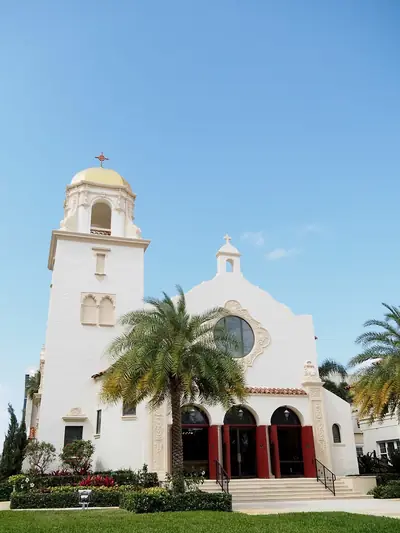
Holy Trinity Episcopal Church
Holy Trinity Episcopal Church stands on Trinity Place beside the Intracoastal Waterway. The congregation began in 1896, when around 60 Episcopalians met in the Free Reading Room. Henry Flagler and Mrs. Marvin donated land for the first church.
The present building was completed in 1924 in a blend of Spanish Colonial and Mission Revival styles, designed by L. Phillips Clarke. Its interior includes hand-forged chandeliers made by Clarke’s father, along with marble work and mosaics crafted by Italian artisans.
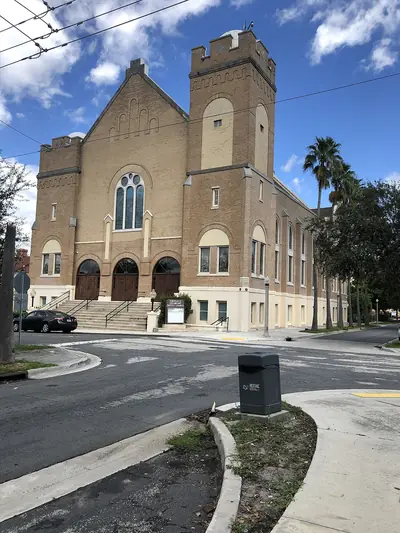
Tabernacle Baptist Church
Tabernacle Baptist Church began in 1893 as Mount Olive Baptist Church. From 1894 to 1896, it also served as the first public school for African American children in Palm Beach County.
The present building was constructed in 1925 in a neo-Romanesque Revival style. Twin towers and illuminated domes make it a distinctive landmark, and its architectural importance was recognized with a place on the National Register of Historic Places in 1992. The stained-glass windows were preserved behind hurricane-proof glass after the building suffered serious damage during Hurricanes Frances and Wilma.
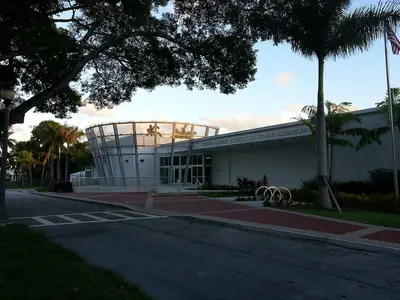
West Palm Beach Armory Art Center
The West Palm Beach Armory Art Center occupies a former National Guard armory built in the 1930s. During and after World War Two, it was used as a training center; later, it became a neighborhood venue for proms, parties, and concerts. Chubby Checker performed there before the building was abandoned in the 1980s.
A restoration led by Robert and Mary Montgomery in 1987 gave the armory its current artistic role. Its arched ceiling recalls an airplane hangar, while Art Deco stars decorate the entrance canopy. Montgomery Hall hosts rotating exhibitions, and the Young Artist Studio Facility is designed around abundant natural light.
Woodlawn Cemetery
Woodlawn Cemetery began as a 17-acre pineapple grove in 1905. Henry Flagler transformed it into a landscaped cemetery inspired by New York’s Woodlawn. The grounds now include the main cemetery, a dedicated Jewish Cemetery, and Woodlawn Cemetery North, with more than 10,000 burials recorded through 1994.
Towering palms, live oaks, shaded paths, and the original iron gate create a reflective setting. The grounds also contain a Confederate Memorial, marking one chapter in the region’s history.
Ann Norton Sculpture Gardens
The Ann Norton Sculpture Gardens began in 1977 as a place where Ann Weaver Norton could present her work in a tropical landscape. The two-acre property includes her former residence and studio, as well as more than 100 sculptures in bronze, stone, and wood.
The house was built in 1925 in the Mediterranean Revival style. It was later redesigned for Ralph Norton by Marion Sims Wyeth in the Modern Movement and Monterey styles. The property forms part of the El Cid Historic District.
Manatee Lagoon
Just north of West Palm Beach, Manatee Lagoon is a sanctuary where manatees gather in warm water discharged from a power plant. The outdoor observation deck is especially useful in winter, when the animals often gather close to the viewing docks.
The Discovery Center provides hands-on exhibits about manatees and includes a live webcam of their underwater habitat. Adult manatees can weigh between 1,500 and 2,000 pounds, yet they move with surprising ease through the water.
Explore West Palm Beach with Neywo
If you are looking for a West Palm Beach self-guided walking tour, Neywo lets you explore without joining a group or following a fixed schedule. The app offers two walking tours, one bus route, and one bike route.
The two walks are:
- Flagler’s Boomtown: Downtown West Palm Beach in the 1920s — 4.77 km, 111 minutes, and 10 narrated stops.
- Art, Music and Flagler’s Cemetery: West Palm Beach’s Cultural Side — 4.75 km, 97 minutes, and 7 narrated stops.
There is also Palm Tran 41: Downtown West Palm Beach to Palm Beach Island, an 8 km bus route lasting 34 minutes with 5 stops, and Intracoastal Ride: Fishing Club to the Ann Norton Sculpture Gardens, a 3.4 km bike route lasting 17 minutes with 3 stops.
Download Neywo to explore West Palm Beach at your own pace. The app tells the story of each place as you reach it, with no group and no schedule.
Places with an audio guide in West Palm Beach
8 places in West Palm Beach with a Neywo audio guide. Each one starts telling its story as you reach it.
Self-guided tours in West Palm Beach
4 tours in West Palm Beach, free in the Neywo app. Each stop tells its story as you reach it.
- Bike ride
Intracoastal Ride: Fishing Club to the Ann Norton Sculpture Gardens
A ride on marked cycle lanes from the Fishing Club on the Intracoastal Waterway past the Royal Park Bridge to the Ann Norton Sculpture Gardens, where over a hundred sculptures stand among 300 species of palms.
West Palm Beach Fishing Club · Royal Park Bridge · Norton House
Open this tour: Intracoastal Ride: Fishing Club to the Ann Norton Sculpture Gardens - Bus ride
Palm Tran 41: Downtown West Palm Beach to Palm Beach Island
Ride the local Route 41 from the Intermodal Center along Dixie Highway and across Royal Palm Way to the island of Palm Beach. It passes the old Clematis Street buildings, the library, the 1934 fishing club and the Royal Park Bridge, for the price of a bus fare.
Royal Park Bridge · Palm Beach Mercantile Company · Mandel Public Library of West Palm Beach · American National Bank Building · West Palm Beach Fishing Club
Open this tour: Palm Tran 41: Downtown West Palm Beach to Palm Beach Island - Walk
Flagler's Boomtown: Downtown West Palm Beach in the 1920s
Trace how a railroad magnate's workers' camp became a city. Start at a church that taught Black children in 1894, then walk the waterfront past the Depression-era fishing club, a restored 1916 courthouse and the Clematis Street banks and department store of the 1920s land boom. End on the Royal Park Bridge, the gateway to Palm Beach.
Tabernacle Baptist Church · West Palm Beach Fishing Club · Richard and Pat Johnson Palm Beach County History Museum · Mandel Public Library of West Palm Beach · Palm Beach Mercantile Company · Guaranty Building …
Open this tour: Flagler's Boomtown: Downtown West Palm Beach in the 1920s - Walk
Art, Music and Flagler's Cemetery: West Palm Beach's Cultural Side
From the Mediterranean plazas of The Square to the Kravis Center's three stages, this walk heads south past Flagler's pineapple-grove cemetery to the Norton Museum of Art, the Armory Art Center in a 1930s National Guard hall and the monumental sculptures of Ann Norton's tropical garden.
The Square · Palm Beach County Convention Center · Raymond F. Kravis Center for the Performing Arts · Woodlawn Cemetery · Norton Museum of Art · West Palm Beach Armory Art Center …
Open this tour: Art, Music and Flagler's Cemetery: West Palm Beach's Cultural Side
Walk West Palm Beach with Neywo
Neywo turns West Palm Beach into a self-guided audio tour. Stories arrive as you reach the place they belong to, and the route reshapes when you wander off it.

