Syracuse, United States: Self-Guided Walking Tour
Things to Do in Syracuse, New York
Looking for things to do in Syracuse? This Central New York city brings together canal history, historic churches, American art, science, education, and stories of social change. Its landmarks are spread across downtown, Armory Square, and University Hill, making Syracuse especially rewarding to explore on foot. Neywo has a free audio guide for Syracuse with 63 narrated places.
What to See in Syracuse
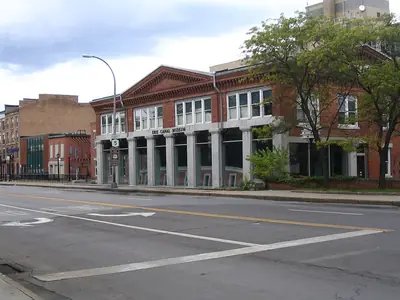
Erie Canal Museum
The Erie Canal Museum occupies the Syracuse Weighlock Building, constructed in 1850. From 1850 to 1883, the building housed a weighlock: an elaborate scale used to weigh boats travelling along the Erie Canal and calculate their tolls. The museum, founded in 1962, explains how the canal transformed New York and continues to connect that history with the waterway’s later forms.
Its permanent exhibition, Erie Canal Made New York, combines original artefacts with interactive displays. The Weighlock Building was added to the National Register of Historic Places in 1971.
Clinton Square and downtown Syracuse
Clinton Square is one of the stops on Syracuse’s canal-history route. Together with nearby Hanover Square, the area helps reveal the city’s development as a canal town and urban centre. Other downtown landmarks include Syracuse City Hall, the State Tower Building, and the Niagara Mohawk Building.
For a compact introduction to the city, these places work well as part of a self-guided walk rather than as isolated sights.
Milton J. Rubenstein Museum of Science and Technology
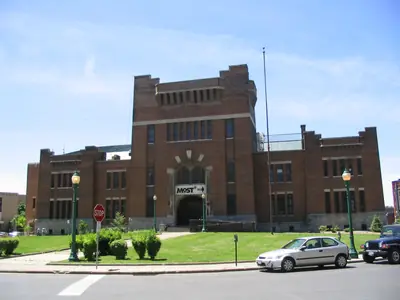
The Milton J. Rubenstein Museum of Science and Technology, usually called the MOST, is housed in the former Syracuse Armory in Armory Square. Its 35,000 square feet of permanent and travelling exhibitions cover subjects ranging from dinosaurs and fossils to electricity, medicine, engineering, minerals, and pollinators.
Highlights include the Dino Zone, Earth Science Discovery Cave, National Grid Energy: Powering Our Future, Technotown Sculpture, Innovation Station, and the Gem & Mineral Gallery. The museum also includes a Science Shop and programmes and events.
Everson Museum of Art
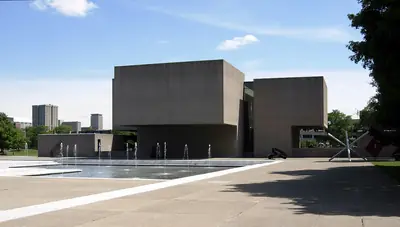
The Everson Museum of Art is dedicated entirely to American art. Founded in 1897 as the Syracuse Museum of Fine Arts, it later developed a specific focus on American works. Its current building opened in 1968 and was designed by I. M. Pei. The geometric concrete structure, with its cantilevered square galleries, is an important part of the visit.
The collection contains approximately 11,000 objects, including paintings, sculptures, ceramics, and video art. Ceramics are a particular strength, with more than 100 works by Adelaide Alsop Robineau, including the carved Scarab Vase.
Saint Paul’s Episcopal Cathedral
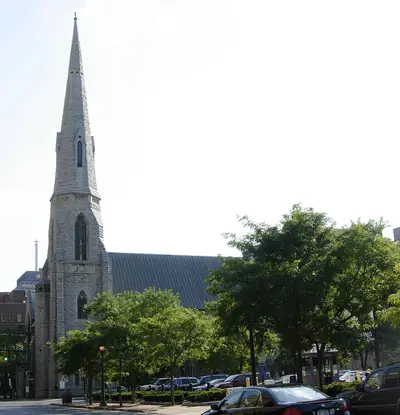
Saint Paul’s Episcopal Cathedral has been part of downtown Syracuse’s story since the growth brought by the Erie Canal in the 1820s. The present Gothic Revival building was completed in 1884 and designed by Henry Dudley. Its locally quarried limestone gives the church a solid, distinctive appearance.
The cathedral’s spire rises 225 feet and was added in 1907. Saint Paul’s is the seat of the Diocese of Central New York and remains one of the defining religious landmarks on the Syracuse skyline.
Cathedral of the Immaculate Conception
The Cathedral of the Immaculate Conception is the mother church of the Roman Catholic Diocese of Syracuse. The building began as St. Mary’s Church in 1874, designed by Lawrence J. O’Connor. After the Diocese of Syracuse was established in 1887, the church was expanded under Bishop Patrick Ludden and redesigned by Archimedes Russell.
The expanded cathedral was consecrated in 1910. Its history includes a brick given by Pope Leo XIII, taken from the Holy Door at St. Peter’s Basilica in Rome. Bishop Ludden and other diocesan clergy are buried in the crypt.
People’s African Methodist Episcopal Zion Church
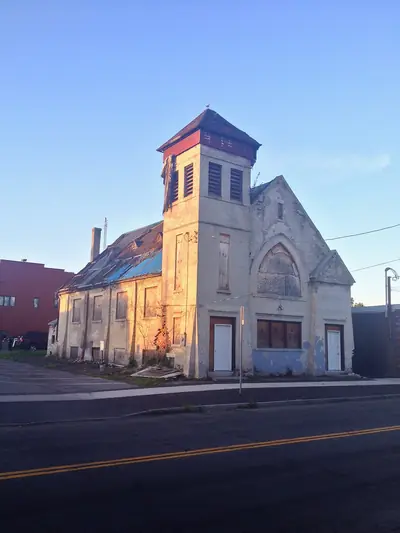
The People’s African Methodist Episcopal Zion Church represents an important part of Syracuse’s African American history. The congregation was incorporated in 1837 and remained at this location for nearly 140 years, until 1976.
The modest Gothic Revival building is made of stuccoed brick on a cut-limestone foundation. Its projecting front gable and three-story bell tower give the small church a strong architectural presence.
First English Lutheran Church
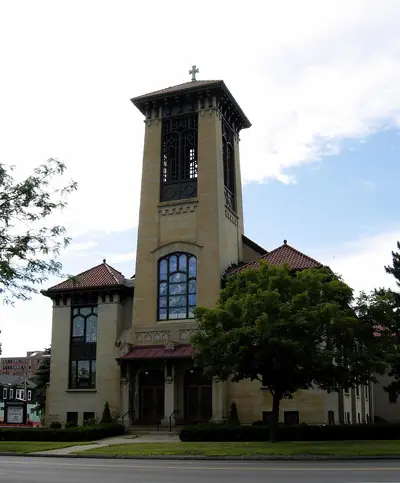
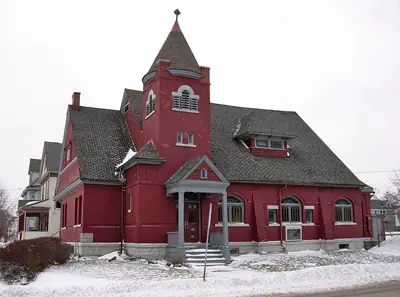
First English Lutheran Church has been part of the Syracuse community since 1879, although the current building was completed in 1911. Designed by Archimedes Russell and Melvin King, it combines Mission-style architecture with Arts and Crafts details.
The bell tower, pyramidal red-tile roofs, colourful stained-glass windows, and largely unchanged interior are central to its character. The church also contains an M. P. Moeller organ installed in 1924. It was added to the National Register of Historic Places in 1998.
Grace Episcopal Church
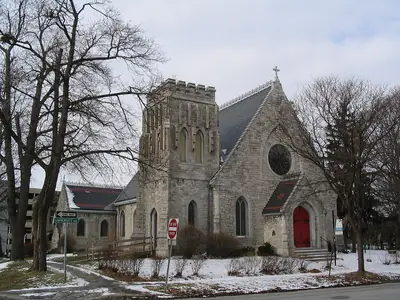
Grace Episcopal Church has stood near Syracuse University since 1876. Designed by Horatio Nelson White, the Gothic Revival building is known for its stone construction and pointed arches. It was added to the National Register of Historic Places in 1973.
The church is also the national shrine to Saint David Pendleton Oakerhater, a Cheyenne warrior and former prisoner who was baptized and ordained there in the nineteenth century. He was elevated to sainthood in 1992 as the first Native American saint in the Episcopal Church. Stained-glass windows installed in 2004 honour his legacy.
Hendricks Chapel and Syracuse University
Syracuse University was founded in 1870 and has a traditional relationship with the United Methodist Church. Its academic strengths include architecture, business, information sciences, communication sciences, creative writing, and public affairs.
On the Shaw Quadrangle, Hendricks Chapel serves as a multi-faith centre for the university community. The octagonal, domed brick building was designed in the Georgian Colonial style and includes a classical portico. More than ten chaplaincies use the chapel, whose interior avoids specific religious symbols to create a shared space.
Onondaga Historical Association Museum and Research Center
Founded in 1862, the Onondaga Historical Association preserves and presents the history of Central New York. Its collections cover the people, events, industries, and cultural heritage of the area, including transportation, sports, and architectural history.
The exhibition Freedom Bound explores Syracuse’s role in the Underground Railroad. Onondaga County: The Heart of New York follows the region’s history from Native American life and the Erie Canal to the industries that shaped it.
ArtRage Gallery
ArtRage Gallery has used art to encourage discussion about social justice, the environment, and cultural change since 2008. Founded by Dik Cool and Rose Viviano, it grew from the work of the Syracuse Cultural Workers.
Exhibitions are paired with films, lectures, workshops, and community partnerships. Its opening exhibition, Combat Paper, established the gallery’s focus on art as a starting point for dialogue and action.
Oncenter War Memorial Arena
The Oncenter War Memorial Arena was built between 1949 and 1951 as a memorial to those who served in World War I, World War II, and the Aroostook War. Its thin-shell concrete roof was an early and sophisticated example of single-span construction.
The building was listed on the National Register of Historic Places in 1988 and renovated in 1994 and 2018. It is part of the wider Oncenter Complex and hosts events in Syracuse.
Explore Syracuse with a Self-Guided Audio Guide
Neywo lets you explore Syracuse independently, with each story playing as you reach the place it describes. There is no group and no schedule: walk at your own pace and let the app introduce the city’s landmarks as you arrive. Narration is available in 11 languages.
The Syracuse audio guide includes:
- 3 walking tours
- Canal Town Syracuse: From Movie Palace to the Weighlock — 1.66 km, 67 minutes, 9 narrated stops
- Cathedrals, Abolitionists and I. M. Pei — 2.08 km, 85 minutes, 10 narrated stops
- University Hill: Stone Churches, Sol LeWitt and a Hilltop Campus — 3.48 km, 92 minutes, 8 narrated stops
- 1 bus route — 7.4 km, 32 minutes, 7 narrated stops
- 1 bike route — 1.5 km, 8 minutes, 4 narrated stops
Download Neywo to explore Syracuse’s churches, museums, university landmarks, and canal heritage with a free audio guide. If you are travelling elsewhere in the state, continue with the guide to New York, or compare Syracuse with Rochester, Ithaca, and Buffalo, New York.
Places with an audio guide in Syracuse
8 places in Syracuse with a Neywo audio guide. Each one starts telling its story as you reach it.
Self-guided tours in Syracuse
5 tours in Syracuse, free in the Neywo app. Each stop tells its story as you reach it.
- Bike ride
Downtown Syracuse by Bike: Armory Square to the Cathedral
A flat downtown ride on the city's bike lanes past the old Armory, the Art Deco Niagara Mohawk tower and the canal-era Clinton Square, ending at Saint Paul's Cathedral.
Milton J. Rubenstein Museum of Science and Technology · Niagara Mohawk Building · Clinton Square · Saint Paul's Episcopal Cathedral
Open this tour: Downtown Syracuse by Bike: Armory Square to the Cathedral - Bus ride
Centro 23: Downtown Syracuse to Eastwood along James Street
A regular Centro city bus from the east side of Syracuse into the centre. It passes the Palace Theatre in Eastwood and a run of historic churches on the way to Clinton Square and the I. M. Pei-designed Everson Museum. Cheap and local.
Palace Theatre · St. Peter's Italian Church · First English Lutheran Church · Church of St. John the Evangelist · Clinton Square · Everson Museum of Art …
Open this tour: Centro 23: Downtown Syracuse to Eastwood along James Street - Walk
Canal Town Syracuse: From Movie Palace to the Weighlock
Syracuse grew rich because the Erie Canal once ran straight through its centre. Follow that story from a 1920s movie palace to Clinton Square, the old canal basin, then to the weighlock that taxed the boats and the skyscraper and civic towers built on the proceeds.
Milton J. Rubenstein Museum of Science and Technology · Jefferson Clinton Hotel · Landmark Theatre · Niagara Mohawk Building · Clinton Square · Erie Canal Museum …
Open this tour: Canal Town Syracuse: From Movie Palace to the Weighlock - Walk
Cathedrals, Abolitionists and I. M. Pei
A stroll through downtown's spiritual and civic heart: churches and two cathedrals, the history museum of Onondaga County, the church where Frederick Douglass spoke, a Beaux-Arts courthouse and a concrete museum designed by I. M. Pei.
First English Lutheran Church · Church of the Saviour · Church of St. John the Evangelist · Saint Paul's Episcopal Cathedral · Onondaga Historical Association Museum & Research Center · Cathedral of the Immaculate Conception …
Open this tour: Cathedrals, Abolitionists and I. M. Pei - Walk
University Hill: Stone Churches, Sol LeWitt and a Hilltop Campus
Climb from the Gothic Revival parish church and the nation's ninth-oldest Reform congregation up to Syracuse University. Along the way you pass a Sol LeWitt maze of concrete walls, the multi-faith chapel at the campus heart and the university art museum.
Grace Episcopal Church · Temple Society of Concord · Six Curved Walls · Syracuse University Gateway · Hendricks Chapel · Syracuse University Art Museum …
Open this tour: University Hill: Stone Churches, Sol LeWitt and a Hilltop Campus
Walk Syracuse with Neywo
Neywo turns Syracuse into a self-guided audio tour. Stories arrive as you reach the place they belong to, and the route reshapes when you wander off it.