Visiting Rochester, United States: Top Sights on Foot
Things to Do in Rochester, New York: What to See and Explore
The best things to do in Rochester include exploring historic bridges, museums, theatres, churches, and landmarks connected with photography, industry, science, and social change. Built along the Genesee River in New York, Rochester combines a rich industrial past with an unusually strong cultural scene. Neywo offers a free audio guide for Rochester with 68 narrated places, so you can discover the city while walking at your own pace.
What to See in Rochester
Main Street Bridge
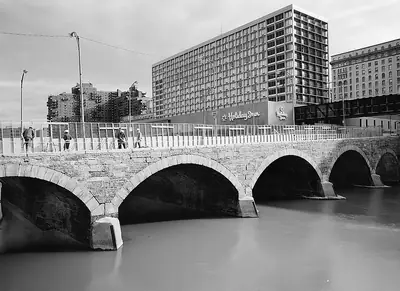
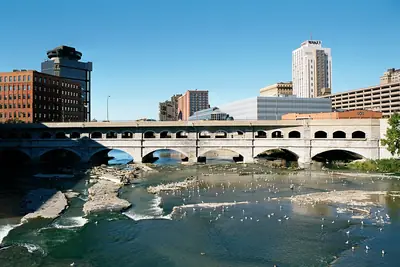
The Main Street Bridge is a historic stone crossing over the Genesee River, constructed in 1857. Also known as East Main Street, it is formed by five segmental stone arches. Their relatively modest rises give the bridge a low, solid profile characteristic of nineteenth-century construction.
Geva Theatre Center
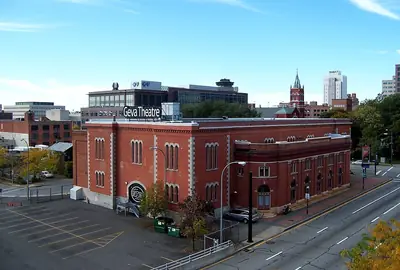
Near High Falls, the Geva Theatre Center occupies a historic building constructed in 1868. Before becoming the home of this regional, not-for-profit professional theatre company, the building served as a military armory and convention hall. It hosted figures including Theodore Roosevelt, Franklin D. Roosevelt, Gustav Mahler, and Anna Pavlova.
Geva began in 1972 and later renovated the former Convention Hall, reopening it as a theatre in 1985. Today, its two main performance spaces are the 522-seat Elaine P. Wilson Stage and the 180-seat Fielding Stage. Its programme includes classic plays, new works, and musicals, alongside discussions, staged readings, and community outreach.
Charlotte-Genesee Lighthouse
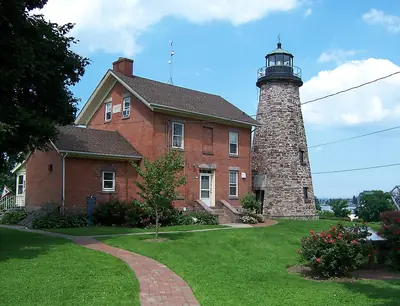
At the mouth of the Genesee River on Lake Ontario, the Charlotte-Genesee Lighthouse is an octagonal stone tower built in 1822. The tower rises 40 feet and originally used ten whale-oil Argand lamps. In 1853, these were replaced by a Fresnel lens.
The lighthouse was turned off in 1881 after changes to the nearby piers left it far from the river mouth. Its light was moved to a pier in 1884, but the original tower survived. Today, Monroe County owns it and the Charlotte Genesee Lighthouse Historical Society manages it as a museum. It is listed on the National Register of Historic Places and is a City of Rochester Landmark.
Broad Street Bridge
The Broad Street Bridge began as the Second Genesee Aqueduct, also called the Broad Street Aqueduct. Built between 1836 and 1842, the stone structure once carried the Erie Canal over the Genesee River. It later became a roadway and carried part of Rochester’s subway.
Including its wings and abutments, the aqueduct stretches about 800 feet and is 70 feet wide. A roadbed for automobile traffic was added in 1927, giving the former canal crossing another role in the city’s transportation history.
Andrews Street Bridge
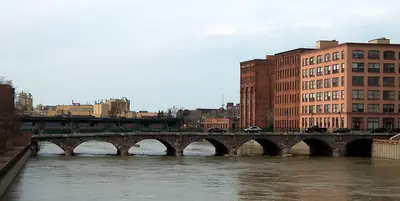
Built in 1893 and designed by city engineer J. Y. McClintock, the Andrews Street Bridge is a historic stone arch bridge over the Genesee River. Its seven segmental arches each span 36 feet and rise nine feet, creating a repeated rhythm across the structure. The bridge was listed on the National Register of Historic Places in 1984.
George Eastman Museum
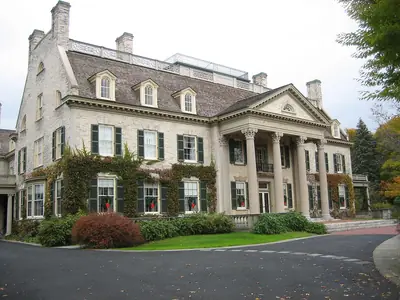
The George Eastman Museum occupies the former Rochester estate of George Eastman, founder of the Eastman Kodak Company. Open to the public since 1949, it is recognised as the world’s oldest museum dedicated to photography and one of the oldest film archives.
The museum is housed in Eastman’s Georgian Revival-style mansion, where the preserved rooms include his private library, correspondence, and personal effects. Its collections include more than 400,000 photographs and negatives, 28,000 films, and millions of cinematic objects such as scripts, posters, celebrity portraits, and early technical equipment. The Dryden Theatre adds a dedicated cinema venue to the museum.
Eastman Dental Dispensary
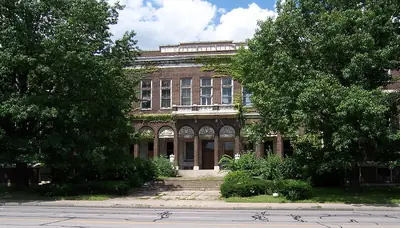
Constructed between 1915 and 1917, the Eastman Dental Dispensary was created as a free dental dispensary serving local residents. Its Italian Renaissance-style design was created by the architects Gordon, Madden, and Kaelber. The building later expanded its services to include diseases of the throat and nose.
After standing vacant for close to four decades, the building fell into disrepair. It was listed on the National Register of Historic Places in 1983.
Times Square Building
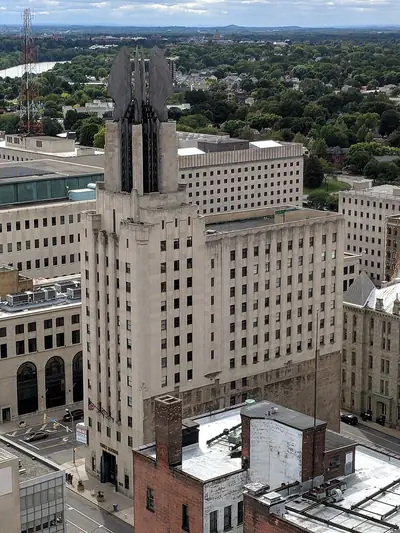
In Rochester’s Four Corners district, the Times Square Building is one of the city’s most recognisable Art Deco landmarks. Completed in 1930, it rises 260 feet and is crowned by four monumental aluminium structures known as the Wings of Progress.
Each wing is 42 feet tall and weighs 12,000 pounds. Their sweeping forms suggest movement and uplift, complementing the building’s streamlined design. The building was originally constructed as the headquarters of the Genesee Valley Trust Company, with its cornerstone laid on October 29, 1929.
Memorial Art Gallery
The Memorial Art Gallery, usually called the MAG, has been a centre for visual arts in the region since 1913. It is part of the University of Rochester and was founded by Emily Sibley Watson as a memorial to her son, James George Averell.
The gallery’s permanent collection contains more than 13,000 objects. Its development was closely connected with Rochester’s local art community, including the Rochester Art Club, and many early additions came through donations inspired by exhibitions.
The National Museum of Play
The National Museum of Play, also known as The Strong, is devoted to toys, games, and the history of play. Its collections include dolls, traditional toys, video games, electronic games, and familiar children’s characters such as the Berenstain Bears and Sesame Street.
The museum began with the personal collection of Rochester native Margaret Woodbury Strong and opened to the public in downtown Rochester in 1982. Its focus later shifted toward collecting, preserving, and interpreting the history of play. The collections have grown to hundreds of thousands of items, and the museum has expanded several times.
Rochester Contemporary Art Center
Rochester Contemporary Art Center, or RoCo, is a nonprofit venue on East Avenue dedicated to contemporary art and opportunities for both emerging and established artists. Its best-known event is the annual 6x6 exhibition, in which thousands of original works share the same six-inch-square format.
The works are displayed anonymously and offered for twenty dollars, with the artist’s identity revealed only after purchase. RoCo began in 1977 as the Pyramid Arts Center and moved to its current East Avenue location in 2001.
Rochester Museum and Science Center
The Rochester Museum and Science Center brings together science, regional history, archaeology, technology, and the natural world. Its hands-on exhibitions, live demonstrations, and immersive experiences are designed for visitors of all ages.
The museum holds more than 1.2 million artefacts. It began in 1912 as the Rochester Municipal Museum, and archaeologist Arthur C. Parker played an important role in expanding its research and collections.
Susan B. Anthony House
The Susan B. Anthony House is an Italianate brick home on Madison Street where Susan B. Anthony lived for four decades. She used the house to lead the campaign for women’s right to vote, host national strategy meetings, and operate the headquarters of the National American Woman Suffrage Association.
In 1872, Anthony voted in a federal election and was arrested for voting illegally in the house’s parlour. She died here in 1906, shortly after delivering her speech “Failure is Impossible.” The museum campus also includes the adjacent home of her sister, Hannah Mosher, which contains the visitor centre and museum shop.
Sacred Heart Cathedral
Sacred Heart Cathedral is the mother church of the Roman Catholic Diocese of Rochester and the seat of the diocesan bishop. The present church was completed in 1927, after its cornerstone was laid in 1925. It became Rochester’s cathedral in 1952.
Designed by Chicago architect Charles H. Prindeville, the building underwent a major renovation between 2003 and 2005. The work reoriented the worship space, moved the altar to the centre, added a baptismal font along the main aisle, and replaced traditional pews with movable chairs.
Rochester’s industrial landmarks
Rochester’s industrial history can also be read through its surviving buildings and skyline. The former Kodak Tower and other downtown landmarks reflect the city’s importance in photography, communications, and business. The Button Factory Building in the High Falls district preserves another part of this story: the complex once housed the Rochester Button Company, founded in 1887.
The site comprises three buildings constructed between 1903 and 1920. Their different heights corresponded to stages in the button-making process. Production continued there until 1990, and the complex was listed on the National Register of Historic Places in 2013.
Explore Rochester with Neywo
If you are looking for a Rochester self-guided walking tour or a free walking tour in Rochester, Neywo lets you explore independently. The app has five walking tours, one bus route, and one bike route in the city:
- High Falls and the Bridges of the Genesee: 2.31 km, 87 minutes, 9 narrated stops.
- Four Corners and the Skyscrapers of the Flour City: 2.7 km, 99 minutes, 12 narrated stops.
- East Avenue: Eastman’s Music, Film and Play: 4.32 km, 103 minutes, 8 narrated stops.
- Susan B. Anthony’s Rochester: 3.81 km, 74 minutes, 4 narrated stops.
- Immigrant Rochester: Churches, Shules and the Public Market: 4.24 km, 111 minutes, 10 narrated stops.
- Route 22 on Lake Avenue: 7.2 km, 31 minutes, 4 narrated stops.
- East Main Street Bike Lane: 1.1 km, 6 minutes, 3 narrated stops.
Each story plays as you reach the place, at your own pace, with no group and no schedule. Narration is available in 11 languages. Download Neywo and turn your visit into a Rochester audio guide that follows your route through the city.
When planning a wider trip through New York, you can also compare Rochester with nearby destinations such as Buffalo, New York, Syracuse, or Ithaca.
Places with an audio guide in Rochester
8 places in Rochester with a Neywo audio guide. Each one starts telling its story as you reach it.
Self-guided tours in Rochester
6 tours in Rochester, free in the Neywo app. Each stop tells its story as you reach it.
- Bike ride
East Main Street Bike Lane: Auditorium to Eastman
A short ride along East Main Street's bike lane from the Auditorium Theatre past the Eastman Dental Dispensary to the Eastman Theatre.
RBTL West Herr Auditorium Theatre · Eastman Dental Dispensary · Eastman Theatre
Open this tour: East Main Street Bike Lane: Auditorium to Eastman - Bus ride
Route 22 on Lake Avenue: Seminary to Kodak Tower and Downtown
A frequent city bus down Lake Avenue, the old road from the lake to downtown. Ride from the stone seminary on its hill past Kodak Tower to the Victorian Powers Building and the Main Street Bridge over the Genesee.
Saint Bernard's Seminary · Kodak Tower · Powers Building · Main Street Bridge
Open this tour: Route 22 on Lake Avenue: Seminary to Kodak Tower and Downtown - Walk
High Falls and the Bridges of the Genesee
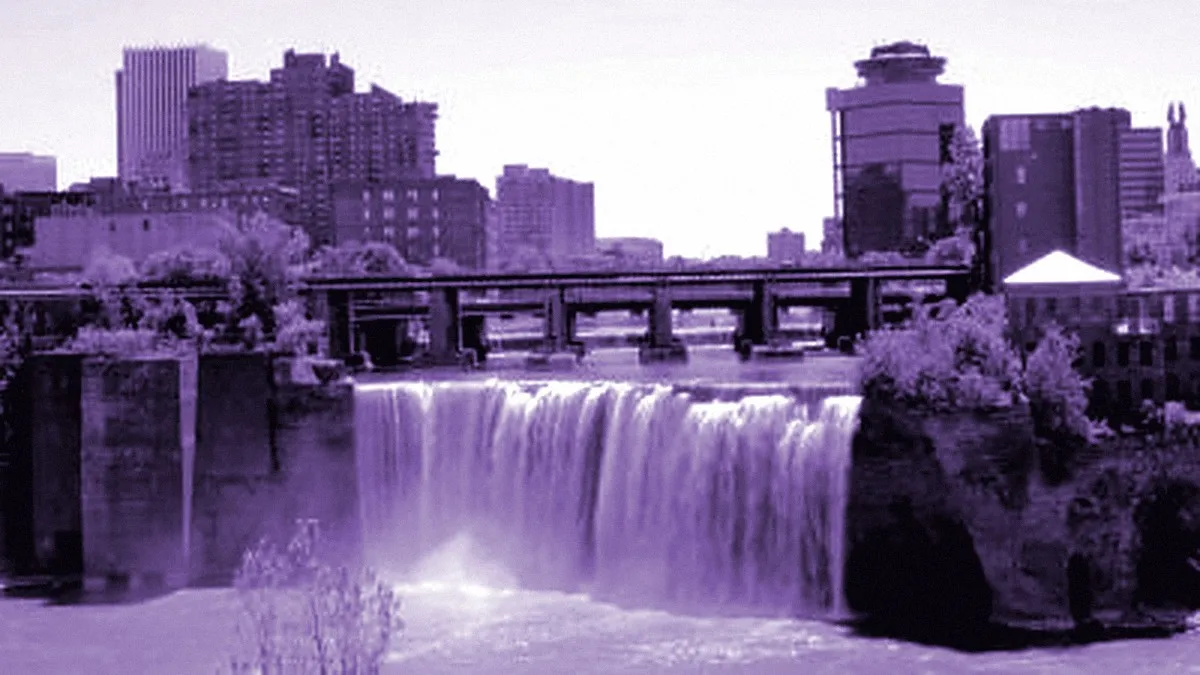
Rochester grew where the Genesee River drops 96 feet. Walk from the Kodak tower to the old mill race and the iron footbridge above the falls, then follow the river across the stone arches and the aqueduct that once carried the Erie Canal.
Kodak Tower · Brown's Race Historic District · Pont de Rennes · High Falls · St. Paul-North Water Streets Historic District · Andrews Street Bridge …
Open this tour: High Falls and the Bridges of the Genesee - Walk
Four Corners and the Skyscrapers of the Flour City
From the sandstone City Hall to the Art Deco Wings of Progress, downtown Rochester stacked its ambitions in stone, brick and aluminium. Follow the story from a Victorian mansard tower to a railway station turned barbecue joint and a 14-storey church.
Brick Presbyterian Church Complex · Rochester City Hall · Powers Building · Times Square Building · Gannett Building · Rundel Memorial Library …
Open this tour: Four Corners and the Skyscrapers of the Flour City - Walk
East Avenue: Eastman's Music, Film and Play
George Eastman's money shaped this stretch of the city. Pass the museum of play and the concert hall he built, a red sandstone church, an art-house cinema and the museums that preserve the history of photography and science.
The National Museum of Play · Eastman Theatre · Christ Church · Little Theatre · Memorial Art Gallery · Rochester Museum and Science Center …
Open this tour: East Avenue: Eastman's Music, Film and Play - Walk
Immigrant Rochester: Churches, Shules and the Public Market
Cross the Genesee to the neighbourhoods that German, French, Irish and Eastern European newcomers built: the Little French Church, a Romanesque German congregation, a Jewish shule, an Art Deco firehouse and the bustling Public Market.
Our Lady of Victory Roman Catholic Church · H. C. Cohen Company Building–Andrews Building · German United Evangelical Church Complex · St. Joseph's Church and Rectory · English Evangelical Church of the Reformation and Parish House · Rochester Fire Department Headquarters and Shops …
Open this tour: Immigrant Rochester: Churches, Shules and the Public Market
Walk Rochester with Neywo
Neywo turns Rochester into a self-guided audio tour. Stories arrive as you reach the place they belong to, and the route reshapes when you wander off it.

