What to See in Charleston, United States: Free Audio Guide
Things to Do in Charleston: Historic Churches, Museums, and Market Streets
Charleston is a historic South Carolina city known for its churches, civic buildings, museums, markets, and layers of architectural and cultural history. The city rewards slow exploration, especially around the French Quarter, Meeting Street, and the streets south of Broad. Neywo’s free audio guide for Charleston brings 112 narrated places to life as you walk.
What to See in Charleston
Charleston’s historic center is compact enough to explore on foot, but its landmarks tell very different stories. These are some of the most important places to include in a visit.
St. Mary’s Roman Catholic Church
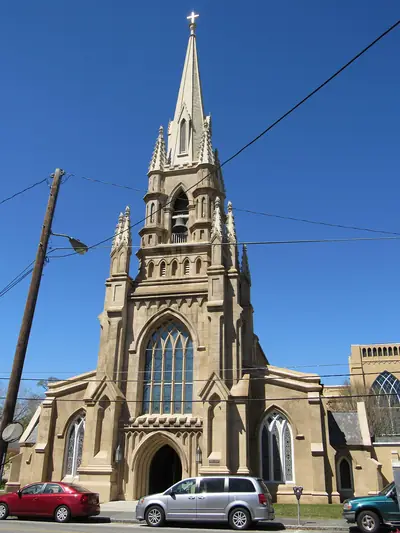
At 93 Hasell Street, St. Mary of the Annunciation—also known as St. Mary’s Roman Catholic Church—belongs to the first Catholic parish established in the Carolinas and Georgia. The present building is the third structure to house the congregation on this site, making the location itself part of the church’s long history.
Central Baptist Church
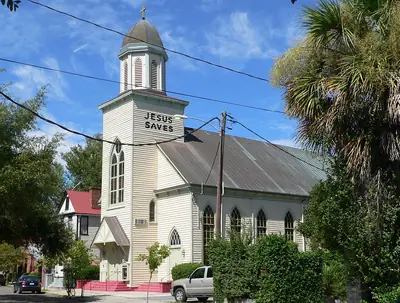
Central Baptist Church at 26 Radcliffe Street was completed in 1893 and is considered the first church in Charleston founded and constructed entirely by African-Americans. Its architecture combines Carpenter Gothic and Italianate influences. Inside, large folk-art murals painted in 1915 portray biblical scenes including the Crucifixion, the Ascension, and the Resurrection of Christ.
The church is an important part of Charleston’s African-American heritage. Construction began in 1891, and the building was added to the National Register in 1977.
Exchange and Provost Building
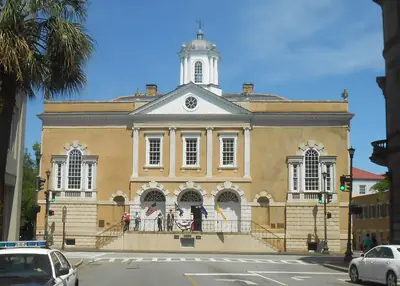
At East Bay and Broad Streets, the Exchange and Provost Building—also known as the Old Exchange and Provost Dungeon and the Custom House—brings together Charleston’s commercial, political, and military history. The present Palladian building was completed between 1767 and 1771, with a formal design of columns and strong symmetry.
The site had civic uses as early as 1680. In 1776, South Carolina declared itself an independent colony from its steps, and in 1788 the building hosted the convention that ratified the United States Constitution. During the American Revolutionary War, British forces used it as a prison for prisoners of war, including signers of the Declaration of Independence. Today, it is a museum operated by the Daughters of the American Revolution.
Belmond Charleston Place
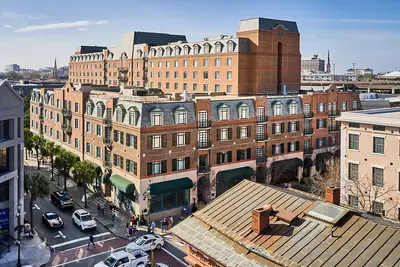
Belmond Charleston Place, also known as The Charleston Place, was designed to fit among Charleston’s nineteenth-century buildings. Opened in 1986, it has 434 rooms and is the largest hotel in Charleston.
At the entrance between Meeting and Hasell Street, the Quadriga fountain features four nine-foot bronze horses by John W. Mills. Inside, a Georgian open-arm staircase frames a hand-blown Venetian chandelier made from more than 3,000 pieces of glass from Murano, Italy.
St. Philip’s Episcopal Church
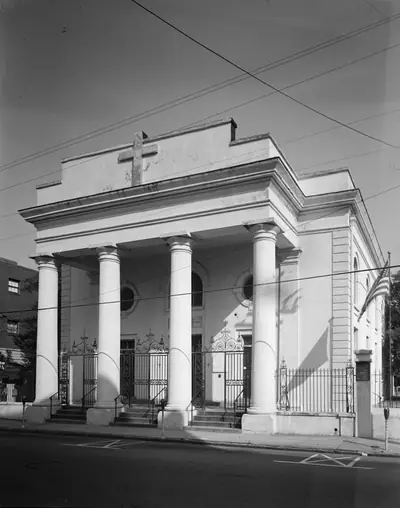
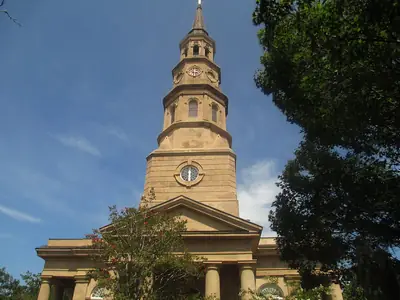
St. Philip’s Episcopal Church stands in Charleston’s French Quarter beneath a tall tower and spire. Although the present church dates from the nineteenth century, its congregation reaches back to Charleston’s earliest colonial period.
The current building was completed in 1836, with the spire added in 1850. Its stuccoed brick walls, three Tuscan porticoes, and Wren Gibbs-inspired tower give it a formal and distinctive appearance. St. Philip’s was designated a National Historic Landmark in 1973.
Gibbes Museum of Art
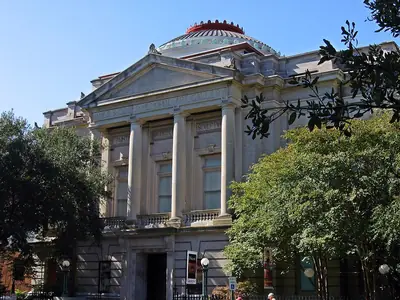
The Gibbes Museum of Art occupies a Beaux-Arts building on Meeting Street. Its collection contains more than 10,000 works connected to American creativity and the history of Charleston and the South, including paintings, photographs, sculpture, ceramics, furnishings, and works by African American artists.
The museum began in 1858 as the Carolina Art Association. Its present building opened in 1905, with a Tiffany-style dome, Doric columns, pediments, and a memorable stained-glass cupola. After a two-year renovation, it reopened in 2016 using the original blueprints to restore the building’s 1905 layout.
Grace Church Cathedral
Grace Church Cathedral, also known as Grace Episcopal Cathedral, is a Gothic Revival landmark and the diocesan cathedral of the Episcopal Church in South Carolina. The parish was founded in 1846, and the present building, designed by E. B. White, was completed in 1848.
The cathedral remained open during the Civil War until a shell struck it in January 1864. It reopened the following year and later suffered severe damage from an earthquake in 1886, a hurricane in 1911, and Hurricane Hugo in 1989.
Cigar Factory
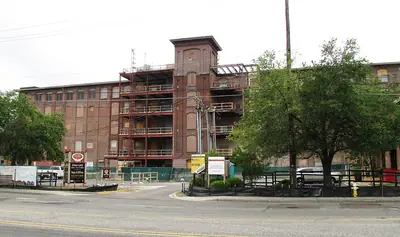
The Cigar Factory at 701 East Bay Street began as the Cotton Mill of Charleston in 1881 before becoming a cigar factory in 1912. During the 1930s, it was Charleston’s largest private employer.
Its most significant chapter came with the Charleston Cigar Factory strike of 1945 and 1946, when “We Shall Overcome” emerged as a civil rights anthem. The building was added to the National Register of Historic Places in 1980 and became a National Historic Landmark in 2024. It has since been redeveloped with restaurants, salons, an event venue, and other businesses.
Cathedral of St. Luke and St. Paul
Construction of the Cathedral of St. Luke and St. Paul on Coming Street began in 1811. The church, also known as St. Luke and St. Paul Anglican Church, preserves much of its early character, particularly in its restrained interior.
Corinthian pilasters with gilt capitals emphasize the chancel, while later stained glass contrasts with the simpler early design. The church remained in continuous use during the Civil War and sheltered congregations from churches closer to Union positions.
Nicholas Trott House and the Powder Magazine
The Nicholas Trott House, also known as Trott’s Cottage, is a small brick building on Cumberland Street that is said to be Charleston’s oldest brick house. Built of English brick by 1719, it is one of the city’s few surviving structures from before the American Revolution. Its thick walls were coated with tabby stucco made from lime, mud, and oyster shells.
The house is associated with Nicholas Trott, who presided over the trial of the pirate Stede Bonnet. Nearby, the Powder Magazine was built in 1713 and is the oldest surviving public building in the former Province of Carolina. It stored gunpowder through the American Revolutionary War and later became a museum.
U. S. Custom House
The U. S. Custom House reflects Charleston’s long connection with the customs service and the political upheavals of the nineteenth century. Construction began in 1852 but stopped in 1859 because of rising costs and the possibility of South Carolina’s secession. Work resumed in 1870 after the Civil War, and the building was completed in 1879.
Circular Congregational Church
Circular Congregational Church traces its history to 1681, when the Independent Church of Charles Towne brought together English Congregationalists, Scots Presbyterians, and French Huguenots. Its first building, the White Meeting House, helped give Meeting Street its name.
The church was rebuilt in 1806 according to a bold, Pantheon-inspired design by Robert Mills. The building’s unusual form made a strong impression, and the congregation has rebuilt after damage from a British cannonball during the siege of Charleston and the great fire of 1861.
Dock Street Theatre
Dock Street Theatre stands in the French Quarter, across from the French Huguenot Church and within sight of St. Philip’s Episcopal Church. Its history began in 1735, when a traveling troupe performed The Orphan inside Charleston’s city courtroom.
The present building reopened in 2010 after a three-year, nineteen-million-dollar restoration. Its restored spaces retain the atmosphere of both a working theater and a historic landmark.
Charleston City Market
Charleston City Market stretches through downtown for four city blocks, beginning with Market Hall on Meeting Street and continuing through one-story sheds toward East Bay Street. Established in the 1790s as the Centre Market, it replaced the Beef Market after that building burned in 1796.
Today, the stalls offer souvenirs, jewelry, and Gullah sweetgrass baskets. Market Hall, added in the early 1840s, has also housed Charleston’s Confederate Museum since 1899. The market’s role has changed, but it remains one of the city’s most recognizable places to walk through.
Explore Charleston with a Self-Guided Walking Tour
A Charleston self-guided walking tour lets you connect the city’s landmarks without following a group or a fixed timetable. Neywo offers six walking tours, with a combined route selection ranging from 1.12 to 2.41 km and individual walks lasting from 60 to 97 minutes. Each tour includes between 8 and 12 narrated stops.
The routes cover different parts of the city:
- Meeting Street and the Four Corners of Law: 1.12 km, 84 minutes, 12 stops
- Harbour, Market and the French Quarter: 1.99 km, 88 minutes, 12 stops
- South of Broad: Mansions and the Battery: 1.64 km, 71 minutes, 11 stops
- Steeples, Squares and Museums Uptown: 1.72 km, 74 minutes, 10 stops
- Jail, Cathedral and Rutledge Row: 1.7 km, 60 minutes, 8 stops
- College of Charleston and the Coming Street Churches: 2.41 km, 97 minutes, 11 stops
The routes include places such as the Gibbes Museum of Art, Circular Congregational Church, City Market, St. Philip’s Episcopal Church, Central Baptist Church, Grace Church Cathedral, and the Cathedral of St. Luke and St. Paul.
Download Neywo and Explore Charleston at Your Own Pace
Neywo is a free Charleston audio guide with 112 narrated places and six walking tours. Narration is available in 11 languages. The app tells the story of each place as you reach it, at your own pace, with no group and no schedule.
Charleston is part of South Carolina, in the United States. If you are continuing through the region, you can also explore Columbia, Beaufort, South Carolina, or Myrtle Beach.
Places with an audio guide in Charleston
8 places in Charleston with a Neywo audio guide. Each one starts telling its story as you reach it.
Self-guided tours in Charleston
6 tours in Charleston, free in the Neywo app. Each stop tells its story as you reach it.
- Walk
Meeting Street and the Four Corners of Law
Walk the spine of the Holy City, where one intersection once held state, city, federal and church law. Pass Charleston's oldest surviving church, a doctor's house with some of America's finest Georgian paneling, a Beaux-Arts museum under a Tiffany-style dome, a circular church and one of America's oldest synagogues.
St. Michael's Episcopal Church · Charleston City Hall · Charleston County Historic Courthouse Interpretive Marker · David Ramsay House · Blake Tenements · Hibernian Hall …
Open this tour: Meeting Street and the Four Corners of Law - Walk
Harbour, Market and the French Quarter
Follow the money, and the memory, of colonial Charleston from the wharves to the market sheds. See the Custom House and the Palladian Exchange, a house built of pinkish Bermuda stone, a Huguenot church, St. Philip's steeple, the Dock Street Theatre and the Old Slave Mart.
Exchange and Provost Building · Waterfront Park · Vendue Range · U. S. Custom House · City Market · St. Philip's Episcopal Church …
Open this tour: Harbour, Market and the French Quarter - Walk
South of Broad: Mansions and the Battery
Stroll Charleston's most photographed streets of pastel mansions and walled gardens, from the Heyward-Washington House where George Washington lodged to the Nathaniel Russell and Calhoun mansions. End at White Point Garden and the sea wall of the Battery, lined with cannon and monuments.
Isaac Holmes Tenement · Heyward-Washington House · First (Scots) Presbyterian Church · Nathaniel Russell House · Miles Brewton House (Charleston) · Calhoun Mansion …
Open this tour: South of Broad: Mansions and the Battery - Walk
Steeples, Squares and Museums Uptown
Head north through the city's spiritual heart: Marion Square, the Citadel Square steeple and Second Presbyterian, then Emanuel AME church, the Georgian Manigault House and America's oldest museum, the Charleston Museum, with two more churches on the way back.
St. Matthew's German Evangelical Lutheran Church · Horn Work Remnant · Marion Square · Citadel Square Baptist Church · Joseph Manigault House · Charleston Museum …
Open this tour: Steeples, Squares and Museums Uptown - Walk
Jail, Cathedral and Rutledge Row
Cross the lower peninsula from the grim Old Charleston Jail and Robert Mills's Gothic Old Marine Hospital to the Cathedral of St. John the Baptist and the Unitarian church with its fan-tracery ceiling. Then pass the Rutledge houses and Robert Mills's Greek Revival First Baptist Church to the waterfront Vanderhorst Row.
Old Marine Hospital · Old Charleston Jail · Unitarian Church in Charleston · Cathedral of Saint John the Baptist · Edward Rutledge House · John Rutledge House …
Open this tour: Jail, Cathedral and Rutledge Row - Walk
College of Charleston and the Coming Street Churches
Walk Charleston's college quarter and the old streets beyond Marion Square: Randolph Hall and the Sottile Theatre, historic Black, Methodist and Baptist congregations, a Gothic cathedral and Grace Church Cathedral.
Morris Brown AME Church · Central Baptist Church · Cathedral of St. Luke and St. Paul · Old Bethel United Methodist Church · Bethel Methodist Church (Charleston, South Carolina) · Mace Brown Museum of Natural History …
Open this tour: College of Charleston and the Coming Street Churches
Walk Charleston with Neywo
Neywo turns Charleston into a self-guided audio tour. Stories arrive as you reach the place they belong to, and the route reshapes when you wander off it.