Visiting Frankfurt, Germany: Top Sights on Foot
Things to Do in Frankfurt: Historic Churches, Museums and Medieval Towers
Frankfurt is a German city where a medieval old town, important museums and surviving fortification towers meet a modern urban skyline. The best things to do in Frankfurt include exploring Römerberg, visiting the Museumsufer and following the city’s connections to democracy, religion, trade and art. Neywo has a free audio guide for Frankfurt with 117 narrated places.
What to See in Frankfurt
Römerberg and Old St. Nicholas Church
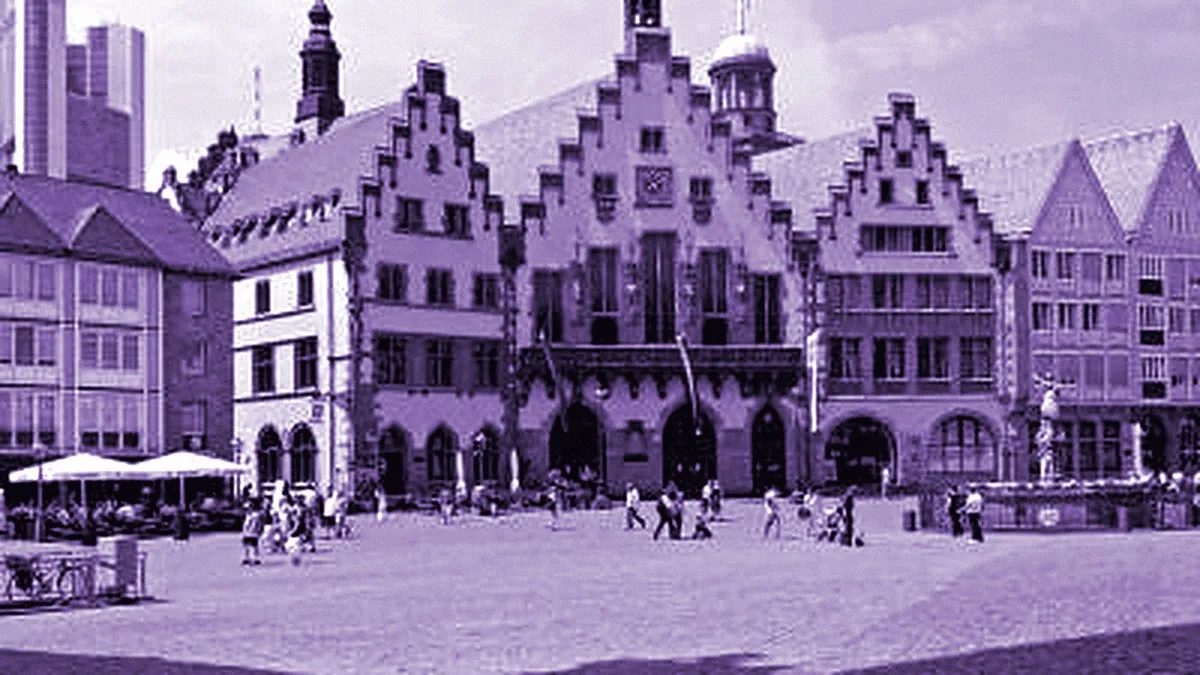
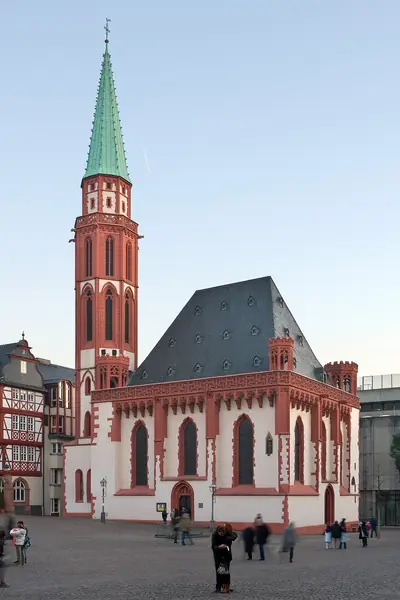
Römerberg is Frankfurt’s historic market square and one of the city’s essential starting points. Old St. Nicholas Church, one of the oldest surviving buildings in the Old Town, stands beside it. Its present form largely reflects late Gothic architecture from the 15th century, with a slender tower, steep rooflines and a carillon.
The church was closely connected to civic ceremonies held around the square and near the city hall. Its bright nave and relatively simple interior offer a quieter contrast to Frankfurt Cathedral.
Rententurm and the medieval city walls
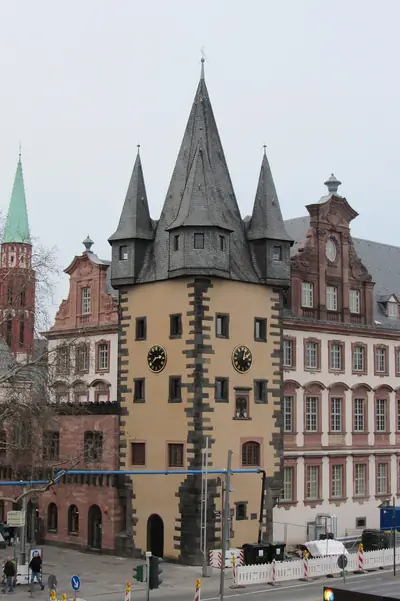
The Rententurm is a four-storey late Gothic gate tower belonging to the Saalhof complex. Built in 1456, it guarded the Fahrtor, the gate connecting Römerberg with the harbour area along the Main. Tolls and port charges were collected here, and the basement was also used as a city prison.
The tower stands on foundation walls associated with the Kaiserpfalz constructed by Emperor Friedrich Barbarossa in 1150. Its square plan, pointed spire and four turrets make it one of the most distinctive reminders of Frankfurt’s former fortifications.
St. Paul’s Church and Germany’s democratic history
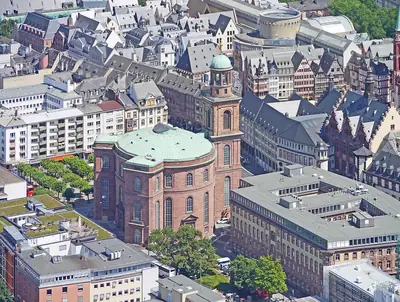
St. Paul’s Church, or the Paulskirche, is one of Frankfurt’s most important political landmarks. Built between 1789 and 1833 to replace the medieval Barfüßerkirche, it served as Frankfurt’s main Protestant-Lutheran church until 1944.
Its circular neoclassical design, created by architect Johann Friedrich Christian Hess, is closely associated with the Frankfurt National Assembly. Delegates met here from 1848 to 1849 in what is described as the first parliament for all of Germany. The building was completely destroyed by fire after a bombing on 18 March 1944 and was later rebuilt. Today, it is used for exhibitions, memorial events and public meetings.
Frankfurt Cathedral and the Dom-Museum
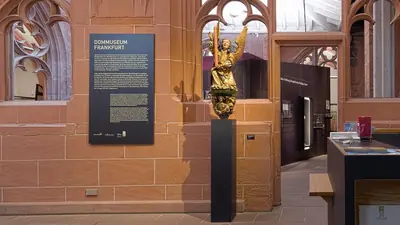
Frankfurt Cathedral, dedicated to Saint Bartholomew, dominates the Old Town. Despite its name, it has never been the seat of a bishop. The site has much older roots: earlier structures can be traced back to the 7th century, while the Carolingian chapel of the royal palace was connected with the Synod of Frankfurt in 794.
The present Gothic building was constructed mainly between 1250 and 1514. The west tower was begun in 1415, completed after the cathedral fire of 1867 and finished in 1878 using surviving medieval plans. The church’s history reflects Frankfurt’s importance in royal elections and the political life of the Holy Roman Empire.
Carmelite Monastery and the Frankfurt Archaeological Museum
The Carmelite Monastery is a significant medieval religious site and the setting of the Frankfurt Archaeological Museum. Founded in the 13th century by the Carmelite order, it stood within Frankfurt’s medieval walls and became part of the city’s religious and intellectual life.
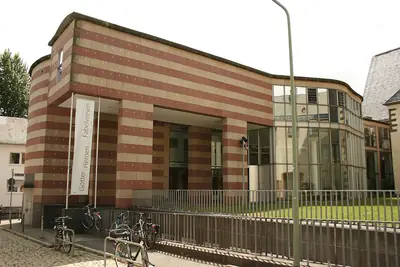
The complex was heavily damaged during the air raids of March 1944 but was later reconstructed. Its cloister, surrounded by Gothic arcades, contains Renaissance frescoes painted by Jörg Ratgeb between 1513 and 1521. The paintings depict scenes from the life of Christ and episodes from the history of the Carmelite order, and are considered among Germany’s significant surviving Renaissance wall paintings.
St. Catherine’s Church and Hauptwache
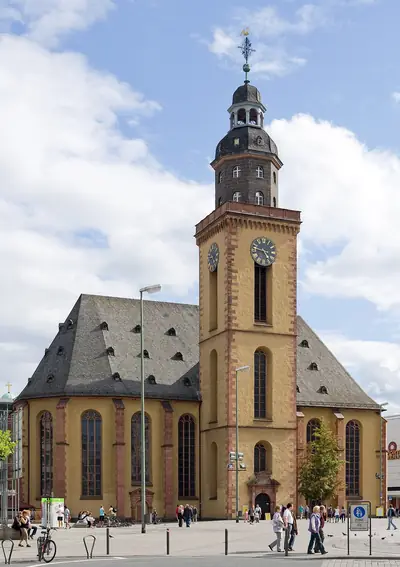
St. Catherine’s Church, or the Katharinenkirche, stands in the busy Hauptwache area. The Baroque church was completed in 1681 after construction began in 1678, and its height is 54 metres.
The site is linked to Frankfurt’s Reformation history. A small parish church here hosted the first Protestant sermon in Frankfurt in 1522, and the Baroque building is described as the city’s first new Protestant church after the Reformation. Allied air raids destroyed it in 1944; it was rebuilt between 1950 and 1954.
The Museumsufer and Städel Museum
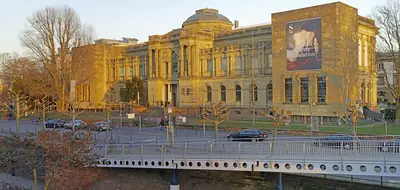
The Museumsufer, or Museum River, stretches along both banks of the Main and forms one of Frankfurt’s major cultural areas. On the Sachsenhausen bank, the Städel Museum houses a collection covering painting from the 14th century to the present day, alongside sculpture, photography, drawings and prints.
The museum was founded in 1816 by the Frankfurt banker Johann Friedrich Städel, who donated his collection and residence to the city. Among its well-known works are Tischbein’s portrait of Goethe in the Italian countryside, Vermeer’s The Geographer and Jan van Eyck’s Lucca Madonna. Modern works include pieces by Bacon, Dubuffet and Yves Klein.
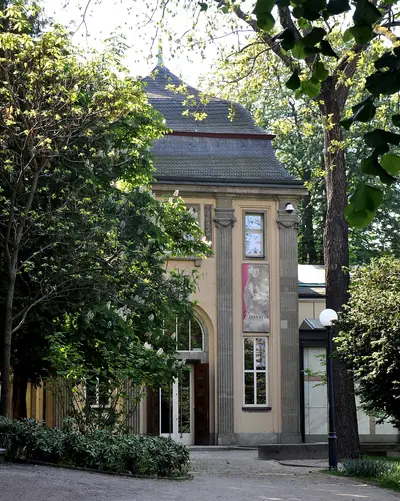
Another important Museumsufer stop is the Liebieghaus, a historicist villa built between 1892 and 1896 as a retirement residence for Baron Heinrich von Liebieg. Its sculpture collection contains around 3,000 works spanning roughly 5,000 years, from Ancient Egypt to Classicism. The building’s design combines influences from the Bamberg Renaissance, Tyrolean architecture and Historicism.
Eschenheimer Turm
Eschenheimer Turm is one of Frankfurt’s best-preserved late-medieval landmarks. Erected at the beginning of the 15th century, it became functional in 1428 and was one of around 60 towers protecting the city.
Many medieval towers were demolished as Frankfurt expanded in the 18th century, but the Eschenheimer Tower survived after French ambassador Count d’Hedouville intervened to prevent its destruction. The tower is 47 metres high, with eight levels, two attics and well-preserved battlements.
Sachsenhausen’s historic fortifications
Several landmarks in Sachsenhausen preserve traces of Frankfurt’s southern defences. Affentorhäuser takes its name from the Affentor, once the southernmost medieval city gate in Sachsenhausen. Nearby, the Kuhhirtenturm—also known as the “Elefant”—is a late Gothic defensive tower built as part of the city fortifications in the late 14th century. It now houses a Hindemith museum.
Holzhausenschlösschen and Stalburger Oede
For a different side of Frankfurt, visit Holzhausenschlösschen, a Baroque moated country house completed in 1729 for Johann Hieronymus von Holzhausen. It was built on the foundations of an older medieval moated castle belonging to the Holzhausen family’s farm. The design is attributed to Louis Rémy de la Fosse.
Stalburger Oede, in Frankfurt-Nordend, is another surviving fragment of the city’s medieval past. Documents trace the site back to the beginning of the 15th century. Its remaining outer walls preserve the memory of a property once associated with gardens, meadows, a pond and, at times, a vineyard. Since the end of the 19th century, a guesthouse and theatre bearing the same name have been integrated into the walls.
Dominican Monastery and Heiliggeistkirche
The Dominikanerkloster Frankfurt am Main began in 1233, when Dominican brothers established themselves in a small four-room house. The monastery grew into a centre for religious instruction and later expanded with Gothic buildings and a chapel. After the Reformation, the Lutherans took over the property; in 1803, it passed to the city.
Today, the former monastery functions as a meeting place and exhibition hall and hosts Protestant gatherings. Heiliggeistkirche is another notable church landmark in this part of Frankfurt, close to the remains of the city’s medieval history.
Explore Frankfurt with a Self-Guided Audio Tour
Neywo offers 8 walking tours, 1 bus route and 1 bike route in Frankfurt, with narration available in 11 languages. The walks range from 0.65 to 5.61 km and from 46 to 213 minutes; the bus route covers 7.9 km in 34 minutes, while the bike route covers 1.5 km in 8 minutes. Together, the tours include narrated stops across Frankfurt’s old town, Museumsufer, banking district, Sachsenhausen and former fortifications.
The app tells the story of each place as you reach it, at your own pace, with no group and no schedule. For a focused introduction to the historic centre, choose the 1.34-km walk through Römerberg, the cathedral and St. Paul’s, with 12 stops. The Museumsufer walk covers 1.37 km and includes 7 stops, while the route through Sachsenhausen and the northern gates covers 5.61 km with 10 stops.
Download Neywo and explore Frankfurt on your own terms. For more ideas in the region, continue to Hesse, or compare Frankfurt with Idstein and Rüdesheim am Rhein.
Places with an audio guide in Frankfurt
8 places in Frankfurt with a Neywo audio guide. Each one starts telling its story as you reach it.
Self-guided tours in Frankfurt
9 tours in Frankfurt, free in the Neywo app. Each stop tells its story as you reach it.
- Bike ride
Museumsufer by Bike
Ride the south bank of the Main along Schaumainkai, Frankfurt's Museum Embankment. Pass the sculpture villa of the Liebieghaus, the Städel, the film and architecture museums and the applied arts museum, then roll on to the medieval Kuhhirtenturm gate tower.
Liebieghaus · Städel Museum · German Film Museum · Museum für angewandte Kunst Frankfurt · Kuhhirtenturm
Open this tour: Museumsufer by Bike - Bus ride
Bus M36: From Bockenheim to Sachsenhausen
A city-centre bus that links the university quarter to the old gates of Frankfurt. See the Bockenheimer Warte, the Senckenberg natural history museum, the Eschenheimer Tower and the Jewish heritage around Börneplatz, then cross to the Sachsenhausen gate at Affentor.
Bockenheimer Warte · Eschenheimer Turm · Heiliggeistkirche · Icon museum of Frankfurt · Affentorhäuser
Open this tour: Bus M36: From Bockenheim to Sachsenhausen - Walk
Sachsenhausen and the northern gates
Five and a half kilometres on the south bank and beyond: the Liebieghaus sculpture collection, the cowherd's tower Hindemith lived in, the Affentor houses of the old village, then over the river to the Eschenheimer Tower and the ring gardens.
Museum Giersch · Liebieghaus · Frankfurter Märchenbrunnen · Dreikönigskirche · Deutschordenskirche · Affentorhäuser …
Open this tour: Sachsenhausen and the northern gates - Walk
The Goethe House, St Catherine's and the Eschenheimer Tower
North of the Römer — the house where Goethe was born, rebuilt after the war from the rubble, the Gutenberg monument, the stock exchange, and the fifteenth-century gate tower left standing in the middle of the banking district.
Museum für Moderne Kunst · Kleinmarkthalle Frankfurt · Liebfrauen, Frankfurt · St. Catherine's Church · Hauptwache · Palais Thurn und Taxis …
Open this tour: The Goethe House, St Catherine's and the Eschenheimer Tower - Walk
The Museumsufer: Städel and six more
The best museum mile in Germany, all on one embankment — the Städel's old masters and moderns, applied arts, world cultures, film, architecture, communication — plus the Jewish Museum in the Rothschild palace.
Museum für angewandte Kunst Frankfurt · Museum der Weltkulturen · German Film Museum · German Architecture Museum · Museum for Communication Frankfurt · Städel Museum …
Open this tour: The Museumsufer: Städel and six more - Walk
The banking district and the Alte Oper
Frankfurt's skyline from the ground: the Main Tower's public viewing platform, the Commerzbank and Deutsche Bank towers, and the opera house rebuilt behind its surviving 1880 facade.
Alte Oper · Guiollett-Denkmal · Deutsche Bank Twin Towers · Beethoven monument · Snow White Monument · Schiller monument …
Open this tour: The banking district and the Alte Oper - Walk
The Judengasse, the Staufenmauer and the modern art museum
East of the centre: the excavated foundations of the Jewish ghetto, the Börneplatz memorial with a name-block for every deported Frankfurt Jew, the old Staufen wall, and the MMK's wedge-shaped 'slice of cake'.
Jewish cemetery Battonnstraße · Memorial Neuer Börneplatz · Museum Judengasse · Heiliggeistkirche · Dominikanerkloster Frankfurt am Main · Staufenmauer
Open this tour: The Judengasse, the Staufenmauer and the modern art museum - Walk
The Anlagenring synagogues and Bethmannpark
A short walk on the old ramparts: the Baumweg synagogue, the Friedberger Anlage bunker built on a destroyed synagogue's site, and the Chinese garden in Bethmannpark.
Synagoge Friedberger Anlage · Heinrich Heine memorial · Baumweg-Synagoge · Bethmann-Denkmal · Bethmannpark
Open this tour: The Anlagenring synagogues and Bethmannpark - Walk
The Römerberg, the Cathedral and St Paul's
The rebuilt old town: the cathedral where Holy Roman Emperors were elected and crowned, St Paul's Church where the first German parliament sat in 1848, the Römer town hall, and the history museum on the river.
Hauptwache · St. Catherine's Church · St. Paul's Church, Frankfurt am Main · Carmelite Monastery · St. Leonhard · Eiserner Steg …
Open this tour: The Römerberg, the Cathedral and St Paul's
Walk Frankfurt with Neywo
Neywo turns Frankfurt into a self-guided audio tour. Stories arrive as you reach the place they belong to, and the route reshapes when you wander off it.


More in Hesse
Elsewhere in Germany
- BinzMecklenburg-Western Pomerania
- RostockMecklenburg-Western Pomerania
- SchwerinMecklenburg-Western Pomerania
- AachenNorth Rhine-Westphalia
- AnholtNorth Rhine-Westphalia
- BonnNorth Rhine-Westphalia
- CologneNorth Rhine-Westphalia
- DuisburgNorth Rhine-Westphalia
- DüsseldorfNorth Rhine-Westphalia
- EssenNorth Rhine-Westphalia
- MonschauNorth Rhine-Westphalia
- MünsterNorth Rhine-Westphalia