Things to Do in Münster, Germany: Walking Guide
Things to Do in Münster: Historic Churches, Palaces and University Life
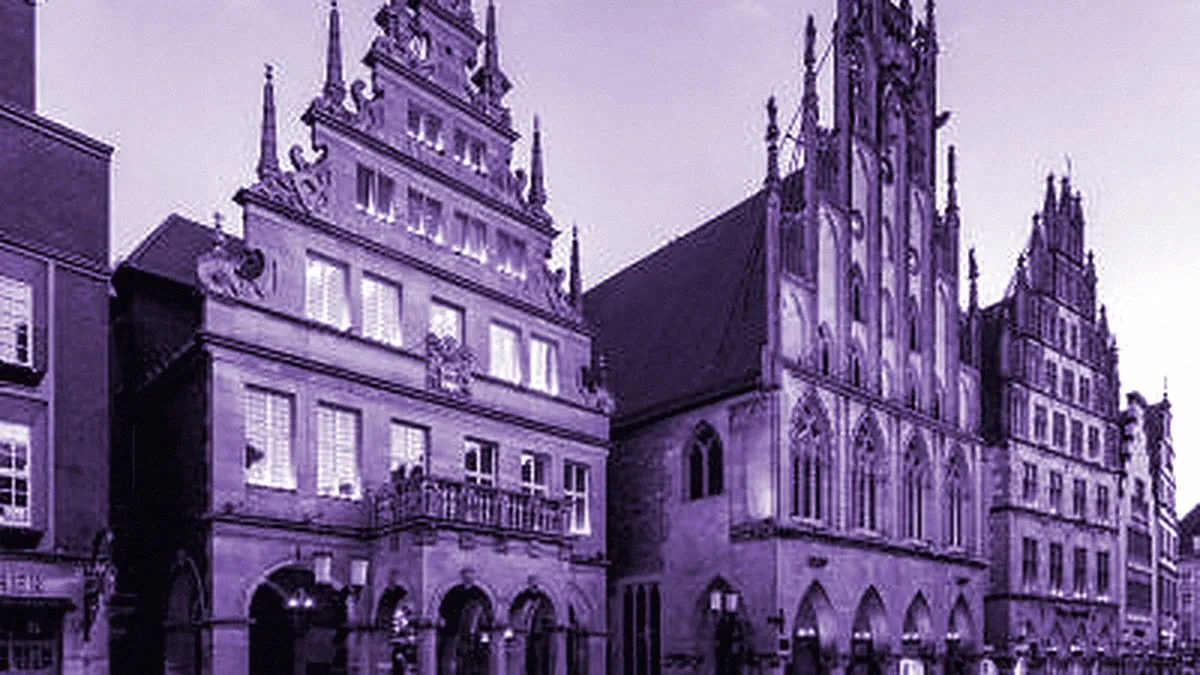
Münster is a historic city in North Rhine-Westphalia, known for its churches, Baroque palaces, university quarter and reconstructed Old Town. The city’s landmarks bring together Romanesque, Gothic, Renaissance and Baroque architecture, making Münster rewarding to explore on foot. Neywo offers a free audio guide for Münster with 133 narrated places.
What to See in Münster
Münster’s main sights are concentrated around the historic centre, Domplatz, the Prinzipalmarkt and the university quarter. These are some of the most important places to include in your visit.
St.-Paulus-Dom
St.-Paulus-Dom is one of Münster’s defining landmarks and, together with the Historic Town Hall, a symbol of the city. The cathedral was built between 1225 and 1264, replacing two earlier cathedrals on the same site.
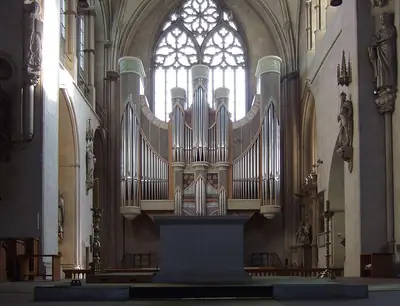
Its architecture combines a Romanesque westwerk, old choir and two imposing west towers with a Gothic nave, transepts, high choir and ring of chapels. The towers, which belonged to the earlier cathedral, are topped with copper-covered pyramids. Inside, the central nave is flanked by two side aisles, while a statue of Saint Christopher, dated 1627, stands near the entrance.
Bischöfliches Palais and Kettelersche Kurie
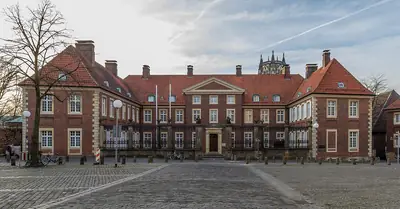
Domplatz is also home to two elegant buildings connected with Münster’s ecclesiastical history. The Bischöfliches Palais, or Bishop’s Palace, is the residence of the Bishop of Münster and the seat of the bishop’s general vicariate.
Nearby, the Kettelersche Kurie forms part of an architectural ensemble with the palace. It was built between 1712 and 1716 by Lambert Friedrich Corfey for Nikolaus Hermann von Ketteler zu Harkotten, the vicar general.
Prinzipalmarkt and St. Lamberti
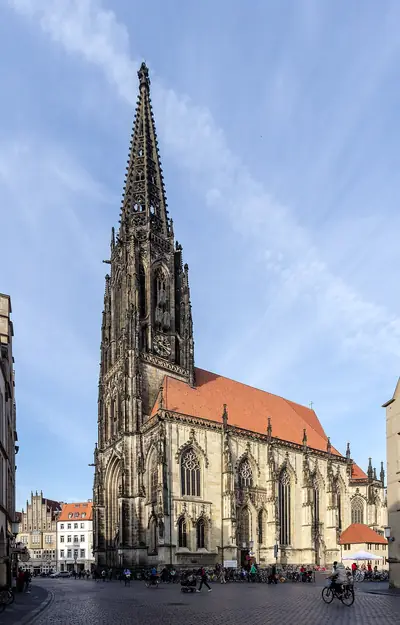
At the northern end of the Prinzipalmarkt, St. Lamberti is one of Münster’s most recognisable landmarks. Built in stages between 1375 and 1525, it served as a market and civic church and is considered the most significant sacred example of Westphalian late Gothic architecture.
The church tower has three iron cages above the clock. They recall the events of 1536, when the bodies of Jan van Leiden, Bernd Krechting and Bernd Knipperdolling were displayed there after the leaders of the Münster Anabaptist movement had been tortured and executed in front of the church.
Inside, the lofty vaulted nave, stained-glass windows and religious artworks deserve attention. St. Lamberti also has two pipe organs and eight bells, several of which are more than five centuries old.
St. Servatii
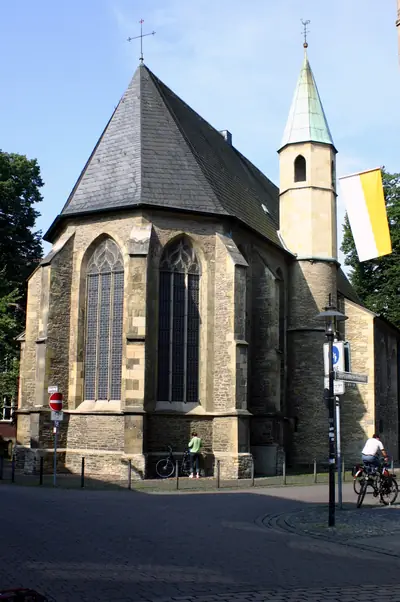
St. Servatii is one of Münster’s oldest churches and the smallest of its six medieval parish churches. Its present form dates from around 1230, combining late Romanesque and early Gothic elements.
Alternating pillars and columns lead towards the high choir, while tracery was added to the choir windows around 1500. The church was almost completely destroyed during the Second World War; only a single column remained standing. Reconstruction began immediately, and the building was fully restored by 1952.
Erbdrostenhof
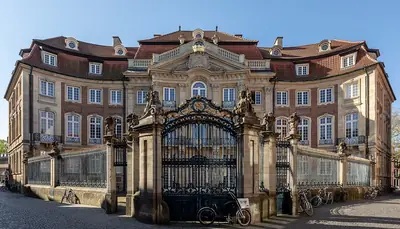
On Salzstraße, the Erbdrostenhof stands out for its curved façade and three-wing design. Johann Conrad Schlaun built this late Baroque palace between 1753 and 1757 for Adolf Heidenreich Freiherr Droste zu Vischering, the Erbdrost of Münster.
The building combines luminous Billerbeck sandstone on its curved façade with warm red clinker brick on the wings. Its compact site encouraged an especially inventive design. The palace was badly damaged during the Second World War and reconstructed between 1953 and 1970. The exterior is the main part accessible to visitors, while public access to the interior is mainly connected with events in the banquet hall.
Clemenskirche
Clemenskirche is a peaceful Baroque church in the historic Old Town. Johann Conrad Schlaun designed it between 1745 and 1753 as part of a monastery and hospital for the Hospitaller Brothers.
The church has a twelve-sided rotunda crowned by a cupola and lantern tower. Inside, Baroque architecture is combined with Rococo decoration, including stucco work by Jakob Rauch and frescoes by Johann Adam Schöpf. Although the church was almost completely destroyed during the Second World War, it was reconstructed between 1956 and 1973.
Dominikanerkirche
The Dominican Church on Salzstraße was built between 1708 and 1725 as part of a Dominican monastery. Its former religious interior now provides a setting for contemporary art.
The spacious nave, columns and dramatic stucco ceiling frame Gerhard Richter’s monumental Two Grey Double Mirrors, installed permanently in 2018. Since 2017, the church has served as a contemporary exhibition space under the stewardship of the LWL Museum of Art and Culture.
St. Aegidii
St. Aegidii offers a quieter atmosphere in the Old Town. The present church began as a Capuchin monastery church and was renewed by Johann Conrad Schlaun between 1724 and 1728, with support from the Plettenberg family.
Its restrained exterior includes an elegant sandstone portal and brick hall. Inside, paintings in the Nazarene tradition and ceiling frescoes, restored in the 1980s, create a more decorative atmosphere.
St. Petri and the university quarter
Near the cathedral and the Aa, St. Petri connects Münster’s religious history with university life. Built between 1590 and 1597 as the church of the Jesuit College, it became the starting point for the University of Münster and is the only surviving part of the original college complex.
The red-brick basilica combines Gothic structural elements with Renaissance details. Two levels of galleries and the church’s excellent acoustics contribute to its calm, balanced interior.
Nearby, the Evangelische Universitätskirche Münster, also known as the Observantenkirche, was once the monastery church of the Franciscan Observants. The monastery was dissolved in 1811. The church stands close to the Buddenturm, another reminder of Münster’s historic centre.
Schloss Münster
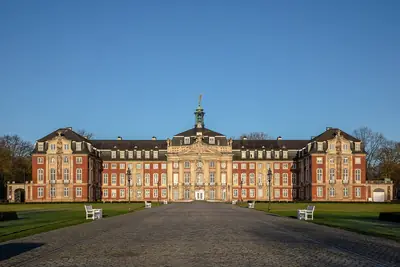
Schloss Münster, or Fürstbischöfliches Schloss, was built between 1767 and 1787 as the residence of the prince-bishops. Johann Conrad Schlaun designed the grand Baroque palace for Maximilian Friedrich von Königsegg-Rothenfels.
The building combines red brick and sandstone in a large, formal complex. It suffered severe damage during the Second World War and was later reconstructed. Since 1954, it has served as the seat and landmark of the University of Münster.
Eighteen bells on the roof chime melodies and mark each quarter hour. The palace is also associated with Münster Botanical Garden, making the surrounding area a natural continuation of a visit.
Apostelkirche
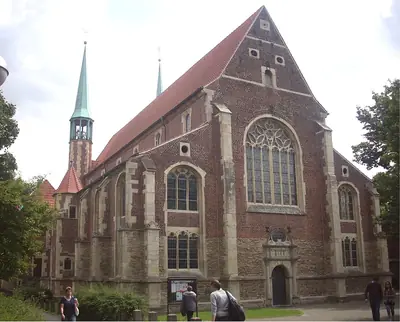
The Apostelkirche is Münster’s principal Protestant church and is regarded as the city’s first Gothic church building. It was built in the second half of the thirteenth century as a Franciscan monastery church.
The interior is a restrained vaulted three-aisled hall with a narrower choir. Richly coloured stained-glass panels and a rose window provide a strong contrast to the simple Gothic space. Vault paintings dating from the fifteenth to the seventeenth century were uncovered during restoration.
Further historic places
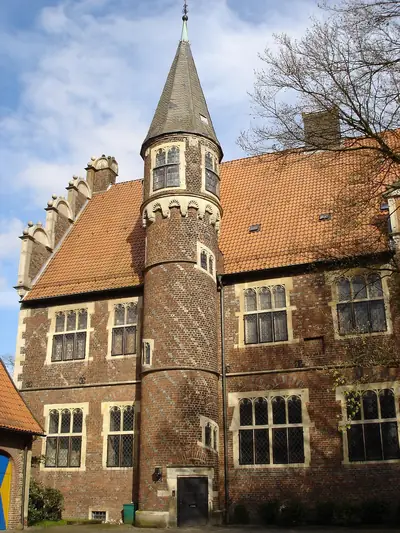
Outside the central group of churches and palaces, Münster’s historic sights include Drostenhof Wolbeck, regarded as the first grand Renaissance estate in the Münsterland region. In Mecklenbeck, Speicher Haus Kump has roots reaching back to 889; its surviving granary was built in 1549 and is protected as a historic monument.
Münster Self-Guided Walking Tour and Audio Guide
Neywo has three walking tours in Münster, as well as one bus route and one bike route. The walks range from 1.67 to 3.14 km and last between 116 and 117 minutes, with 12 narrated stops each.
The routes focus on different sides of the city:
- A 1.67 km walk through the Prinzipalmarkt and cathedral area, including Domplatz, St.-Paulus-Dom, St. Lamberti and the Historic Town Hall.
- A 2.22 km Baroque walk featuring St. Servatius, Erbdrostenhof, Clemenskirche, Dominikanerkirche and St. Aegidii.
- A 3.14 km route around Schloss Münster, the university quarter and the former Altbier brewery, with stops at Münster Botanical Garden, St. Petri, the Evangelische Universitätskirche Münster and Apostelkirche.
There is also a 7.4 km bus route lasting 32 minutes with 10 stops, and a 2.9 km bike route lasting 14 minutes with 7 stops. The bus route crosses the Old Town from Wolbecker Straße towards Gievenbeck, while the bike route connects Servatiiplatz with the Schlossgarten area.
Download the Neywo app and explore Münster at your own pace. The app tells the story of each place as you reach it, with no group and no schedule. Narration is available in 11 languages, and the free audio guide includes 133 narrated places.
Münster is part of North Rhine-Westphalia in Germany. It also makes a useful base for discovering other destinations in the region, including Essen, Düsseldorf and Aachen.
Places with an audio guide in Münster
8 places in Münster with a Neywo audio guide. Each one starts telling its story as you reach it.
Self-guided tours in Münster
5 tours in Münster, free in the Neywo app. Each stop tells its story as you reach it.
- Bike ride
Münster by Leeze: Servatii to the Schlossgarten
Münster is Germany's bike city, and this ride on its cycle paths links Servatiiplatz in the east with the Engelenschanze bastion, the Farmhand and Bull sculpture, the Antoniuskirche, Oldenburg's giant pool balls at the Aasee edge, Bispinghof manor and Tuckesburg, the house of the zoo-founding professor and his monkey.
Servatiiplatz · Engelenschanze · Farmhand with a Horse and Maid with a Bull · St. Antonius · Giant Pool Balls · Bispinghof Manor …
Open this tour: Münster by Leeze: Servatii to the Schlossgarten - Bus ride
StadtBus 11: From Wolbecker Straße through the Old Town to Gievenbeck
Münster's StadtBus 11 runs west across the whole city: from the Herz-Jesu church and Servatiiplatz past Schlaun's Clemenskirche to the Historical Town Hall and Domplatz beside the cathedral, then on past the Geomuseum and Tuckesburg to the Lukaskirche and St. Michael in Gievenbeck.
Herz-Jesu-Kirche · Servatiiplatz · Engelenschanze · Clemenskirche · Historical Town Hall of Münster · Domplatz …
Open this tour: StadtBus 11: From Wolbecker Straße through the Old Town to Gievenbeck - Walk
The Town Where the Thirty Years' War Ended: Prinzipalmarkt and the Cathedral
Münster's showpiece walk, twelve stops in under two hours: the Gothic church across the Aa, Cathedral Square with the Bishop's curia and the art museum, the cathedral with its astronomical clock, the Kiepenkerl bronze, the old rye market, the cages on St. Lamberti's tower, the Dutch guild house and the town hall where peace was signed in 1648, ending at the Picasso museum.
Überwasserkirche · Kettelersche Kurie · Westphalian State Museum of Art and Cultural History · Domplatz · St.-Paulus-Dom · Kiepenkerldenkmal …
Open this tour: The Town Where the Thirty Years' War Ended: Prinzipalmarkt and the Cathedral - Walk
Baroque Münster: Schlaun's Churches and Noble Town Palaces
Follow Johann Conrad Schlaun and his contemporaries through the east and south of the old town: Otto Bartning's post-war Erlöserkirche, a tiny medieval parish church, the curved facade of the Erbdrostenhof, hospital and Dominican churches, the synagogue on the Promenade, aristocratic townhouses and the baroque curia that holds the Geomuseum.
Erlöserkirche · City Museum of Münster · St. Servatius church · Erbdrostenhof · Clemenskirche · Dominikanerkirche …
Open this tour: Baroque Münster: Schlaun's Churches and Noble Town Palaces - Walk
Prince-Bishops' Palace, University and the Last Altbier Brewery
From the professor's house at the old zoo and the botanical garden behind the prince-bishops' palace, now the university's seat, through the Jesuit church where the university began to the old Kuhviertel pub quarter with the last of Münster's 150 altbier breweries, then the city wall's oldest tower, a Gothic chapel and the Franciscan church.
Tuckesburg · Münster Botanical Garden · Schloss Münster · Schlossplatz · Bispinghof Manor · St. Petri (Münster) …
Open this tour: Prince-Bishops' Palace, University and the Last Altbier Brewery
Walk Münster with Neywo
Neywo turns Münster into a self-guided audio tour. Stories arrive as you reach the place they belong to, and the route reshapes when you wander off it.

