What to See in Anholt, Germany: Free Audio Guide
Things to do in Anholt: castles, churches and borderland heritage
Looking for things to do in Anholt? The town’s main attraction is Anholt Castle, a remarkably preserved water castle in Isselburg, where medieval fortifications meet a later baroque residence. Its setting in the borderland between Münsterland and the Lower Rhine makes Anholt a rewarding stop for anyone interested in castles, churches and regional history. Neywo offers a free audio guide for Anholt with 137 narrated places.
What to see in Anholt and the surrounding area
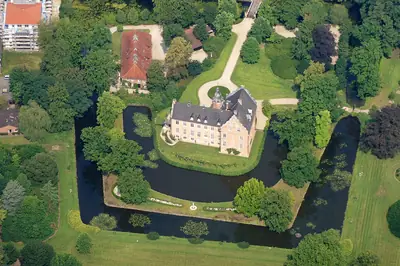
Anholt Castle
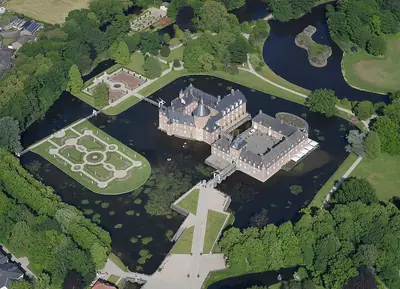
Anholt Castle is one of the largest and best-preserved water castles in western Germany. The complex is completely surrounded by a broad moat fed by the Issel, giving it the defensive appearance that shaped its history.
Its story began in the late twelfth century, when the Prince-Bishopric of Utrecht built a strategic stronghold here. During the Middle Ages, it developed into the imperially immediate Lordship of Anholt. In 1647, the princely House of Salm-Salm made the castle its hereditary residence.
Around 1700, Prince Charles Theodore of Salm transformed the medieval fortress into a stately baroque home. The façades were unified beneath slate roofs, and formal gardens were laid out around the castle. The result is a striking combination of medieval foundations and baroque remodelling.
The castle’s most imposing feature is the Dicke Turm, or Thick Tower: a massive round keep that once formed the final line of defence. Together with the moat, it recalls the complex’s earlier role as a formidable stronghold. Anholt Castle suffered devastating damage in 1945, but remains the defining sight of the town.
Schloss Raesfeld
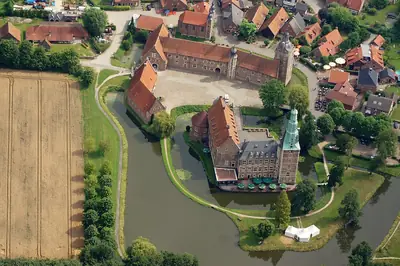
Schloss Raesfeld is another historic water castle in the surrounding region. Its roots reach back to the early twelfth century, when it was the stronghold of the Lords of Raesfeld. At the end of the sixteenth century, it passed to the von Velen family.
The castle was transformed in the mid-seventeenth century, when Imperial Count Alexander II von Velen turned the medieval fortress into a Renaissance residence. He added the elegant west wing and the distinctive stepped tower that still shapes the castle’s silhouette.
After the family line died out in the early eighteenth century, the castle was occupied only occasionally and gradually fell into decay. Parts were demolished in the early nineteenth century, and the remaining complex became a farm estate. After the Second World War, the Chambers of Crafts of North Rhine-Westphalia acquired and restored it.
Today, Schloss Raesfeld contains a training centre, a restaurant and spaces for cultural events. Since 2007, couples have also been able to marry there. Of the original four wings of the upper castle, two remain.
Schloss Rhede
Schloss Rhede, formally known as Haus Rhede, is a manor house with origins reaching back to the thirteenth century. The building visible today took shape in 1564, when Lubbert von Rhemen erected a two-winged manor house on the foundations of an earlier castle.
The difference between its local name and formal name reflects its origins: Haus Rhede began as a noble residence rather than a princely palace. It offers another perspective on the region’s architectural history, alongside the larger fortified complexes of Anholt and Raesfeld.
Agneskapelle
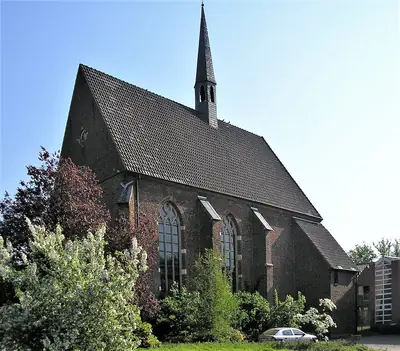
In Bocholt, the Agneskapelle, also known as St. Agnes Church, began as the convent church of a community of Augustinian nuns. Centuries later, it became a Protestant parish church.
Its changing religious role reflects the layered history of the region’s historic churches, many of which have served different communities over time.
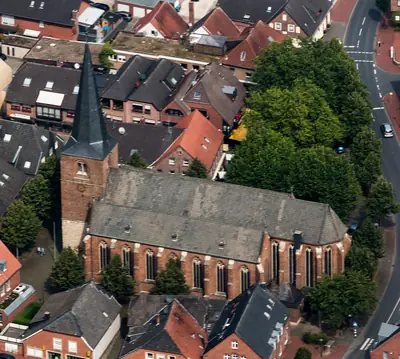
Sts. Simon and Jude
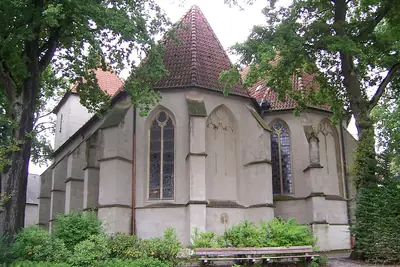
The old parish church of Sts. Simon and Jude stands in the heart of Groß-Reken. Known locally as St. Simon und Judas, it served for centuries as the village’s Catholic parish church. After the modern Church of St. Heinrich was completed, the older building took on a second role as the Museum Alte Kirche Reken, while continuing to host regular services.
The church is especially notable for its unusual two-aisled design. The two parallel aisles are of equal height, a rare feature among village churches in Münsterland. The building also escaped the historicist renovations that altered many medieval churches in the nineteenth century. Its surviving medieval character is therefore particularly valuable.
Inside, the baroque high altar and side altars remain part of the historic interior.
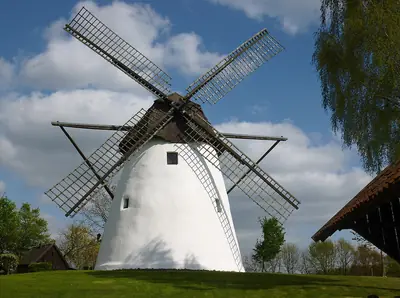
Windmühle Reken and Heimatmuseum Windmühle
The historic Windmühle Reken is a windmill that also houses the Heimatmuseum Windmühle. It combines an example of regional industrial heritage with a museum dedicated to local history.
Churches across the region
Several churches add smaller but distinctive stops to an exploration of the area around Anholt:
- St. Martin in Raesfeld is the Catholic parish church at the heart of the town and a protected historic building.
- St. Maria Immaculata in Rhedebrügge began as a votive church built in fulfilment of a vow. It later served as the local parish church and now functions as a filial church of St. Martin in nearby Raesfeld.
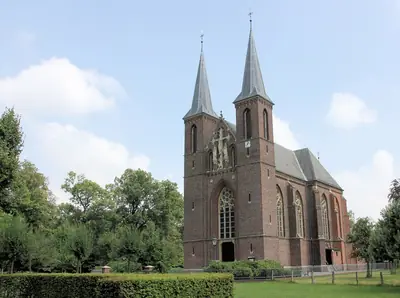
- St. Jakobus in Oeding is marked by massive twin brick towers, visible across the flat Münsterland landscape. For centuries, it served as one of the mission stations of the Prince-Bishopric of Münster.
- St. Gudula is the Catholic parish church at the centre of Rhede and a protected historic monument.
- Hilgenbergkapelle, also known as Hilgenbergkapelle Unserer Lieben Frau, is a pilgrimage chapel dedicated to Our Lady in Stadtlohn.
Historic buildings and former sites
The Old Town Hall of Bocholt, or Altes Rathaus, is one of the city’s most important historic buildings. Since the city administration moved to the New Town Hall in 1977, it has mainly served a ceremonial role. Its Council Hall hosts cultural events and the mayor’s annual New Year’s reception.
Another Altes Rathaus stands in the heart of Schöppingen. This protected historic building is one of the town’s notable landmarks.
At Haus Döring in the Marbeck district of Borken, only the site of the former castle complex remains. The castle itself has disappeared over the centuries, leaving behind the location of what was once a fortification.
Kloster Mariengarden in Burlo brings together monastic, educational and parish history. The monastery was founded in the Middle Ages and passed between Cistercians, Wilhelmites and Cistercians again before its dissolution during secularization in 1803. Monastic life returned in 1920, when the Oblates of the Immaculate Virgin Mary took over the buildings and opened a school that still operates today.
The Church of St. Marien stands at the centre of the complex. Monastery and school buildings surround it, forming a unified courtyard. Until 2013, the church also served as the parish church for Catholics in Burlo.
Anholt is part of North Rhine-Westphalia, a region rich in historic towns and varied cultural landscapes. It also belongs to the wider story of Germany, where castles, churches and former ecclesiastical territories often stand close together.
Explore Anholt with Neywo
Neywo’s free audio guide makes it easy to explore Anholt independently. The city guide includes 137 narrated places, and the app offers one walking tour: “Anholt to Isselburg: Castle, Crypt and Border River.” The route covers 5.6 km, takes around 115 minutes and includes 5 narrated stops: the Princely Pantheon of Salm-Salm, Anholt, Anholt Castle, Evangelische Kirche Isselburg and St. Bartholomäus in Isselburg.
Each story plays as you reach the place, at your own pace, with no group and no schedule. Narration is available in 11 languages. Download Neywo and turn a visit to Anholt and Isselburg into a self-guided walking tour through castles, churches and borderland history.
Places with an audio guide in Anholt
8 places in Anholt with a Neywo audio guide. Each one starts telling its story as you reach it.
Walk Anholt with Neywo
Neywo turns Anholt into a self-guided audio tour. Stories arrive as you reach the place they belong to, and the route reshapes when you wander off it.

