Essen, Germany: Self-Guided Walking Tour
Things to Do in Essen: Industrial Heritage, Castles and Culture
Essen is a city in North Rhine-Westphalia known for its industrial heritage, historic churches, castles, museums and green Ruhr landscapes. The city is especially worth visiting for the contrast between the monumental Zollverein Coal Mine Industrial Complex, medieval ruins and estates, and cultural venues created in former industrial buildings. Neywo offers a free audio guide for Essen with 217 narrated places.
What to See in Essen
Zollverein Coal Mine Industrial Complex
Zollverein is Essen’s defining industrial landmark and a powerful reminder of the Ruhr’s coal and heavy-industry history. The first mine on the site was founded in 1847, mining began in 1851, and operations continued until 23 December 1986.
The complex takes its name from the German Customs Union, founded in 1834. Its most striking section is Shaft 12, opened in 1932 and built in the New Objectivity style. Its architecture is regarded as a technical and artistic masterpiece, earning Zollverein the reputation of being the most beautiful coal mine in the world.
Today, the former mine is an anchor point of the European Route of Industrial Heritage. It also houses cultural institutions, including a location of the Folkwang University of the Arts. The site brings together industrial history, distinctive architecture and contemporary culture in one extensive complex.
Essen Minster and the cathedral treasury
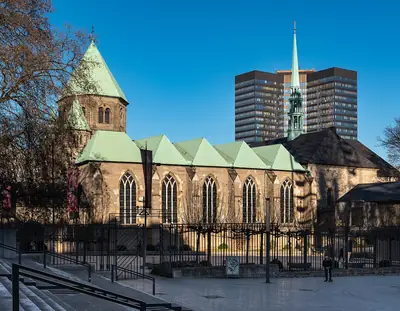
At the heart of the city, Essen Minster stands on Burgplatz. Dedicated to the Virgin Mary and Saints Cosmas and Damian, it is the bishop’s church of the Diocese of Essen. The church began as the collegiate church of Essen Abbey, founded around 845 by Altfrid, Bishop of Hildesheim. Essen later developed around the abbey.
The present building is a Gothic hall church made from light-coloured sandstone, constructed after 1275 and rebuilt after its destruction during the Second World War. Parts of the earlier Ottonian building survive in the octagonal westwork and the crypt. A cloister is attached on the north side, while the separate Church of St. John the Baptist stands at the western end.
The church’s most celebrated treasure is the Golden Madonna, described as the oldest fully sculptural figure of Mary north of the Alps. The cathedral and its treasury are central stops for anyone interested in Essen’s religious and architectural history.
Burg Altendorf
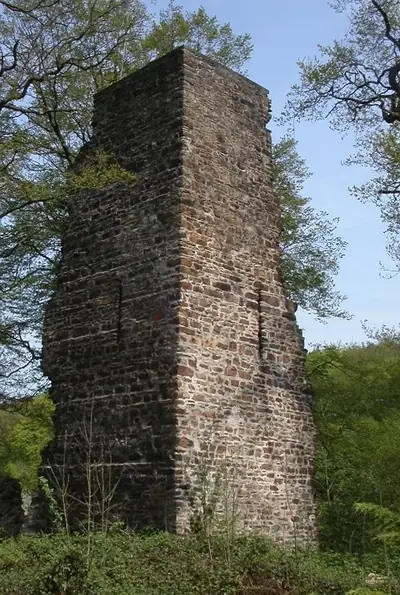
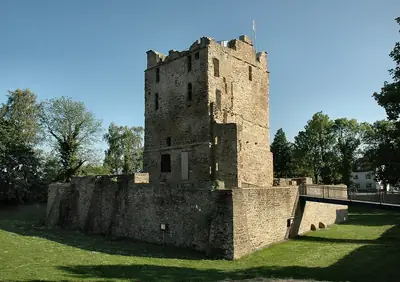
Burg Altendorf is a medieval castle ruin on a peninsula south of the Ruhr. Its surviving residential tower, or donjon, is regarded as the largest preserved tower of its kind between the Rhine and the Weser.
The castle was built in the second half of the twelfth century in the Romanesque style and later altered during the Gothic and Renaissance periods. Its defensive design included a moat, although historical records indicate that it was never used as a water-filled ditch.
After falling into ruin in the early twentieth century, the remains were secured from 1903 onward and systematically uncovered and restored between 1957 and 1970. The castle grounds outside the ruins can be visited freely.
Kattenturm Essen
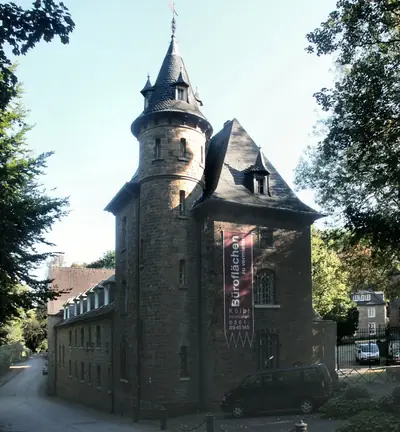
Also known as Burg Luttelnau, Kattenturm Essen is the surviving residential tower of a medieval motte castle on the northern bank of the Ruhr in Essen-Kettwig. It is the only at least partly preserved motte castle on the Ruhr.
The site was once a seat of knights in the Ruhr Valley. Across the river stands Schloss Oefte, directly opposite the castle grounds. The older name, Lüttelnau, was associated with the Low German word “lütt”, meaning “small”, while the name Kattenturm only appeared in the nineteenth century. Later stories connected the name with cats and with the Chatti, who were said to have guarded a treasure there.
Villa Hügel and Hügel Park
Villa Hügel rises above the Ruhr Valley and Baldeney Lake. Built for the Krupp industrial family, the grand residence has hundreds of rooms and extensive residential and service areas set within the 40-hectare Hügel Park.
Alfred Krupp commissioned the villa between 1870 and 1873 as both the family’s main residence and a setting for formal representation. He took a personal interest in its practical systems, including heating, ventilation and water supply. The house was designed to impress, but also to function as a modern home for its time.
Villa Hügel hosted important visitors, including politicians, kings and emperors. Emperor Wilhelm the Second visited eleven times, among them for the wedding of Bertha Krupp and Gustav von Bohlen und Halbach and for the company’s centenary in 1912.
Schloss Borbeck
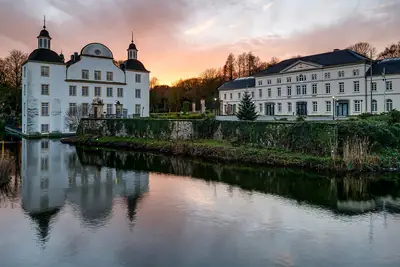
Schloss Borbeck is a Baroque moated castle in Essen’s Borbeck district. From the fourteenth century onward, it served as the preferred residence of the prince-abbesses of Essen Abbey. Its present external appearance dates from the eighteenth century, when the castle acquired its Baroque character.
Schloss Schellenberg
In the Rellinghausen district, Schloss Schellenberg stands among the Schellenberg Forest and the small streams of the Ruhr hills. Its elevated setting makes it unusual: it is one of the rare surviving examples of a former two-part moated castle built high above the surrounding landscape.
The castle has been protected as a historic monument since 1984. From 1452 until 1993, it belonged to the Barons of Vittinghoff, also known as Schell zu Schellenberg, and remained their residence until 1909.
Haus Heisingen
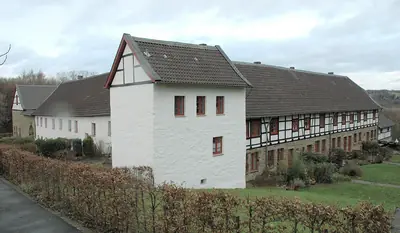
Haus Heisingen is a former knight’s estate on the right bank of the Ruhr. Its oldest surviving sections date from the twelfth century, and the estate was held as a fief of Werden Abbey. From 1458, it remained with the Staël von Holstein barons for more than two centuries.
At the beginning of the eighteenth century, the complex became a summer residence for the abbots of Werden. After secularisation, it passed to Prussia in 1815 and then into private ownership in 1890. Today, the complex contains rented apartments. Its importance to the district is reflected in Heisingen’s unofficial coat of arms, which features a simplified image of the estate.
Mineralien-Museum Kupferdreh
The Mineralien-Museum Kupferdreh grew from a local cultural project created through cooperation between the people of Kupferdreh and a major museum institution. It was established in 1984 through a partnership between Bürgerschaft Kupferdreh and the former Ruhrlandmuseum, now known as the Ruhr Museum.
The museum therefore combines a strong local foundation with a connection to Essen’s wider museum tradition.
Colosseum Theater
The Colosseum Theater occupies a converted industrial workshop in Essen’s Westviertel. The building was formerly the Eighth Mechanical Workshop of Friedrich Krupp AG, a factory hall that is now a protected historic monument.
Its transformation into a performance venue captures one of Essen’s central themes: industrial buildings given a new cultural life.
Other places to explore
Essen’s wider collection of narrated places includes the Kunsthaus Essen, an exhibition and events centre for artists in Rellinghausen; Zeche Carl, a former hard-coal mine now used as a cultural centre in Altenessen; and St. Lambertus, a protected Catholic parish church in Rellinghausen.
In Kettwig, the setting around the protected Marktkirche includes the Geusenengel and the Kaiser-Wilhelm-Denkmal. In Horst, Villa Vogelsang is a protected historic villa and former residence of the entrepreneur Wilhelm Vogelsang. Its grounds also include a former coach house, or remise. Both buildings form part of the Route of Industrial Culture.
Explore Essen with a self-guided audio guide
Neywo makes it easy to discover Essen independently. Its free Essen audio guide includes 217 narrated places, with stories available in 11 languages. Each story plays as you reach the place, at your own pace, with no group and no schedule.
The city has five walking tours, one bus route and one bike route:
- “Where Essen Began: Minster, Treasure and the Old Synagogue” — a 1.99 km walk lasting 119 minutes, with 12 narrated stops.
- “Zollverein: The Most Beautiful Coal Mine in the World” — a 3.37 km walk lasting 111 minutes, with 9 stops.
- “Werden: An Abbey Town on the Ruhr” — a 2.35 km walk lasting 83 minutes, with 8 stops.
- “Folkwang, Opera and the Südviertel” — a 3.12 km walk lasting 115 minutes, with 11 stops.
- “Kupferdreh: Where Germany’s First Railway Began” — a 3.53 km walk lasting 106 minutes, with 6 stops.
- “Bus 145: From the Main Station to Baldeney Lake” — a 14.3 km route lasting 61 minutes, with 9 stops.
- “Zollverein by Bike: The Ring Promenade” — a 1.2 km route lasting 6 minutes, with 5 stops.
Download Neywo and explore Essen as you go: from the cathedral and its treasures to Zollverein, the Ruhr valley estates and the city’s former industrial workshops. You decide the pace, the route and the stops.
Places with an audio guide in Essen
8 places in Essen with a Neywo audio guide. Each one starts telling its story as you reach it.
Self-guided tours in Essen
7 tours in Essen, free in the Neywo app. Each stop tells its story as you reach it.
- Bike ride
Zollverein by Bike: The Ring Promenade
Cycle the car-free paths of the Zollverein UNESCO World Heritage Site, freely open to cyclists. Roll from the giant coking plant past the shaft complex, the Ruhr Museum and the Red Dot Design Museum to the PACT dance centre. Give way to walkers; bikes can be hired on site.
Kokerei Zollverein · Zollverein Coal Mine Industrial Complex · Ruhr Museum · Red Dot Design Museum · PACT Zollverein
Open this tour: Zollverein by Bike: The Ring Promenade - Bus ride
Bus 145: From the Main Station to Baldeney Lake
A regular Ruhrbahn bus that runs from Haarzopf through the city centre past the Hauptbahnhof and the Aalto Theatre to Heisingen on Lake Baldeney. Ride it past Essen's Old Synagogue, Haus der Technik, the Colosseum Theater and the churches of the southern suburbs.
Saint George Church · St. Andreas · Steile Lagerung · Hauptpost Essen · Haus der Technik · Old Synagogue …
Open this tour: Bus 145: From the Main Station to Baldeney Lake - Walk
Where Essen Began: Minster, Treasure and the Old Synagogue
Start on Burgplatz, the point where the city began around a women's abbey founded in 845. Walk past a Gothic minster hiding Ottonian treasure, Essen's first Protestant church and Germany's largest cinema hall, and pass the Art Nouveau synagogue that survived as a house of Jewish culture. Finish at the old stock exchange and the rooftop sign opposite the main station.
Burgplatz · Essen Minster · Essen Cathedral Treasury · St. Johann Baptist · Marktkirche · Baedekerhaus …
Open this tour: Where Essen Began: Minster, Treasure and the Old Synagogue - Walk
Zollverein: The Most Beautiful Coal Mine in the World
Wander the UNESCO-listed Zollverein site, once Europe's most modern coking plant and mine. Visit the giant coking plant, the Bauhaus-style shaft complex, the Ruhr Museum inside the coal washing plant, the Red Dot Design Museum in a former boiler house and a dance centre in the old washhouse, then walk on into Katernberg to a church turned art space, a protected farmstead and a miners' colony.
Kokerei Zollverein · Zollverein Coal Mine Industrial Complex · Castell · Ruhr Museum · Red Dot Design Museum · PACT Zollverein …
Open this tour: Zollverein: The Most Beautiful Coal Mine in the World - Walk
Werden: An Abbey Town on the Ruhr
Walk through one of the oldest parts of Essen, where Saint Liudger founded a monastery around 800. Start at the old Ruhr lock, see a knight's seat, a Romanesque basilica, one of Germany's oldest parish churches, a Protestant church with a surprisingly rich interior and the ruins of medieval Werden.
Schleuse Neukirchen · Haus Heck · St. Lucius (Werden) · Evangelische Kirche Werden · Werden Abbey · St.-Ludgerus Basilica …
Open this tour: Werden: An Abbey Town on the Ruhr - Walk
Folkwang, Opera and the Südviertel
From the modern art of Museum Folkwang walk through Essen's Südviertel past Bauhaus-era offices and Max Bill's infinite loop to the lively Isenbergplatz, a church turned choir centre, the Philharmonic and the Aalto opera house. End at a bronze miners' monument and a 1960s high-rise by the station.
Museum Folkwang · Soul of Africa Museum · Glückaufhaus · Steag-Zentrale · Unendliche Schleife · Isenbergplatz …
Open this tour: Folkwang, Opera and the Südviertel - Walk
Kupferdreh: Where Germany's First Railway Began
Follow the Ruhr valley's industrial past in Kupferdreh. See the old station beside the start of Germany's first railway, a small mineral museum, a red-brick church and a Neo-Gothic sandstone church, then walk into the Deilbach valley to the Kupferhammer, a former copper hammer mill.
Haus Heisingen · Old Kupferdreh station · Mineralien-Museum Kupferdreh · Christuskirche Kupferdreh · St. Mariä Geburt (Essen) · Kupferhammer
Open this tour: Kupferdreh: Where Germany's First Railway Began
Walk Essen with Neywo
Neywo turns Essen into a self-guided audio tour. Stories arrive as you reach the place they belong to, and the route reshapes when you wander off it.

