Visiting Aachen, Germany: Top Sights on Foot
Things to Do in Aachen: Historic Gates, Thermal Springs and Charlemagne’s City
Aachen is a historic city in North Rhine-Westphalia, shaped by Charlemagne, medieval trade, thermal springs and a lively modern cultural scene. The city’s compact centre brings together Aachen Cathedral, the former imperial palace, preserved city gates, museums and elegant spa architecture. Neywo offers a free audio guide for Aachen with 213 narrated places.
What to See in Aachen
Aachen Cathedral
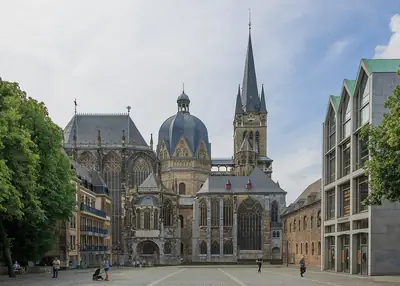
Aachen Cathedral began as Charlemagne’s Palatine Chapel, constructed between 795 and 803 as the centre of his imperial palace. Its Carolingian octagon was modelled on the Byzantine church of San Vitale in Ravenna, and its dome’s height and diameter both measure one hundred Carolingian feet.
Charlemagne was buried here in 814. From 936 to 1531, thirty-one German kings and twelve queens were crowned at the cathedral, and the throne used for these ceremonies still stands in the octagon. More than twelve hundred years of additions and changes have created a building in which Carolingian, medieval and later history remain visible together.
Aachen Town Hall and the Centre Charlemagne
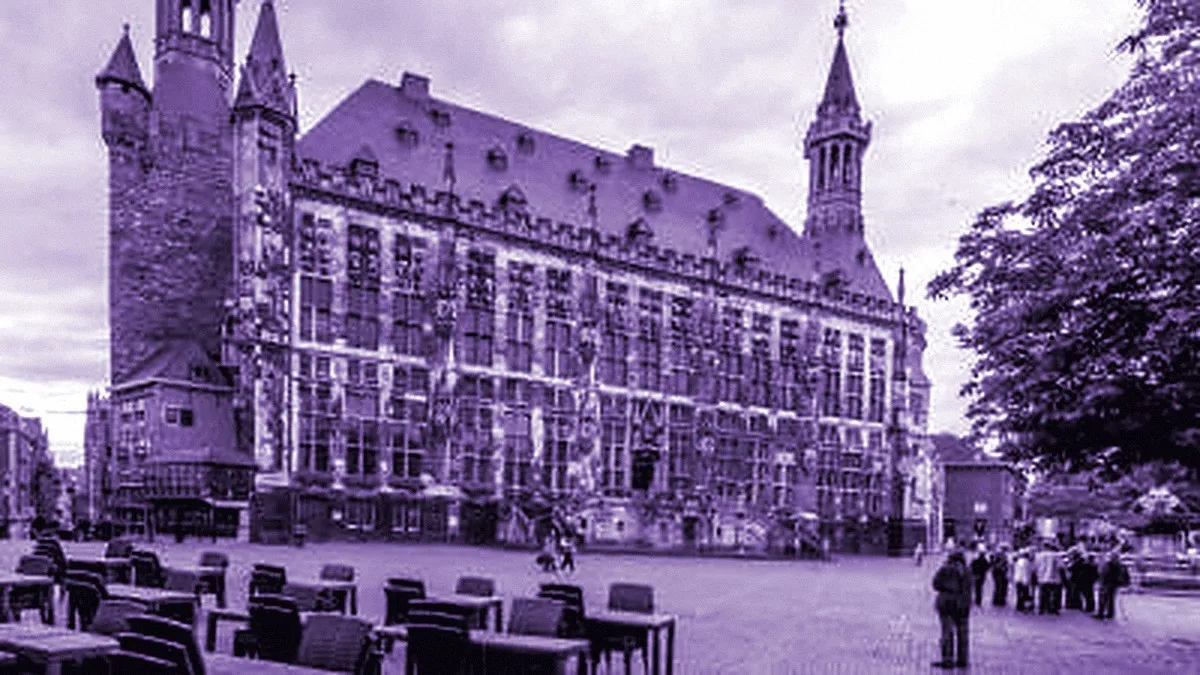
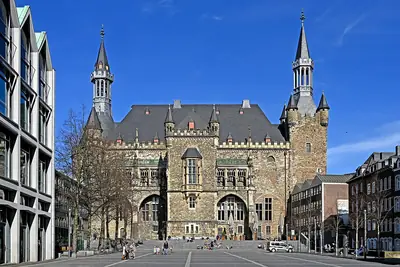
Opposite the cathedral, Aachen Town Hall stands between Katschhof and Market squares on foundations belonging to Charlemagne’s palace. Built in the first half of the fourteenth century, it incorporated parts of the earlier imperial complex, including older masonry still visible on the south wall.
The Coronation Hall recalls the imperial ceremonies that followed royal coronations in the cathedral. Inside are replicas of the imperial crown, sword and gospel book associated with those ceremonies. A fire in 1656 led to the rebuilding of the roof and towers, adding another layer to the building’s long history.
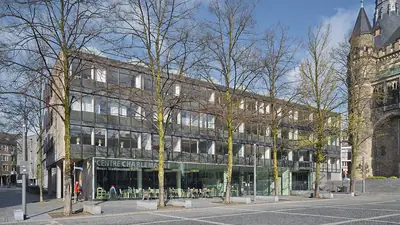
Across Katschhof Square, the Centre Charlemagne presents Aachen’s story as a chronological journey. Its permanent exhibition begins with the first settlements attracted by the hot springs and continues through Charlemagne’s choice of Aachen as an imperial residence and the city’s role as a coronation capital. The museum occupies a modern glass building that began life as a municipal administrative office in the late 1950s and received its sweeping façade in 2009.
Ponttor and Marschiertor
Aachen’s medieval fortifications are best represented by two surviving gates. Ponttor was built in the early fourteenth century as the westernmost northern entrance. It stood on the trade routes towards Maastricht and Liège, where merchants and travellers passed through inspections and paid taxes. Its fore-gate, round towers, narrow passage and defensive openings show how carefully the entrance was designed for protection.
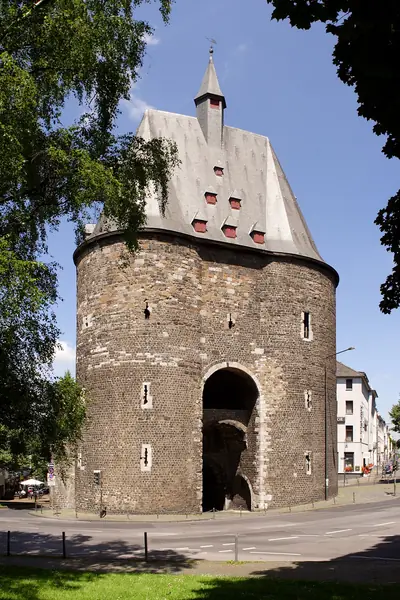
Marschiertor guarded the southern entrance to the city’s outer fortifications. Construction began around 1257, and the gate was completed shortly after 1300. Its name refers to the troops who once marched through it. Two large round towers flank the passage, while the surviving drawbridge grooves, vaulted gateway and guardrooms reveal the building’s military purpose.
Elisenbrunnen and Aachen’s spa heritage
The Elisenbrunnen is the architectural symbol of Aachen’s thermal tradition. Johann Peter Cremer designed the neoclassical colonnade with Karl Friedrich Schinkel, and it was built between 1824 and 1827 under the supervision of Andreas Hansen.
Doric columns frame two pavilions, each containing a drinking fountain supplied with thermal water. In the nineteenth century, the colonnade became a meeting place for European royalty, politicians and artists who came to Aachen to take the waters. Although badly damaged during the Second World War, it was restored and remains one of the city’s best-known landmarks.
Ludwig Forum für Internationale Kunst
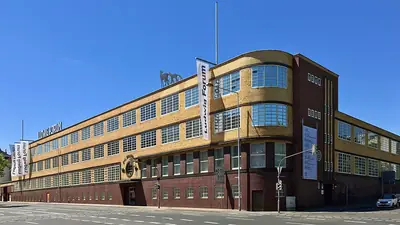
For a different side of Aachen, visit the Ludwig Forum for International Art. The museum’s collection grew from the work of Irene and Peter Ludwig, whose interests included artists from Europe and the United States. The museum opened in 1991 inside a former umbrella factory dating from the early twentieth century.
The industrial structure was retained, giving the galleries high ceilings and broad, open rooms suited to installations, video works and large-scale contemporary art. Pop Art has a particularly strong presence, including works by Andy Warhol and Roy Lichtenstein.
Frankenberg Castle
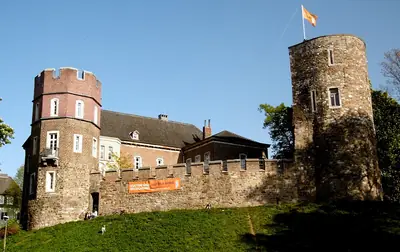
Frankenberg Castle is a thirteenth-century water castle in the Frankenberg quarter, between Burtscheid and Forst. Built on marshy ground, it was designed with thick walls, a central tower and surrounding water. Its role was primarily administrative and residential rather than that of a major military fortress, and it became a fief of the Counts, later Dukes, of Jülich, Cleves and Berg.
After falling into ruin in the eighteenth century, the castle was restored between 1834 and 1838. The restoration added Gothic-style details reflecting nineteenth-century Romantic taste; some of these additions were removed in 1971 to bring the building closer to its earlier appearance.
Aachen’s churches and quieter landmarks
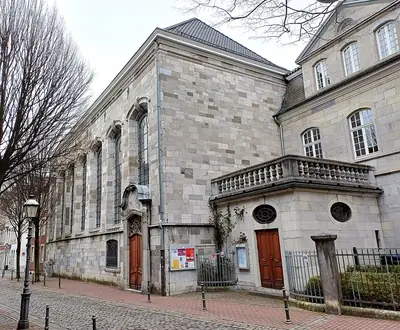
Aachen’s architectural story extends beyond its best-known monuments. Annakirche began as the church of a Benedictine monastery founded in 1511 and consecrated in 1532. After Napoleon’s secular reforms dissolved the monastery in 1803, it became a Protestant church. Its Baroque exterior reflects a redesign around 1748 by Johann Joseph Couven, while the interior was reconstructed after wartime damage in 1950 and 1951.
Dreifaltigkeitskirche stands on the former boundary between Aachen and Burtscheid. Built between 1897 and 1899 in Neo-Gothic style, it was heavily damaged during the Second World War. Its restored exterior contrasts with a simpler, brighter interior, and the church is also known for its acoustics and organ and choir concerts.
St. Fronleichnam, built between 1929 and 1930, is the most celebrated work of architect Rudolf Schwarz. Its clean lines and deliberate simplicity made it an important example of modern sacred architecture.
Outside the centre, Burg Orsbach recalls a fortified site whose roots reach back to the Carolingian era. Nearby, St. Peter serves as the parish church of Orsbach. Other historic estates include Soerser Haus, a former water-castle manor house at the southern edge of the A4 motorway, and Schloss Schönau in Richterich, largely a brick building from 1732 with origins reaching back to a lordship granted in 1244.
Explore Aachen with a Self-Guided Audio Tour
Neywo’s Aachen audio guide includes five walking tours, one bus route and one bike route. Together, they offer different ways to explore the city’s imperial centre, spa quarter, medieval walls, parks and southern districts:
- Five walking tours, ranging from 1.05 to 4.11 km and from 79 to 111 minutes, with between 7 and 12 narrated stops
- One 7.1 km bus route, lasting 30 minutes and featuring 9 stops
- One 5.3 km bike route, lasting 26 minutes and featuring 7 stops
The walks include Charlemagne’s palace, the cathedral and town hall; Aachen’s fountains and spa landmarks; the medieval gates and towers; the Stadtgarten and Ludwig Forum; and the Burtscheid abbey quarter. The bus and bike routes add further stops around the medieval ring and Aachen’s southern ring.
Download Neywo and explore Aachen at your own pace. The app tells the story of each place as you reach it, with no group and no schedule. Narration is available in 11 languages, and you can choose between walking, bus and bike routes as you discover the city.
Places with an audio guide in Aachen
8 places in Aachen with a Neywo audio guide. Each one starts telling its story as you reach it.
Self-guided tours in Aachen
7 tours in Aachen, free in the Neywo app. Each stop tells its story as you reach it.
- Bike ride
Along Aachen's southern ring: Kaiserplatz to the Lavenstein and beyond
Follow the cycle lanes that skirt the old town from the Kaiserplatz and its 1,000-year-old church, past the station square and the mighty Marschiertor, to the Lavenstein tower of the old outer wall. Then roll on west to a Franciscan church and the strikingly modern Genezareth church.
St. Adalbert · Redemptoristenkloster Aachen · Bahnhofplatz · Marschiertor · Lavenstein · Klosterkirche St. Franziskus …
Open this tour: Along Aachen's southern ring: Kaiserplatz to the Lavenstein and beyond - Bus ride
Bus 3A: The Medieval Ring Ride
ASEAG's circular line 3A runs around the old town along the line of the medieval wall. Ride past the modern Genezareth church, the Lavenstein tower and the Marschiertor gate, the Suermondt-Ludwig art museum, the Kaiserplatz emperor, the Marienturm and the Ponttor, and end at the Bilal Mosque.
Genezareth-Kirche · Lavenstein · Marschiertor · Bahnhofplatz · Suermondt-Ludwig-Museum · Friedrich III. Denkmal …
Open this tour: Bus 3A: The Medieval Ring Ride - Walk
In Charlemagne's Footsteps: Palace, Throne and Town Hall
Aachen was the favourite home of Charlemagne, and thirty-one German kings were crowned here. Walk from the playful Chicken Thief fountain to the Katschhof, the old palace courtyard, then through the town hall, the Carolingian cathedral with its marble throne, its cloister and its treasury. The walk ends at the Grashaus, the city's very first town hall.
Hühnerdieb · Puppenbrunnen · St. Foillan · Galerie S. · Karlsbrunnen · Aachen Town Hall …
Open this tour: In Charlemagne's Footsteps: Palace, Throne and Town Hall - Walk
Spa Water, Stage and Fountains
Aachen's hot springs made it a spa town. Start at the Suermondt-Ludwig art museum, pass Schinkel's neoclassical theatre and the Elisenbrunnen colonnade where sulphur water still flows, then follow the town's fountains: a bronze money cycle, a Gothic column in front of the cathedral and a medieval drinking fountain that works again.
Suermondt-Ludwig-Museum · Synagoge Aachen · Klenkes · Theater Aachen · Elisenbrunnen · Ursulinenkloster Aachen …
Open this tour: Spa Water, Stage and Fountains - Walk
Gates and Towers of the Medieval Wall
Of Aachen's eleven medieval city gates only two remain, and both are on this walk. Start at the Ponttor, follow the surviving wall towers past a pilgrim church that is the first stop on the Camino to Santiago, and end at the Marschiertor, the marching gate built for war.
Ponttor · Marienturm · Langer Turm · Pfaffenturm · St. Jakob · Roskapellchen …
Open this tour: Gates and Towers of the Medieval Wall - Walk
Stadtgarten and the Ludwig Forum: Aachen's art and park quarter
Leave the medieval core for the city park, where a travelled monument, a baroque garden staircase and a young art association sit among spa-era lawns. Start at a church reborn as a cultural venue and the Ludwig Forum, a modern-art museum in a former umbrella factory, and finish at one of Aachen's oldest parish churches.
St. Elisabeth · Ludwig Forum für Internationale Kunst · Ballerina Clown · Kongressdenkmal · Neuer Aachener Kunstverein · Guaita’sche Gartentreppe …
Open this tour: Stadtgarten and the Ludwig Forum: Aachen's art and park quarter - Walk
Burtscheid: the abbey quarter above the valley
A quiet district with its own history as an independent imperial abbey. Walk past a chapel on a corner, the fountain at the abbey square and the former abbey church of St John, then follow the stone arches of the railway viaduct to the Trinity Church and the moated Frankenberg Castle.
Marienkapelle Burtscheid · Couvenwandbrunnen · St. John's Church, Aachen-Burtscheid · St. Michael · Burtscheider Viadukt · Dreifaltigkeitskirche …
Open this tour: Burtscheid: the abbey quarter above the valley
Walk Aachen with Neywo
Neywo turns Aachen into a self-guided audio tour. Stories arrive as you reach the place they belong to, and the route reshapes when you wander off it.

