What to See in Düsseldorf, Germany: Free Audio Guide
Things to Do in Düsseldorf: Churches, Palaces and the Historic Old Town
Düsseldorf is a city of historic churches, former aristocratic residences, listed castles and cultural venues, with many of its best-known landmarks concentrated in and around the Altstadt. From St. Lambertus and the Jan-Wellem monument to quieter sites beyond the centre, there is plenty to discover on foot. Neywo offers a free audio guide for Düsseldorf with 118 narrated places.
What to See in Düsseldorf
St. Lambertus and the Jan-Wellem monument
St. Lambertus is one of the defining landmarks of Düsseldorf’s Altstadt and is described as the city’s oldest building. Construction began in 1288, the year Düsseldorf was officially founded, and the church was consecrated in 1394. Its interior includes the tomb of Wilhelm V of Julich-Kleve-Berg, a Gothic tabernacle and several distinctive statues.
Nearby, on the Marktplatz, the Jan-Wellem-Reiterstandbild shows Johann Wilhelm, known locally as Jan Wellem, in armour with an electoral hat and marshal’s baton. Created by Gabriel Grupello, the equestrian monument was set up in 1711 and remains one of Düsseldorf’s landmarks. A second Jan-Wellem statue, also by Grupello, stands inside the Town Hall.
Church of St. Andrew
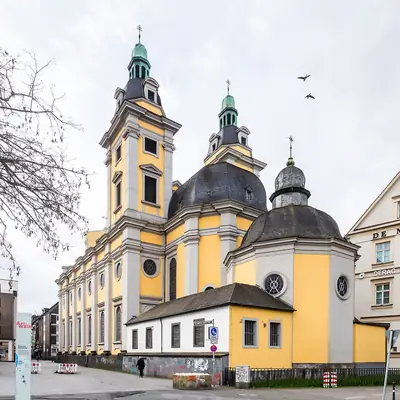
The Church of St. Andrew, or St. Andreas-Kirche, stands in the centre of the Altstadt. Built between 1622 and 1629 as a Jesuit and court church, it later became a parish church and then a monastery church connected with the Dominican Friars.
The building is regarded as an important transition between the German Renaissance and the Baroque era. Inside, sculptures of apostles and saints accompany the mausoleum associated with Johann Wilhelm and other Electors Palatine. The original high altar was destroyed during the Second World War and later replaced with one designed by Ewald Matare. Paintings by Ernst Degar can be found in the side chapels.
Neanderkirche
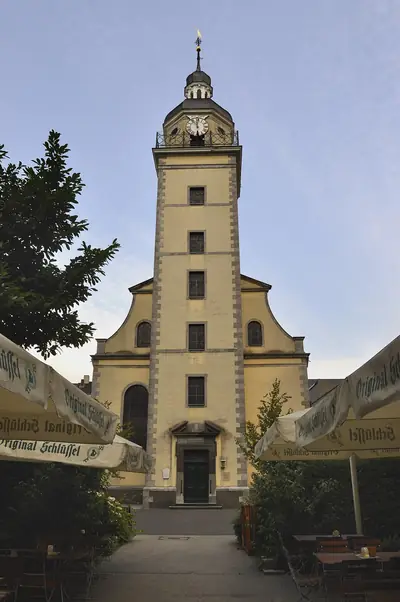
On Bolkerstraße, the Neanderkirche is the oldest Protestant church in Düsseldorf. Completed in 1687, this early Baroque building was named after Joachim Neander, a Reformed minister and hymn writer.
The church was initially designed to remain unobtrusive, reflecting opposition to its construction, but it later became a prominent Altstadt landmark. Its renowned acoustics make it a venue for chamber music and organ concerts. The Rieger organ, installed in 1965, is associated with the church’s musical programme.
Berger Kirche
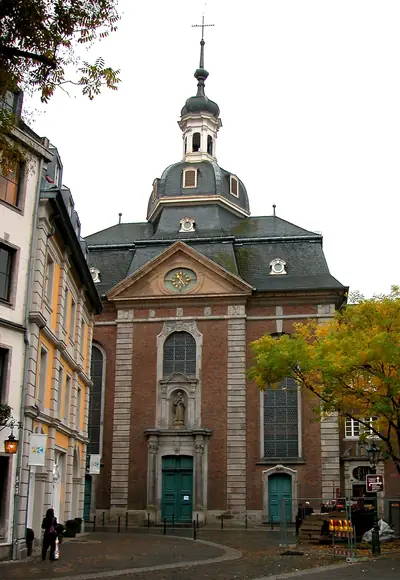
The Berger Kirche was the first Lutheran church built in Düsseldorf. Construction took place between 1683 and 1687, and the church was inaugurated on August 31, 1687, as a court church set away from the main streets.
Its exposed red-brick exterior and simple hall-church layout have a late German Renaissance character, while the interior was richly redesigned during the Baroque period. War damage in 1943 led to a later reconstruction in the 1960s, and the church was rededicated in 1966. Since 2003, it has belonged to Diakonie Düsseldorf.
St. Maximilian and Maxhaus
In the Carlstadt district, St. Maximilian is a late Baroque church with an imposing steeple. It developed from a Franciscan monastery founded in the 17th century, and the church itself was built in the 18th century. After the monastery was abolished in 1804, St. Maximilian became a parish church.
Inside, look for the bronze eagle lectern from 1449, originally made for Altenberg Cathedral, and choir stalls from an earlier 17th-century church. Fourteen oil paintings by Heinrich Nuttgens, created in 1903, form a dramatic Way of the Cross along the side walls. The former monastery building next door is now known as the Maxhaus.
Kreuzherrenkirche
At the corner of Ursulinengasse and Ratinger Straße, the Kreuzherrenkirche recalls the long religious history of Düsseldorf’s old centre. Its origins reach back to a chapel of Our Lady that stood outside the city fortifications as early as 950. A hospital for pilgrims and the poor was later established on the site.
The Brothers of the Cross took over in 1407, and construction connected with today’s Order of the Cross Church followed an instruction from Duke Gerhard I in 1443. The building grew in stages, including the addition of two naves in the late 15th century—one for parish life and one for pilgrims. Today, it serves as a school church and auditorium.
Palais Wittgenstein
Palais Wittgenstein is an 18th-century city palace in Carlstadt that once served as a residence for the Wittgenstein family. Following renovation between 1974 and 1976, it became a city cultural centre.
The palace brings several cultural uses together: a chamber music hall, the Düsseldorf marionette theatre and the Institut Français Düsseldorf. It also contains a Jugendstil cafeteria in historic Art Nouveau interiors. Performances take place at the venue, giving the former residence an active cultural role.
Kaiser-Wilhelm-Denkmal
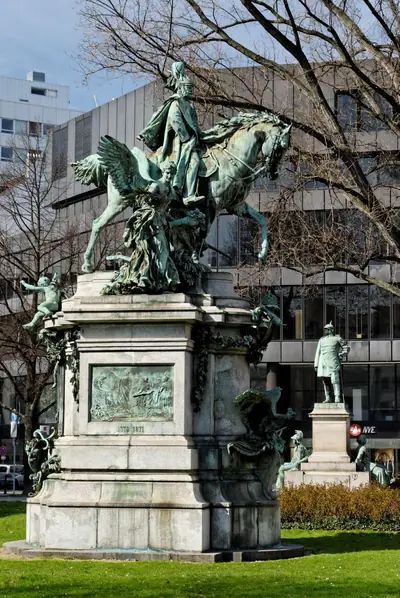
The Kaiser-Wilhelm-Denkmal is an equestrian monument to Kaiser Wilhelm I, presented as the “founder of the empire.” The emperor appears as a general on horseback, accompanied by bronze figures representing the “geniuses of war and peace.”
The granite base is decorated with cartouches, coats of arms and emblems associated with the German Empire, Prussia and Düsseldorf. Two bas-reliefs represent the fall of the Holy Roman Empire and the founding of the empire in 1871. Planned in 1888 and inaugurated on October 18, 1896, the monument was created by Karl Janssen, a sculptor and professor at the Düsseldorf Art Academy.
Quadenhof
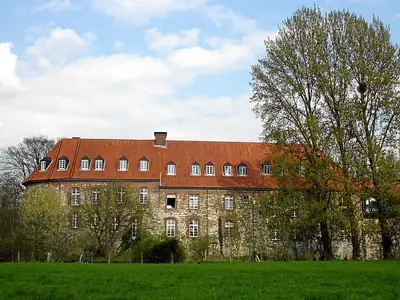
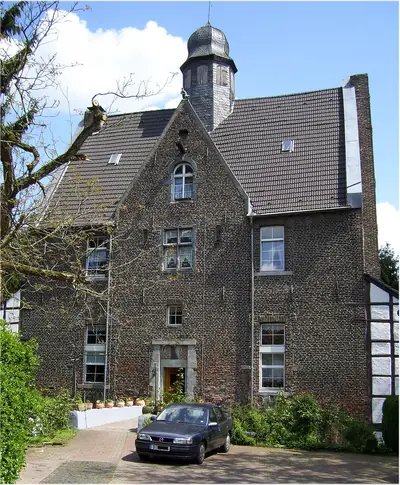
At Gerricusplatz 23 in Düsseldorf-Gerresheim, the Quadenhof is one of the area’s few surviving late-medieval secular brick buildings. It was built between 1427 and 1436 for Godert von Broichhusen.
Its name comes from the Quad von Raede family, who received the property through marriage in 1458. The surviving brickwork makes the Quadenhof a particularly rare example of late-medieval secular brick architecture in the Düsseldorf area.
Schloss Kalkum
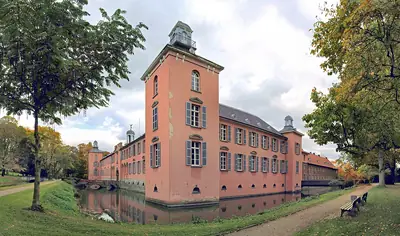
Schloss Kalkum is a water castle in the northern Düsseldorf district of the same name. Together with its castle park, it has been a listed landmark since January 1984 and is regarded as an exceptional example of Classicism in the Rhineland.
The estate grew from one of the region’s oldest knights’ seats, associated with the lords von Kalkum. After passing to the lords von Winkelhausen in the 15th century, it was transformed into a Baroque castle in the 17th century. Its present exterior largely results from a classicist conversion carried out between 1808 and 1814, when Georg Peter Leydel connected the outer bailey and manor house into a closed four-winged complex. Maximilian Friedrich Weyhe designed the surrounding park in the English landscape style.
Burg Angermund and Schloss Eller
In Angermund, Burg Angermund—also called Kellnerei or Alte Kellnerei—is a water castle on the Angerbach and one of Düsseldorf’s important listed buildings. Cologne’s rulers and the Counts of Berg used it as a territorial stronghold for centuries. After the Duchy of Berg ended in 1806, the complex was used mainly for agriculture before being converted into a modern residential development between 1982 and 1985.
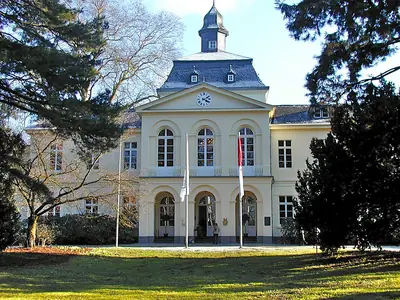
Schloss Eller, long known as Haus Eller, has the appearance of a manor house. The present building dates from 1826 and was erected on the site of a medieval water castle.
St. Suitbertus and Urdenbacher Dorfkirche
St. Suitbertus is a Catholic church in Düsseldorf-Kaiserswerth, built as a flat-roofed, three-aisled pillar basilica. The church was added to the list of protected monuments of history and architecture on December 23, 1982.
In Urdenbach, the Evangelical Urdenbacher Dorfkirche was dedicated in 1695 and is considered one of Düsseldorf’s oldest Evangelical churches.
Explore Düsseldorf with a Self-Guided Audio Tour
A Düsseldorf self-guided walking tour lets you explore the city without joining a group or following a fixed schedule. Neywo has six walking tours and one bus route, with narration available in 11 languages.
The walks include:
- The palaces and churches of the Altstadt: 1.29 km, 125 minutes and 12 narrated stops.
- Burgplatz, St Lambertus and the art academy: 1.14 km, 115 minutes and 12 stops.
- Pempelfort, Schloss Jägerhof and the Hofgarten: 5.33 km, 176 minutes and 12 stops.
- The Rhine promenade and the city museum: 1.21 km, 56 minutes and 6 stops.
- The opera house and the K20 collection: 0.73 km, 32 minutes and 4 stops.
- The longer Altstadt route: 1.94 km, 180 minutes and 15 stops.
There is also a bus route from Medienhafen to the Rhine Promenade, covering 2.1 km in 9 minutes with 5 narrated stops. The app tells the story of each place as you reach it, at your own pace, with no group and no schedule.
Download Neywo and explore Düsseldorf with its free audio guide. You can also continue discovering North Rhine-Westphalia and nearby cities such as Cologne, Essen and Duisburg.
Places with an audio guide in Düsseldorf
8 places in Düsseldorf with a Neywo audio guide. Each one starts telling its story as you reach it.
Self-guided tours in Düsseldorf
7 tours in Düsseldorf, free in the Neywo app. Each stop tells its story as you reach it.
- Bus ride
Bus 726: Medienhafen to the Rhine Promenade
Rheinbahn bus 726 links the Gehry buildings of the Medienhafen with the Rhine embankment and the Altstadt's churches. Ride it past Hubertus-Stift, Villa Horion and the Mannesmann building to Maxplatz.
Neuer Zollhof · Hubertus-Stift · Villa Horion · Mannesmann-Haus · St. Maximilian
Open this tour: Bus 726: Medienhafen to the Rhine Promenade - Bus ride
Bus 726 · the Medienhafen and the Rhine bank
Board at Rheinturm, alight at Maxplatz. 5 narrated places along the way: Neuer Zollhof, Hubertus-Stift, Villa Horion, Mannesmann-Haus, St. Maximilian.
Neuer Zollhof · Hubertus-Stift · Villa Horion · Mannesmann-Haus · St. Maximilian
Open this tour: Bus 726 · the Medienhafen and the Rhine bank - Walk
Burgplatz, St Lambertus and the art academy
The old town on the Rhine: the surviving castle tower with the maritime museum inside, the old town hall and the Jan Wellem statue, the twisted spire of St Lambertus, and the academy where Beuys and Richter taught.
Jan-Wellem-Denkmal · Altes Rathaus Düsseldorf · Burgplatz · Schifffahrtsmuseum · Schlossturm · Stadterhebungsmonument …
Open this tour: Burgplatz, St Lambertus and the art academy - Walk
Pempelfort: Schloss Jägerhof and the Hofgarten
Five kilometres through the park and the quarter north of it — the rococo Jägerhof palace that now holds the Goethe museum, the artists' club Malkasten, the Kaiser Wilhelm and Bismarck monuments, and four nineteenth-century churches.
Karl-Arnold-Haus · Florapark · Friedenskirche · St. Peter · Ständehaus · Kaiser-Wilhelm-Denkmal …
Open this tour: Pempelfort: Schloss Jägerhof and the Hofgarten - Walk
The Rhine promenade and the city museum
Three kilometres along the buried motorway that became a riverside walk — the maritime museum in the castle tower, the city museum, the Carlsplatz market, and the art space inside the tunnel.
Hubertus-Stift · Villa Horion · Kunst im Tunnel · Mannesmann-Haus · Stadtmuseum Düsseldorf · Carlsplatz
Open this tour: The Rhine promenade and the city museum - Walk
The opera house and the K20 collection
Seven hundred metres and the city's two big cultural stops: the opera and the Kunstsammlung Nordrhein-Westfalen, whose Klee holdings are among the best anywhere.
Tritonenbrunnen in Düsseldorf · Schadow-Denkmal · Opernhaus Düsseldorf · Kunstsammlung Nordrhein-Westfalen
Open this tour: The opera house and the K20 collection - Walk
The Ultimate Düsseldorf: the palaces and churches of the Altstadt
Under two kilometres through the whole old town — two baroque palaces, five churches including St Lambertus and the Kreuzherrenkirche, the Heine house and the Marian column.
Jan-Wellem-Denkmal · Altes Rathaus Düsseldorf · Schlossturm · St. Lambertus · Josephskapelle Düsseldorf · Kreuzherrenkirche …
Open this tour: The Ultimate Düsseldorf: the palaces and churches of the Altstadt
Walk Düsseldorf with Neywo
Neywo turns Düsseldorf into a self-guided audio tour. Stories arrive as you reach the place they belong to, and the route reshapes when you wander off it.

