Things to Do in Bonn, Germany: Walking Guide
Things to Do in Bonn: Beethoven, History and the Rhine
Bonn is a historic city on the Rhine, known as Beethoven’s birthplace and as the former seat of West Germany’s government. The best things to do in Bonn range from exploring Romanesque churches and Baroque palaces to tracing the political history of the Federal Republic. Neywo offers a free audio guide for Bonn with 461 narrated places.
Part of North Rhine-Westphalia and one of Germany’s most distinctive cultural cities, Bonn combines music, university life, museums and leafy historic districts. Its compact centre is especially rewarding to explore on foot, while the former government quarter extends along the Rhine.
What to see in Bonn
Beethoven House
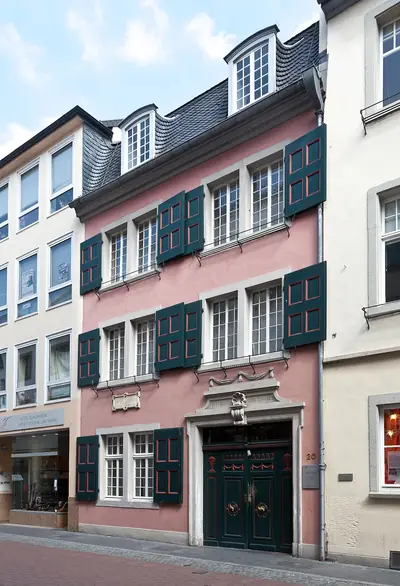
Beethoven House is the birthplace of Ludwig van Beethoven on Bonngasse. Beethoven was born here in December 1770, and the building is one of the few surviving 18th-century houses in Bonn.
The house has been preserved as a memorial, museum and cultural centre since the Beethoven-Haus Association acquired it in 1889. Its Baroque façade, older cellars and modest domestic rooms offer a direct connection with the composer’s early life. The Beethoven family lived here only until 1774, but the building later served as a grocery, beer garden, concert hall and restaurant before its restoration.
Beethoven Monument
On Münsterplatz, the Beethoven Monument presents the composer in bronze at the heart of Bonn. It was unveiled on 12 August 1845, during a four-day celebration that included music, dancing and fireworks and became the first Beethovenfest.
The monument is the oldest Beethoven monument in Germany. Its base represents four forms of music associated with Beethoven: instrumental, opera, spiritual and symphonic. The square also provides a memorable view towards the towers of Bonn Minster.
Bonn Minster
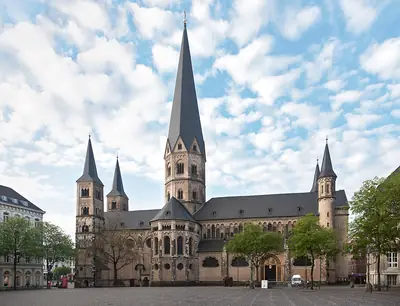
Bonn Minster is one of Germany’s oldest churches and a defining landmark of the city. The present Romanesque basilica took shape between the 11th and 13th centuries on a site that had previously held a Roman temple and necropolis.
The church is dedicated to Saints Cassius and Florentius, Roman soldiers traditionally associated with the Theban Legion. Five towers give the Minster its distinctive silhouette, with the central towers rising to 81 metres. Inside, the long history of the site is reflected in the building’s Romanesque structure and earlier religious foundations.
Fontainen-Obelisk and the Old Town Hall
The Fontainen-Obelisk stands in front of Bonn’s Old Town Hall on the Market Square. The slender stone monument rises from a shallow pool and was once topped by a ceremonial elector’s hat, or Kurhut.
Napoleon’s soldiers knocked off the crown during the French occupation. It was never replaced, which explains why Bonn residents came to call the fountain simply the Obelisk. The surrounding square, with its civic architecture and cafés, remains one of the city’s central public spaces.
St. Helena-Kapelle
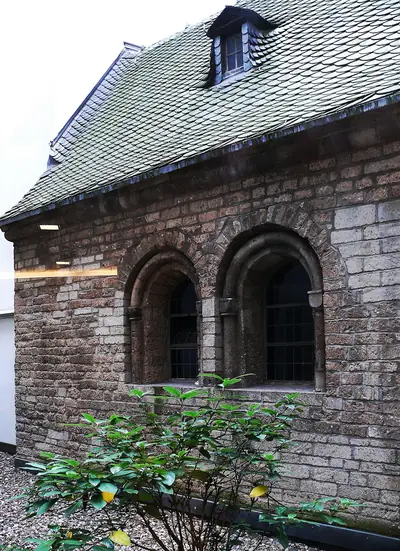
Hidden behind the shops of the city centre, St. Helena-Kapelle is a small Romanesque chapel built around 1160. It is the only preserved Romanesque house chapel of a collegiate curia in the Rhineland.
The chapel measures only three and a half by three and a half metres. Its intimate interior includes a cross vault, a semicircular apse and original 12th-century floor tiles. The building was damaged during the bombardment of Bonn in 1689 and restored from 1752 onwards.
St Remigius’ Church
St Remigius’ Church on Brüdergasse is a Gothic three-nave pillar basilica consecrated in 1307. Built by the Franciscan Order, it has no bell tower, reflecting the mendicant tradition’s preference for simplicity.
The church’s cross-ribbed vault dates from 1317 and is made from local tuff stone. It also has a special connection with Beethoven: as a boy, he substituted for the main organist and was formally engaged as assistant organist by the age of 13.
Electoral Palace and the Hofgarten
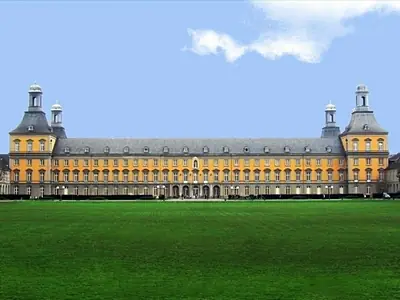
The Electoral Palace is the former residence of the Prince-Electors of Cologne and is now the heart of the University of Bonn. Joseph Clemens of Bavaria commissioned the Baroque palace, built between 1697 and 1705 to designs by Enrico Zuccalli.
The palace stands beside the Hofgarten, its spacious court garden. Today the green space is closely associated with student life, but it has also been the setting for major public events, including the peace demonstration of October 1981.
Hammerschmidt Villa
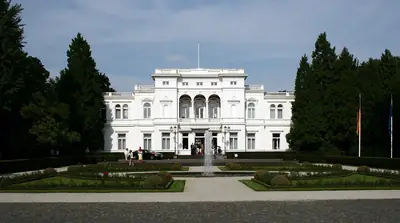
The Hammerschmidt Villa was the primary official residence and office of the President of the Federal Republic of Germany from 1950 to 1994. Because of its role in the young republic, it became known as the White House of Bonn.
The neoclassical villa was designed in 1860 by August Dieckhoff as a private home for a wealthy industrialist. Today it remains the president’s secondary official residence. It forms one of the most important stops in Bonn’s former government district.
Palais Schaumburg
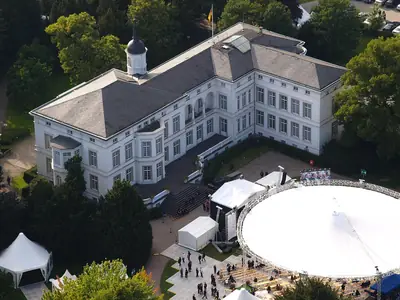
Palais Schaumburg was the first official seat of the Federal Chancellery from 1949 to 1976. It was the working centre of the chancellors of the young Federal Republic, from Konrad Adenauer to Helmut Schmidt.
The building began as a villa constructed between 1858 and 1860 before being expanded into a palace-like neoclassical residence. After the new Chancellery opened, Palais Schaumburg took on ceremonial and representative roles and later served again as the Chancellor’s secondary seat.
Altes Wasserwerk
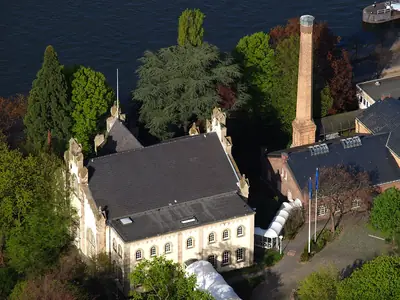
The Altes Wasserwerk began as a late-19th-century complex built to supply Bonn with drinking water. Its industrial brick architecture still reflects that original purpose.
From 1986 to 1993, however, the former pump house served as the plenary chamber of the German Bundestag while the permanent parliament building was being renovated. Its later conversion into offices and conference rooms leaves the building with a distinctive place in Bonn’s parliamentary history.
Museum Alexander Koenig
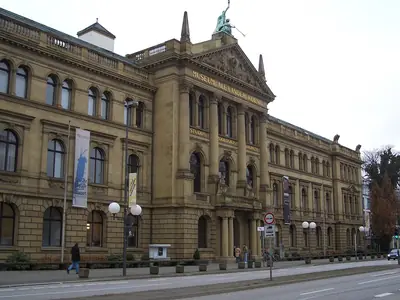
Museum Alexander Koenig, on Bonn’s Museum Mile, combines a natural history museum with a research institute. Its main exhibition, Our Blue Planet – Living in a Network, uses detailed dioramas to present environments ranging from African savannahs and tropical rainforests to polar regions, deserts and European habitats.
The museum also played a role in German political history. On 1 September 1948, its main hall hosted the ceremonial opening of the Parliamentary Council, which was responsible for drafting the Basic Law of the Federal Republic.
Other historic places to explore
Bonn’s musical and architectural heritage continues beyond the centre. The Ernst-Moritz-Arndt-Haus, close to the Rhine in Südstadt, is the city’s first Rhine villa and a protected 19th-century heritage site. The Kurfürstliches Gärtnerhaus in Weststadt is a modest Baroque building that once housed the head gardener of the electoral nursery.
In Endenich, Schumannhaus Bonn commemorates Robert Schumann, who spent the final years of his life in a private psychiatric clinic housed in the building. The site now contains a museum and the city’s music library.
Burg Medinghoven, in the Hardtberg district, began as a medieval water castle before being replaced after 1834 by the neo-Gothic manor house that stands today. Its northern wing was added in 1896, and the property is now protected as a historic monument.
Explore Bonn with a self-guided audio tour
A Bonn self-guided walking tour lets you follow the city’s history without joining a group. Neywo has six walking tours, one bus route and one bike route in Bonn, with narration available in 11 languages.
The walks include:
- Beethoven’s Bonn: Market, Minster and a Baptism — 1.14 km, 112 minutes and 10 narrated stops
- Capital Without a Crown: West Germany’s Parliament Quarter — 2.61 km, 114 minutes and 11 stops
- Chancellors, Villas and the White House on the Rhine — 2.06 km, 114 minutes and 11 stops
- Prince-Electors and Students: The University and the Rhine Bank — 2.41 km, 108 minutes and 11 stops
- Bad Godesberg: Castle Hill, Spa Park and Villa Avenue — 2.78 km, 100 minutes and 12 stops
- Poppelsdorf to the Old Cemetery: Palaces, Museums and Macke — 3.02 km, 108 minutes and 11 stops
There is also a 3.8 km bus route lasting 16 minutes with nine narrated stops, and a 3.4 km bike route lasting 17 minutes with 10 stops.
Download Neywo and explore Bonn at your own pace. The app tells the story of each place as you reach it, with no group and no schedule—an easy way to turn a visit into a free audio guide experience. When you have explored Bonn, continue through the region with Cologne, Aachen or Düsseldorf.
Places with an audio guide in Bonn
8 places in Bonn with a Neywo audio guide. Each one starts telling its story as you reach it.
Self-guided tours in Bonn
8 tours in Bonn, free in the Neywo app. Each stop tells its story as you reach it.
- Bike ride
Museum Mile and the Rhine: Along the Old Government Quarter
A short, flat ride on Bonn's cycle lanes from the old waterworks, where the Bundestag once sat, past the Hammerschmidt villa, the riverside villas, the Alexander Koenig museum and Palais Schaumburg to the House of History, the Kunstmuseum and the Tulpenfeld. Good for seeing the Bonn of 1949 to 1990 without walking.
Altes Wasserwerk · Hammerschmidt Villa · Villa Ingenohl · Ernst-Moritz-Arndt-Haus · Synagogue Bonn · Museum Alexander Koenig …
Open this tour: Museum Mile and the Rhine: Along the Old Government Quarter - Bus ride
Bus 604 Through Bonn: From the Nordstadt to the Old Town
Ride SWB bus 604 from Bonn's Nordstadt into the old town and out to the Weststadt. You pass St. Marien, Beethoven's birthplace, the Rococo Altes Rathaus on the market square, the tiny Romanesque St. Helena chapel and the neo-Renaissance Hauptbahnhof. An ordinary city bus line that links the quarters most visitors see on foot.
St. Marien · Rheinisches Malermuseum · Friedensplatz · Beethoven House · Altes Rathaus · St. Helena-Kapelle …
Open this tour: Bus 604 Through Bonn: From the Nordstadt to the Old Town - Walk
Beethoven's Bonn: Market, Minster and a Baptism
Follow the young Ludwig through Bonn's old town: his birth house, the twin-towered Jesuit church, the Franciscan-era church where he was baptized and the Rococo town hall where presidents and Gorbachev signed the Golden Book. Pass the medieval Sterntor and the old post palace, then end at the Minster and a tiny Romanesque chapel hidden above a shop.
Beethoven House · Holy Name Church · St Remigius' Church, Bonn · Altes Rathaus · Fontainen-Obelisk · St. Helena-Kapelle …
Open this tour: Beethoven's Bonn: Market, Minster and a Baptism - Walk
Capital Without a Crown: West Germany's Parliament Quarter
From 1949 to 1990 this strip along the Rhine was the seat of a republic. Start under the Post Tower, pass the Bundestag's Long Eugene tower, the old waterworks that housed parliament and the tiny kiosk where politicians bought their newspapers, then follow the Museum Mile past the House of History and the Bundeskunsthalle.
Post Tower · Langer Eugen · Altes Wasserwerk · Bundesbüdchen · Platz der Vereinten Nationen · Bundeshaus …
Open this tour: Capital Without a Crown: West Germany's Parliament Quarter - Walk
Chancellors, Villas and the White House on the Rhine
Bonn's chancellors lived and worked along Adenauerallee. Walk from the Step of the Century and the former Chancellery to Palais Schaumburg and the glass Kanzlerbungalow, then on to the Hammerschmidt villa the Germans called their White House, the grand riverside villas and the Alexander Koenig museum.
Der Jahrhundertschritt · Bundesministerium für wirtschaftliche Zusammenarbeit und Entwicklung · Konrad Adenauer head (Bonn) · Palais Schaumburg · Kanzlerbungalow · Kanzler-Teehaus …
Open this tour: Chancellors, Villas and the White House on the Rhine - Walk
Prince-Electors and Students: The University and the Rhine Bank
The Archbishops of Cologne built Bonn a palace and today students fill it. Walk from the Arndt house and the university library to the Arithmeum, the Electoral Palace now home to the university, the Studenten-Brunnen and the Rhine gate, then finish by the opera house and the Bridge Man.
Ernst-Moritz-Arndt-Haus · University and State Library Bonn · Arithmeum · University of Bonn · Studenten-Brunnen · Electoral Palace …
Open this tour: Prince-Electors and Students: The University and the Rhine Bank - Walk
Bad Godesberg: Castle Hill, Spa Park and Villa Avenue
Bonn's spa quarter was once a town of its own. Climb to the ruins of the Godesburg, then stroll down through the old burial ground and the spa streets to the Redoute, the post-war theatres, the English-style Stadtpark and the palace-like villas of Kurfürstenallee.
Löbestraße 3 · Synagogue (Bad Godesberg) · Godesburg · Saint Michael Chapel (Bad Godesberg) · Burgfriedhof Bad Godesberg · St. Marien …
Open this tour: Bad Godesberg: Castle Hill, Spa Park and Villa Avenue - Walk
Poppelsdorf to the Old Cemetery: Palaces, Museums and Macke
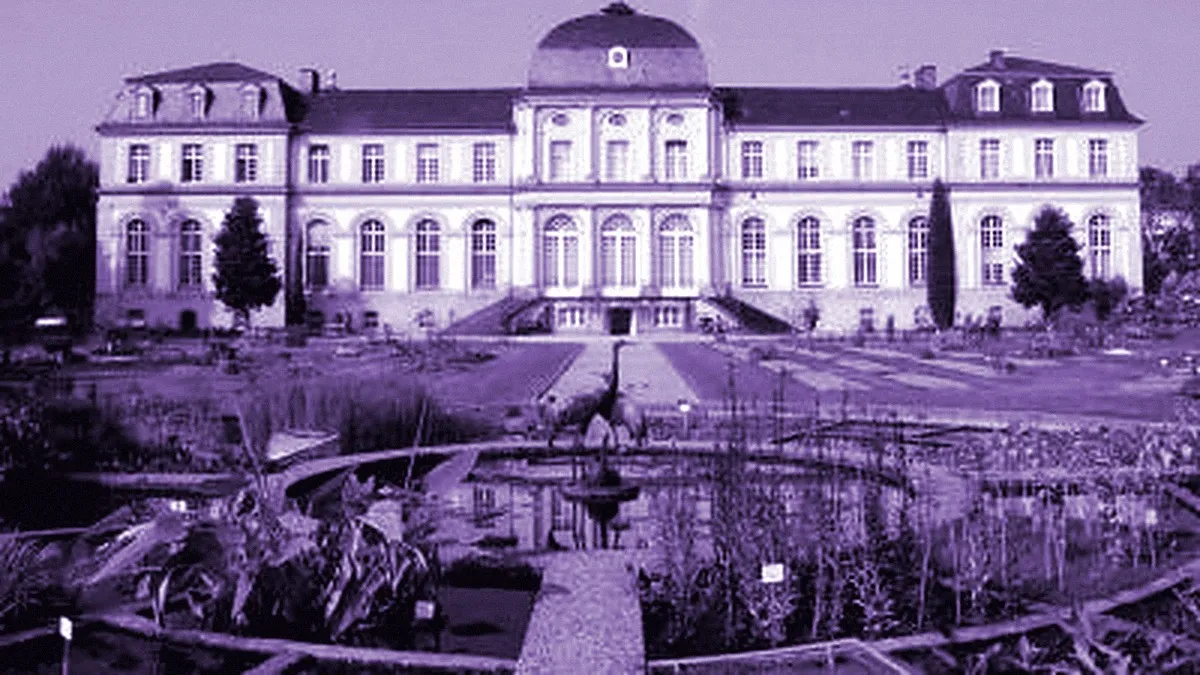
A quiet side of Bonn away from the market square. Walk from the moated Poppelsdorf Palace past the mineral and Goldfuss museums and the electors' garden house to the state museum, the Old Cemetery and the house where August Macke painted.
August-Macke-Haus · St. Marien · Alter Friedhof Bonn · Georgskapelle · LVR-Landesmuseum Bonn · Rotation …
Open this tour: Poppelsdorf to the Old Cemetery: Palaces, Museums and Macke
Walk Bonn with Neywo
Neywo turns Bonn into a self-guided audio tour. Stories arrive as you reach the place they belong to, and the route reshapes when you wander off it.

