Visiting Corfu, Greece: Top Sights on Foot
Things to Do in Corfu: Historic Fortresses, Museums and Coastal Landmarks
Corfu offers far more than beaches: its historic capital, Venetian fortresses, churches, museums and archaeological sites reveal the island’s layered past. From the Old Town and the Old Fortress to Achilleion, Paleokastritsa and Angelokastro, there are plenty of things to do in Corfu for travellers interested in history, architecture and landscapes. Neywo has a free audio guide for Corfu with 66 narrated places, available in 11 languages.
Part of the Ionian Islands and Greece, Corfu brings together Byzantine, Venetian, British, French and Greek influences. The best way to experience that history is to move through the places where it happened, from the city’s defensive walls to its rural museums and monasteries.
What to see in Corfu
Corfu Old Town and its historic churches
Corfu Old Town is the natural starting point for exploring the island. Its streets lead to landmarks connected with the island’s religious, political and cultural history.
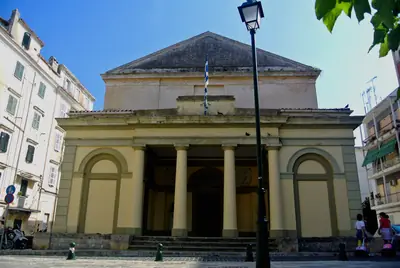
The Cathedral of Saint James and Saint Christopher, also called the Catholic Metropolitan Church or Duomo, was built at the urging of the Venetian authorities and consecrated in 1533. Since 1718, it has served as the cathedral of the Archdiocese of Corfu, Zakynthos and Cephalonia. Its Tuscan pilasters, triangular pediment, Gothic bell tower, basilica plan and marble columns reflect the church’s Venetian character. Ottoman sieges, explosions, earthquakes and damage during the Second World War all contributed to the layered appearance of the building today.
The Catholic Church of the Blessed Virgin of Carmel offers another religious landmark, while the Church of Agios Antonios and Andreas adds a further stop for visitors exploring Corfu’s churches.
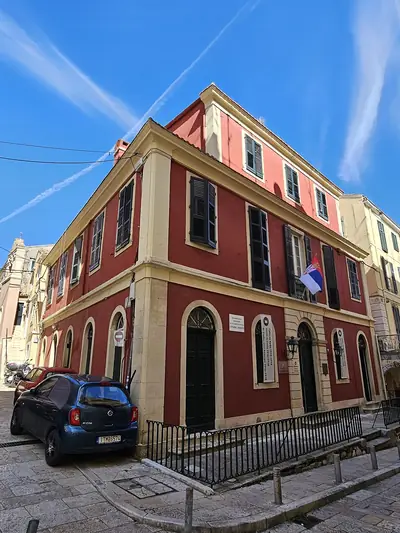
Serbian Museum of Corfu
The Serbian Museum of Corfu, also known as Srpska kuća, occupies a neoclassical mansion in Corfu Town. It recalls the wartime refuge of the Serbian army and government on Corfu during the First World War.
In 1915, after the Serbian army was defeated by Austro-Hungarian forces, around 150,000 Serbian soldiers and government members found shelter on the island. They remained there for three years, while part of the army stayed on the nearby islet of Vido. The museum’s collection includes photographs, uniforms, weapons, flags, medals, church vestments, documents and personal belongings. It also remembers the soldiers who died from disease and exhaustion and were buried on Vido, a place associated with the name “Blue Graveyard”.
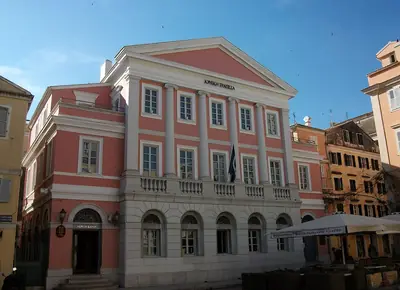
Banknote Museum of Alpha Bank
The Banknote Museum of Alpha Bank is housed in the former Ionian Bank building and traces the history of Greek money from 1822 to the introduction of the euro in 2002. Its collection contains around 2,000 objects, including banknotes, sketches, trial designs and printing plates.
Among the unusual pieces are the 1860 “colonata”, a Byzantine-inspired banknote showing Hagia Sophia that was designed in 1920 but never circulated, and phoenix banknotes associated with Governor Kapodistrias. The museum was founded by the Ionian Bank in 1981, renovated after its merger with Alpha Bank and reopened in 2005. An additional exhibition hall presents the story of Ionian Bank Limited, described as the first bank to operate on Greek territory.
Ionian Parliament
The Ionian Parliament occupies a neoclassical building constructed in 1855 by Ioannis Chronis. Its entrance is framed by Doric columns, while marble inscriptions in Greek and English commemorate the union of the Ionian Islands with Greece.
Representatives of the Ionian Islands expressed their determination to unite with Greece within the building. The decision was confirmed by a resolution of the Ionian Parliament on September 23, 1863.
Municipal Theatre of Corfu
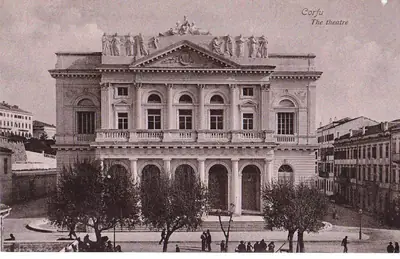
The Municipal Theatre of Corfu was once the island’s principal theatre and opera house. It operated from 1902 to 1943 and succeeded the Nobile Teatro di San Giacomo, which later became Corfu’s city hall.
Construction began in 1893, following a decision made in 1883 during the mayoral term of Geórgios Theotókis. Italian architect Conrado Pergolesi prepared plans inspired by La Scala in Milan. During the First World War, the theatre also served as the meeting place of the Serbian Parliament in exile from January 19, 1916, to November 19, 1918.
Corfu Art Gallery
The Corfu Art Gallery was established in 2005 as the first private initiative dedicated to studying the history of Corfiot art from the nineteenth century to the present. Its collection includes paintings, icons, engravings and sculptures by artists from Corfu or artists who lived on the island.
The gallery occupies a five-floor building with specialized rooms. The Etching Room presents works, personal objects and tools belonging to Spiros Alamanos, who lived from 1947 to 2011. Another room focuses on the artist Pinelopi Volterra and includes both her sculptures and paintings.
Old Fortress of Corfu and Sideros Lighthouse
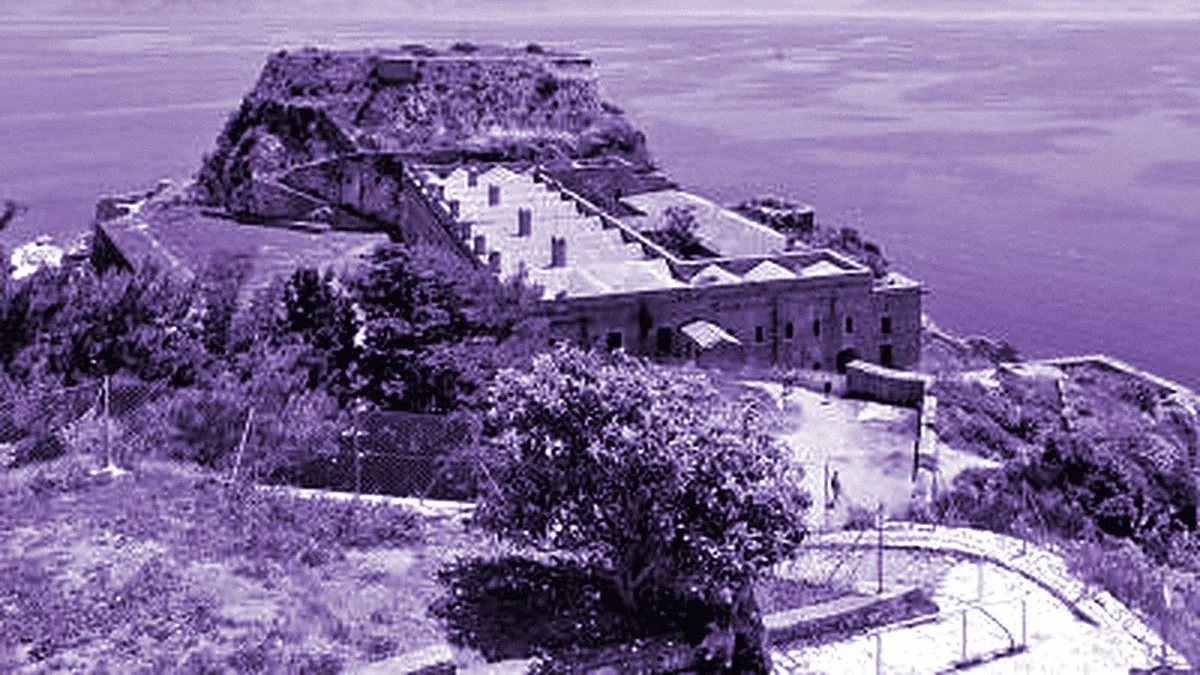
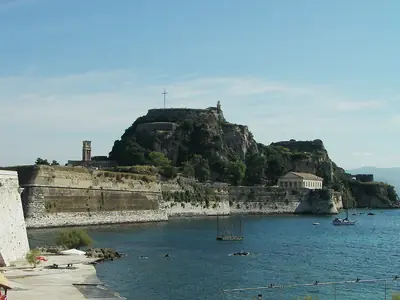
The Old Fortress, or Fortezza Vecchia, stands on a rocky peninsula between the Gulf of Kerkyra and Garitsa Bay. Its two peaks and massive walls reflect the strategic importance of this position.
The site was fortified after the sixth century, when survivors of the destruction of the ancient city of Corcyra settled there. It later became the old Byzantine capital before the Venetians rebuilt and expanded its defenses from the fifteenth century onward. The Contrafossa, an artificial sea channel, separated the peninsula from the city and turned the fortified area into an artificial island.
The fortress resisted three major Ottoman attacks, in 1537, 1571 and 1716. Its bastions, towers, courtyards and passages also contain traces of later British additions. The Sideros Lighthouse belongs to this nineteenth-century chapter, when the British added a lighthouse and military barracks to the fortress.
Achilleion
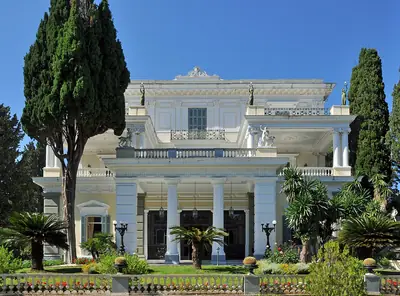
Achilleion stands in Gastouri, about ten kilometres south of Corfu Town. The palace and its gardens were created for Empress Elisabeth of Austria, known as Sisi, and completed in 1890.
Achilles and ancient Greek mythology shape the design. The gardens contain statues of Achilles, the Nine Muses, bougainvilleas, palms and views toward the Ionian Sea. Italian architects Raffaele Caritto and Antonio Landi designed the building in a style inspired by a Pompeian palace. Inside, murals and decorative works complement the palace’s classical character, while an Ionic colonnade occupies the second floor.
Kapodistrias Museum
The Kapodistrias Museum occupies Ioannis Kapodistrias’s former summer home in the Koukouritsa area of Evropouli, on the island where he was born. The museum was established in 1981 and presents the memory and life’s work of this important Corfiot historical figure in the setting of his former residence.
The property was donated by Maria Desylla-Kapodistria, a great-granddaughter of Georgios Kapodistrias. She was also a former mayor of Corfu and the first female mayor in Greece.
Paleokastritsa Monastery and Angelokastro
The Monastery of Paleokastritsa is located in Paleokastritsa, one of Corfu’s best-known coastal areas. Nearby, Angelokastro rises on the highest peak of the island’s northwestern shoreline.
Angelokastro is one of the most important Byzantine castles in Greece. Its position above the sea provided a wide view toward Corfu, the city, the mountains of mainland Greece and the southern Adriatic. Together with Gardiki Castle and Kassiopi Castle, it formed part of Corfu’s defensive network.
The exact construction date is unknown, although the castle is often associated with Michael the First Komnenos and his son, Michael the Second. The first documentary evidence dates from 1272. Over the centuries, Angelokastro resisted sieges, helped defend the island against pirate attacks and played a role during three Ottoman sieges.
Monastery of Vlacherna
Near Kanoni, south of Corfu Town, the Monastery of Vlacherna stands on a small island about 300 metres from the shore, reached by a footbridge. The Greek Orthodox monastery is dedicated to Saint Mary of Blachernae, or Panagia Vlachernon.
Tradition holds that the present monastery was built in the seventeenth century. It remained a women’s monastery until 1980. Its tiled roofs surround a small white church, while a two-storey bell tower marks the entrance. Inside, frescoes cover the walls and a carved wooden iconostasis separates the sanctuary.
History and Folklore Museum of Messi Sinarades
The History and Folklore Museum of Messi Sinarades presents the local history of Sinarades in Corfu. It is also known as the Folkloric Museum or the History and Folklore Museum of Messi, making it a useful stop for discovering the island’s local heritage beyond the capital.
Explore Corfu with a self-guided audio guide
Neywo offers a Corfu audio guide with three walking tours, one bus route and one bike route. Together, they cover 66 narrated places:
- Fortress, Esplanade and Liston: Corfu Under Three Flags — a 2.1 km walk lasting 82 minutes, with 9 stops.
- Lanes of the Old Town: Saints, Theatre and Refuge — a 1.71 km walk lasting 78 minutes, with 10 stops.
- Ancient Korkyra: From Menecrates to Mon Repos — a 3.92 km walk lasting 102 minutes, with 8 stops.
- Blue Bus 2A: From Kanoni to the Esplanade — a 5.3 km bus route lasting 23 minutes, with 6 stops.
- Garitsa Bike Lane: Theatre, Tomb and Byzantine Church — a 1.5 km bike route lasting 8 minutes, with 3 stops.
Download Neywo and explore Corfu at your own pace. The app tells the story of each place as you reach it, with no group and no schedule.
Places with an audio guide in Corfu
8 places in Corfu with a Neywo audio guide. Each one starts telling its story as you reach it.
Self-guided tours in Corfu
5 tours in Corfu, free in the Neywo app. Each stop tells its story as you reach it.
- Bike ride
Garitsa Bike Lane: Theatre, Tomb and Byzantine Church
Pedal the Garitsa cycle lane south from the old town. Stop at the site of the opera-house municipal theatre destroyed in 1943, the archaic Tomb of Menecrates and the Byzantine church of Saints Jason and Sosipater.
Municipal Theatre of Corfu · Tomb of Menecrates · Church of Saints Jason and Sosipater
Open this tour: Garitsa Bike Lane: Theatre, Tomb and Byzantine Church - Bus ride
Blue Bus 2A: From Kanoni to the Esplanade
Ride the city's blue bus 2A from the islet monastery of Vlacherna at Kanoni back to the Spianada. On the way it passes the early Christian basilica of Palaiopoli, the Byzantine church of Saints Jason and Sosipater and the archaic Tomb of Menecrates, a cheap way to cover ancient Korkyra.
Monastery of Vlacherna · Early Christian Basilica of Palaiopoli (Corfu) · Church of Saints Jason and Sosipater · Tomb of Menecrates · Maitland Monument · Spianada
Open this tour: Blue Bus 2A: From Kanoni to the Esplanade - Walk
Fortress, Esplanade and Liston: Corfu Under Three Flags
Start on the twin-peaked Old Fortress, where Venetians held off three Ottoman sieges, then cross to the Spianada, the largest square in Greece. Venetian ramparts, a British rotunda, a French arcade inspired by Paris and a living-history mansion show how each ruler left a layer on the town.
Old Fortress of Corfu · Church of Agios Georgios (Saint George) - Old Fortress · Sideros lighthouse · Maitland Monument · Spianada · Palace of St. Michael and St. George …
Open this tour: Fortress, Esplanade and Liston: Corfu Under Three Flags - Walk
Lanes of the Old Town: Saints, Theatre and Refuge
Wander the car-free kantounia of the Venetian old town: the lion on the New Fortress, the red dome and tall bell tower of Saint Spyridon, a cathedral with a Gothic tower and the stage where Greek opera was born. Along the way meet a bank museum, a Serbian wartime refuge and the parliament that voted for union with Greece.
Corfu New Fortress · Holocaust Memorial, Corfu · Spilia Square · Byzantine Museum of Antivouniotissa · Saint Spyridon Church · Banknote Museum …
Open this tour: Lanes of the Old Town: Saints, Theatre and Refuge - Walk
Ancient Korkyra: From Menecrates to Mon Repos
Follow the south road out of town through the footprints of the ancient city of Korkyra. See the lion and pediment of its temples in the museum, a cylinder tomb on Garitsa hill, a Byzantine church of Paul's disciples and the Doric ruins scattered through the royal estate of Mon Repos.
Archaeological museum of Corfu · Tomb of Menecrates · Church of Saints Jason and Sosipater · Early Christian Basilica of Palaiopoli (Corfu) · Temple of Artemis · Mon Repos …
Open this tour: Ancient Korkyra: From Menecrates to Mon Repos
Walk Corfu with Neywo
Neywo turns Corfu into a self-guided audio tour. Stories arrive as you reach the place they belong to, and the route reshapes when you wander off it.

