Visiting Santorini, Greece: Top Sights on Foot
Things to Do in Santorini: Ancient Sites, Caldera Views and Historic Villages
The best things to do in Santorini range from exploring a Bronze Age settlement beneath volcanic ash to visiting cliffside churches, Venetian castles and museums in Fira, Oia, Akrotiri and Pyrgos. The island’s archaeological sites, religious buildings and volcanic landscapes make it worth exploring beyond its famous caldera views. Neywo offers a free audio guide for Santorini with 46 narrated places, available in 11 languages.
Santorini belongs to the South Aegean region of Greece. Its history is closely connected to volcanic eruptions, maritime routes and settlements built into the island’s hills and cliffs.
What to see in Santorini
Akrotiri archaeological site
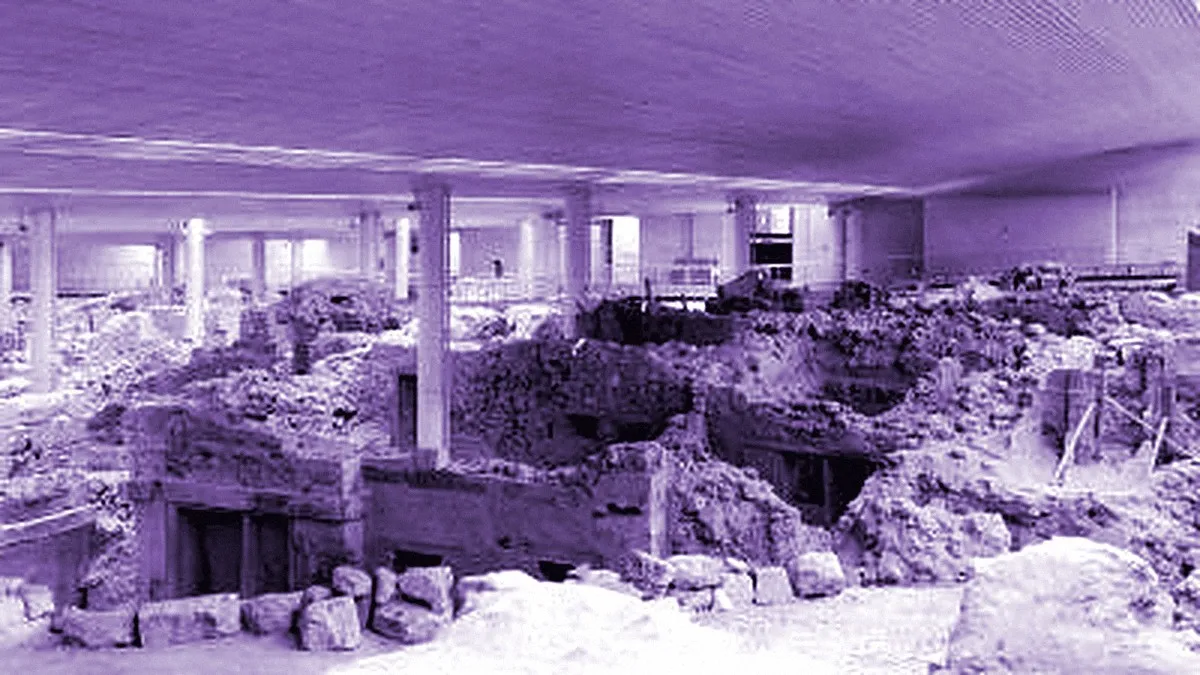
Akrotiri is one of the most important places to see in Santorini. Beneath volcanic ash lies a Bronze Age settlement preserved for more than 3,500 years after the eruption of Santorini, or Thera, in the 16th century BCE.
The settlement began as a fishing and farming community in the fifth millennium BCE and later grew into a prosperous centre connected to other Aegean cultures, Cyprus and Minoan Crete. Its paved streets, drainage system and buildings surviving to more than one story reveal an advanced town. The volcanic ash also protected objects and wall paintings, offering an unusually detailed view of Bronze Age life.
Museums in Fira
Fira brings together several museums that explain Santorini’s ancient history.
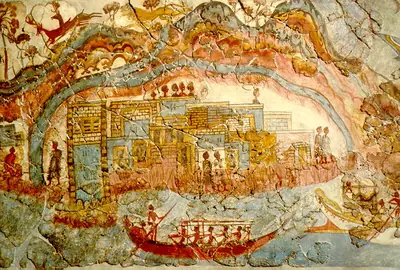
The Museum of Prehistoric Thera contains many finds from Akrotiri, including pottery, jewellery, bronze tools and distinctive bird jugs decorated with swallow motifs. Plaster casts preserve the shapes of wooden beds and storage units, while the second-floor exhibition of Thera wall paintings presents frescoes such as the saffron gatherers, the spring scene with swallows, the Ladies, Papyri and Blue Monkeys.
The Archaeological Museum of Thera covers the island’s history from the Early Cycladic period through the Roman era. Its collection includes marble figurines from the third millennium BCE, prehistoric vessels from Akrotiri, sculpture, inscriptions, pottery, clay figurines and objects connected with everyday life, religious practices and funerary customs. The present building was constructed in 1960 after the earlier museum was destroyed in the 1956 earthquake.
Cathedral of Candlemas and Saint John the Baptist
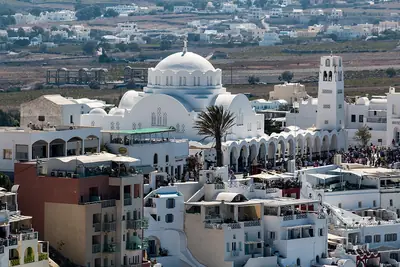
In central Fira, the Orthodox Cathedral of the Presentation of the Lord is also known as the Cathedral of Candlemas. It was first built in 1827, reconstructed after the 1956 earthquake and decorated with frescoes by local artist Christoforos Asimis.
A short distance away, the Catholic Cathedral of Saint John the Baptist, or the Domo, stands out with its peach-coloured Baroque façade. Completed in 1823, it was damaged in the same earthquake and restored in 1975. Its dome and contrasting colour make it a distinctive part of Fira’s religious architecture.
Three Bells of Fira
The Three Bells of Fira is the familiar blue-domed church above Santorini’s western cliffs. The Greek Catholic Church of the Dormition of the Virgin Mary is recognised by its bright dome, three bells and separate bell tower overlooking the caldera and the volcanic islet of Nea Kameni.
The church dates from 1757, although the site has older layers, including two cave churches carved into the cliff in the seventeenth century. After serious earthquake damage, the building underwent extensive restoration and acquired its present appearance.
Akrotiri Castle
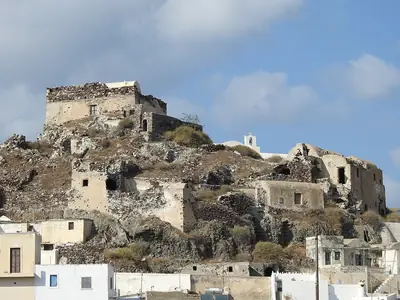
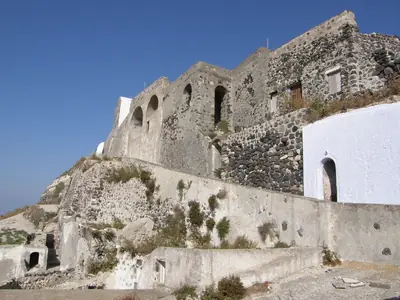
In the centre of Akrotiri village, the ruined Castle of Akrotiri recalls the island’s Venetian past. Also known as the Goulas, the medieval stronghold was one of five fortified settlements on Santorini.
The castle is integrated into the village rather than isolated from it. Around the remains are picturesque houses, occasional windmills, a central church and views extending across the island towards Oia. Its quieter setting offers a different experience from the busy streets of Fira.
Kasteli tou Pyrgou
Pyrgos Kallisti is defined by Kasteli tou Pyrgou, a Venetian fortress rising above the settlement. The castle is one of the main landmarks to notice while exploring this hill village. Nearby, Holy Trinity Church is another separate point of interest included in the Pyrgos visit.
Oia and the Citadel of Oia
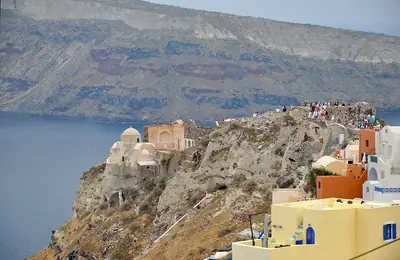
Oia combines traditional architecture with the remains of a Venetian fortress. The Citadel of Oia, also called Londsa Castle, is the ruined Castle of Saint Nicholas, built before 1480 during the period of Venetian rule.
The fortress stood on a hill about 55 metres above sea level, overlooking sea routes and forming part of Santorini’s network of fortified settlements. It took its name from a church dedicated to Saint Nicholas, dating from around 1450. Fragments of walls and defensive structures remain, although much of the stronghold collapsed towards the cliffs after the 1956 earthquake.
Oia’s historic character also comes from its cave dwellings, restored captains’ houses, churches and maritime heritage. The village provides a natural setting for a self-guided walking tour, with several notable buildings and viewpoints close together.
Saint Nicholas at Santorini’s Old Harbor
Santorini’s Old Harbor lies below Fira, where the volcanic landscape meets the island’s maritime history. For centuries it served as the island’s main maritime entrance for small cargo vessels and passenger boats. It remains a tender harbor for cruise ships, while larger-scale traffic has moved to newer port facilities.
The steep cliff path to Fira has about 580 steps. The cable car reaches the upper town in about five minutes, while walking up the cliff is more demanding, particularly in summer heat. From the harbor, the height of the caldera cliffs is especially apparent.
Smaller museums and local points of interest
The Tomato Industrial Museum D. Nomikos offers another perspective on Santorini’s industrial heritage. In Megalochori, the Lost Atlantis Experience Museum is a distinctive local point of interest.
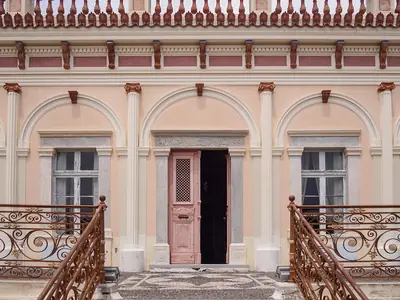
Argyros Mansion is a historic building in Thira Municipality, while the church at Agioi Apostoloi is another stop to include when exploring the island’s villages. These smaller sites add variety to an itinerary focused on the major archaeological and scenic landmarks.
A Santorini self-guided walking tour with Neywo
Neywo has three walking tours in Santorini, with a combined 22 narrated stops across Fira, Oia and Pyrgos.
- Fira to Skaros: Museums, Bells and the Caldera Path covers 3.62 km in 101 minutes and includes 8 narrated stops, including the Museum of Prehistoric Thera, the Archaeological Museum of Thera, the Cathedral of Candlemas, the Three Bells of Fira and the Castle of Skaros.
- Oia: Windmills, Blue Domes and Venetian Ruins covers 1.94 km in 79 minutes and includes 10 narrated stops, including the Citadel of Oia, churches, the Panagia Platsani and Ammoudi Port.
- Pyrgos and the Prophet Elias: Santorini’s Hill Villages covers 4.13 km in 82 minutes and includes 4 narrated stops, including Kasteli tou Pyrgou, Moni Profiti Ilia and Panagia Episkopi.
Download Neywo and explore Santorini with a free audio guide. The app tells the story of each place as you reach it, at your own pace, with no group and no schedule. Discover the island’s museums, churches, castles and villages while the narration accompanies your walk.
Places with an audio guide in Santorini
8 places in Santorini with a Neywo audio guide. Each one starts telling its story as you reach it.
Self-guided tours in Santorini
2 tours in Santorini, free in the Neywo app. Each stop tells its story as you reach it.
- Walk
Fira to Skaros: Museums, Bells and the Caldera Path
Begin in Fira with the museums that hold Santorini's prehistoric and ancient past, then pass the cathedral, the Three Bells and the cable car station on the caldera rim. Continue along the cliff-top path through Firostefani to Skaros rock and Imerovigli, with the volcano in view the whole way.
Museum of Prehistoric Thera · Archaeological museum of Thera · Cathedral of Candlemas of the Lord · Santorini cable car · Three Bells of Fira · Agios Nikolaos Monastery …
Open this tour: Fira to Skaros: Museums, Bells and the Caldera Path - Walk
Oia: Windmills, Blue Domes and Venetian Ruins
Walk Oia's marble main street from the windmills at the western tip to the ruined Venetian castle and the postcard churches with their blue domes. Finish at the village churches and the harbour of Ammoudi below, where the caldera cliffs meet the sea.
Windmills in Oia (Santorini) · Citadel of Oia · St. Nikolaos Church (Oia) · Museum of Ancient Greek, Byzantine and Post-Byzantine Instruments · Anastasi Church (Oia) · St Spyridon church (Oia) …
Open this tour: Oia: Windmills, Blue Domes and Venetian Ruins
Walk Santorini with Neywo
Neywo turns Santorini into a self-guided audio tour. Stories arrive as you reach the place they belong to, and the route reshapes when you wander off it.

