Visiting Chora, Greece: Top Sights on Foot
Things to do in Chora, Kalymnos
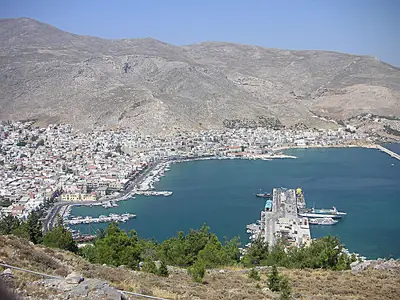
Chora is the historic old capital of Kalymnos, a mountainous Greek island in the southeastern Aegean and part of the Dodecanese. Its castles, churches, museums and archaeological remains reveal the island’s long history, from the Byzantine period to the age of the Knights Hospitaller. Neywo offers a free audio guide for Chora with 15 narrated places, available in 11 languages.
Kalymnos is known for its connection with natural sponge fishing and, more recently, climbing. The island has passed through Greek, Roman, Byzantine, Hospitaller, Ottoman and Italian periods, becoming part of Greece in 1947. Chora is one of the best places to explore this layered past.
For broader island discoveries, you can also explore the South Aegean and Greece.
What to see in Chora
Castle of Chora of Kalymnos
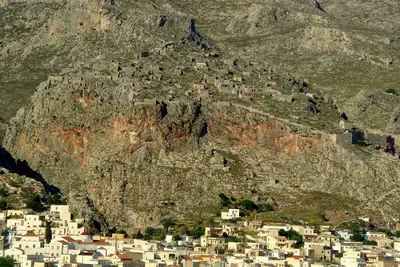
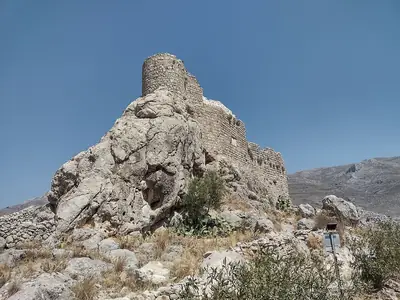
The Castle of Chora, also called the Great Castle or New Castle, stands on the foothills of Prophet Elias at an elevation of 255 metres. It was more than a defensive fortress: its walls enclosed a medieval settlement with homes, water cisterns, an olive mill and ten churches.
The earliest castle was built by the Byzantines in the eleventh century to protect against raids by the Ottoman pirate Tzaha. After an earthquake damaged it in 1492, the Knights Hospitaller of Rhodes rebuilt it within three years. Parts of the fortifications still reach seven metres in height, while the walls are about one and a half metres thick. The castle had a single entrance on its southern side, positioned above ground level and operated with a chain.
Chrysocheria Castle
Between Pothia and Chora, Chrysocheria Castle is also known as Pera Castle. Its most distinctive feature is the group of three windmills outside the eastern wall. The surviving fortress includes two towers, two gates and an outer defensive wall.
Inside stands the Church of Panagia Chrysocheria, which existed before the castle and gave it its name. Above the eastern gate are the coats of arms of the Guerini family and other commanders of Kalymnos.
The fortress was built in the fifteenth century by the knight commander Fantino Guerini, following orders from Jean de Lastic, Grand Master of the Knights Hospitaller of Rhodes. The site was inhabited long before the fortress: archaeological evidence shows continuous settlement from the Neolithic period.
Archaeological Museum of Kalymnos
In Pothia, the Archaeological Museum of Kalymnos presents objects discovered on the island and beneath the surrounding sea. Its permanent exhibition follows human presence on Kalymnos from prehistoric times through the post-Byzantine period.
The museum opened in 2009 and is housed in the Vouvális family mansion, a building dating from the middle of the nineteenth century that was restored in 1894. The historic setting adds context to the collections, which preserve archaeological material from excavations and chance discoveries around the island.
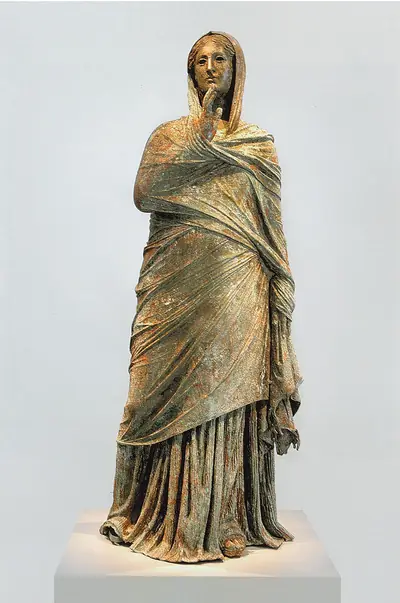
Among the museum’s most important objects is the Hellenistic bronze statue known as the Kyra tis Kalymnou. A fisherman from Kalymnos recovered it from the sea in 1995. Its artistic quality and exceptional preservation make it one of the significant examples of Hellenistic sculpture in the Aegean.
Metamorfosi Sotiros Christou Cathedral
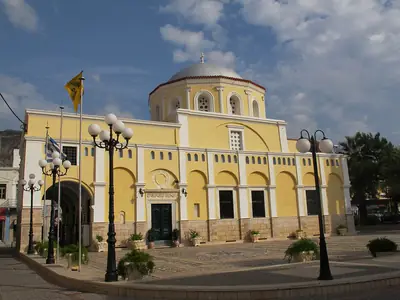
The Metamorfosi Sotiros Christou Cathedral, or Cathedral of the Transfiguration of the Savior, stands in Pothia. Its prominent silver-coloured dome is visible above the building, while a separate bell tower stands beside a paved square decorated with stonework.
Completed in 1861, the Orthodox cathedral was designed by local artists and architects. Inside, murals by local artists cover the walls, and the iconostasis was made by the sculptor Giannoulis Chalepas.
The cathedral also played a part in Kalymnos’s social history. In 1884, sponge fishermen held a meeting there that led to the adoption of laws regulating trade and workers’ rights, considered unusually progressive for the period.
Galatiani Castle
High on Mount Galatiani, at an elevation of 589 metres, the Castle of Galatiani offers a glimpse of a Byzantine settlement. It was built in the seventh century to protect the inhabitants from Arab raids. The settlement stood inside the fortifications, so the site was both a stronghold and a place of residence.
The walls protected the southern and western sides and were between 1.35 and 2 metres thick. The remaining sides relied on steep cliffs for defence. The castle maintained visual contact with Kastelli and the Castle of Saint Constantine on Telendos, forming part of a wider defensive network.
Archaeological remains include sections of wall reaching 2.6 metres, parts of water cisterns and foundations of houses. Research indicates that the settlement survived at least until the tenth century, although its exact abandonment date is unknown.
Castle of Saint Constantine on Telendos
On the rocky northern part of Telendos, about 250 metres above sea level, the Castle of Saint Constantine overlooks the remains of a medieval settlement. Its position beside steep cliffs left only one accessible approach and one entrance gate.
The fortress is thought to have been built during the second half of the seventh century, when Arab raids threatened the settlement. Walls between one and one and a half metres thick, together with a smaller outer defence wall, protected the site. The castle and settlement were probably in use until the tenth century, when people began returning to the coastal areas.
Today, the ruins include low sections of wall, house remains and a small lookout tower. The castle stood opposite Kastelli and maintained visual contact with Galatiani Castle.
Other museums and churches
Kalymnos also has the Maritime and Folklore Museum and Sea World in Vlychadia. These museums add further perspectives on the island’s maritime and local heritage.
The Church of Agios Nikolaos and the Church of Agios Georgios are additional religious sites in the Municipality of Kalymnos. The island’s historic religious landscape also includes the fortified Monastery of Panagia Kyra Psili, the Castle of Casteli—also known as Panagia Kasteliou—and several smaller churches and chapels.
Chora self-guided walking tour with Neywo
Neywo’s free audio guide lets you explore Chora independently, with each story playing as you reach the place it describes. The app works at your own pace, with no group and no schedule.
The available route is one walking tour:
- Sponge Divers, Knights and Two Castles: 4.46 km, 90 minutes and 4 narrated stops
The walk includes the Metamorfosi Sotiros Christou Cathedral, Kalymnos, the Archaeological Museum of Kalymnos, Chrysocheria Castle and Chora Castle. Download Neywo to explore Chora while the app tells the story of each place as you arrive.
Places with an audio guide in Chora
6 places in Chora with a Neywo audio guide. Each one starts telling its story as you reach it.
Walk Chora with Neywo
Neywo turns Chora into a self-guided audio tour. Stories arrive as you reach the place they belong to, and the route reshapes when you wander off it.

