Things to Do in Rhodes, Greece: Walking Guide
Things to Do in Rhodes: A Guide to the City’s Historic Sights
Looking for things to do in Rhodes? The city brings together an ancient acropolis, a medieval walled town, Ottoman mosques, Catholic and Orthodox churches, Jewish heritage, and the harbour associated with the Colossus of Rhodes. Neywo’s free audio guide for Rhodes covers 31 narrated places, helping you understand the city as you explore it.
Rhodes is the capital of the island and a particularly rewarding destination for walking. Its monuments reflect the successive communities and powers that shaped the city, from the classical polis of Rhodes to the Knights Hospitaller, the Ottoman period, and the Italian administration.
What to see in Rhodes
The Acropolis of Rhodes
The Acropolis of Rhodes crowns Monte Smith hill above the western coast. It was the religious and civic centre of the ancient city, with major temples and public buildings built mainly between the fifth and third centuries BC.
The archaeological site includes the Temple of Athena Polias and Zeus Polieus, the Temple of Apollo, a stadium, an odeon, and a gymnasium. Unlike many ancient acropoleis, the Acropolis of Rhodes was not enclosed by a defensive wall. Excavations by the Italian Archaeological School of Athens between 1912 and 1945 uncovered and partially reconstructed the remains.
The Palace of the Grand Master
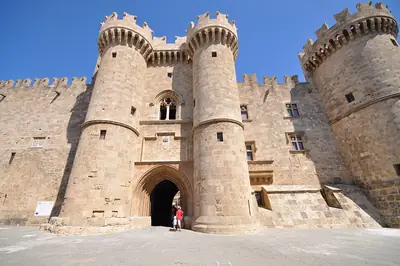
At the highest point of the Old Town stands the Palace of the Grand Master of the Knights of Rhodes, also known locally as the Kastello. The site began as a Byzantine fortress before the Knights Hospitaller took it over in the early fourteenth century and transformed it into their palace and administrative centre.
Its fortified walls and towers reveal the building’s two roles: it was both a residence and a stronghold. The palace is also notable as a rare example of Gothic architecture in Greece, and its elevated position gives views across the medieval city.
The Suleymaniye Mosque
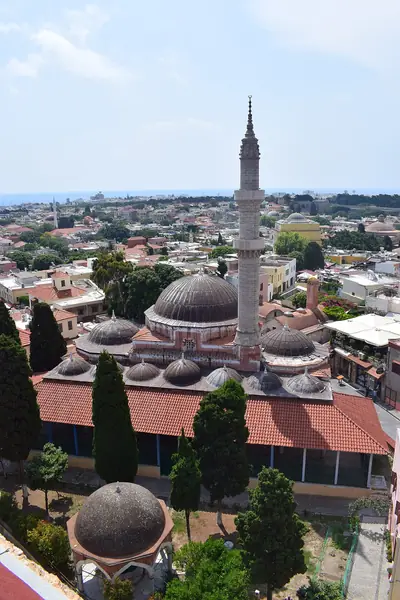
The pink-plastered Suleymaniye Mosque is Rhodes’ most significant Ottoman monument. It was first built shortly after the Ottoman conquest of Rhodes in 1522 and rebuilt in its present form in 1808. The building has a square plan topped by ten domes, with a rose-pink courtyard and a sixteenth-century ablution fountain, or şadırvan.
The outer arcade incorporates pillars taken from an earlier Christian church, while other construction materials came from buildings that once occupied the site. The mosque has been closed for worship since 2014, but it has hosted cultural exhibitions since 2005. Restorations took place in the 1990s and 2000s, and the monument received an honorary distinction from Europa Nostra in 2006.
Panagia tou Kastrou and the Church of Holy Trinity
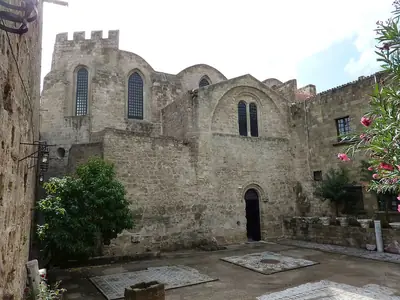
Panagia tou Kastrou, or Our Lady of the Castle, is the largest surviving Byzantine church on Rhodes. It stands within the Old Town and reflects the city’s changing religious history: it began as an Orthodox church, later became a Roman Catholic church, and was subsequently used as a Muslim mosque.
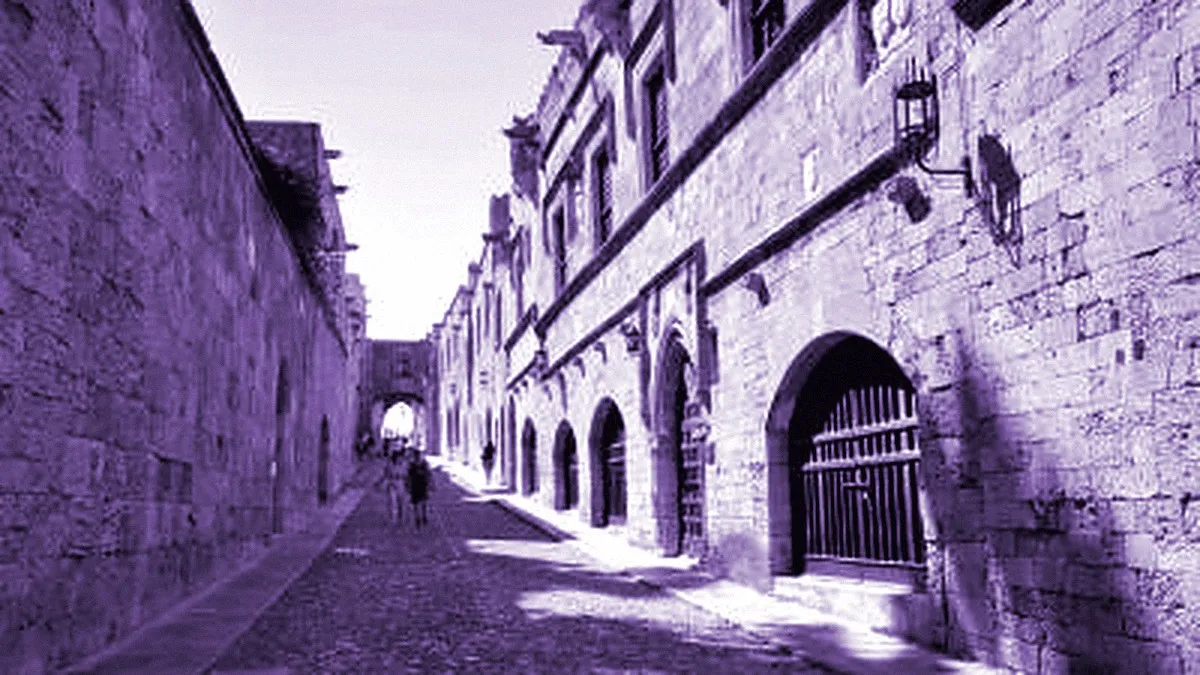
On the Street of the Knights, the Church of Holy Trinity offers another example of this layered heritage. It is one of only two churches in the medieval town dedicated to the Holy Trinity. During the Ottoman period it was converted into a mosque, before being reconsecrated as a Christian church.
The Jewish Museum and Kahal Shalom Synagogue
The Jewish Museum of Rhodes occupies six rooms that once formed the women’s prayer area of Kahal Shalom Synagogue. Its exhibits preserve the history and culture of Rhodes’ Jewish community, including Ladino theological books and a travel permit issued to Isaac Nessim Ben Veniste and his family as they left the Ottoman Empire for Katanga, Congo.
Next door, Kahal Shalom is the oldest synagogue in Greece. This Sephardic synagogue dates from the sixteenth century and remains connected with seasonal services and community events. Together, the synagogue and museum offer an important perspective on the historic community of La Juderia.
The Murat Reis Mosque
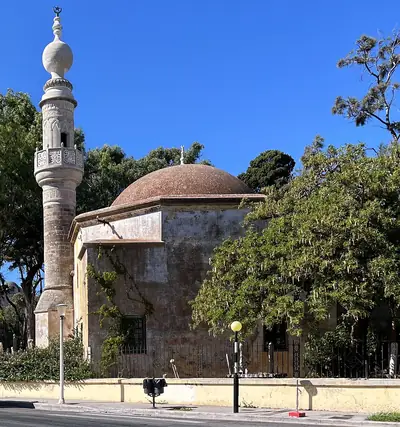
The Murat Reis Mosque is an Ottoman monument inside the old walled town. Completed around 1623, it was named after Murat Reis the Elder, an admiral of the Ottoman Navy. Although it served the Muslim community for centuries, it was abandoned in the 1940s and is now awaiting restoration.
The minaret is particularly unusual: it was added after the Ottoman period, when Rhodes was under Italian administration following the Italo-Turkish War.
The Rejep Pasha and Hamza Bey Mosques
The Rejep Pasha Mosque is one of the seven mosques inside the old walled city. Its alternative local name, St. Artemios, reflects the changing identities associated with historic buildings in Rhodes.
The smaller Hamza Bey Mosque, also known as Bastión de San Jorge or Santa Irene, dates from around 1887. Built during the Ottoman period, it is simpler than some of the city’s other mosques. It is no longer used for worship and stands abandoned.
The Catholic churches of Rhodes
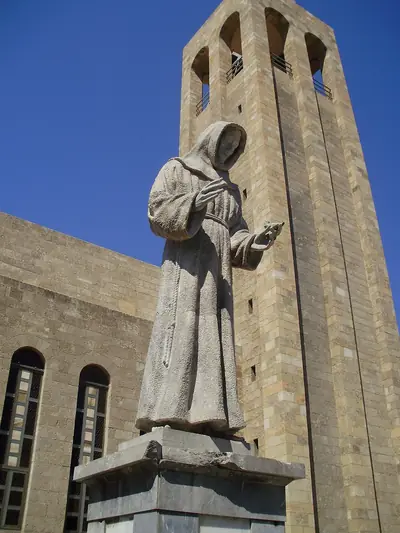
The St. Francis of Assisi Cathedral, also known as the Catholic Cathedral of Rhodes, stands near the Gate of St. Athanasius, between the Acandia and St. John districts. It is the seat of the Archbishop of Rhodes. Its design includes a three-arched façade, a nave with a flat roof, two side aisles, a transept with two chapels, and a semi-elliptical choir.
The cornerstone was laid on 20 September 1936 by Archbishop Giovanni Castellani and Mario Lago, the Italian governor of the Dodecanese. Designed by Armando Bernabiti, the cathedral was completed in 1939.
Panagia tis Nikis, also called Santa Maria, is the island’s most important Catholic place of worship. Located in the central Niochori district, the church dates from 1743, was enlarged in 1851, and renovated in 1929. It forms part of a complex that includes a Franciscan monastery and a guesthouse.
Church of the Evangelismos
In the new town, the Church of the Evangelismos is the Greek Orthodox cathedral of Rhodes and the seat of the Metropolitan of Rhodes. It was originally built during the Italian period as a Roman Catholic church, designed by Rodolfo Petracco and Florestano Di Fausto.
Its alternative names, San Giovanni and the Church of Saint John, preserve the memory of its Catholic origins. The building therefore adds another layer to Rhodes’ history of changing religious communities.
Mandraki Harbour and the Fort of Saint Nicholas
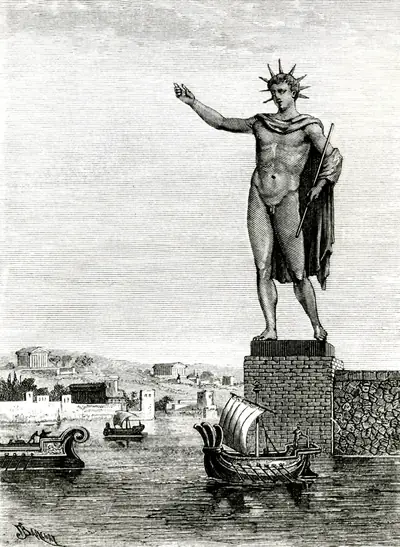
Mandraki Harbour is associated with the story of the Colossus of Rhodes. The massive bronze statue of Helios was erected after the successful defence of Rhodes against the year-long siege by Demetrius I of Macedon. At about 33 metres tall, it was the tallest statue in the ancient world.
The Colossus stood for just over fifty years before toppling in an earthquake in 226 BC. The Rhodians chose not to rebuild it after consulting the Oracle of Delphi, and the remains were eventually cleared away by Arab forces. The precise location of the original statue is still uncertain.
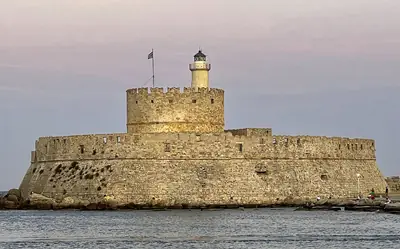
At the harbour entrance, the Fort of Saint Nicholas occupies the Mandraki mole. Grand Master Zacosta built the fort around 1464–1467, replacing an earlier Church of Saint Nicholas. It was damaged during the Ottoman siege of 1480 and the earthquake of 1481, then rebuilt and strengthened by Grand Master D’Aubusson.
A lighthouse was installed on the fort’s roof in the mid-seventeenth century, and it continues to guide ships. Restoration began in 1998, and the fort is now also a living workshop of preservation.
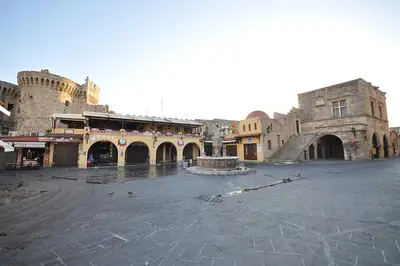
Hippokratous Square and Enydriou Square provide two open spaces among the city’s historic streets. Hippokratous Square is also known by several other names, including Agia Triada and Kastellania-Municipal Library.
Explore Rhodes with a self-guided walking tour
A Rhodes self-guided walking tour is a practical way to connect the city’s monuments without joining a group. Neywo has two walking tours:
- Knights, Sultans and the Walled Town of Rhodes: 2.28 km, 89 minutes, and 10 narrated stops.
- Mandraki Harbour: Where the Colossus Stood: 0.94 km, 49 minutes, and 6 narrated stops.
Download Neywo to explore Rhodes with its free audio guide. The app tells the story of each place as you reach it, at your own pace, with no group and no schedule. Narration is available in 11 languages. If you are continuing through the South Aegean, you can also discover destinations such as Kos Town, Santorini, or Naxos.
Places with an audio guide in Rhodes
8 places in Rhodes with a Neywo audio guide. Each one starts telling its story as you reach it.
Self-guided tours in Rhodes
2 tours in Rhodes, free in the Neywo app. Each stop tells its story as you reach it.
- Walk
Knights, Sultans and the Walled Town of Rhodes
Inside the medieval walls, Rhodes was a Hospitaller fortress, then an Ottoman town, and the streets still show both. Climb from the Grand Master's Palace past the vanished knights' church to the pink Suleymaniye Mosque, the old hamam quarter and the Jewish quarter of La Juderia.
Palace of the Grand Master of the Knights of Rhodes · Church of St John of the Collachium · Panagia tou Kastrou · Suleymaniye Mosque, Rhodes · Mehmet Agha Mosque · Rejep Pasha Mosque …
Open this tour: Knights, Sultans and the Walled Town of Rhodes - Walk
Mandraki Harbour: Where the Colossus Stood
Walk the harbour where, legend says, a bronze Helios straddled the entrance. See the fifteenth-century Fort of Saint Nicholas that has doubled as a lighthouse since the 1600s, an Italian-built cathedral and a mosque whose minaret dates from the Italian occupation.
Murat Reis Mosque · National Theatre of Rhodes · Eleftherias Square, Rhodes · Church of the Evangelismos · Colossus of Rhodes · Fort of Saint Nicholas
Open this tour: Mandraki Harbour: Where the Colossus Stood
Walk Rhodes with Neywo
Neywo turns Rhodes into a self-guided audio tour. Stories arrive as you reach the place they belong to, and the route reshapes when you wander off it.

