Things to Do in Parikia, Greece: Walking Guide
Things to Do in Parikia: What to See in Paros’s Capital
Looking for things to do in Parikia? Start with the historic harbor town itself: a compact Cycladic center where whitewashed buildings, religious monuments, and narrow lanes reflect the long history of Paros. The most important place to see is Panagia Ekatontapiliani, while the wider island offers monasteries, churches, museums, and traditional villages to explore. Neywo also has a free audio guide for Parikia with 15 narrated places, available in 11 languages.
Parikia is the capital of Paros, one of the islands of the South Aegean. Its harbor provides an open view toward the sea, while the old quarter leads into a more intimate world of lanes, chapels, homes, and local architectural details.
What to see in Parikia
Panagia Ekatontapiliani
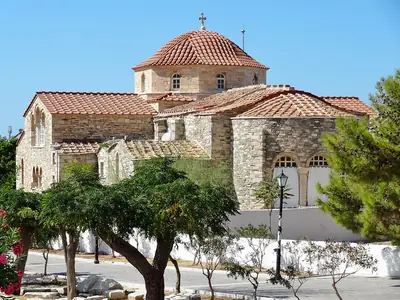
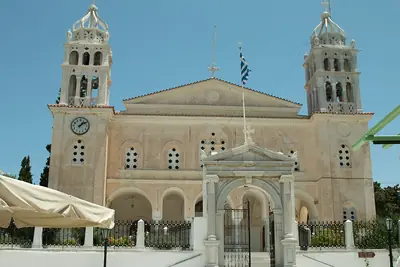
Panagia Ekatontapiliani is one of the most important landmarks in Parikia. This historic Byzantine church complex stands close to the harbor and brings together several centuries of religious architecture.
The name is usually translated as “the Church of the Hundred Gates,” although the complex does not actually have one hundred doors. Tradition speaks of ninety-nine doors and one secret door, which is said to open when Hagia Sophia in Constantinople becomes an Orthodox church again. Another explanation connects the name with Panagia Katapoliani, meaning the church of the lower town.
The church began as a three-aisled basilica in the fourth century. In the sixth century, Emperor Justinian I expanded it and added the dome. Later changes brought early Christian, Byzantine, and post-Byzantine elements together. Reused pieces from ancient buildings on Paros, including temples, can also be found in the complex.
Panagia Ekatontapiliani is more than a single church. It includes the main church, three chapels within it, three chapels outside, a baptistery with a cruciform font, and the monks’ cells.
Agios Konstantinos Church
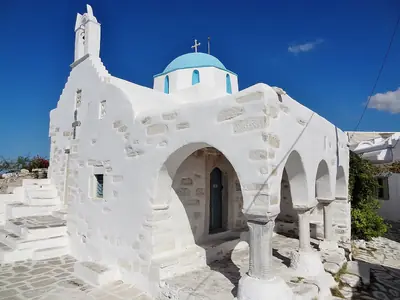
Agios Konstantinos Church, or Saint Constantine, is another historic place to see in Parikia. The building is also associated with the names Frankish Castle and Paros Public Library, linking it with several different chapters of the town’s past.
The Cyclades around Parikia
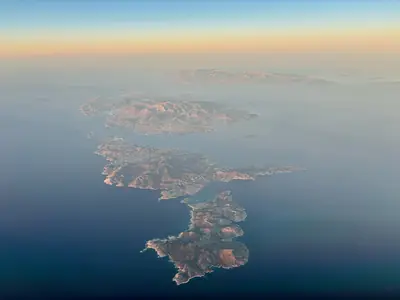
Parikia is one of the larger towns in the Cyclades, the archipelago scattered across the Aegean Sea southeast of mainland Greece. The islands range from busy destinations to smaller, quieter islets, and their landscapes combine mountainous and volcanic features.
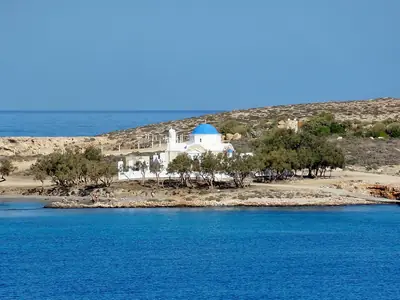
The Cyclades are especially associated with whitewashed houses, churches with blue domes, and windmills. Their name comes from the ancient idea that the islands formed a circle around Delos, an island that held a sacred place in ancient Greek religion. The group is also described as two roughly parallel lines extending from the direction of Cape Sounion and Euboea, creating the distinction between the Western and Eastern Cyclades.
Parikia offers a useful introduction to this wider island world. From here, you can also compare its atmosphere with places such as Naousa, another destination on Paros, or explore other Cycladic islands including Naxos, Santorini, and Mykonos.
Monasteries and churches beyond Parikia
Paros has several religious sites outside the capital, offering a different way to discover the island’s history.
Moni Christou Dasous
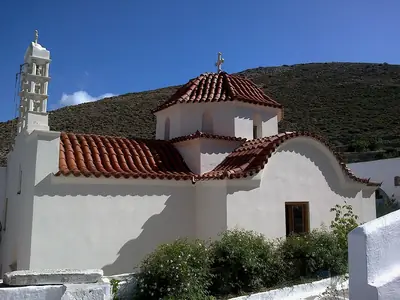
About seven kilometres south-southwest of Parikia, Moni Christou Dasous is also known as the Monastery of Saint Arsenios. This peaceful Orthodox women’s monastery was founded in the seventeenth century.
Until 1793, the complex belonged to the Mavrogenis family. It was then dedicated to the municipal church of Panagia Ekatontapiliani. The monastery’s second name comes from Saint Arsenios, the patron saint of Paros. He died here on January 31, 1877, and his tomb and relic are preserved in the Church of Saint Arsenios, in the northern part of the monastery’s western outer courtyard.
Agii Theodori monastery
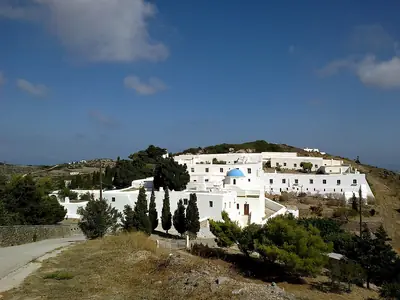
The Monastery of Agii Theodori, or Moni Agion Theodoron, stands about 17 kilometres south of Parikia at an elevation of 330 metres. It was built over the remains of an earlier monastery dating from the sixteenth or seventeenth century.
This women’s monastery follows the Old Calendar tradition. Its fortress-like form includes defensive openings in the walls, while the main church is built in the shape of a cross and crowned with a dome. The complex also contains a two-storey building with cells and guest rooms, as well as several single-storey structures.
Longovarda monastery
In northern Paros, Longovarda Monastery is also known as the Monastery of Zoodochos Pigi. It stands at an altitude of about 145 metres, roughly six kilometres northeast of Parikia and six kilometres southwest of Naousa, overlooking the coast near Naousa Bay.
Moni Agiou Antoniou
Moni Agiou Antoniou, the Monastery of Saint Anthony, is another Orthodox monastery in northern Paros. It stands beside Naousa and provides a quieter point of interest beyond the island’s main town.
Other churches and museums
Several smaller religious and cultural sites add to the island’s range of places to see. These include the Church of Agia Triada, also known as Agios Chrysostomos, Agios Nikolaos, and Agios Spyridon; Agios Antonios; Agios Fokas; and Moni Taxiarchon.
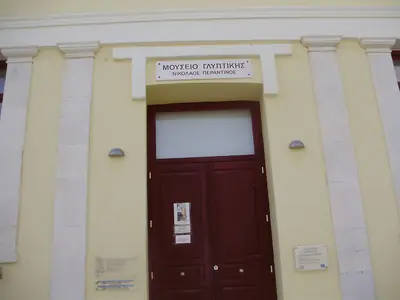
The Byzantine Museum of Paros offers another way to explore the island’s religious heritage. In Marpissa, the Nikos Perantinos Sculpture Museum focuses on sculpture. In Aliki, the Benetos and Popi Skiadas Art Museum of Cycladic Civilization, also known as the Benetos Skiadas Museum of Cycladic Folklore, is a private folk art museum. Lefkes is home to Agia Ekaterini, an art museum in the village.
Exploring Parikia at your own pace
A visit to Parikia is not only about reaching its best-known monument. The town’s historic center is suited to slow exploration, with narrow lanes leading between whitewashed homes, traditional chapels, and the harbor. Its atmosphere changes through the day: the waterfront feels open and cosmopolitan, while the old quarter becomes quieter away from the sea.
In the evening, the lanes reveal tavernas, small shops, and everyday island life. An unhurried stroll, known in Greece as a volta, is a natural way to experience Parikia’s social rhythm.
Explore Parikia with Neywo
Neywo’s free Parikia audio guide includes 15 narrated places. The app tells the story of each place as you reach it, at your own pace, with no group and no schedule. It is a simple self-guided way to discover Parikia while walking, without having to follow a fixed tour.
Download Neywo and explore the capital of Paros with its stories playing at the places where they happened.
Places with an audio guide in Parikia
8 places in Parikia with a Neywo audio guide. Each one starts telling its story as you reach it.
Walk Parikia with Neywo
Neywo turns Parikia into a self-guided audio tour. Stories arrive as you reach the place they belong to, and the route reshapes when you wander off it.

