Kefalos, Greece: Self-Guided Walking Tour
Things to Do in Kefalos: Historic Sites and the Western Side of Kos
Looking for things to do in Kefalos? This town on the southwestern end of Kos, set on the Kefalos peninsula, offers a quieter perspective on the island, with connections to the ancient city of Astypalaia and historic sites across the surrounding landscape. Neywo has a free audio guide for Kefalos with 29 narrated places, so you can discover its history as you explore.
Kefalos stands about 101 metres above sea level. Its setting changes from mostly level ground to the northwest to hillier terrain towards the southeast, with the sea closest to the west and a nearby high point reaching 321 metres. This landscape helps explain the area’s distinctive character: the modern town, the peninsula, and the remains of earlier settlements all belong to the same story.
For a broader introduction to the island, see the page on Kos Town, the capital and principal port of Kos.
What to see in Kefalos and nearby
The most important places to visit in Kefalos are connected not only with the town itself, but also with the historic villages and archaeological sites of western and central Kos.
Kefalos and ancient Astypalaia
Kefalos is associated with the ancient city of Astypalaia, which once stood nearby and was formerly the centre of Kos. The present-day town gives visitors a chance to see how modern settlement and the island’s ancient past occupy the same landscape.
The peninsula’s position at the southwestern end of Kos also makes Kefalos a useful starting point for understanding this less urban part of the island. The surrounding land rises and falls between open, level areas and hills, while the western sea remains close by.
Basilica of Agios Stefanos
Near Kambos on the Kefalos peninsula, the ruins of Agios Stefanos preserve the remains of two early Christian churches built parallel to one another. Both churches were formerly dedicated to Saint Stephen, known in Greek as Agios Stefanos.
The site is one of the notable historic places in this part of Kos Municipality. Its importance lies in the visible remains of the two churches and in the way they add an early Christian layer to Kefalos’s longer history.
Tomb of Charmylos
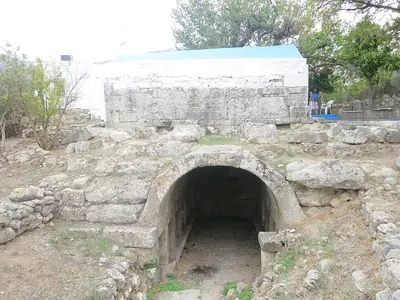
In the village of Pyli, the Tomb of Charmylos is an ancient built tomb connected with Charmylos. It is also known as the Grave of Charmylos and by the Greek name Charmyleion, with the alternative forms Harmyleion and Grave of Harmylos.
The site has a simple identity but forms part of a wider group of ancient and medieval remains scattered across Kos. It is a worthwhile stop for travellers interested in the island’s archaeological heritage.
Pili Fountain
The Pili Fountain brings together water, stone, and local life. Built around 1592 during the period of Ottoman rule, it stands in the centre of Pili, about 86 metres above sea level, and remains a popular meeting place for local residents.
Its most distinctive detail is the stone structure from which water flows through carved lion’s mouths. The fountain offers a concrete reminder of the Ottoman period and of the practical role that public water sources played in village life.
Palaio Pyli
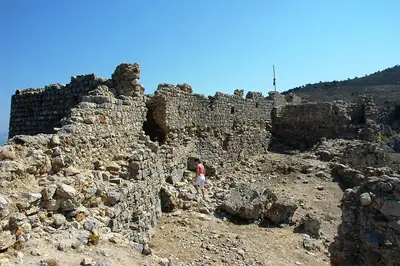
Palaio Pyli is an abandoned village on the northern slope of Kos’s mountain range, crowned by the ruins of a medieval castle. The site is also called Palio Pyli Castle or Kastro Palaio Pyli.
The remains include the Church of Panagia of Kastriana, also known as the Church of Panagia ton Kastrianon. Exploring the deserted settlement and the castle ruins gives Palaio Pyli an atmospheric quality: the site preserves both the defensive structure and the traces of the village that once occupied the mountainside.
Antimachia Castle
Antimachia Castle is a medieval fortress of the Knights of St. John. Known in Greek as Kástro Antimácheias, it stands about three kilometres east of Antimachia in the central part of Kos.
The fortress provides another perspective on the island’s medieval history. Nearby Antimachia is closely connected with the surrounding plateau, plain, and farmland, while the Kos International Airport lies just southwest of the town.
Asclepeion of Kos
The Asclepeion of Kos is the island’s most important archaeological monument and one of the best-known healing sanctuaries of the ancient world. The complex included temples, a healing facility, and baths.
It occupies a green hillside near Platani, about four kilometres southwest of the modern city of Kos, with views towards the sea and the coast of Asia Minor. Its setting was an important part of the sanctuary’s character, linking the buildings and healing spaces with the surrounding vegetation and landscape.
The site was identified and excavated in the early twentieth century after clues from the Kos-born historian Iakovos Zaraftis led the German archaeologist Rudolf Herzog to the remains. Excavations continued until 1904.
Casa Romana
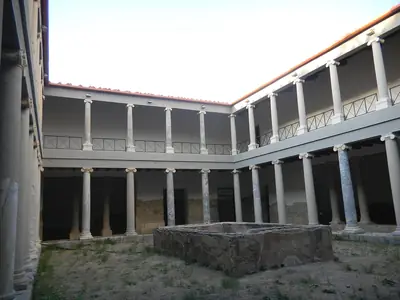
Casa Romana, or the Roman House, is a restored villa that offers a detailed view of an ancient private residence. Built in the late second or early third century AD on the remains of an earlier Hellenistic house, it follows the type of Roman home associated with Pompeii.
The villa has two storeys, 36 rooms, and three open courtyards, or atria. Each atrium had a fountain at its centre. Mosaics, frescoes, and sculptures depicting mythological figures and animals decorated the rooms, while the drainage system reveals the care given to the building’s construction.
The ruins were uncovered during excavations that began after the 1933 earthquake, which almost completely destroyed Kos. The house visitors see today is the result of major reconstruction.
Neratzia
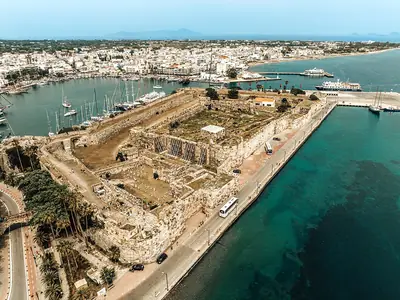
Neratzia, also known as the Fortress of Neratzia, is the most important part of the fortifications built by the Knights of Saint John on Kos. The stronghold stands in Kos city on the island’s coast and began to take shape at the end of the fourteenth century.
Its name refers to the bitter orange tree, which was planted abundantly on Kos during the late fourteenth and early fifteenth centuries. The fortress consists of two fortified enclosures: an older inner enclosure and a later outer one. The inner section has a rectangular plan, four tall corner towers, and a broad moat separating it from the other enclosure.
The two sections connect on the eastern side by a sloping road. Neratzia later served as a barracks for the Turkish garrison and as the residence of the Turkish governor. An ammunition-store explosion on March 17, 1816, destroyed a large part of the castle, while much of its present form comes from restoration during the Italian period.
Gazi Hassan Pasha Mosque
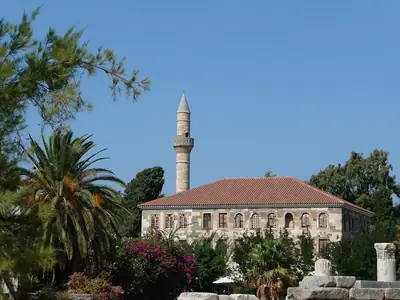
Near the Plane Tree of Hippocrates and Neratzia Castle, the Gazi Hassan Pasha Mosque is a historic Islamic prayer house also known as the Loggia Mosque. It was built between about 1778 and 1786 and named after Hassan Pasha, who was the island’s ruler at the time.
Unlike the typical domed form associated with a mosque, this building has two storeys and the appearance of a small palace. Its loggias, or columned galleries, are among its most distinctive features, and parts of ancient buildings were reused in its construction. The mosque also includes a minaret.
It was damaged in the 1933 earthquake during the period of Italian rule, restored, and then damaged again in the 2017 earthquake before being restored once more. Nearby, St. Georg Arrenagogeiou, also known as St. George tou Arrenagogeiou, adds another place of worship to this historic part of Kos.
Bab Gedid Mosque
Only the northwestern minaret of Bab Gedid Mosque survives today. The former place of prayer stood in Kos city and was largely destroyed by the 1933 earthquake.
The remaining minaret is now the last visible remnant of the building, offering a concise but striking reminder of the city’s Ottoman architectural heritage.
Discover Kefalos and Kos with Neywo
There are no scheduled tours listed for Kefalos, but Neywo’s free audio guide includes 29 narrated places. The app tells the story of each place as you reach it, at your own pace, with no group and no schedule. Narration is available in 11 languages.
Download Neywo and explore Kefalos independently, from the peninsula’s ancient connections to the villages, castles, churches, mosques, and archaeological sites of Kos. Kefalos is part of the South Aegean and Greece.
Places with an audio guide in Kefalos
8 places in Kefalos with a Neywo audio guide. Each one starts telling its story as you reach it.

Walk Kefalos with Neywo
Neywo turns Kefalos into a self-guided audio tour. Stories arrive as you reach the place they belong to, and the route reshapes when you wander off it.

