Visiting Milos, Greece: Top Sights on Foot
Things to Do in Milos: Archaeological Sites, Churches and Volcanic Landscapes
Milos is a Cycladic island shaped by volcanic geology, ancient settlements and a long religious tradition. The most interesting things to do in Milos include visiting early Christian catacombs, exploring a major Bronze Age site and discovering churches connected with the island’s Orthodox heritage. Neywo offers a free audio guide for Milos with 10 narrated places, available in 11 languages.
What to See in Milos
Ecclesiastical Museum of Milos
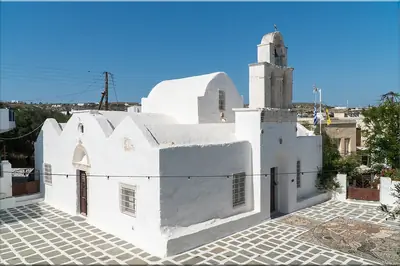
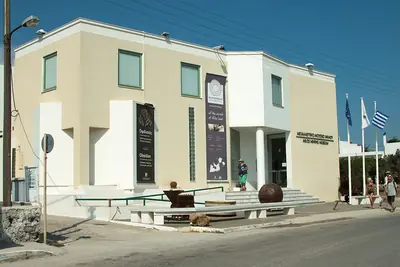
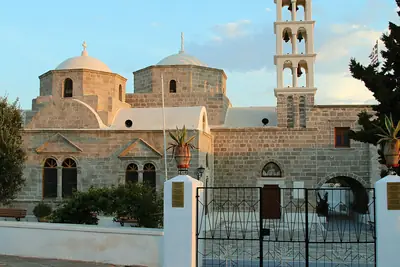
In Adamantas, the Ecclesiastical Museum of Milos preserves objects from the island’s religious tradition. It is housed in the Church of the Holy Trinity, one of the oldest churches on Milos, whose architecture has a rare character. Established in 2000 by decision of the local diocese, the nonprofit museum operates under the control and supervision of the Diocese of Syros, Tinos, Andros, Kea, and Milos.
The museum’s purpose is to protect and present the treasured objects associated with the island’s ecclesiastical heritage. It is one of the places that helps explain the role of Orthodox Christianity in Milos’s cultural history.
Milos Mining Museum
The Milos Mining Museum, also known as Άγιος Γεώργιος, offers another way to understand the island. Its subject is closely connected with the geological character of Milos, whose volcanic landscape is one of its defining features.
A visit here complements the island’s archaeological and religious sites by focusing on the importance of mining and the materials found beneath the surface.
Catacombs of Milos
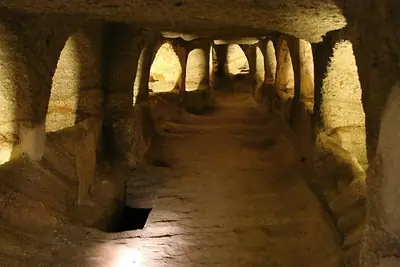
Near Trypiti, the Catacombs of Milos are an ancient underground Christian cemetery carved into porous volcanic rock. They date from the first to the fifth century AD and provide a glimpse of the island during the early Christian period.
The catacombs stand beside the agora of ancient Melos and about two hundred metres east of the ancient theatre. Their passages are arranged in three groups, with five galleries in total. Tombs were cut into the walls, while other graves were placed in the floor and covered with rough stones.
The galleries vary in size, measuring from one to five metres in width and from about 1.6 to 2.5 metres in height. Other tombs and underground chambers can also be found nearby. The site is a particularly striking example of how Milos’s soft volcanic rock was adapted for religious and funerary use.
Phylakopi
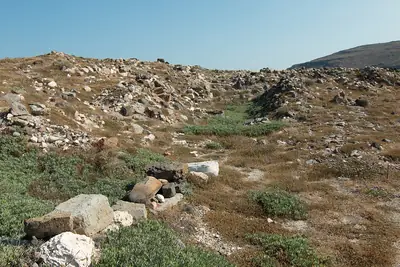
On the northern coast, Phylakopi is one of the most important Bronze Age settlements in the Aegean, and particularly in the Cyclades. The site was occupied from the middle of the third millennium BC until the twelfth century BC, making it important for understanding several stages of Bronze Age life in the region.
Phylakopi was influenced first by the Minoan civilization and later by the Mycenaean civilization. Its importance was such that it gave its name to one of the archaeological phases of the Cyclades.
Among the principal remains are the Cyclopean walls, the megaron and the sanctuary. Together, they offer clues to the settlement’s buildings and organization. Phylakopi was abandoned at the end of the Bronze Age. Around 1200 BC, the Dorians founded a new city at Klima.
The site was first excavated between 1896 and 1899 by members of the British School at Athens. Later campaigns took place in 1911, 1963 and from 1974 to 1977, under the direction of Colin Renfrew.
Church of Koimisis Theotokou, Zefyria
The Church of Koimisis Theotokou stands in Zefyria and is an Orthodox church in the Municipality of Milos. It is also known as the Church of the Holy Virgin Portiani.
The church adds a religious and architectural stop to a visit through the island, alongside the churches and monasteries found elsewhere in the municipality.
Church of Panagia Thalassitra
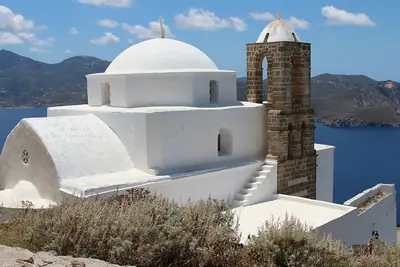
The Church of Panagia Thalassitra is another religious landmark associated with Milos. Its presence forms part of the island’s Orthodox heritage and gives visitors an opportunity to encounter a church building within the historical landscape of Melos.
Antimilos
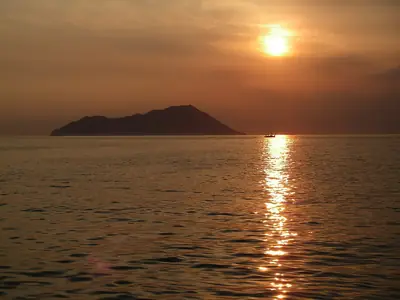
Northwest of Milos, Antimilos is a stark, uninhabited volcanic island in the Cyclades. Its rocky slopes rise to 671 metres, creating a rugged profile above the sea. The island is a volcanic dome made from lava, tuff and other volcanic flows, with steep cliffs descending from its summit.
Antimilos still has a dormant crater. Its rocks have been dated to about 320,000 years ago. The island is also known locally as Erimomilos, meaning Desert Milos, while in antiquity it was called Ephyra or Ephora.
Archaeological discoveries suggest that people lived there in prehistoric times. Ancient inhabitants even transformed the crater into an open rainwater tank. Seen from Milos, Antimilos adds another dimension to the volcanic geography of the area.
Religious sites around Milos
The island’s religious landscape extends beyond its museums and historic churches. The source locations also include Agios Ioannis, known as the Monastery of Saint John the Theologian; Agia Marina, where a monastery stands in the Municipality of Milos; and Agioi Theodoroi, a church that forms part of the island’s religious heritage.
These sites provide a broader picture of Milos as a place where archaeological remains, volcanic surroundings and Orthodox traditions exist side by side.
Explore Milos with Neywo
There are no scheduled group walks or fixed tour times to follow. Neywo’s free audio guide for Milos includes 10 narrated places, with stories available in 11 languages. Each story plays as you reach the place, at your own pace, so you can explore independently without a group or a schedule.
Download Neywo and discover Milos through its catacombs, Bronze Age archaeology, churches, museums and volcanic surroundings. For more islands and destinations in the same region, explore South Aegean and Greece.
Places with an audio guide in Milos
7 places in Milos with a Neywo audio guide. Each one starts telling its story as you reach it.
Walk Milos with Neywo
Neywo turns Milos into a self-guided audio tour. Stories arrive as you reach the place they belong to, and the route reshapes when you wander off it.

