Jaipur, India: Self-Guided Walking Tour
Things to Do in Jaipur: What to See in India’s Pink City
Jaipur is the capital of Rajasthan, a historic city known as the Pink City for its distinctive pink and peach-coloured buildings. Founded in 1727 by Sawai Jai Singh II and carefully planned by Vidyadhar Bhattacharya, it is worth visiting for its royal palaces, hill forts, astronomical observatory, museums and lively historic streets. Neywo has a free audio guide for Jaipur with 23 narrated places.
What to See and Do in Jaipur
The best things to do in Jaipur bring together architecture, history, science and craftsmanship. These are the places that reveal the city’s character most clearly.
Hawa Mahal
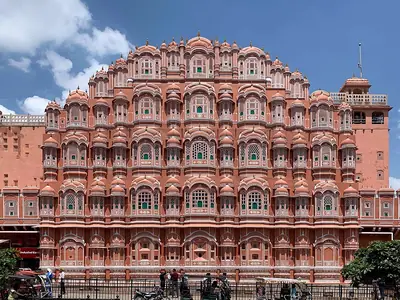
The Hawa Mahal, or Palace of Winds, is one of Jaipur’s most recognisable landmarks. Built in 1799 by Maharaja Sawai Pratap Singh and designed by Lal Chand Ustad, its five-storey pink sandstone façade resembles a giant honeycomb.
The building contains 953 small jharokhas, or enclosed windows, decorated with intricate latticework. They allowed royal women to observe the streets while remaining screened from view. The design also channelled air through the openings, helping to cool the palace. Early morning light brings out a golden tone in the sandstone.
City Palace
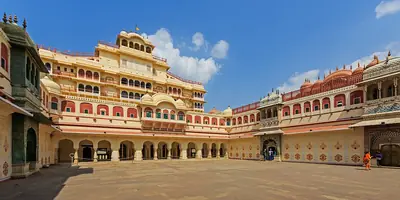
The City Palace is the centre of Jaipur’s royal heritage. Construction began soon after Sawai Jai Singh II founded the city, and the palace was completed in 1732. It served as the ceremonial and administrative seat of the Maharajas until Jaipur became the capital of Rajasthan in 1949.
The complex combines Mughal and Rajput architectural styles, with red and pink sandstone, carved marble pillars, arches, marble elephant statues and colourful glasswork. It remains the home of the Jaipur royal family and houses the Maharaja Sawai Man Singh II Museum. Its collections include astronomical manuscripts in Arabic, Persian, Latin and Sanskrit, as well as swords with meenakari decoration and jewelled scabbards.
Jantar Mantar
Jantar Mantar is an astronomical observatory built by Sawai Jai Singh in the early eighteenth century and completed in 1734. The UNESCO World Heritage site contains monumental stone instruments designed to observe the heavens with the naked eye.
Its instruments work across horizon-zenith, equatorial and ecliptic coordinate systems, allowing measurements of time, planetary positions and eclipses. The observatory is also home to the world’s largest stone sundial. It is one of five observatories commissioned by Sawai Jai Singh across India; only the examples in Delhi and Jaipur survive today.
Albert Hall Museum
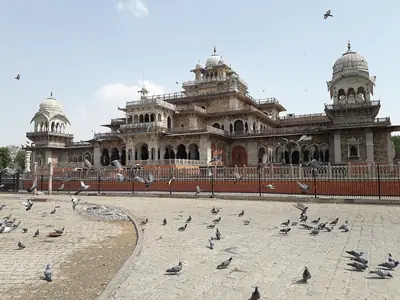
Located in Ram Niwas Garden just outside the old city wall, Albert Hall Museum is Jaipur’s oldest museum and the state museum of Rajasthan. Its Indo-Saracenic architecture combines Indian and Islamic motifs and was designed by the British engineer Samuel Swinton Jacob with assistance from Mir Tujumul Husain.
The foundation stone was laid on 6 February 1876 by Prince Albert Edward. The building opened as a museum in 1887, after an earlier plan to use it as a town hall was changed. Its collections include paintings, textiles, weapons, metalwork and other objects, offering a broad introduction to Rajasthan’s artistic heritage.
Jal Mahal
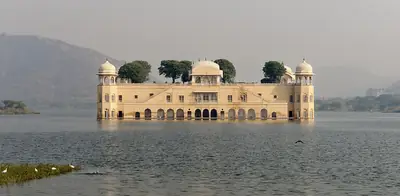
Jal Mahal, or the Water Palace, stands in the middle of Man Sagar Lake. Built from red sandstone, it features arched entrances, bastions, chhatris and stepped galleries with a distinctly Rajput appearance.
When the lake is full, the lower part of the palace disappears beneath the water, leaving the upper section visible. The palace was commissioned by Sawai Jai Singh II in the eighteenth century, and the lake was later expanded and improved. The area is also becoming a bird sanctuary, with a nursery containing over one hundred thousand trees.
Jaigarh Fort
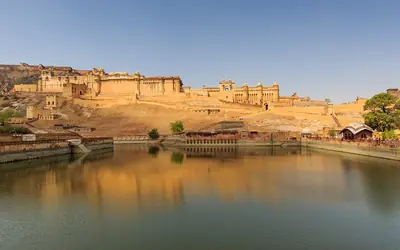
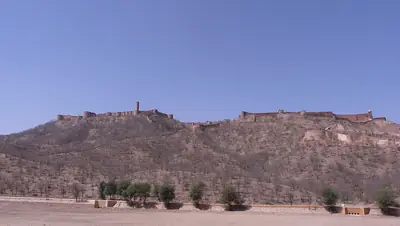
Jaigarh Fort occupies Cheel ka Teela, the Hill of Eagles, overlooking Amer Fort and Maota Lake. Known as the Victory Fort, it forms a single defensive complex with Amer Fort, connected by subterranean passages.
The fortress stretches about three kilometres from north to south and one kilometre from east to west. Its most famous object is the Jaivana cannon, described as the largest wheeled cannon ever made. The fort also contains a substantial rainwater harvesting system that collected and stored monsoon water for its inhabitants. Major additions commissioned by Raja Jai Singh II were completed around 1726.
Amer Fort and its historic gates
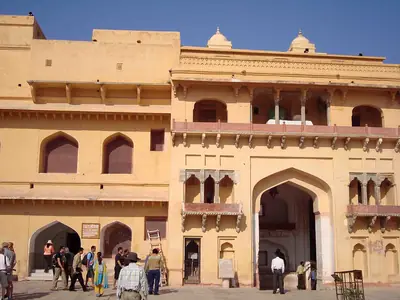
The former capital of Amer remains closely connected to Jaipur’s history. The Amer walking route includes Suraj Pol, the Sun Gate, and Chand Pol, the Moon Gate, both gate buildings forming part of Amber Fort. Together with Jaigarh Fort, the fortifications show how the region’s rulers protected their palaces and settlements.
Nearby, the Anokhi Museum of Hand Printing explores Rajasthan’s traditional block-printing craft through textiles, wooden blocks, dyes, tools and equipment. The museum opened in 2005 and was created by Rachel Bracken-Singh and Pritam Singh, founders of the Anokhi retail brand.
Amrapali Museum
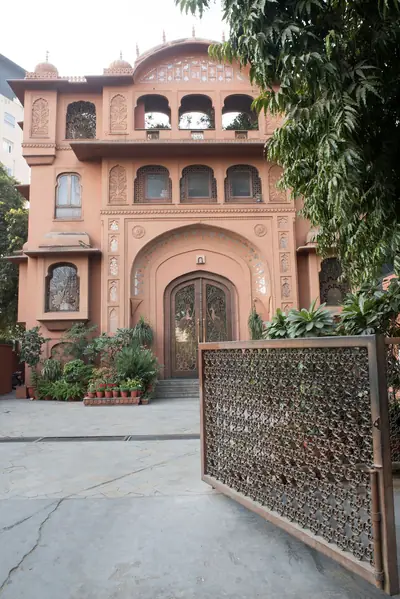
The Amrapali Museum celebrates India’s jewellery traditions through more than four thousand objects, ranging from tribal adornment to contemporary creations. It opened on 20 January 2018 in Jaipur’s C-Scheme area and occupies 6,500 square feet.
More than eight hundred pieces are displayed across two floors, while the remaining objects are kept in visual storage and can be rotated into the exhibition. It is a focused way to explore the craftsmanship and cultural importance of Indian jewellery.
Sisodiya Rani Bagh
Sisodiya Rani Bagh is a garden and palace built in 1728 by Sawai Jai Singh II as a gift for his second queen, who came from the Sisodia lineage of Mewar. Its terraced gardens include fountains, watercourses and painted pavilions.
A double-storeyed palace crowns the upper terrace. Its galleries and pavilions are decorated with murals depicting scenes from the life of Lord Krishna, creating a quieter contrast with Jaipur’s busy historic centre.
Birla Mandir
Birla Mandir, also known as the Lakshmi Narayan Temple, is a white-marble Hindu temple in Jaipur’s Tilak Nagar area. Completed in 1988 under the Birla Foundation, it is dedicated to Lakshmi and Lord Vishnu, also known as Narayan.
The temple is built entirely from white marble. Inside are images of Lakshmi, Vishnu and other Hindu deities, together with verses from the Bhagavad Gita and the Upanishads.
Explore Jaipur with a self-guided audio tour
Neywo offers two walking tours in Jaipur, with 23 narrated places available across the city. Each story plays as you reach the place, at your own pace: there is no group and no schedule. Narration is available in 11 languages.
The two walks are:
- The Pink City: Palace of Winds, a Stone Observatory and the Maharaja’s Home — 2.8 km, 75 minutes and 5 narrated stops, including Hawa Mahal, City Palace, Jantar Mantar and Albert Hall Museum.
- Amer: Fortress, Gates and Stepwell — 2.8 km, 85 minutes and 7 narrated stops, including Anokhi Museum of Hand Printing, Suraj Pol, Chand Pol, Amber Fort and Jaigarh Fort.
Download Neywo to explore Jaipur as you walk and hear the story of each place when you arrive. Jaipur is also a natural starting point for discovering other destinations in India, including Jodhpur, Jaisalmer, Udaipur and Bundi.
Places with an audio guide in Jaipur
8 places in Jaipur with a Neywo audio guide. Each one starts telling its story as you reach it.
Self-guided tours in Jaipur
2 tours in Jaipur, free in the Neywo app. Each stop tells its story as you reach it.
- Walk
The Pink City: Palace of Winds, a Stone Observatory and the Maharaja's Home
Jaipur's old city was painted pink in 1876 and laid out in 1727 on strict geometric lines. See the honeycomb window wall of Hawa Mahal, the giant stone sundial of Jantar Mantar and the City Palace where the royal family still lives, then finish at the Indo-Saracenic Albert Hall Museum.
Hawa Mahal · Sawai Man Singh Town Hall · City Palace · Albert Hall Museum
Open this tour: The Pink City: Palace of Winds, a Stone Observatory and the Maharaja's Home - Walk
Amer: Fortress, Gates and Stepwell
Before Jaipur, there was Amer. Climb from a block-printing museum and a medieval stepwell to the Sun and Moon gates and the red sandstone Amber Fort, then reach Jaigarh, the Victory Fort that guards the hill and holds the world's largest wheeled cannon.
Anokhi Museum of Hand Printing · Panna Meena ka Kund · Jama Masjid · Suraj Pol · Chand Pol · Amber Fort …
Open this tour: Amer: Fortress, Gates and Stepwell
Walk Jaipur with Neywo
Neywo turns Jaipur into a self-guided audio tour. Stories arrive as you reach the place they belong to, and the route reshapes when you wander off it.

