Things to Do in Chennai, India: Walking Guide
Things to Do in Chennai: Historic Forts, Churches and South Indian Culture
Chennai is a coastal city in southern India where colonial history, Tamil culture and religious landmarks meet everyday urban life. The city grew around Fort St. George, while neighborhoods such as Mylapore, Royapettah and George Town preserve a rich mix of churches, palaces, museums and cultural institutions. Neywo offers a free audio guide to Chennai with 53 narrated places.
What to See in Chennai
Fort St. George
Fort St. George is the fortress around which Chennai developed. Founded on the coast in 1639, it was the first English—and later British—fortress in India. Chennai was known as Madras until July 1996, and the area around the fort was historically called White Town.
The fort’s walls rise about six metres, and a moat remains visible. Three entrances lead into the complex, whose defenses helped it withstand attacks during the eighteenth century. From 1640 onward, buildings were added inside the fort, and it became the headquarters of English governors. Today, it houses the Tamil Nadu government secretariat, ministers’ offices and the legislative assembly.
Fort St. George is one of the main stops on a Chennai self-guided walking tour.
St. Mary’s Church and the churches of George Town
Within Fort St. George stands St. Mary’s Church, one of the historic landmarks associated with the complex. Nearby, George Town reveals another side of Chennai’s religious and colonial history.
The Armenian Church of the Virgin Mary, also known as Saint Mary Church, was first constructed in 1712 and reconstructed in 1772. Its most distinctive feature is a belfry with six bells.
On Armenian Street in Parrys Corner, St. Mary’s Co-Cathedral traces its history to 1658, when the Capuchins established an open pavilion for Christian worship. The building was rebuilt in 1692 and renovated again in 1775 and 1785. It became a cathedral in 1886 and received its present title of co-cathedral in 1952, when the headquarters of the united Madras and Mylapore ecclesiastical provinces moved to San Thome Basilica.
San Thome Basilica
San Thome Basilica is a Roman Catholic church dedicated to Saint Thomas the Apostle, and the cathedral of the Archdiocese of Madras and Mylapore. It is also recognised as a minor basilica.
The present church was built by Portuguese builders in 1523 over the tomb associated with Saint Thomas. It was renovated in 1896, acquiring the Neo-Gothic character associated with late nineteenth-century British architecture. The renovation was consecrated on April 1, 1896.
The name Santhome is described as a Portuguese form of San and Thome, meaning Saint Thomas. The Portuguese first named the church Madre de Deus, or Mother of God.
Amir Mahal
In Royapettah, Amir Mahal remains the official residence of the titular Nawab of Arcot and his family. Unlike a palace preserved only as a monument, it continues to be a lived-in royal residence.
Built in 1798 in the Indo-Saracenic style, the palace was designed by British architect Robert Chisholm. The Nawab of Arcot’s family has lived there since 1876, and the grounds cover fourteen acres.
Chepauk Palace
Chepauk Palace is closely connected with the history of the Nawab of Arcot. Located in Chennai’s Chepauk neighborhood, it served as the Nawab’s official residence until 1855.
The palace was built in 1801 in the Indo-Saracenic style and designed by the English engineer Paul Benfield. One of its buildings is known as Khalsa Mahal. The British government took over the palace in 1859.
Vivekanandar Illam
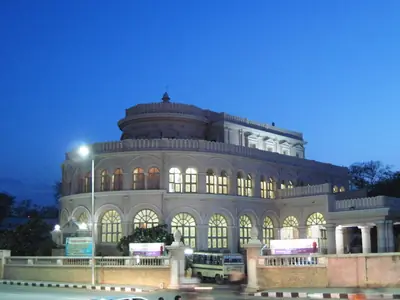
Vivekanandar Illam is a museum and permanent exhibition devoted to Swami Vivekananda, maintained by Ramakrishna Math. The building was constructed in 1842 by Frederic Tudor and was first known as the Ice House, in connection with his ice business.
After the business declined, Bilgiri Iyengar bought the house around 1880, redesigned it as a residence and renamed it Castle Kernan. Swami Vivekananda stayed there for nine days in 1897, from February 6 to February 14, after returning to India from his work in the West. During that stay, he gave several lectures and agreed to the creation of a permanent centre.
The building has also been known as Ice House and Castle Kernan. In 1963, the Tamil Nadu government gave it the name Vivekanandar Illam, meaning Vivekananda’s home.
University of Madras
Founded in Chennai in 1857, the University of Madras is one of India’s oldest universities. It is a public state university and a collegiate research institution whose work covers sciences, social sciences, humanities, management and medicine.
The university was established under British government rule through an act of the Legislative Council of India, with a founding model based on the University of London. Postgraduate teaching and research are organised through eighteen schools.
Government Museum and National Art Gallery
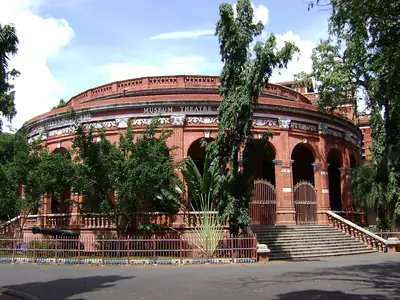
The Government Museum in Egmore, also known as the Madras Museum, brings together archaeology, coins, zoology, natural science and sculpture. Founded in 1851, it is the second-oldest museum in India after the Indian Museum in Kolkata.
The Government Museum Complex covers 16.25 acres and includes six buildings with 46 galleries. Its collection of bronze idols is especially notable, including around 500 dated to 1000 BCE. The Museum Theatre is one of the complex’s central landmarks.
The grounds also contain the National Art Gallery. Built in the Indo-Saracenic style, it houses rare European and Asian paintings by artists including Raja Ravi Varma.
Birla Planetarium
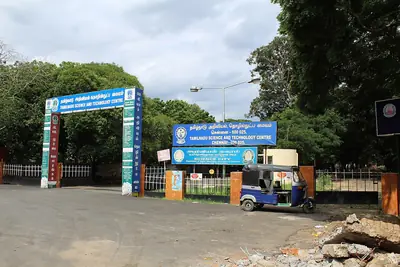
At Chennai’s Birla Planetarium, cosmic shows and virtual journeys through space unfold beneath a specially perforated hemispherical aluminium dome. Built in 1988 in memory of B. M. Birla, it is the fifth B. M. Birla planetarium in India.
The planetarium is part of a wider campus where exhibits lead from familiar scientific displays to the vastness of the virtual night sky.
Chennai Rail Museum
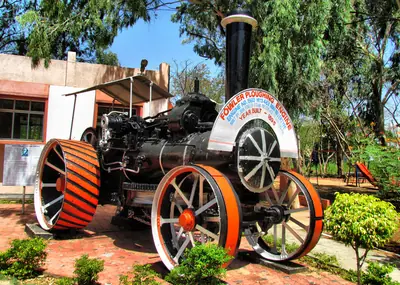
The Chennai Rail Museum near Perambur presents railway history through historic engines, coaches, technical displays and heritage exhibits. It opened on April 16, 2002, and covers 6.25 acres.
The collection includes steam engines from the period of the British Raj and vintage coaches such as those used on the Ooty trains. Some trains on display are more than a century old, and many of the older railway models were manufactured by the North British Locomotive Company.
The museum also has three air-conditioned galleries: the ICF Gallery, the Rail History Gallery and an Art Gallery. Other facilities include two additional galleries, a ninety-seat Dolby Digital cinema, Natyarangam and an Amphitheatre.
Zion Church, Chintadripet
Zion Church is one of the important landmarks of Chintadripet and remains a working place of worship. Built in 1847 by missionaries from the United States, it is described as the oldest church in Chennai built by US missionaries.
The church has a Gothic architectural style and a bell considered the second-oldest in the city.
Ambedkar Manimandapam
Ambedkar Manimandapam, also known as the Ambedkar Memorial, is dedicated to B. R. Ambedkar, remembered here as the architect of the Indian Constitution. The memorial stands in Chennai’s Adyar area, near the Adyar estuary on Greenways Road in Mandhavelipakkam.
The site occupies about one and a half acres. Its memorial building and bust of Ambedkar are set among lawns and a garden, giving the place an open setting for remembrance.
Valluvar Kottam
Valluvar Kottam is a monument dedicated to Valluvar, the classical Tamil poet and philosopher. It is also Chennai’s biggest Tamil cultural centre.
The foundation stone was laid on April 27, 1973, by the then Chief Minister M. Karunanidhi. The memorial was completed in 1976 and stands near the junction of Kodambakkam High Road and Village Streets.
Chennai is part of Tamil Nadu, a region with other notable destinations including Madurai and Mahabalipuram. It is also an excellent starting point for discovering more of India.
Explore Chennai with Neywo
Download Neywo’s free audio guide and discover Chennai independently. The app includes 3 walking tours and 1 bus route:
- Fort St George and the Churches of George Town: 1.84 km, 54 minutes and 5 narrated stops.
- Marina Beach, Nawabs and Ice: 4.86 km, 109 minutes and 8 narrated stops.
- Egmore: Museums, Kirks and a Methodist Church: 3.88 km, 80 minutes and 5 narrated stops.
- Route 27D: Mosques, Gardens and San Thome: 19.4 km, 83 minutes and 6 narrated stops.
Neywo has 53 narrated places in Chennai. Each story plays as you reach the place, at your own pace, with no group and no schedule. Narration is available in 11 languages.
Places with an audio guide in Chennai
8 places in Chennai with a Neywo audio guide. Each one starts telling its story as you reach it.
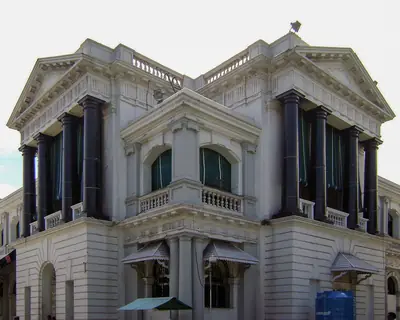
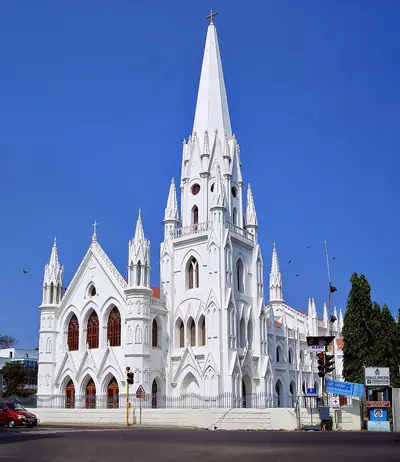
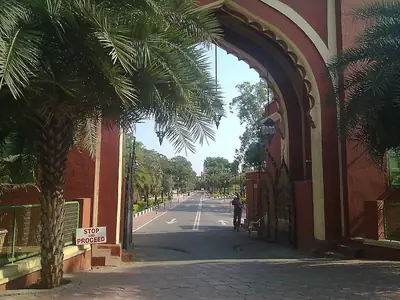
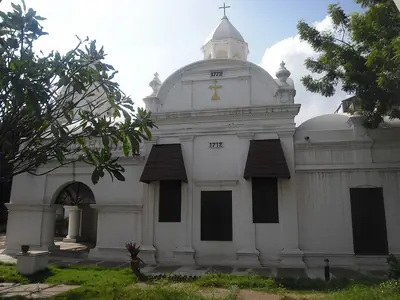
Self-guided tours in Chennai
4 tours in Chennai, free in the Neywo app. Each stop tells its story as you reach it.
- Bus ride
Route 27D: Mosques, Gardens and San Thome
An ordinary MTC city bus that runs down Anna Salai and across Royapettah to the sea at San Thome. Ride it from Egmore's Wesley Church past two Nawab-era mosques, Chennai's first botanical garden, the basilica built over the tomb of Saint Thomas and the Nawab of Arcot's lived-in palace.
Wesley Church, Egmore · Bahram Jung Mosque · Thousand Lights Mosque · Semmozhi Poonga · San Thome Basilica · Amir Mahal
Open this tour: Route 27D: Mosques, Gardens and San Thome - Walk
Fort St George and the Churches of George Town
Start where Madras began: the 1639 fortress that gave birth to the city, and the Anglican church inside it that people call the Westminster Abbey of the East. Then walk into George Town, where a Scottish mission church, a six-bell Armenian church and a Capuchin cathedral stand within a few steps of each other.
Fort St. George · St. Mary's Church, Chennai · Anderson Church, Chennai · Armenian Church, Chennai · St.Mary's Co-Cathedral
Open this tour: Fort St George and the Churches of George Town - Walk
Marina Beach, Nawabs and Ice
Walk north along the Marina from the house where Swami Vivekananda lectured, a former ice warehouse, past the Ice House mosque and the granite Triplicane Big Mosque to Chepauk's cricket ground and Nawab palace, then the university, the Labour statue and the memorials on the sand. Chennai's political, religious and cultural history in a short stretch.
Vivekanandar Illam · Hafiz Ahmad Khan Mosque · Triplicane Big Mosque · M. A. Chidambaram Stadium · Chepauk Palace · University of Madras …
Open this tour: Marina Beach, Nawabs and Ice - Walk
Egmore: Museums, Kirks and a Methodist Church
Explore Chennai's colonial Egmore: the Government Museum complex and its red-stone Indo-Saracenic art gallery, a Methodist church from 1903, the Scottish kirk modelled on London's St Martin-in-the-Fields and the church at Vepery.
Government Museum, Chennai · National Art Gallery, Chennai · Wesley Church, Egmore · St. Andrew's Church, Chennai · St. Matthias' Church, Vepery
Open this tour: Egmore: Museums, Kirks and a Methodist Church
Walk Chennai with Neywo
Neywo turns Chennai into a self-guided audio tour. Stories arrive as you reach the place they belong to, and the route reshapes when you wander off it.

