What to See in Mahabalipuram, India: Free Audio Guide
Things to Do in Mahabalipuram: Pallava Monuments by the Sea
The best things to do in Mahabalipuram are exploring its Shore Temple, monolithic rathas, rock-cut cave temples and monumental stone reliefs. Also known as Mamallapuram, this historic town on the Coromandel Coast brings together seventh- and eighth-century Pallava architecture in a remarkable landscape shaped by granite and the Bay of Bengal. Neywo has a free audio guide for Mahabalipuram with 12 narrated places, available in 11 languages.
What to See in Mahabalipuram
The main monuments belong to the Group of Monuments at Mahabalipuram, a UNESCO World Heritage Site since 1984. Together, they show several forms of Pallava architecture: structural temples assembled from stone blocks, sanctuaries carved into rock and monuments cut from single granite outcrops.
Shore Temple
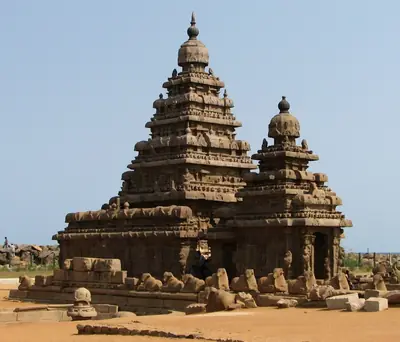
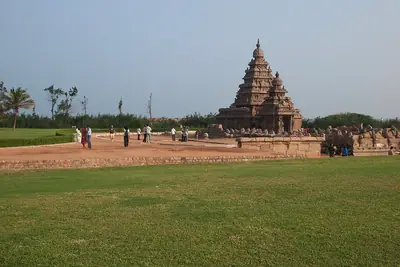
The Shore Temple is Mahabalipuram’s most recognisable landmark, facing the Bay of Bengal. Built around 725 AD during the reign of Narasimhavarman II, it is a structural temple made from carefully placed granite blocks rather than carved directly from living rock. It is regarded as one of the oldest structural stone temples in southern India.
The temple was built when Mahabalipuram was an active Pallava port, giving the monument a strong connection with the town’s maritime past. Within the complex, damaged sacred images include Somaskandar in the form of a linga and Jalasayana Perumal shown reclining.
Sthalasayana Perumal Temple
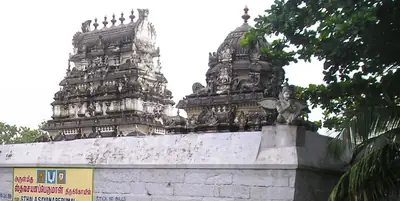
Sthalasayana Perumal Temple, also known as Thirukadalmallai, is a living Vishnu temple connected with Tamil devotional tradition. Vishnu is worshipped here as Sthalasayana Perumal, while Lakshmi is honoured as Nilamangai Thayar.
The central shrine shows the reclining Sthalasayana Perumal with Sri Devi and Bhu Devi at his feet. The temple follows the Pallavan style, with later contributions attributed to the Medieval Cholas, Vijayanagara kings and Madurai Nayaks. Its traditions also include the story of the Pundarika Pushkarani tank and a king cursed to live in the water as a crocodile.
Krishna Cave Temple
Krishna Cave Temple, or Krishna Mandapam, began as an open-air bas-relief in the middle of the seventh century. It was enclosed within a mandapa during the sixteenth century under the Vijayanagara Empire.
The main relief depicts Krishna lifting Govardhana Hill to protect cowherds and milkmaids from violent rain and flooding. Other carvings show Krishna with the milkmaids, giving the devotional scene a playful and human quality.
Descent of the Ganges, or Arjuna’s Penance
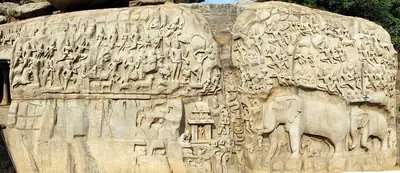
The Descent of the Ganges is also known as Arjuna’s Penance. This vast open-air relief stretches across two monolithic boulders measuring about 29 metres by 13 metres. A natural cleft between the rocks forms part of the composition, interpreted as a river flowing through the scene.
The carving presents gods, humans, animals, birds and elements of nature across different cosmic levels. At its centre, a human figure stands on one leg in penance near Shiva, who holds a trident and is surrounded by attendant spirits. The relief is commonly understood as the descent of the Ganges from heaven to earth, led by Bhagiratha, although its other familiar name refers to Arjuna’s penance.
Ganesha Ratha
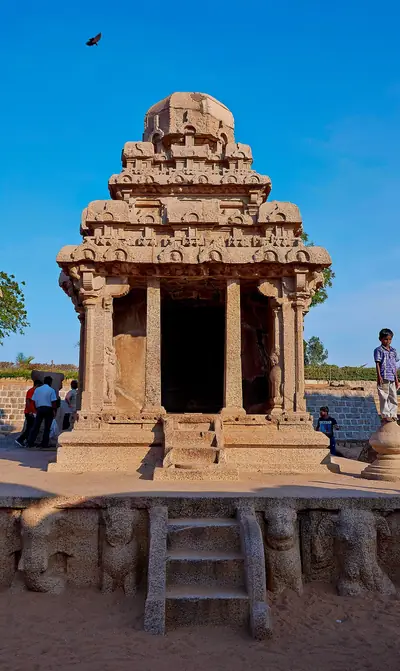
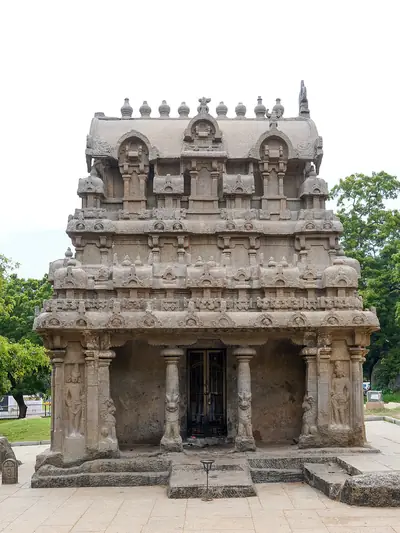
Ganesha Ratha is a monolithic temple carved from a single block of pink granite. Created in the late seventh century during the reigns of Mahendravarman I and his son Narasimhavarman I, it is one of the ten rathas carved from the rock at Mahabalipuram.
The shrine originally contained a Shiva Linga. After the linga was removed, it came to house Ganesha, giving the monument its present name. Its compact form is an example of the Pallava experimentation with temples carved from stone.
Varaha Cave Temple
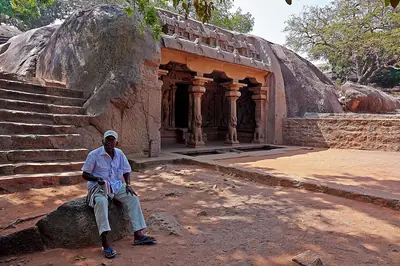
The Varaha Cave Temple, or Varaha Mandapa, is a small rock-cut shrine carved into the western side of a rock. Dating from the late seventh century, it stands in the hilltop village area about four kilometres north of Mahabalipuram’s main monuments.
The principal sculpture shows Vishnu in his Varaha, or boar, incarnation, lifting Bhudevi, the mother earth goddess, from the sea. Other mythical figures fill the cave, making this an intimate example of the sculpture and architecture found across the Group of Monuments.
Olakkannesvara Temple
Olakkannesvara Temple rises above the Mahishasuramardini Mandapa on a hillock. It forms part of the wider Group of Monuments at Mahabalipuram and offers another perspective on the relationship between the town’s temples, caves and rocky landscape.
Mahishasuramardini Mandapa
Near the lighthouse, the Mahishasuramardini Mandapa is a late seventh-century cave temple cut directly into a hill. Also known as Mahishamardini Cave and Yampuri, it has three sanctums and a façade supported by pillars, including distinctive lion pillars.
Its sculpted reliefs include Vishnu reclining on the seven-hooded serpent Adishesha and Durga fighting the buffalo-headed demon Mahishasura. A relief of Somaskanda appears on the rear wall of the central sanctum, whose floor includes a socket intended for a lingam.
Pancha Rathas
The Pancha Rathas, or Five Rathas, are five monuments carved from single blocks of granite. Each has its own shape and scale, and the monuments stand in a row on a slight incline, with the stone running roughly from north to south.
Although they are often called temples, they were never consecrated. The work remained unfinished, and the structures were not used as completed shrines. Their familiar names come from the five Pandava brothers and Draupadi in the Mahabharata, but they were not actually their chariots or temples.
The rathas illustrate an important stage in the development of Dravidian architecture, as earlier wooden forms were translated into monuments carved in stone.
A wider look at Mahabalipuram
Mahabalipuram was one of the two major port cities of the Pallava kingdom. The town was named after the Pallava king Narasimhavarman I, also known as Mamalla, while its ancient name was Thirukadalmallai.
Its monuments bring together temples, cave sanctuaries, monolithic chariot temples and enormous open-air reliefs. Around 40 important ancient monuments and temples are associated with the site, which has been restored since 1960 and is managed by the Archaeological Survey of India.
For a broader trip through southern India, you can continue to Tamil Nadu, explore Chennai, or compare Mahabalipuram with Madurai. The wider story also belongs to India, where Pallava religious architecture forms one part of a much larger cultural landscape.
Explore Mahabalipuram with Neywo
Download Neywo and follow its Mahabalipuram self-guided walking tour: one walk covering 2.56 km in 92 minutes, with nine narrated stops. The route includes the Shore Temple, Sthalasayana Perumal Temple, Krishna Cave Temple, Descent of the Ganges, Ganesha Ratha, Varaha Cave Temple, Olakkannesvara Temple, Mahishasuramardini Mandapa and Pancha Rathas.
Neywo tells the story of each place as you reach it, at your own pace, with no group and no schedule.
Places with an audio guide in Mahabalipuram
8 places in Mahabalipuram with a Neywo audio guide. Each one starts telling its story as you reach it.
Self-guided tours in Mahabalipuram
1 tour in Mahabalipuram, free in the Neywo app. Each stop tells its story as you reach it.
- Walk
Stone Made Into Story: Mamallapuram's Pallava Masterpieces
Start where the Bay of Bengal laps at an 8th-century temple built block by block, then climb into the rocky hill where Pallava sculptors carved caves, chariots and a whole mythic landscape straight out of the granite. You finish among the unfinished Pancha Rathas, five monolithic chariots that show how South Indian temple architecture was born.
Shore Temple · Sthalasayana Perumal Temple · Krishna Cave Temple · Descent of the Ganges · Ganesha Ratha · Varaha Cave Temple …
Open this tour: Stone Made Into Story: Mamallapuram's Pallava Masterpieces
Walk Mahabalipuram with Neywo
Neywo turns Mahabalipuram into a self-guided audio tour. Stories arrive as you reach the place they belong to, and the route reshapes when you wander off it.

