Pompei, Italy: Self-Guided Walking Tour
Things to do in Pompei: what to see in the ancient city
The best things to do in Pompei begin at its archaeological excavations, where an ancient Roman city remains remarkably preserved beneath the ash of Mount Vesuvius. Streets, houses, temples, markets, frescoes and mosaics offer an unusually detailed picture of daily life two thousand years ago. Pompei is also an important stop for travellers exploring Campania, with Naples nearby.
Neywo has a free audio guide for Pompei with 34 narrated places, available in 11 languages.
What to see in Pompei
Archaeological excavations of Pompeii
The archaeological excavations are the essential starting point for understanding Pompei. The city was buried during the eruption of Mount Vesuvius in 79 AD, preserving frescoes, mosaics, statues and everyday utensils alongside streets and buildings. Excavations began at the wish of Charles III of Bourbon. Many of the objects discovered are housed in the National Archaeological Museum of Naples, while a smaller collection is displayed in Pompei’s own Antiquarium.
The remains provide one of the best testimonies to daily life in an ancient Roman city. Rather than showing only monumental architecture, the site also reveals the ordinary details of homes, work and public life.
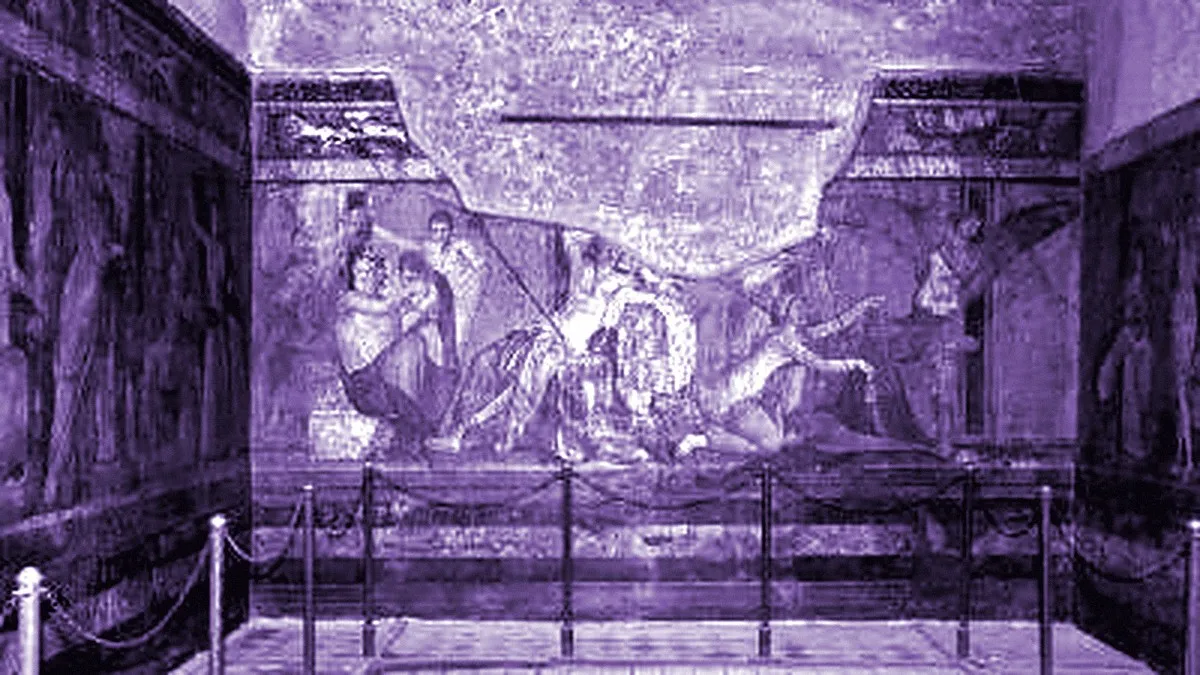
Villa of the Mysteries
A short walk from Porta di Ercolano, the Villa of the Mysteries is a suburban Roman villa known for its extraordinary frescoes. Its most famous room is Room 5, where a vivid series of paintings is usually interpreted as the initiation of a bride into a Greco-Roman mystery cult, probably connected with Dionysos.
The walls are painted in bright cinnabar and framed by a double meander, while illusionistic columns, masonry and imagined landscapes create the effect of an architectural scene. The villa originated in the 2nd century BC, was later enlarged and remodelled, and remained buried until excavations began in 1909.
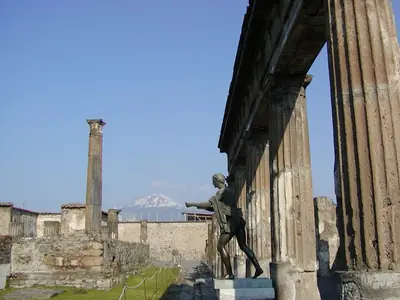
Temple of Apollo
The Temple of Apollo, also known as the Sanctuary of Apollo, is one of the oldest and most important religious sites in Pompei. Dedicated to Apollo, it reflects the combination of Greek and Roman influences that shaped the city’s religious culture.
The sanctuary dates back to around 120 BC, although its present form belongs to the second century BCE. It was buried by the eruption of 79 AD and uncovered during excavations in the 18th century. For many years, it was the city’s most frequented place of worship.
House of the Vettii
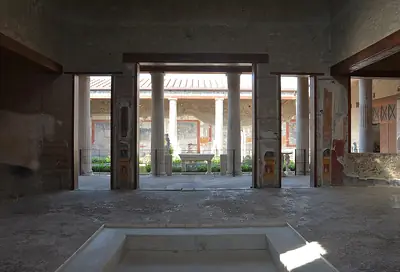
The House of the Vettii is one of Pompei’s most celebrated private residences. Its Fourth Style wall paintings include the black-and-red Oecus, the Pentheus chamber and the Ixion room, each decorated with elaborate painted architecture and figures.
A painted Priapus greets visitors in the vestibule, while the atrium opens onto a peristyle garden with fountains. The house belonged to two brothers, Aulus Vettius Conviva and Aulus Vettius Restitutus. Their bronze seals were found in the atrium, although their precise social status remains debated.
House of the Faun
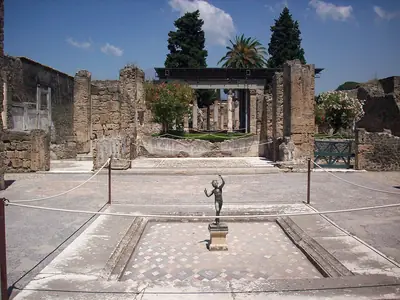
The House of the Faun was the largest private house in Pompei, covering roughly 2,940 square metres and extending across almost the whole of Insula 12 in Regio VI. Its name comes from a bronze statue of a dancing faun found beside the impluvium. The original is now in the National Archaeological Museum of Naples.
Built in the early second century BCE, the residence was extensively remodelled later in that century. Its Hellenistic-style peristyles, geometric garden and Alexandrian-influenced mosaics point to the wealth and cultural interests of its owners. The most famous work is the Alexander Mosaic, showing Alexander the Great in battle.
Macellum of Pompeii
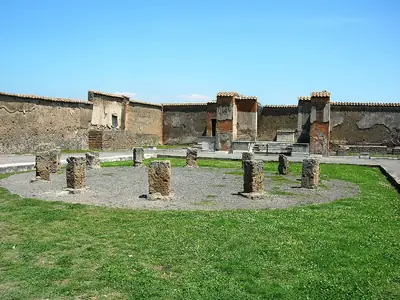
The Macellum was the city’s provision market and stood beside the Forum. Residents gathered here to buy food and other goods, making it an important meeting point in daily life.
The building developed through several construction phases and was damaged by the earthquake of 62 AD. It was not fully repaired before the eruption. Parts of the complex were dedicated to the imperial cult, while food remains, everyday objects and fragments of wall painting help reveal the connection between commerce, religion and public life.
House of the Golden Cupids
The House of the Golden Cupids is a Roman private home buried by the eruption of Vesuvius in 79 AD. Like many residences in the archaeological site, it preserves a glimpse of domestic life in ancient Pompei.
House of the Greek Epigrams
The House of the Greek Epigrams takes its modern name from Greek inscriptions found on wall paintings in a small room beside the peristyle. Remnants of Second Style paintings survive, although many are poorly preserved.
The building developed from at least two earlier dwellings dating to the second half of the second century BCE. Staircases suggest the presence of an upper floor, including one that may have led to a rented apartment. First uncovered in 1748, the house was fully excavated in 1875 and 1876 and later suffered heavy bomb damage during World War II.
House of the Geometric Mosaics
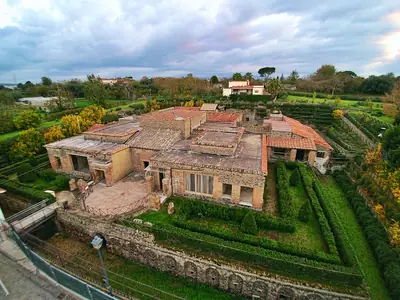
The House of the Geometric Mosaics stands on the edge of Pompei, where the ground slopes towards the sea. Its numerous geometric mosaics give the house its modern name. The building extends across two levels, adapting to the descending terrain.
The house was first uncovered in 1826, with extensive further excavations carried out in 2013.
Other houses and residences
Several smaller or less familiar homes add further detail to a visit. The House of the Lararium of Achilles takes its name from stucco decoration depicting scenes from the Trojan War. It is also known as the Casa del Sacello Iliaco.
The Casa del Naviglio, or House of Zephyrus and Flora, was richly decorated with wall paintings. Several were removed during 19th-century excavations and taken to the museum in Naples; their original arrangement is known today through old drawings.
The House of the Bull was a spacious residence whose name comes from a bronze bull statuette, now housed in Naples. The House of Marcus Epidius Rufus is notable for its rare figurative capitals and remnants of Fourth Style paintings. The House of Romulus and Remus offers another opportunity to imagine domestic life in ancient Pompei.
A Pompei self-guided walking tour with Neywo
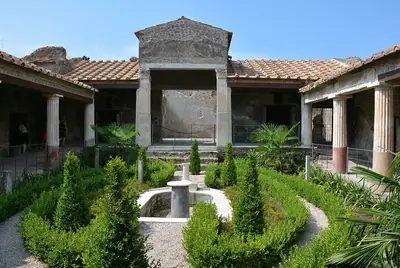
Neywo offers three walking tours in Pompei, with no group and no fixed schedule. The app tells the story of each place as you reach it, so you can explore at your own pace.
- Forum to Faun: Houses of Pompeii’s Elite — 1.2 km, 84 minutes and 12 narrated stops.
- Gladiators, Gates and the Amphitheatre — 2.34 km, 83 minutes and 10 narrated stops.
- Beyond the Walls: Tombs, Soap and Mystery Villas — 2.02 km, 72 minutes and 8 narrated stops.
The routes cover markets, villas, temples, houses, gates and the amphitheatre. Together, they make it easier to follow a route through the ruins while learning the story of each place when you arrive.
Download Neywo and explore Pompei with a free audio guide, at your own pace and without joining a group or following a schedule. You can also continue your journey through Italy and discover other places in Campania, including Salerno, Sorrento and Amalfi.
Places with an audio guide in Pompei
8 places in Pompei with a Neywo audio guide. Each one starts telling its story as you reach it.
Self-guided tours in Pompei
3 tours in Pompei, free in the Neywo app. Each stop tells its story as you reach it.
- Walk
Forum to Faun: Houses of Pompeii's Elite
Start at the forum's food market, then wander the streets of the richest quarter of a city frozen in 79 AD. The House of the Faun, the painted rooms of the Vettii, the hunting frescoes of the Ancient Hunt and the vast atrium of the Silver Wedding show how Pompeii's wealthiest families lived.
Macellum of Pompeii · Casa del Naviglio o di Zefiro e Flora · Casa dell'ancora · Casa dei cinque scheletri · House of the Faun · House of the Vettii …
Open this tour: Forum to Faun: Houses of Pompeii's Elite - Walk
Gladiators, Gates and the Amphitheatre
Walk the eastern side of Pompeii, where gladiators trained in a house turned into a practice ground. Pass the Nola Gate and the garden of Octavius Quartio, reach the amphitheatre, one of the oldest surviving in the Roman world, then loop back through the Nocera and Stabian gates.
Casa di Marco Lucrezio Fronto · House of the Gladiators · Porta Nola · House of Octavius Quartio · Porta Sarno · Amphitheatre of Pompeii …
Open this tour: Gladiators, Gates and the Amphitheatre - Walk
Beyond the Walls: Tombs, Soap and Mystery Villas
Leave the city by its northern gate and follow the road out to the suburban villas: the Villa of the Mysteries with its initiation frescoes, then the Villa of Diomedes and an ancient soap workshop. Return towards the forum past the Temple of Apollo and Igor Mitoraj's bronze centaur.
Porta Vesuvio · Villa of the Mysteries · Villa of Diomedes · Taberna Phoebi · House of Romulus and Remus · Temple of Apollo …
Open this tour: Beyond the Walls: Tombs, Soap and Mystery Villas
Walk Pompei with Neywo
Neywo turns Pompei into a self-guided audio tour. Stories arrive as you reach the place they belong to, and the route reshapes when you wander off it.

