Salerno, Italy: Self-Guided Walking Tour
Things to Do in Salerno, Italy: A Self-Guided Guide to the City
Looking for things to do in Salerno? This seaside city in Campania combines a medieval historic centre, museums connected with the famous Salerno Medical School, coastal fortifications and open waterfront spaces. Its location makes it a rewarding stop in Campania, whether you are exploring southern Italy or travelling through the region. Neywo has a free audio guide for Salerno with 53 narrated places, available in 11 languages.
What to See in Salerno
Piazza della Libertà and the waterfront
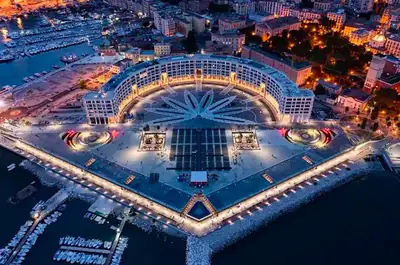
Piazza della Libertà is one of Salerno’s newest major urban spaces, in the Santa Teresa area. Designed by Spanish architect Ricardo Bofill as part of the waterfront redevelopment, it covers about 28,000 square metres and is described as the largest seaside square in Europe and one of the largest in Italy.
The square is closely connected to the Salerno Crescent, the semicircular complex along its northern edge. Its design combines a curved section with a triangular extension opening towards the sea. Green Guatemala marble, lava stone from Mount Etna, granite and travertine create patterns across the paving, while a shallow pool occupies an elevated, diamond-shaped area. Steps lead towards the promenade beside the Port of Santa Teresa and down towards the beach.
Salerno Cathedral
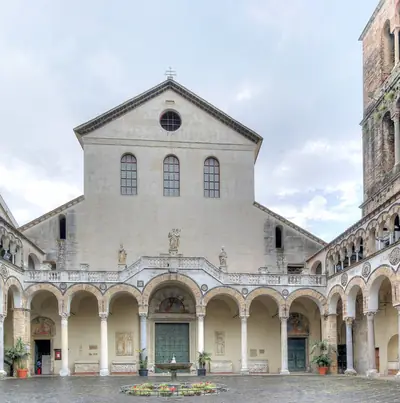
Salerno Cathedral, officially the Metropolitan Primatial Cathedral of Santa Maria degli Angeli, Saint Matthew and Saint Gregory VII, is one of the city’s essential landmarks. Construction began under Norman rule in 1080, and the church was inaugurated in 1084 after its consecration by Pope Gregory VII. It was completed the following year.
The cathedral is a major example of Romanesque architecture and reflects Salerno’s importance under Norman religious and political authority. Bronze doors open onto a rectangular atrium enclosed by a covered portico supported by 28 columns. Roman and medieval tombs are built into the surrounding walls, and two stone lions stand at the base of the staircase. The cathedral is dedicated in part to Saint Matthew, Salerno’s patron saint.
Diocesan Museum of Salerno
The Diocesan Museum, also known as the Museum of Saint Matthew, occupies the former archbishop’s seminary. The building later became the final home of the Salernitan Medical School before its suppression in 1811.
Its most remarkable collection is the ivory cycle, described as the world’s most extensive and comprehensive collection of Christian medieval ivory tablets. The 69 pieces form a continuous biblical narrative, with Old Testament scenes arranged horizontally and New Testament sections vertically. Scholars date the cycle to between the late eleventh and early twelfth centuries.
The Virtual Museum of the Salerno Medical School
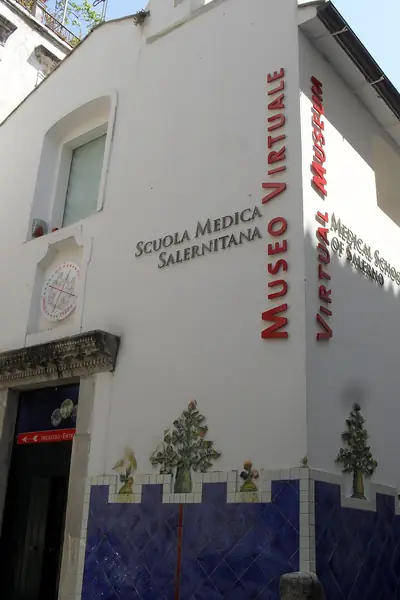
Housed in the ancient Church of San Gregorio on Via dei Mercanti, the Virtual Museum of the Salerno Medical School uses films, three-dimensional reconstructions and displays to explain the history of medicine in Salerno. Its focus is the knowledge and techniques of the medical school, especially during its period of prominence from the tenth to the thirteenth century.
A glass floor reveals the older structure beneath the building. The displays also include surgical instruments associated with physicians of the past.
Minerva’s Garden
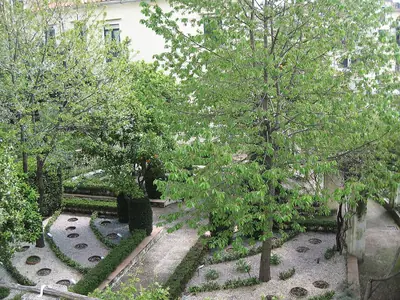
Giardino della Minerva, or Minerva’s Garden, preserves the memory of Salerno’s medical tradition. In the Middle Ages, it served as a garden of simples, where medicinal plants were cultivated for teaching. It is associated with Matteo Silvatico, a master of the Salerno Medical School who established his medical garden here in the early fourteenth century.
The terraced garden reflects the systematic cultivation and classification of plants for study, teaching and medicinal use. This approach later influenced botanical gardens in Padua, Pisa, Florence, Pavia and Bologna. The complex also incorporates Capasso Palace, where medieval painted tiles were discovered during restoration.
The Monumental Complex of Santa Sofia
The Monumental Complex of Santa Sofia includes the Church of the Santissima Addolorata and the former Monastery of Santa Sofia, whose history reaches back to the ninth century and has Lombard origins. In the sixteenth century, the Jesuits settled in the monastery and helped create the church that stands there today.
Its grand staircase reflects the ideals of the Counter-Reformation and the Jesuits’ emphasis on sacred representation. Inside, wall paintings from the sixteenth and seventeenth centuries remain part of the building’s character. The complex also hosts cultural events and exhibitions.
Palazzo Fruscione
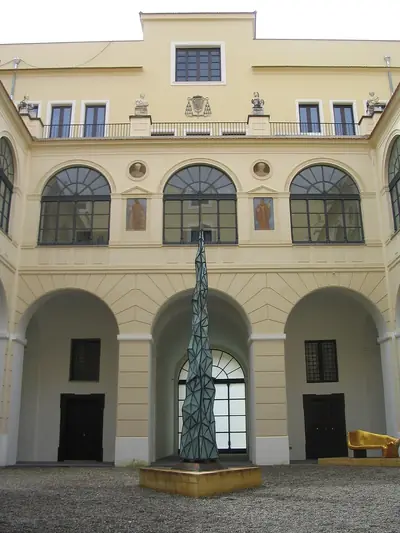
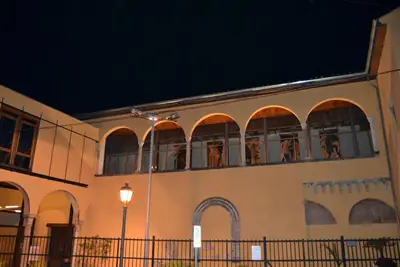
Palazzo Fruscione, also known as Casa della Poesia, is one of the most distinctive medieval buildings in Salerno’s historic centre. It stands near the ancient Via dei Canali of Roman Salerno and was built partly over the remains of an imperial Roman thermal complex.
Construction began in the thirteenth century. The eastern façade has three ground-floor portals framed by alternating grey and yellow tuff stone, sculpted mullioned windows and elegant multi-lancet windows with pointed arches. The interior’s courtyard and vertical arrangement reveal how the building developed as the surrounding streets changed. Today, the palace hosts exhibitions, installations and cultural events.
Palazzo Pinto and the Provincial Pinacotheca
Palazzo Pinto is an elegant historic residence close to the cathedral and home to the Provincial Pinacotheca. The palace dates from the eleventh or twelfth century, giving the collection a strong connection with Salerno’s urban history.
The artworks trace the development of painting from the Renaissance to the first half of the twentieth century. The eighteenth century is represented by works from Francesco Solimena and his academy, alongside paintings connected with Salerno and the wider province.
The Provincial Archaeological Museum
The Provincial Archaeological Museum brings together finds from Salerno and the surrounding province. It occupies a complex with Lombard-era roots: the first records of the monastery of San Benedetto date from 868, and the monastery became an abbey in 930.
The building itself contains remains of the southern and eastern porticoes of the Church of San Benedetto, as well as traces of the loggia of Castelnuovo Reale, a royal palace where Queen Margherita of Durazzo spent her final years in the early fifteenth century. The site’s successive transformations make it both an archaeological museum and a layered historic structure.
Roberto Papi Museum
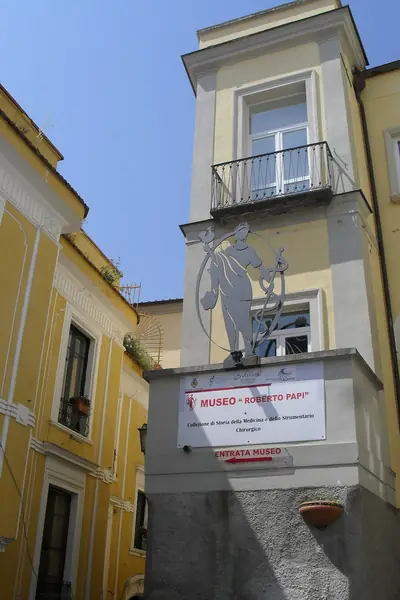
The Roberto Papi Museum explores medical history through a collection of medical and surgical instruments assembled by Mario Papi. Established in September 2009, it is dedicated to Roberto Papi, Mario Papi’s son.
The museum occupies Palazzo Galdieri, also known as Palazzo San Massimo or Palazzo Maiuri, in the upper part of the historic centre, an area once known as Plaium Montis. The building’s history is connected with the monastery and church of San Massimo. Its four levels cover about 3,700 square metres and vary considerably in size.
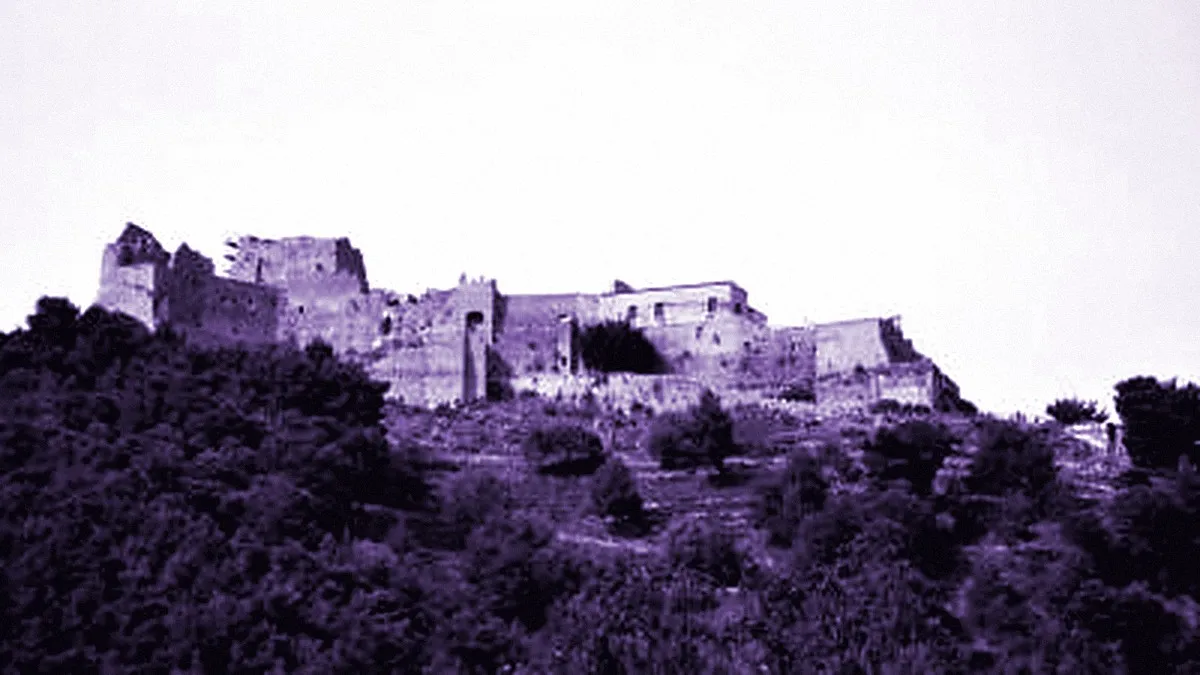
Arechi Castle
High above the city on Monte Bonadies, Arechi Castle overlooks Salerno and the Gulf of Salerno. The medieval castle dates back to the sixth century. Its elevated position reflects its original role as a fortified building commanding the city and the gulf.
Fort Carnale
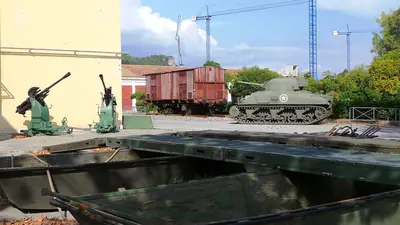
Fort Carnale, or Forte La Carnale, is a coastal stronghold near the mouth of the Irno River. It was built in the 1560s as part of a wider defensive system created from 1563 onwards, protecting Salerno against Saracen incursions.
Originally conceived as a coastal cavalry tower, it was remodelled into a fortress in the nineteenth century. That transformation explains the name Forte and gives the building its present character.
Explore Salerno with a Self-Guided Audio Tour
A Salerno self-guided walking tour is an easy way to connect the city’s monuments while keeping your own rhythm. Neywo’s free audio guide includes four walking tours and one bike route, with 53 narrated places across the city:
- Via dei Mercanti: From the Norman Cathedral to Fornelle — 1.55 km, 80 minutes and 11 stops.
- Medicine, Gardens and Music on Salerno’s Hill — 1.74 km, 70 minutes and 9 stops.
- Salerno by the Sea: Zaha Hadid to the Opera House — 1.12 km, 57 minutes and 8 stops.
- The Devil’s Bridge and the Norman Castle: East Salerno — 1.24 km, 63 minutes and 9 stops.
- Lungomare Trieste: Salerno’s Seafront by Bike — 1.5 km, 8 minutes and 5 stops.
The tours include places such as Salerno Cathedral, Minerva’s Garden, Piazza della Libertà, the Provincial Archaeological Museum, Villa Comunale and the City Hall of Salerno. The app tells the story of each place as you reach it, at your own pace, with no group and no schedule.
Download Neywo and Discover Salerno
Download Neywo to explore Salerno with a free audio guide covering 53 narrated places. Choose one of four walking tours or the bike route, follow the route at your own pace and listen as each story plays when you arrive. With narration in 11 languages and no group or schedule, Neywo lets you discover Salerno independently.
After Salerno, continue through Campania to Naples, Pompei, Sorrento, Amalfi, Capri or Ischia.
Places with an audio guide in Salerno
8 places in Salerno with a Neywo audio guide. Each one starts telling its story as you reach it.
Self-guided tours in Salerno
5 tours in Salerno, free in the Neywo app. Each stop tells its story as you reach it.
- Bike ride
Lungomare Trieste: Salerno's Seafront by Bike
Ride Salerno's flat waterfront from Piazza della Libertà and the Villa Comunale along the green-surfaced seafront cycle path, passing the Art Deco and Coppede palaces of Corso Garibaldi on the way east.
Piazza della Libertà · Villa Comunale · City Hall of Salerno · Palazzo Santoro · Palazzo D'Ambrosio
Open this tour: Lungomare Trieste: Salerno's Seafront by Bike - Walk
Via dei Mercanti: From the Norman Cathedral to Fornelle
Follow Salerno's main medieval street from the Romanesque cathedral and its twenty-eight-column atrium to the quiet Fornelle quarter. On the way: a museum of medieval ivories, the old Medical School, a Baroque jewel of a church and the thirteenth-century Palazzo Fruscione, built over a Roman bath.
Salerno Cathedral · Diocesan Museum of Salerno · Palazzo Carrara · Museo virtuale della scuola medica salernitana · San Giorgio · Palazzo Fruscione …
Open this tour: Via dei Mercanti: From the Norman Cathedral to Fornelle - Walk
Medicine, Gardens and Music on Salerno's Hill
Climb into the upper old town, the 'plaium montis', where the first medical school of the Western world grew. Visit Minerva's medieval medicinal garden, a museum of medical history, the music conservatory and the painting gallery in Palazzo Pinto.
Conservatorio Giuseppe Martucci · Minerva's Garden · Palazzo Conforti · Roberto Papi Museum · Museo della Ceramica Alfonso Tafuri · Sant'Agostino …
Open this tour: Medicine, Gardens and Music on Salerno's Hill - Walk
Salerno by the Sea: Zaha Hadid to the Opera House
A walk through modern and Belle Epoque Salerno: Zaha Hadid's oyster-shaped maritime station, Ricardo Bofill's great square and Crescent, the Art Nouveau palace facing Teatro Verdi and the city garden, then along Via Roma's civic buildings.
Salerno harbor station · Piazza della Libertà · Sorgenti degli Uberti Palace · Teatro Verdi · Villa Comunale · Palazzo della Prefettura …
Open this tour: Salerno by the Sea: Zaha Hadid to the Opera House - Walk
The Devil's Bridge and the Norman Castle: East Salerno
Start under the medieval aqueduct known as the Devil's Bridge, said to have been built by a magician in one night. Pass the archaeological museum and the site of Robert Guiscard's castle, then follow Via Portanova and Corso Garibaldi to the Coppede-style Palazzo Santoro.
Acquedotto medievale · Museo archeologico provinciale di Salerno · Castel Terracena · Church of the Holy Cross · San Pietro in Vinculis · Palazzo della Camera di commercio …
Open this tour: The Devil's Bridge and the Norman Castle: East Salerno
Walk Salerno with Neywo
Neywo turns Salerno into a self-guided audio tour. Stories arrive as you reach the place they belong to, and the route reshapes when you wander off it.

