Visiting La Coruña, Spain: Top Sights on Foot
Things to Do in La Coruña: What to See in the Atlantic City
La Coruña is a coastal city in Galicia, Spain, where Roman history, science museums, historic streets, and the Atlantic promenade come together. The city is worth visiting for landmarks such as the Tower of Hercules, its museums, and the distinctive glass-fronted buildings along the waterfront. Neywo has a free audio guide for La Coruña with 74 narrated places.
What to See in La Coruña
From the seafront to the Old Town, these are some of the most important places to include when exploring La Coruña. The city’s compact layout makes it well suited to discovering on foot, especially with a La Coruña self-guided walking tour.
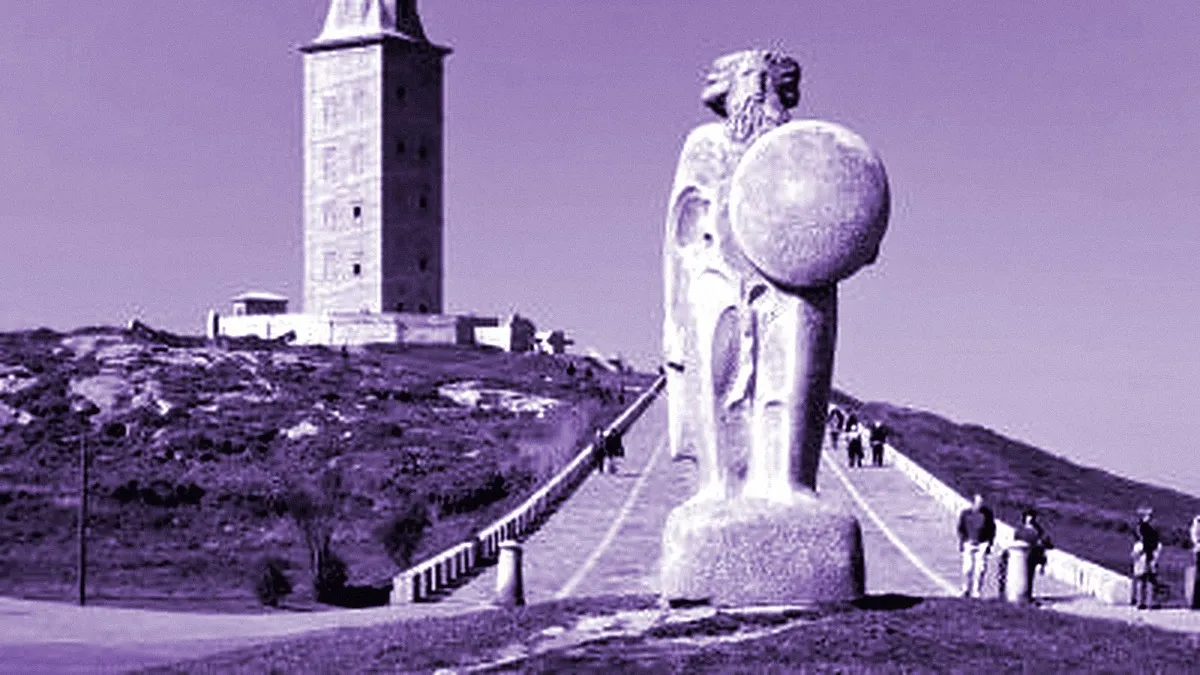
Tower of Hercules
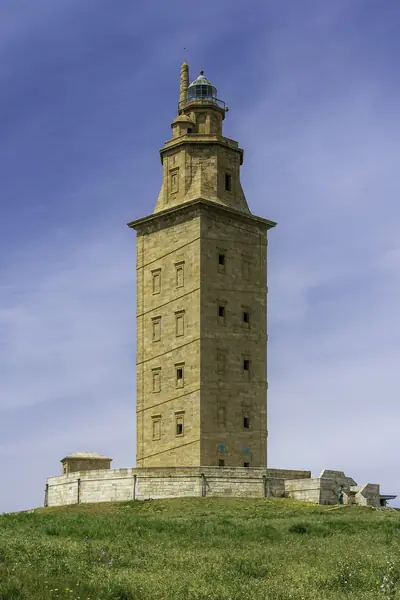
The Tower of Hercules is La Coruña’s best-known landmark and the oldest Roman lighthouse still in operation. The tower rises 55 metres above the coast and was declared a UNESCO World Heritage Site in 2009.
Its history reaches back to the late first or early second century, when it was known as Farum Brigantium and guided ships along the western seaboard. The Roman masonry remains at the core, while two octagonal sections were added during an eighteenth-century restoration led by Eustaquio Giannini, under Charles the Third of Spain. A wooden staircase had already been installed in the seventeenth century, and visitors today climb 230 steps to the summit.
The tower is also connected with the legend of Hercules, who is said to have arrived on this coast and defeated the giant Geryon.
Breogán and the Atlantic edge
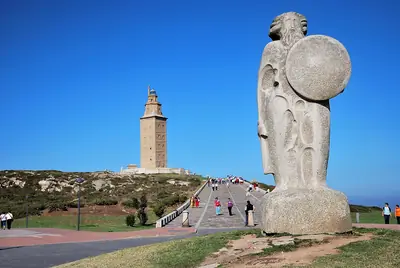
Breogán is one of the monuments encountered around the city and offers a brief introduction to the figures and stories associated with Galicia. It is also close to the open Atlantic setting that gives La Coruña much of its character.
Aquarium Finisterrae
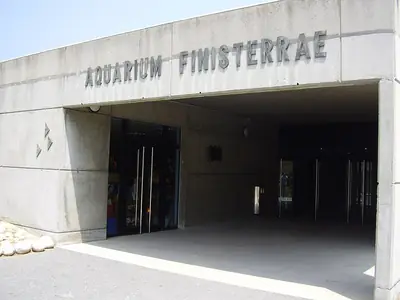
Aquarium Finisterrae, also known as the Casa de los Peces or Fish House, explores the biology of the sea, oceanography, and the marine world. Its Sala Maremágnum presents more than six hundred species from the Atlantic Ocean, while the Sala Humboldt and the Octopus’ Garden focus on marine ecosystems and one of the ocean’s most mysterious creatures.
The Sala Nautilus is designed like Captain Nemo’s study from Twenty Thousand Leagues Under the Sea. It surrounds a pool containing 4.4 million litres of water, where sharks and other Atlantic fish swim past the glass. Outside, the Piscinarium is home to a colony of seals, and the Stroking Pool offers a hands-on encounter with marine life.
Casa del Hombre
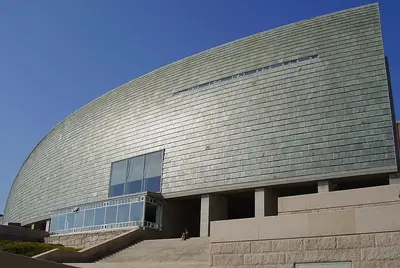
Along the Seaside Promenade, Domus—also known as Casa del Hombre or House of Humankind—is a science museum dedicated to the human being. Its interactive exhibits cover identity, genetics, human evolution, the senses, nutrition, movement, the circulatory system, and the human foot.
The building itself is one of the city’s notable sights. Designed by César Portela and Arata Isozaki, its curved façade follows the rugged coastline. Granite surfaces are combined with 6,600 pieces of slate, attached with almost 160,000 hand-installed screws. Inside, around 1,500 square metres contain almost 200 exhibition modules, most of which require visitors to activate a mechanism or take part in an activity.
A Coruña Town Hall and María Pita Square
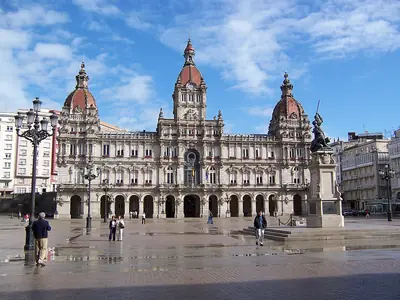
A Coruña Town Hall, also called the María Pita Palace or Municipal Palace, forms the northern side of María Pita Square. Designed by Pedro Mariño and built between 1904 and 1912, the building combines an eclectic style with the functions of the city government and the Clock Museum.
Its façade includes four white stone statues representing the four Galician provinces: A Coruña, Lugo, Ourense, and Pontevedra. Allegorical sculptures and the city’s coat of arms complete the upper part of the building. The highest tower carries a large clock whose bronze-and-tin bells weigh more than 1,600 kilos.
Inside, a grand staircase leads to rooms including the Red Salon, Blue Salon, and Golden Salon. The latter contains ornate reliefs depicting important events from A Coruña’s history.
Casa Museo de María Pita
The Casa Museo de María Pita recalls the life of one of A Coruña’s best-known heroines. It focuses on her role in the fight against an English fleet in the sixteenth century, led by Francis Drake.
The museum stands on the site of a sixteenth-century house owned by María Pita’s first husband, Xoán Alonso de Rois, on Rúa dos Ferreiros. Together with María Pita Square and the Town Hall, it adds a personal dimension to the city’s history.
Casa Museo Emilia Pardo Bazán
In the Old Town, at number 11 on Tabernas Street, the Casa Museo Emilia Pardo Bazán occupies the former family home of the countess and writer. The house is closely connected with the literary life of La Coruña and shares its premises with the Real Academia Galega.
The museum presents the family residence while highlighting Emilia Pardo Bazán’s work as an author. Its rooms combine a historicist atmosphere with more contemporary staging. The museum is temporarily closed for rehabilitation work, but the house remains an important part of the city’s literary heritage.
Real Colegiata de Santa María do Campo and its museum
The Museum of Sacred Art of Santa María do Campo contains religious treasures connected with the Collegiate Church of Santa María do Campo. Its collection consists of silver objects used for religious purposes, dating from the sixteenth to the twentieth century. One of its highlights is a monstrance from the late seventeenth century.
The nearby church has origins in the twelfth and thirteenth centuries. Completed in 1302 and made a collegiate church in 1411, it has a Romanesque structure with three naves and a façade combining Romanesque and Gothic features. Inside, pointed arches separate the naves, while the Baroque altar presents scenes from the life of the Virgin Mary.
Coruña Fine Arts Museum and the Church of the Capuchinas
The Coruña Fine Arts Museum combines a modern building with preserved elements of the former Capuchinas convent. Its collection covers Spanish and European painting from the sixteenth to the twentieth centuries, Galician painting from the nineteenth century to the present, prints by Francisco de Goya, and ceramics from Sargadelos.
The modern building was designed by Manuel Gallego Jorreto. Nearby, the Church of the Capuchinas on Rua das Panadeiras recalls the religious complex that once occupied the site.
Casa de las Ciencias
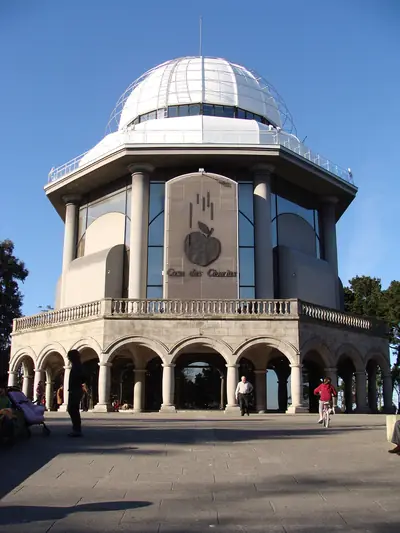
In Santa Margarita Park, Casa de las Ciencias introduces science through experiments, interactive exhibitions, and a planetarium. Created on the initiative of Mayor Francisco Vázquez Vázquez, it opened in 1985 and was designed to make science and technology accessible through hands-on discovery.
The museum occupies a palace with classic architecture. Its three floors contain physics experiments, pendulum demonstrations, and astronomy displays. The Foucault pendulum swings through the central stairwell, offering a visible demonstration of the Earth’s rotation. An incubator also gives visitors the unusual opportunity to watch chicks hatch.
National Museum of Science and Technology
MUNCYT, the National Museum of Science and Technology, presents Spain’s scientific and technological history through objects, interactive displays, and permanent exhibitions. It occupies the Prisma de Cristal, a glass-and-concrete building designed by Victoria Acivro and Anxo Alonso.
The museum’s six permanent exhibition halls include interactive displays, technological landmarks, historic objects, and examples of Spanish innovation. The Iberia hall contains the front section of the Boeing 747 that carried Picasso’s Guernica back to Spain from New York. The museum also displays the former lantern from the Tower of Hercules.
Other cultural stops
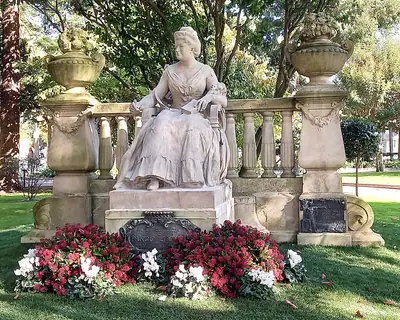
Several smaller places add variety to a visit. The Fundación Luis Seoane is a contemporary art and cultural centre where Galician art meets historical and contemporary avant-garde movements. Kiosco Alfonso, in the Méndez Núñez Gardens, hosts exhibitions and public events. The gardens also contain a monument dedicated to Emilia Pardo Bazán.
The Military Museum of La Coruña occupies part of the former Convent of San Francisco in Plaza de Carlos I. Its collection includes weapons, uniforms, flags, military decorations, maps, models, works of art, scientific objects, and pre-Roman objects associated mainly with the Gallaeci. Among its unusual exhibits is an eighteenth-century clock mechanism from the Palace of the Captaincy General.
Explore La Coruña with Neywo
Neywo offers a free audio guide to La Coruña with 74 narrated places. Its six routes include four walking tours, one bus route, and one bike route:
- Four walking tours: routes of 1.6 km and 83 minutes, 2.03 km and 89 minutes, 3.21 km and 104 minutes, and 3.93 km and 95 minutes. They include between 8 and 12 narrated stops.
- One bus route: 3.1 km, 13 minutes, and 7 stops.
- One bike route: 3.2 km, 16 minutes, and 5 stops.
The routes cover the Tower of Hercules, the Old Town, the Méndez Núñez Gardens, the Atlantic Promenade, Riazor, museums, churches, monuments, and other city landmarks. The app tells the story of each place as you reach it, at your own pace, with no group and no schedule. Download Neywo and explore La Coruña independently, with narration available in 11 languages.
La Coruña is part of Galicia, in Spain. If you are continuing through the region, you can also discover Santiago de Compostela and Vigo.
Places with an audio guide in La Coruña
8 places in La Coruña with a Neywo audio guide. Each one starts telling its story as you reach it.
Self-guided tours in La Coruña
6 tours in La Coruña, free in the Neywo app. Each stop tells its story as you reach it.
- Bike ride
Paseo Marítimo: Along the Atlantic Promenade
Ride the seafront cycle lane beside the sea from the Hercules monument past the aquarium and the Domus science museum to Riazor beach and the football stadium. Flat, scenic and mostly traffic-free.
Combate entre Hércules e Xerión · Aquarium Finisterrae · Casa del Hombre (La Coruña) · Praia de Riazor · Estadio Municipal de Abanca Riazor
Open this tour: Paseo Marítimo: Along the Atlantic Promenade - Bus ride
Bus 5: Through the Heart of A Coruña
The city's line 5 runs straight through the centre. Ride it from the port-side Praza da Palloza and Praza de Ourense to the Curros Enríquez monument and Teatro Colón, then to the Pardo Bazán house, the Military Museum and the Santa Bárbara convent in the old town.
Praza da Palloza · Praza de Ourense · Monument to Curros Enríquez · Teatro Colón · Casa Museo Emilia Pardo Bazán · La Coruna Military Museum …
Open this tour: Bus 5: Through the Heart of A Coruña - Walk
Hercules, Giants and the Edge of the Atlantic
Walk the rocky headland where Hercules is said to have buried the giant Geryon. You pass twelve standing stones for peace, the monument to the executed of the Republic and the giant Breogán, climb to the only working Roman lighthouse in the world, then follow the Atlantic promenade to the aquarium and the slate-clad House of Humankind.
Menhirs for Peace · Monumento aos Fusilados da Republica · Breogán · Combate entre Hércules e Xerión · Ara Solis · Tower of Hercules …
Open this tour: Hercules, Giants and the Edge of the Atlantic - Walk
Heroines, Emperors and a General's Tomb: The Old Town
Wander the medieval quarter of A Coruña, from the square named after the woman who faced down Francis Drake to the house museums of María Pita and Emilia Pardo Bazán, Romanesque churches and a quiet garden with a British general's tomb. Convents, a relief of the Last Judgment, the ruins of a convent that hosted an emperor and the sixteenth-century castle of San Antón are all within a few streets.
Churche of Saint George · María Pita square · Iglesia de Santiago · Casa Museo Emilia Pardo Bazán · Real Colexiata de Santa María do Campo · Casa Museo de María Pita …
Open this tour: Heroines, Emperors and a General's Tomb: The Old Town - Walk
The Crystal City: Glass Galleries and Garden Statues
Start at the house museum of the statesman Casares Quiroga and the San Agustín market, then stroll the waterfront that gave A Coruña the nickname Crystal City, where white glazed galleries run along one of the largest glass complexes in the world. Continue past two theatres, a neoclassical block, a bold obelisk and the sculpture-filled Méndez Núñez gardens.
Casa Museo Casares Quiroga · Mercado Municipal de San Agustín · Coruña Fine Arts Museum · Teatro Colón · Teatro Circo Emilia Pardo Bazán · Avenida da Mariña …
Open this tour: The Crystal City: Glass Galleries and Garden Statues - Walk
Picasso's Childhood to the Millennium Obelisk
Begin at the apartment where the young Picasso lived in A Coruña, then cross to the Santa Margarita park and its Opera Palace and science house. Reach the Riazor beach and stadium and follow the Paseo Marítimo to the national science museum and the Millennium obelisk.
Casa Museo Picasso · Palacio de la Ópera A Coruña · Casa de las Ciencias (La Coruña) · Church of San Francisco de Asís, A Coruña · Praia de Riazor · Estadio Municipal de Abanca Riazor …
Open this tour: Picasso's Childhood to the Millennium Obelisk
Walk La Coruña with Neywo
Neywo turns La Coruña into a self-guided audio tour. Stories arrive as you reach the place they belong to, and the route reshapes when you wander off it.

