What to See in Alicante, Spain: Free Audio Guide
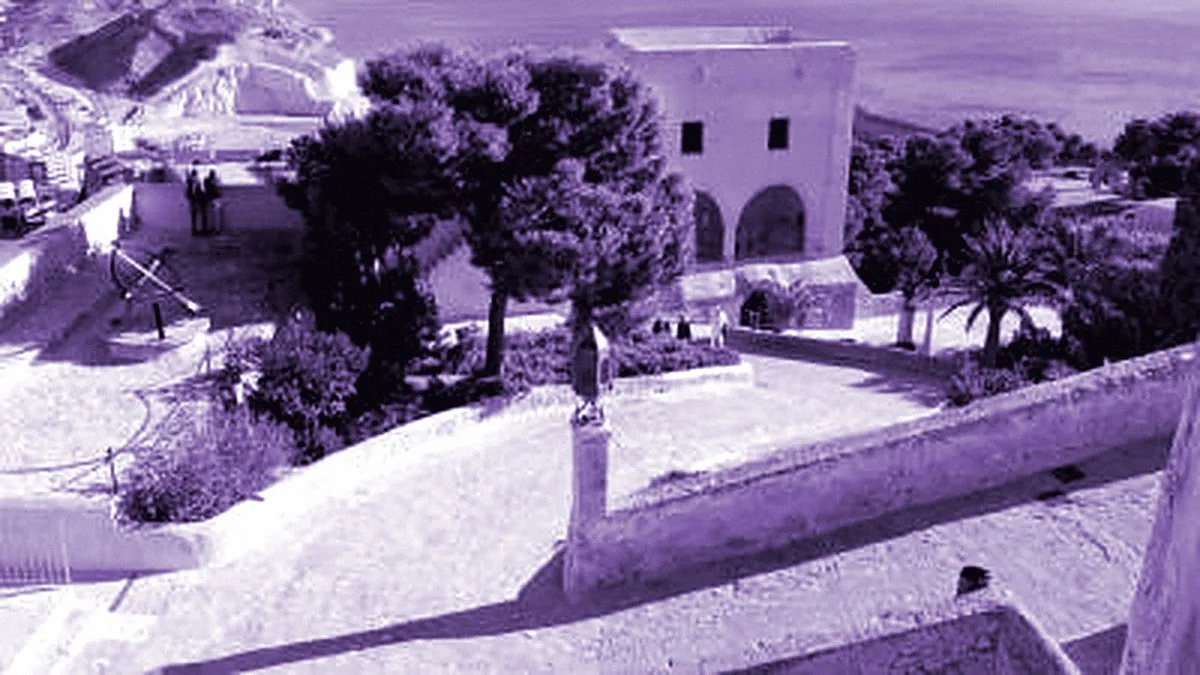
Things to do in Alicante: the best places to see in Alicante
Alicante is a Mediterranean city with a remarkable historic center, a castle above the bay, churches shaped by different eras, and a waterfront promenade known for its wave-patterned pavement. The city is compact enough to explore on foot, with history, architecture, local food, and coastal scenery close together. Neywo offers a free audio guide for Alicante with 8 narrated places.
What to see and do in Alicante
Santa Bárbara Castle
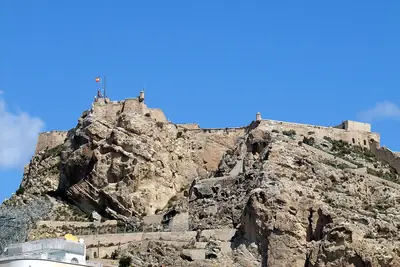
Santa Bárbara Castle is one of Alicante’s defining landmarks. The fortification stands on Mount Benacantil, overlooking the bay and coastline, and the rock beneath it is said to resemble a face known locally as “the face of the Moor.”
The castle is divided into three main levels built during different periods. The highest section, La Torreta, contains the oldest structures, including remains of Islamic fortifications and the Tower of Homage, once the most important defensive point. Thick stone walls and the castle’s elevated position reveal why the site was so valuable as a stronghold.
In 1961, Santa Bárbara Castle was declared a historic-artistic monument.
Archaeological Museum of Alicante
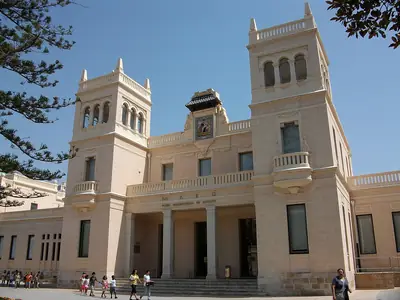
The Archaeological Museum of Alicante, usually known as MARQ, presents the history of the Costa Blanca through galleries devoted to prehistory, Iberian culture, Roman culture, the Middle Ages, and modern and contemporary cultures. It also has an area for temporary exhibitions.
MARQ occupies the former Hospital San Juan de Dios, a building designed by Juan Vidal Ramos between 1926 and 1929. The museum was inaugurated in its definitive form in 2000 and is known for its multimedia approach, with audiovisual and computer-based material complementing more than 81,000 pieces.
The building itself was declared a historic-artistic monument in 1962. Together, its collections and presentation offer a broad introduction to the civilizations that shaped Alicante and the Costa Blanca.
Basilica of Saint Mary
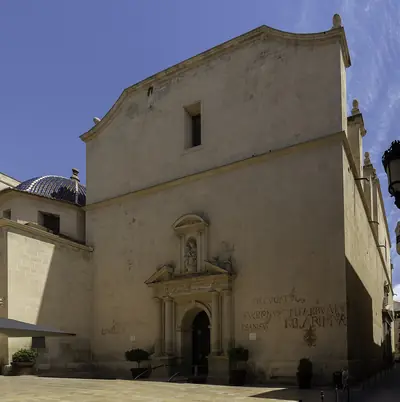
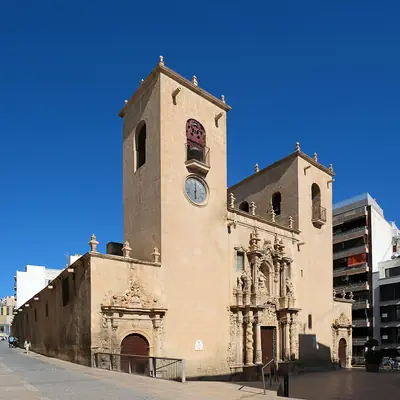
The Basilica of Saint Mary stands in Plaza de Santa María and is the oldest church in Alicante. Its origins go back to the 14th century, when it was built on the site of the principal mosque from the Moorish era.
The basilica is in Valencian Gothic style and has a single nave with six side chapels between the buttresses. Its two bell towers are particularly distinctive: the first dates from the 14th century, while the second was added in the 18th century. Major changes in the 15th century, carried out under the Catholic Monarchs, helped shape the building seen today.
The church is one of the most important sights in Alicante’s historic center, combining Gothic architecture with the deeper religious and urban history of the site.
Alicante Town Hall
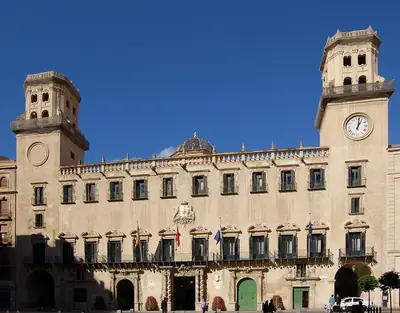
Alicante Town Hall is a Baroque building between the Plazas of the Ayuntamiento and the Santísima Faz, in the Santa Cruz quarter. Its façade is framed by two towers, while Solomonic columns mark the entrance.
Inside, a red marble staircase leads to the Blue Room, an example of Isabelline style. The building also contains the Plenary Room and a chapel. Its minimalist annex provides a contrast to the ornate main structure and includes a glimpse of Alicante’s medieval city on the ground floor.
The Town Hall was built in the 18th century and declared a historic-artistic monument in 1961.
Co-Cathedral of St. Nicholas of Bari
The Co-Cathedral of St. Nicholas of Bari is dedicated to Saint Nicholas and belongs to the Diocese of Orihuela-Alicante. It became a cathedral on 9 March 1959, when Pope John XXIII elevated it to co-cathedral status.
The present church was designed between 1610 and 1615 by Agustín Bernardino, a student of Juan de Herrera, and constructed between 1613 and 1662. It stands on the foundations of an ancient mosque, adding another layer to the history of the site.
The building follows a Latin cross plan with short transepts, six interconnected side chapels, and an ambulatory around the apse. Above the crossing, a blue dome rises to 45 meters, giving the interior one of its most striking features.
Mercado Central de Alicante
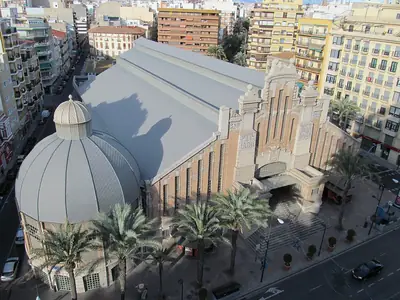
Mercado Central de Alicante is both a food market and an important example of the city’s early 20th-century architecture. It is also known as the Mercat Central d’Alacant or Mercat d’Abastos d’Alacant.
The building was designed by Enrique Sánchez Sedeño and completed in 1921. It opened in 1922 as a larger and more organized replacement for several smaller markets that had served Alicante during the 19th century. Its eclectic style includes ornaments associated with Valencian modernism.
The market has a rectangular plan, broad interior corridors, and high ceilings designed to improve ventilation and movement. On the south-west side, a rounded rotunda topped by a dome gives the building a particularly recognizable form.
Casa Carbonell
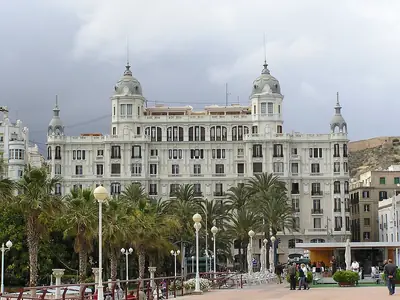
Casa Carbonell is one of Alicante’s emblematic buildings, standing along the Explanada opposite Casa Lamaignere, another project by architect Juan Vidal Ramos. Casa Carbonell combines historicist elements with Valencian modernism.
Its façade follows a symmetrical, tripartite design with a clear hierarchy. French-style ornamentation adds to its grand appearance, while the materials reveal careful attention to detail: marble in the hallways, sandstone for the plinth, iron and glass for the canopies and locksmithwork, and simulated slate for the roof.
Its position beside the promenade makes it an essential stop when exploring Alicante’s waterfront.
Paseo de la Explanada de España
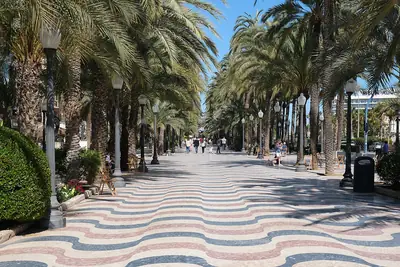
The Paseo de la Explanada de España, commonly called La Explanada, is Alicante’s best-known seaside promenade. Its signature feature is the wave-patterned mosaic pavement, made from millions of small marble tiles in red, cream, and black.
Four rows of mainly date palms run along more than 500 meters of the walkway. The promenade was built in the first half of the 20th century on land that formed part of Alicante’s old waterfront defenses. Before the Spanish Civil War, it was known as the Passeig dels Màrtirs.
A renovation and restoration in the 1990s helped preserve this distinctive public space. Walking along the Explanada also brings Casa Carbonell into view at its northern end, linking the city’s waterfront atmosphere with its architectural heritage.
Explore Alicante with a free audio guide
Neywo has 2 walking tours in Alicante, both covering the old town and the Explanada. One is a 0.93 km walk lasting 33 minutes, with 5 narrated stops: the Basilica of Saint Mary, Casa Carbonell, Alicante Town Hall, the Co-Cathedral of St. Nicholas of Bari, and the Paseo de la Explanada de España.
The second is a 2.76 km walk lasting 76 minutes, with 8 narrated stops. It adds the Archaeological Museum of Alicante, Santa Bárbara Castle, and Mercado Central de Alicante to the same historic-center route.
Download Neywo and explore Alicante at your own pace. The app tells the story of each place as you reach it, with no group and no schedule. Narration is available in 11 languages.
Alicante is part of the Valencian Community in Spain, and nearby destinations include Benidorm, Villajoyosa, and Calpe.
Places with an audio guide in Alicante
8 places in Alicante with a Neywo audio guide. Each one starts telling its story as you reach it.
Self-guided tours in Alicante
1 tour in Alicante, free in the Neywo app. Each stop tells its story as you reach it.
- Walk
Alicante old town: two churches and the Explanada
Under a kilometre through the centre — the fortress-like basilica of Santa Maria, the baroque co-cathedral, the modernista Casa Carbonell — finishing on the marble-waved promenade along the harbour.
Archaeological Museum of Alicante · Santa Bárbara Castle · Basilica of Saint Mary · Alicante town hall · Casa Carbonell · Paseo de la Explanada de España …
Open this tour: Alicante old town: two churches and the Explanada
Walk Alicante with Neywo
Neywo turns Alicante into a self-guided audio tour. Stories arrive as you reach the place they belong to, and the route reshapes when you wander off it.

