Santiago de Compostela, Spain: Self-Guided Walking Tour
Things to Do in Santiago de Compostela: What to See in Galicia’s Historic Pilgrimage City
Santiago de Compostela is the historic capital of Galicia and the legendary destination of the Camino de Santiago. Its cathedral, monasteries, Romanesque churches, museums and granite squares make it one of the most rewarding cities to explore in northwestern Spain. Neywo has a free audio guide for Santiago de Compostela with 55 narrated places, available in 11 languages.
What to See in Santiago de Compostela
Cathedral of Santiago de Compostela
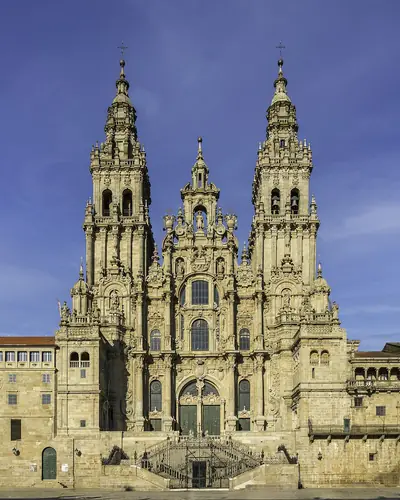
The Cathedral of Santiago de Compostela is the city’s spiritual and architectural centre. Tradition holds that it houses the tomb of Saint James the Greater, making it one of the few churches in the world built over an apostle’s grave and the endpoint of the Camino de Santiago.
Construction began in 1075, and the core Romanesque structure was completed around 1128. Later reforms added Gothic, Renaissance and Baroque elements. The cathedral’s importance was recognized through its Holy or Jubilee Year privilege, granted in 1122, and through its inclusion in the World Heritage listings associated with Santiago and the Camino.
Praza do Obradoiro and the Botafumeiro
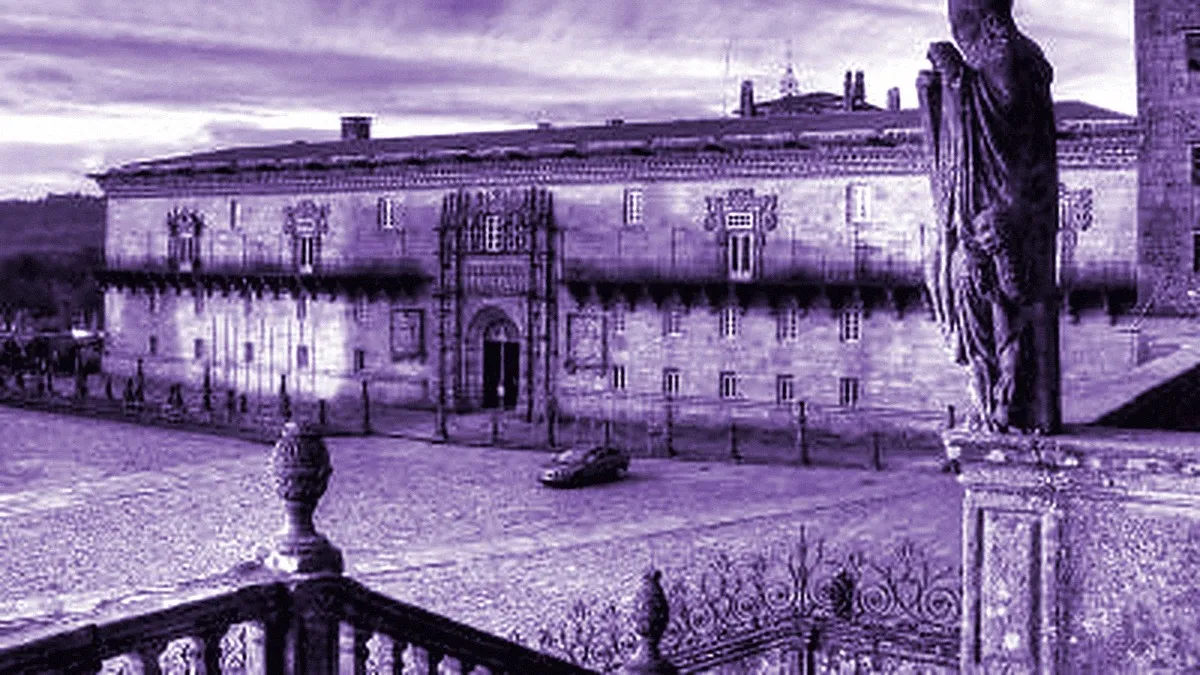
Praza do Obradoiro is the monumental square in front of the cathedral and one of the defining places in Santiago de Compostela. It brings together the cathedral and historic buildings connected with the city’s religious and pilgrimage heritage, including the Pazo de Raxoi and the former Hospital de los Reyes Católicos.
Inside the cathedral, the Botafumeiro reflects the long history of pilgrimage. The Camino is a network of routes arriving from across Europe and the Iberian Peninsula, converging in Santiago at the tomb traditionally identified with Saint James.
Monastery of Saint Pelagius of Antealtares
The Monastery of Saint Pelagius of Antealtares, or San Paio de Antealtares, stands directly in front of the cathedral’s apse and closes one side of Praza da Quintana. It has been a Benedictine convent since the ninth century, and cloistered nuns have continued to live and pray there for more than a thousand years.
Its name, Antealtares, refers to its position before the cathedral’s high altar. The monastery remains a working convent and a quiet presence at the centre of Santiago’s spiritual geography.
Museum of the Cathedral of Santiago de Compostela
The Museum of the Cathedral of Santiago de Compostela is spread through different spaces within the cathedral complex. Its collections include liturgical objects, gifts from noble pilgrims and archaeological discoveries made during restorations, with material ranging from Roman times to the present.
The crypt is one of its atmospheric spaces. Sometimes called the old cathedral, it was created as the foundation for Master Mateo’s work on the Pórtico de la Gloria. The museum also includes the cathedral treasury and other areas connected with the building’s long history.
Fountain of the Horses and the Museum of Pilgrimages
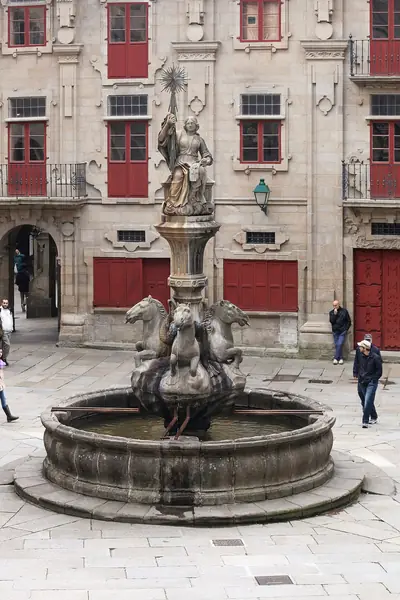
Praza das Praterías was historically associated with silversmiths working in the shadow of the cathedral. At its centre stands the Fonte dos Cabalos, or Fountain of the Horses, a Baroque fountain created in 1825 by José Pernas.
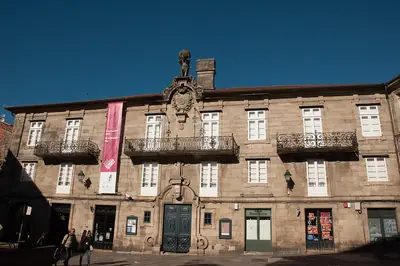
Four stone horses rise around its base, while a female figure above holds the star of Compostela. The building behind the fountain houses the Praterías headquarters of the Museo das Peregrinacións e de Santiago, founded in 1951 to explore pilgrimage, particularly the Camino de Santiago and the cult of Saint James.
Monastery of San Francisco do Val de Deus
The Monastery of San Francisco do Val de Deus is a Franciscan house in the valley known as Val de Deus. The Franciscans established the convent in the early thirteenth century, not long after the order was founded, creating a place for prayer, study and hospitality for pilgrims.
The church and cloister have a simple, sturdy character shaped by centuries of Franciscan life. The monastery was declared a Historic-Artistic Monument in 1896 and became part of the expanded World Heritage listing for the Camino in 2015.
Monument to Saint Francis
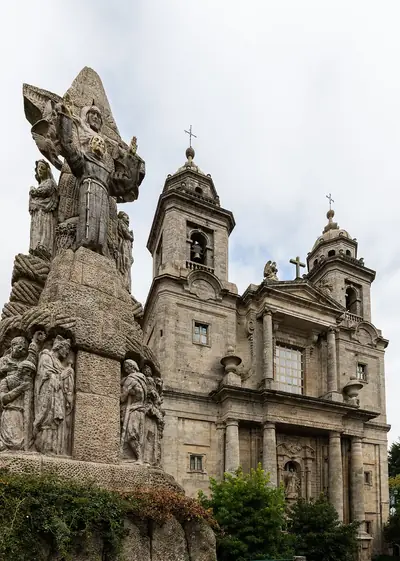
In front of the convent church stands the Monument to Saint Francis, a bronze sculpture created between 1926 and 1930 to mark the seventh centenary of Saint Francis of Assisi’s death. Its position in Val de Deus places it directly beside the Franciscan house that has anchored this corner of Santiago for centuries.
The statue faces the convent church, creating a striking connection between the sculpture and the religious institution behind it.
Church of Saint Dominic of Bonaval and the Museum of the Galician People
The former convent of San Domingos de Bonaval houses the Museum of the Galician People. Opened in the mid-1970s, the museum preserves and presents Galician traditional culture, including everyday life, customs and heritage.
The building also contains the Pantheon of Illustrious Galicians. Outside, the former convent gardens were transformed into a public park in the 1990s by Álvaro Siza and Isabel Aguirre. Nearby, the Galicia Contemporary Art Center creates a contrast between Galician traditions and contemporary artistic currents.
Galicia Contemporary Art Center
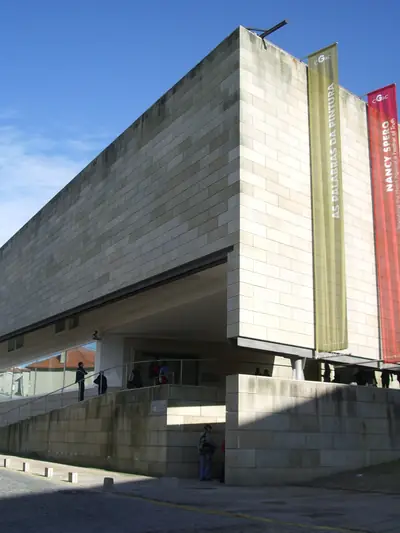
The Galicia Contemporary Art Center, known locally as the CGAC, is the region’s flagship institution for contemporary art. Its program focuses on temporary exhibitions presenting current artistic trends and changing creative practices in Galicia.
Because the exhibitions rotate regularly, the museum offers a different view of contemporary art each time its program changes.
Church of Santa María la Real del Sar
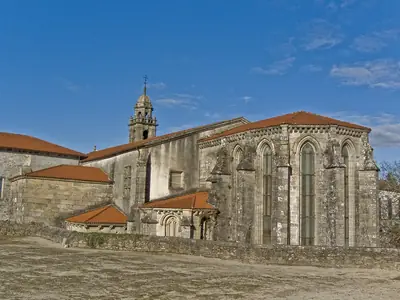
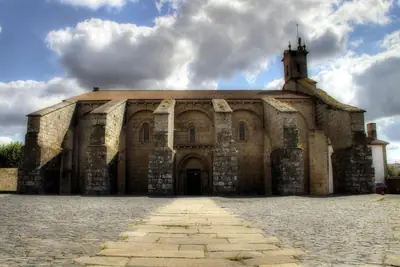
Beside the Sar River, the Church of Santa María la Real del Sar is one of Santiago’s most remarkable Romanesque monuments. Construction began in the mid-twelfth century and probably finished in the early thirteenth.
The church and cloister reflect the influence of the workshop associated with Master Mateo, who also worked on the cathedral’s Pórtico da Gloria. Its most distinctive feature is structural: built on marshy ground beside the river, the walls began to lean over time. Massive buttresses added in the eighteenth century stabilized the building and became part of its unmistakable appearance.
Museo Centro Gaiás
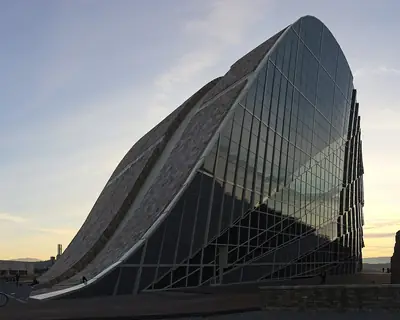
The Museo Centro Gaiás forms part of the Cidade da Cultura complex on the hill above Santiago. Its temporary exhibitions always have a Galician connection and may focus on art, history, photography or contemporary ideas.
The centre opened in 2011 and began its regular programming the following year. Its changing exhibitions offer another way to explore Galicia’s culture beyond the historic centre.
The Kingdom of Galicia
Santiago de Compostela was once at the heart of the Kingdom of Galicia, a political entity with its own kings, laws, mint and distinct identity. Santiago became its capital in the eleventh century, linking the city’s religious importance with a much broader political history.
The kingdom’s roots reach back to the Suevi kingdom founded in 410. Its history later developed through periods of Visigothic and Asturian rule before Galicia took shape as a distinct kingdom in the early tenth century.
Explore Santiago with a Self-Guided Audio Tour
A Santiago de Compostela self-guided walking tour lets you discover the city without joining a group or following a fixed timetable. Neywo’s app tells the story of each place as you reach it, at your own pace, so you can stop, look around and continue whenever you are ready.
The Santiago de Compostela audio guide includes:
- Three walking tours, covering 1.49 km in 88 minutes, 2.32 km in 86 minutes, and 1.71 km in 74 minutes.
- One bus route of 6.4 km, taking 27 minutes.
- 55 narrated places across the city.
The walks focus on the cathedral, Obradoiro and Quintana, the pilgrimage entrance at Porta do Camiño and Bonaval, and the Baroque convents and Alameda Park. The bus route connects old-town convents with the University of Santiago de Compostela.
Download Neywo and explore Santiago de Compostela with a free audio guide that accompanies you as you walk. No group, no schedule: just the stories of the city playing as you arrive at each place.
Places with an audio guide in Santiago de Compostela
8 places in Santiago de Compostela with a Neywo audio guide. Each one starts telling its story as you reach it.
Self-guided tours in Santiago de Compostela
4 tours in Santiago de Compostela, free in the Neywo app. Each stop tells its story as you reach it.
- Bus ride
Tussa Line 15: Old Town Convents to the University
An ordinary city bus (Tussa line 15) from the Sar quarter up through the old town's eastern edge: As Orfas, San Fiz de Solovio and the Augustinian college, the Carmelite convent and finally the University of Santiago. A cheap way to cover the hillier parts of the historic centre.
Praza do Seminario de Estudos Galegos · Las Huérfanas · Church of San Fiz de Solovio · Church and Convent of Saint Augustine · Convento do Carme · University of Santiago de Compostela
Open this tour: Tussa Line 15: Old Town Convents to the University - Walk
The Apostle's Square: Obradoiro, Cathedral and Quintana
Every Camino ends at one square. Start at the Obradoiro, framed by the cathedral, the royal pilgrim hospital, the neoclassical city hall and the old college, then circle the apostle's cathedral through Quintana, past the Benedictine nuns of Antealtares and the baroque Horse Fountain, with the huge San Martiño Pinario monastery on the way. Continue to the Fountain of the Horses, Cervantes square, the Romanesque-rooted San Bieito and the Gothic house of King Pedro.
Palacio de Rajoy · Plaza del Obradoiro · Hospital de los Reyes Católicos · San Martiño Pinario monastery · Cathedral of Santiago de Compostela · Museum of the Cathedral of Santiago de Compostela …
Open this tour: The Apostle's Square: Obradoiro, Cathedral and Quintana - Walk
Where the Pilgrims Enter: Porta do Camiño and Bonaval
Follow the French Way backwards from the old city gate where pilgrims first entered Santiago. Visit the Museum of the Galician People in the Dominican convent of Bonaval, the Siza-designed park and contemporary art centre, then walk down through the Augustinian college to San Fiz de Solovio, said to be the city's oldest church, and on to the Poor Clares, the Carmelites and the Franciscan valley.
Museum of the Galician People · Galicia Contemporary Art Center · Porta do Camiño · Church of Sant Mary of the Way · Church and Convent of Saint Augustine · Church of San Fiz de Solovio …
Open this tour: Where the Pilgrims Enter: Porta do Camiño and Bonaval - Walk
Baroque Convents and the Alameda Park
Leave the crowds for the south side of the old town: the cloistered Dominicans of Belvís, the Jesuit university church, the orphan girls' convent of As Orfas, the surrealist Granell museum, and the leafy Alameda park with its bronze Two Marys, the Romanesque chapel of Santa Susana and the monument to Rosalía de Castro, a classic Compostela sunset walk.
Convent of Saint Mary of Belvís · Colexio Compañía de María. Santiago de Compostela · Igrexa da Compañía ou da Universidade · Convent of Madres Mercedarias, Santiago de Compostela · Las Huérfanas · Church of María Salomé, Santiago de Compostela …
Open this tour: Baroque Convents and the Alameda Park
Walk Santiago de Compostela with Neywo
Neywo turns Santiago de Compostela into a self-guided audio tour. Stories arrive as you reach the place they belong to, and the route reshapes when you wander off it.

