What to See in Cartagena, Spain: Free Audio Guide
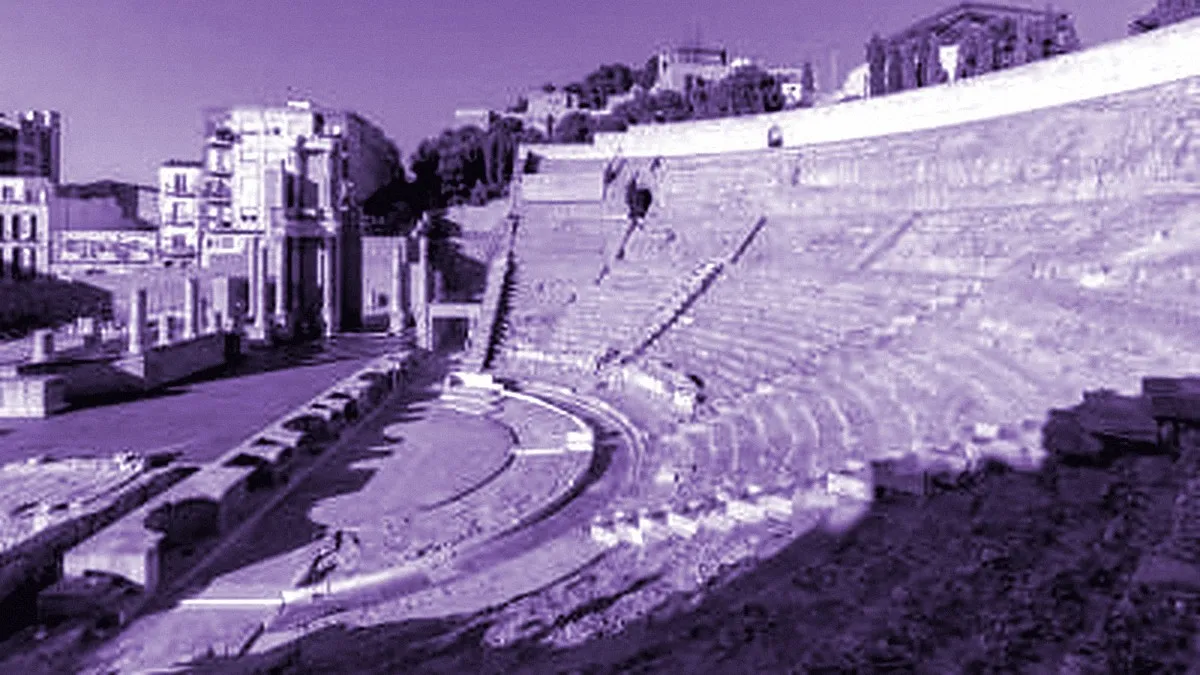
Things to do in Cartagena, Spain
Cartagena is a historic port city in Spain’s Region of Murcia, where Roman remains, modernist palaces, churches and coastal fortifications come together. The best things to do in Cartagena include exploring its layered history in the old town, visiting landmarks above the harbor and following the military heritage of the surrounding coast. Neywo has a free audio guide for Cartagena with 40 narrated places.
What to see in Cartagena
Castle of Despeñaperros
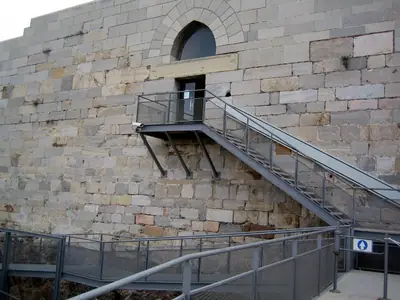
Also known as Castillo de San José, the Castle of Despeñaperros is a 19th-century fortification in Cartagena’s old town. Its masonry walls enclose two levels: the lower area contains rooms and a water reservoir, while the upper section was used for cannons. The castle was declared a cultural site on 7 August 1997.
Palacio de Aguirre
Palacio de Aguirre is one of Cartagena’s most important modernist buildings. Architect Víctor Beltrí designed it for mining entrepreneur Camilo Aguirre, who commissioned the palacete in 1898 after Beltrí’s success with Casa Cervantes. The building was completed in 1901 and remains closely connected with the city’s cultural life.
Basilica of Nuestra Señora de la Caridad
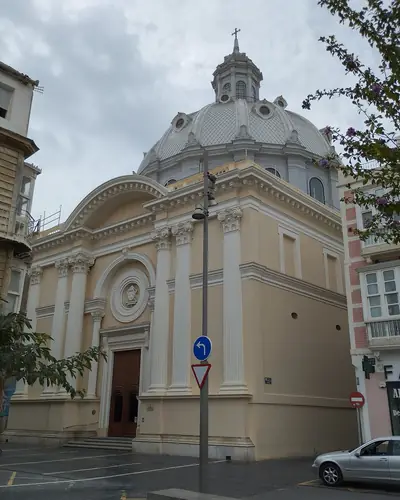
Dedicated to Cartagena’s patron, Nuestra Señora de la Caridad, this basilica combines a neoclassical design with a metal structure and a prominent dome. Its artistic influence is often compared with that of the Pantheon of Agrippa in Rome. Inside, an 18th-century Neapolitan image represents the Virgin of Charity. Pope Benedict XVI granted the shrine the status of Minor Basilica on 23 March 2012.
Palacio de Molina
The Palacio de Molina, also called Casa-Palacio de Molina, is another of Cartagena’s historic palaces. A formal process to declare it a cultural heritage site began in 1986, although it has not received a final resolution.
Casino of Cartagena
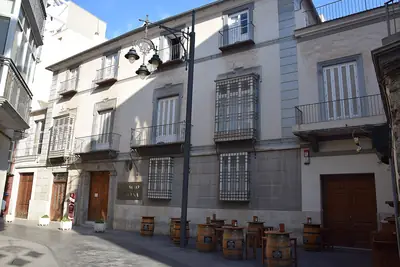
The Casino of Cartagena occupies the former 18th-century palace of the Marqués de Casa Tilly on Calle Mayor. The institution was created in the first half of the 19th century, with early references dating to 1836. It established its headquarters in the palace as a tenant in 1853 and became its owner in 1890. The building was later reformed to accommodate the casino’s activities.
Castle of La Concepción
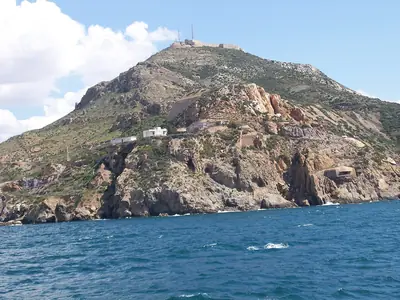
The Castle of La Concepción stands on the hill of the same name above Cartagena and its harbor. This medieval fortress dates from the 13th or 14th century and is represented on the city’s coat of arms.
The hill contains evidence of several earlier periods. Restoration work uncovered remains of a Roman temple dedicated to Aesculapius, while Roman-made cisterns were reused in the castle’s first floor. Beneath the medieval structure, archaeologists also found remains of towers belonging to a 12th-century Muslim citadel. The castle’s lantern is a surviving feature from the Arab period, when it served as a lighthouse.
Cartagena’s coastal defenses
Cartagena’s strategic position created an extensive network of military fortifications around the city and coast.
The Castle of Los Moros, in the Santa Lucía neighborhood, was built in the 18th century and declared a cultural property on 7 August 1997. The Castle of Galeras, also known as Fuerte de Galeras, is another 18th-century fortress with the same cultural designation.
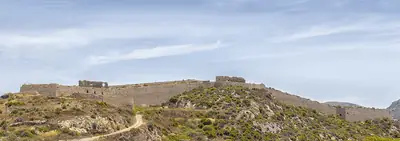
The Castle of San Julián occupies the heights of the mountain bearing its name. Its history includes a cylindrical tower built by the British during the Aústriacist occupation of Cartagena in 1706. Construction and remodeling continued later, with a major reform carried out between 1861 and 1883. The fortress was declared a cultural property on 7 August 1997.
The Cenizas Battery, also known as C-9, was built as an artillery support fortification for coastal defense and is a protected cultural site. The Conejos Battery is an old anti-aircraft battery in Cartagena.
Cape Palos Lighthouse
The Cape Palos Lighthouse stands on the highest small rise of the cape, in its rockiest area, above the fishing village of the same name and near the beginning of La Manga del Mar Menor. In 2025, the lighthouse was declared a cultural heritage site.
Monastery of San Ginés de la Jara
The Monastery of San Ginés de la Jara is an old Franciscan monastery on the slopes of Cabezo de San Ginés, near the Mar Menor. The building has been undergoing rehabilitation since 2012, following a long period of abandonment. Although the convent is currently abandoned, the patron saint remains part of local tradition: on 25 August, a traditional pilgrimage travels from Cartagena to the convent.
Castillito de Los Dolores
Castillito de Los Dolores, also known as the Palacio de los Marqueses de Fuente Sol, is a mansion associated with the Los Dolores neighborhood. Architect Tomás Rico built it in 1900.
Apolo Theatre in El Algar
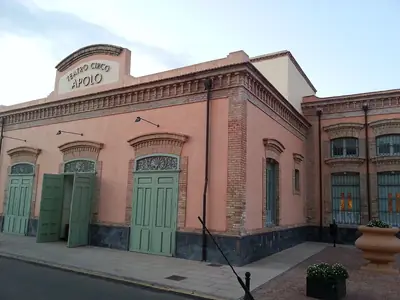
The Apolo Theatre, or Teatro Circo Apolo, is a modernist theatre in El Algar, within the municipality of Cartagena. Pedro Cerdán designed it in 1905, and it opened on 4 January 1907, during the mining expansion of the Cartagena–La Unión area.
Its Italian-style layout includes a platea, boxes and an amphitheatre. The original hand-painted proscenium curtain has been restored. After the theatre fell into poor condition, restoration began at the end of the 1990s and was completed in 2009.
How to explore Cartagena’s historic center
Cartagena’s Roman and modernist heritage is particularly concentrated. Roman foundations and archaeological sites appear alongside the Basilica of Nuestra Señora de la Caridad, Palacio de Aguirre, Palacio de Molina, Casino of Cartagena and Castle of Despeñaperros.
For a wider introduction to historic cities in Spain, Cartagena offers a distinctive combination of archaeological remains, modernist architecture and military landmarks. The city’s heritage is shaped by successive periods rather than a single architectural style.
A Cartagena self-guided walking tour can connect several of these places without a group or fixed timetable. Neywo’s walking routes include the Roman Theatre of Cartagena, the Castle of La Concepción, the Basilica of Nuestra Señora de la Caridad, Palacio de Aguirre, Palacio de Molina, Casino of Cartagena and Castle of Despeñaperros. The waterfront route also links the Naval Museum of Cartagena, Héroes de Cavite and the Museo del Teatro Romano de Cartagena.
Explore Cartagena with Neywo
Neywo offers 3 walking tours and 1 bus route in Cartagena, covering 40 narrated places:
- A 1.9 km walking tour lasting 128 minutes, with 12 narrated stops.
- A 0.38 km walking tour lasting 31 minutes, with 4 narrated stops.
- A 3.52 km walking tour lasting 174 minutes, with 13 narrated stops.
- A 2.5 km bus route lasting 11 minutes, with 4 narrated stops. It connects the Punic Wall of Cartagena, the Museo del Teatro Romano de Cartagena, the Casino of Cartagena and Palacio Pedreño.
The app tells the story of each place as you reach it, at your own pace, with no group and no schedule. Narration is available in 11 languages. Download Neywo and explore Cartagena with a free audio guide that brings its Roman remains, modernist palaces and historic defenses into focus as you move through the city.
Places with an audio guide in Cartagena
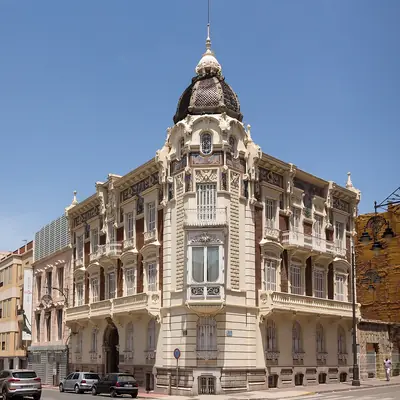
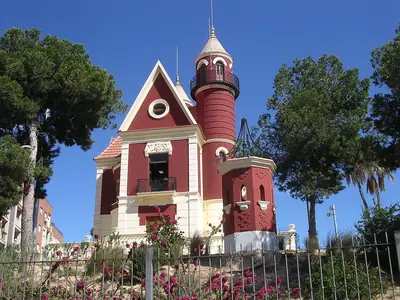
8 places in Cartagena with a Neywo audio guide. Each one starts telling its story as you reach it.
Self-guided tours in Cartagena
3 tours in Cartagena, free in the Neywo app. Each stop tells its story as you reach it.
- Bus ride
Bus L11: Punic Wall to the Modernist Mansions
Town bus L11 runs from the Punic wall into the old town and on towards the port. Hop off for the Roman Theatre Museum by Rafael Moneo, the Casino on the Calle Mayor and the eclectic Palacio Pedreño beside the statue of El Icue. A cheap way to cover Cartagena's Carthaginian, Roman and modernist layers.
Punic wall of Cartagena · Museo del Teatro Romano de Cartagena · Casino of Cartagena · Palacio Pedreño
Open this tour: Bus L11: Punic Wall to the Modernist Mansions - Walk
The naval waterfront
Four hundred metres by the harbour: the naval museum, the monument to the dead of Cavite, the old rowing club, and the museum that fronts the Roman theatre.
Antiguo Club de Regatas · Naval Museum of Cartagena · Héroes de Cavite · Museo del Teatro Romano de Cartagena
Open this tour: The naval waterfront - Walk
Roman Cartagena and the modernista palaces
A Roman theatre found under a demolished cathedral in 1988, the forum excavations on the Molinete hill, and the wealth of the nineteenth-century mining boom in the Aguirre and Molina palaces, with two castles above.
Palacio Pedreño · Palacio de Molina · Gran Hotel de Cartagena · Casino of Cartagena · Antiguo Club de Regatas · Héroes de Cavite …
Open this tour: Roman Cartagena and the modernista palaces
Walk Cartagena with Neywo
Neywo turns Cartagena into a self-guided audio tour. Stories arrive as you reach the place they belong to, and the route reshapes when you wander off it.

