Cáceres, Spain: Self-Guided Walking Tour
Things to do in Cáceres: what to see in the historic city
The best things to do in Cáceres are concentrated around its atmospheric monumental quarter, where medieval houses, Renaissance palaces, churches and defensive towers share the same honey-coloured stone. Beyond the old town, castles and museums add further layers to the history of this Extremaduran city. Neywo has a free audio guide for Cáceres with 41 narrated places.
What to see in Cáceres
Castillo de las Arguijuelas de Arriba
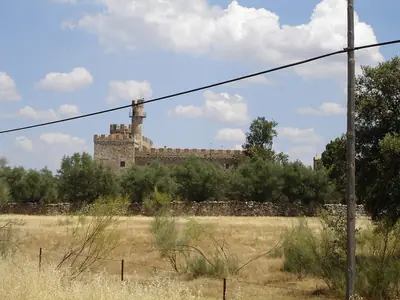
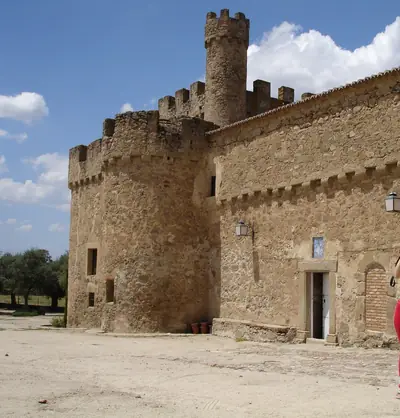
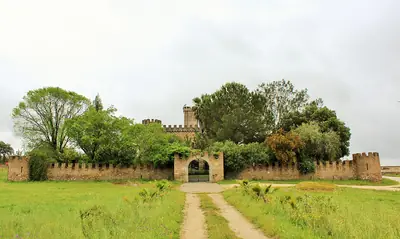
Around twelve kilometres south of the city centre, the Castillo de las Arguijuelas de Arriba rises from the highest point of a 300-hectare dehesa. This 16th-century palatial castle stands near the ancient Vía de la Plata and commands views across the surrounding countryside. It remains privately owned. Its smaller, slightly lower counterpart, Castillo de las Arguijuelas de Abajo, is about 500 metres away.
Cáceres Museum and the Palacio de las Veletas
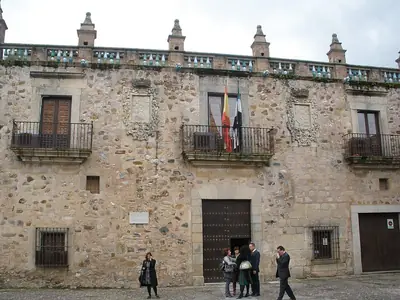
The Cáceres Museum occupies the Palacio de las Veletas, a medieval palace built over the remains of an Andalusí alcázar. Its most important architectural feature is the ancient aljibe, or cistern, one of the outstanding survivals in the old town. The palace’s current structure dates from the late 15th century and was later modified. Noble families including the Torres and the Ulloa used it as a residence for five centuries.
The building was declared a Bien de Interés Cultural in 1931, with the decree specifically highlighting its aljibe. The surrounding historic neighbourhood received World Heritage status in 1986.
Casa de los Cáceres Ovando
Also known as the Palace of the Storks, the Casa de los Cáceres Ovando occupies a prominent position in the historic enclosure. Its name recalls the colony of storks that once nested on its tower. The façade combines a rounded-arch entrance, carved stone details, heraldic shields and pointed horseshoe-arch windows.
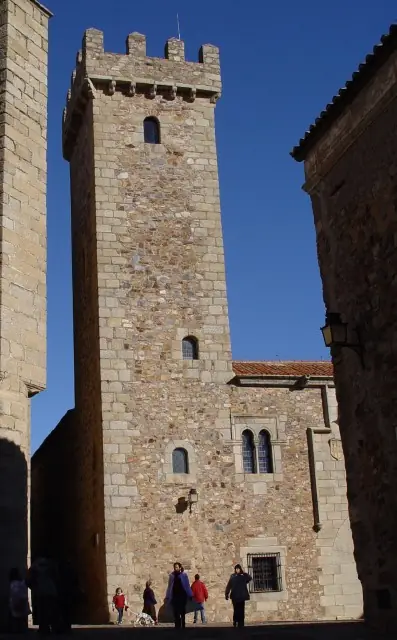
Inside, a Gothic courtyard is one of the main features. Above the palace stands a 25-metre tower with battlements supported by small corbels. It is the only undiminished tower left in the historic enclosure. Built at the end of the 15th century and the beginning of the 16th, the palace was constructed by Diego Fernández de Cáceres y Ovando, probably on the site of a former Almohad alcazar.
Palacio de los Golfines de Abajo
The Palacio de los Golfines de Abajo is a 16th-century residence associated with one of Cáceres’ most powerful local families. Its construction took place in two phases, beginning around 1510–1511 on the site of an earlier family home.
The façade brings together defensive and decorative elements: lateral towers, machicolations and lowered arches stand alongside plateresque cresting, granite mouldings and the coats of arms of the Golfines and Álvarez families. It is an especially revealing example of how Cáceres’ noble residences developed from fortified homes into more refined Renaissance palaces.
Castle of Las Seguras
The Castle of Las Seguras is a defensive fortification whose origins reach back to the 14th century. It forms part of the group of historic castles around Cáceres, showing how the city’s heritage extends beyond the monumental quarter.
Palacio de la Generala
In the Plaza de Caldereros, the Palacio de la Generala began as a casa fuerte, or fortified noble residence, and ancestral home of the Monroy family. Repeated remodelling gave it its present appearance. The façade includes the coats of arms of the Ovando-Mogollón lineage, while a truncated tower recalls the building’s defensive beginnings.
Palacio de los Golfines de Arriba
The Palacio de los Golfines de Arriba is one of the noble houses within Cáceres’ monumental quarter. Built by the influential Golfines family, it stands among the old town’s stone walls and towers. Its position inside the historic enclosure makes it part of the dense sequence of palaces, churches and fortified residences that defines the city centre.
Palacio de los Toledo-Moctezuma
The Palacio de los Toledo-Moctezuma began as a 15th-century medieval house, but its present appearance comes mainly from renovations at the end of the 16th and the beginning of the 17th century. Those changes followed the marriage of Mariana de Carvajal y Toledo to Juan de Toledo Moctezuma, a direct descendant of Isabel de Moctezuma, daughter of Moctezuma II.
An open brick gallery runs across the upper façade. Three heraldic shields represent the Toledo, Carvajal and Moctezuma families, making the palace’s name and lineage visible in its architecture.
Palacio del Comendador de Alcuéscar
Also known as the Palacio de los Marqueses de Torreorgaz, this palace now forms part of the Parador de Turismo de Cáceres. Its origins go back to the 14th century, when Diego García de Ulloa, the Comendador de Alcuéscar, commissioned it as a fortified palace.
The defensive tower at one corner is the oldest surviving part and still bears the Ulloa family’s heraldic shields. A 16th-century remodelling added the arcaded courtyard, while the main façade took on its current neoclassical appearance in the 18th century. After restoration in the late 1980s, the palace became part of the Parador in 1989.
Palacio de Carvajal
Palacio de Carvajal is a medieval house in Cáceres’ Old Town. Its importance comes from both its medieval origins and its place among the historic buildings of the monumental quarter.
Casa del Sol
The Casa del Sol, or House of the Sun, is a Gothic fortress built in the 15th century as a stronghold for the Solís family. It was modified and enlarged in the 16th century.
Its façade is dominated by the family coat of arms: a human-faced sun with sixteen rays, eight ending in serpent heads, beneath a helmet. The rounded-arch doorway is framed by an alfiz, while the tower retains a semicircular machicolation and cross-shaped arrow slits. The imagery presents the family’s power and protection in a striking architectural emblem.
Church of Santiago
The Church of Santiago gave its name to the surrounding neighbourhood. It was one of the four original parishes of Cáceres, together with Santa María, San Mateo and San Juan, and continued in that role until the 19th century.
Ermita de San Jorge
The Ermita de San Jorge is a modest, ruined hermitage with an unusual beginning. Built around the 14th century, it was originally an aljibe for the nearby castle of Mogollones before becoming a private place of worship.
Its remaining walls preserve murals painted in the mid-16th century by the local artist Juan de Ribera. Biblical scenes and religious images make the site a rare survival of Renaissance wall painting in Extremadura. The Junta de Extremadura moved to protect it in 2014, while Hispania Nostra placed it on its Red List in 2008. The roof has disappeared and parts of the walls have collapsed, leaving the murals exposed to the elements.
Museum of Contemporary Art Helga de Alvear
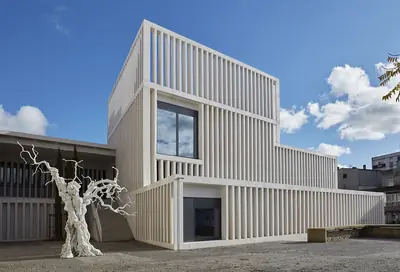
The Museum of Contemporary Art Helga de Alvear offers a striking contrast to Cáceres’ medieval and Renaissance architecture. It grew from the Centro de Artes Visuales Fundación Helga de Alvear and remains governed by the non-profit foundation bearing her name.
The collection is described as the most complete private collection of contemporary art in Europe. The foundation is supported by public institutions across Extremadura, including the regional government, the university and the city council.
Explore Cáceres with a self-guided walking tour
A Spain trip can take you from historic cities to Roman sites and modern cultural centres, but Cáceres is particularly rewarding on foot. Neywo’s two walking tours provide a structured way to discover the monumental quarter without joining a group or following a fixed timetable.
The first walk, Honey-Coloured Stone: Gates, Palaces and the House of the Sun, covers 0.76 km in 66 minutes and includes 11 narrated stops. The second, Family Feuds and Aristocrats: Palaces West of the Plaza, covers 1.43 km in 75 minutes and also includes 11 stops. Together, they introduce places including the Arco de la Estrella, Palacio de los Toledo-Moctezuma, Palacio de los Golfines de Abajo, Casa del Sol, Palacio de los Golfines de Arriba, Palacio de la Generala, the Church of San Juan and the Museum of Contemporary Art Helga de Alvear.
Download Neywo and explore Cáceres at your own pace
Download Neywo to explore Cáceres with two walking tours, covering 0.76 km and 1.43 km, lasting 66 and 75 minutes, with 11 narrated stops on each route. The app has 41 narrated places in the city. Each story plays as you reach the place, at your own pace: no group and no schedule. Narration is available in 11 languages, so you can discover Cáceres while walking through its streets and letting the city’s history unfold around you.
Places with an audio guide in Cáceres
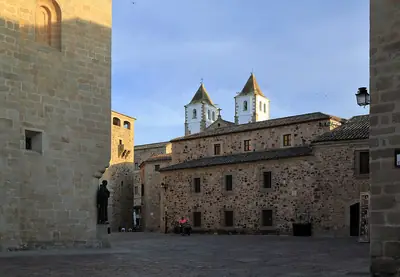
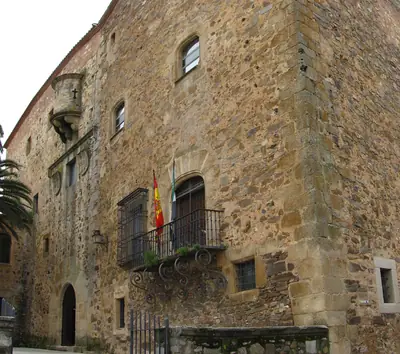
8 places in Cáceres with a Neywo audio guide. Each one starts telling its story as you reach it.
Self-guided tours in Cáceres
2 tours in Cáceres, free in the Neywo app. Each stop tells its story as you reach it.
- Walk
Honey-Coloured Stone: Gates, Palaces and the House of the Sun
Step through the Arco de la Estrella into the best-preserved medieval city in Europe, a UNESCO World Heritage site. Wander honey-coloured lanes past a Bishop's palace with a spelling mistake carved in stone, the house of an Aztec emperor's descendants, a Roman gate and a Gothic fortress with a sun besieged by serpents. Finish at the Palace of the Storks and the museum built over a Moorish cistern.
Ermita de la Paz · Arco de la Estrella · Museo Santa Maria · Palacio de los Toledo-Moctezuma · Palacio de los Golfines de Abajo · Los Siete Jardines …
Open this tour: Honey-Coloured Stone: Gates, Palaces and the House of the Sun - Walk
Family Feuds and Aristocrats: Palaces West of the Plaza
A walk through the other Cáceres: noble houses where rival branches of one family carved insults in Latin on their walls, a fortified palace turned Parador, a Renaissance courtyard, a convent of Franciscan nuns, a Gothic church just outside the walls and one of Europe's most important private collections of contemporary art. Ends at the House of Tricks, its name unexplained to this day.
Gran Teatro · Church of San Juan, Cáceres · Museum of Contemporary Art Helga de Alvear · Palacio del Comendador de Alcuéscar · Casa de los Perero · Convent of San Pablo, Cáceres …
Open this tour: Family Feuds and Aristocrats: Palaces West of the Plaza
Walk Cáceres with Neywo
Neywo turns Cáceres into a self-guided audio tour. Stories arrive as you reach the place they belong to, and the route reshapes when you wander off it.

