What to See in Winchester, United Kingdom: Free Audio Guide
Things to Do in Winchester: Historic Sights and Medieval Landmarks
Winchester is one of England’s most historic cathedral cities, shaped by Roman settlement, Anglo-Saxon kings and medieval royal power. The former capital sits beside the River Itchen at the western edge of the South Downs National Park, with a cathedral, castle ruins, ancient gateways and museums packed into a walkable historic centre. Neywo’s free Winchester audio guide adds stories to 131 narrated places as you explore.
Winchester is part of England in the United Kingdom, and its long history is visible at almost every turn. These are the main things to do in Winchester.
What to see in Winchester
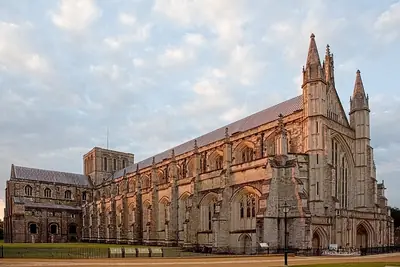
Winchester Cathedral
Winchester Cathedral is the city’s defining landmark and one of the most remarkable medieval buildings in Europe. It is the Cathedral Church of the Holy Trinity, Saint Peter, Saint Paul and Saint Swithun, as well as the seat of the Bishop of Winchester and the mother church of the ancient Diocese of Winchester.
At 558 feet long, it is the longest medieval cathedral in the world and the sixth largest in the United Kingdom by area. Construction began in 1079 on the site of an earlier Saxon church dating from the time of King Alfred, and the building was completed in the early sixteenth century.
The cathedral brings together several architectural periods. Its transepts and central tower are Norman and Romanesque, the retroquire is Early English Gothic, and the great nave was transformed in the Perpendicular Gothic style. The result is a building in which centuries of religious and architectural history can be read in the stonework.
Wolvesey Castle
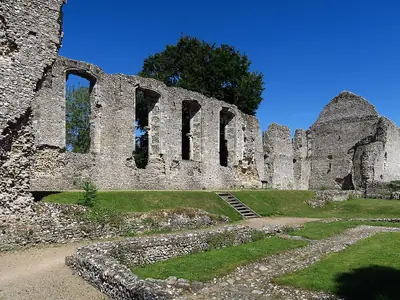
Wolvesey Castle, also called the Old Bishop’s Palace, was the principal residence of the Bishops of Winchester for centuries. The site began around 970, when Bishop Æthelwold built a palace on what had originally been an island in the River Itchen known as Wulf’s Island.
Most of the surviving ruins date from the transformation carried out by Henry of Blois between 1135 and 1171. The curtain walls, the outline of the great hall, a round arch and a Norman window all help reveal the scale of the complex.
Despite its defensive appearance, Wolvesey was a palace rather than a military castle. Its fortifications expressed the wealth and authority of the bishops, while also responding to the unstable conditions of the period.
Winchester Castle and the Great Hall
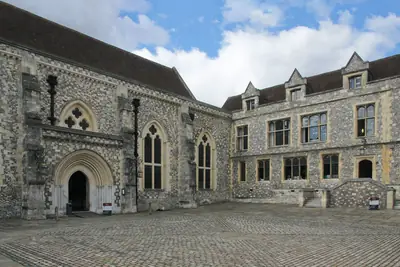
William the Conqueror founded Winchester Castle in 1067, only a year after his victory at Hastings. It became one of the principal seats of royal power in medieval England, although much of the original fortress has since disappeared.
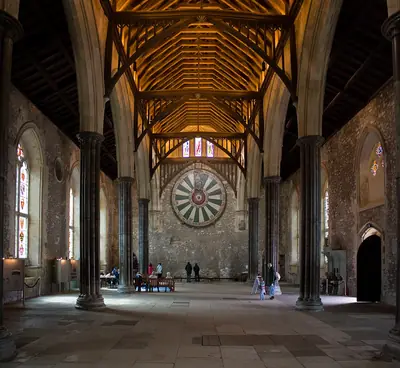
The Great Hall is the castle’s outstanding survivor. Henry III built it between 1222 and 1235, and it is regarded as one of the finest medieval halls remaining in England. Its flint walls, stone dressings, soaring aisles and timber roof create a space that feels both imposing and carefully proportioned.
The hall is also associated with the legend of King Arthur. A large wooden tabletop known as the Round Table hangs at the far end. It was made in the thirteenth century, long after the historical Arthur would have lived, but Arthurian stories became attached to it over the centuries. Henry VIII had it repainted in the early sixteenth century with a Tudor rose and a portrait of Arthur, while the names of 25 knights appear around the table.
Westgate
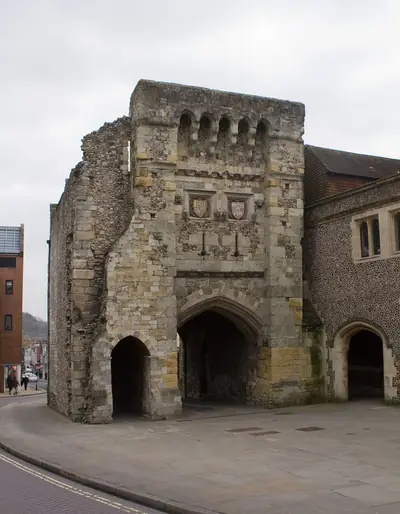
Westgate is one of only two medieval fortified gateways still standing in Winchester. It once formed the main western entrance to the city and belonged to the walls that formerly enclosed Winchester.
The gateway contains several layers of history. Its earliest fabric is Anglo-Saxon, while later rebuilding took place in the twelfth, thirteenth and late fourteenth centuries. On the western façade, two inverted keyhole-shaped openings are early gunports designed for hand-held cannons. The groove for the former portcullis is still visible above them.
Westgate remained in active use until 1959, when traffic was diverted around the gateway. In the nineteenth century, the City Corporation saved it from demolition and converted it into a museum and archive repository. Today, the museum space is run by Hampshire Cultural Trust.
The Statue of Alfred the Great
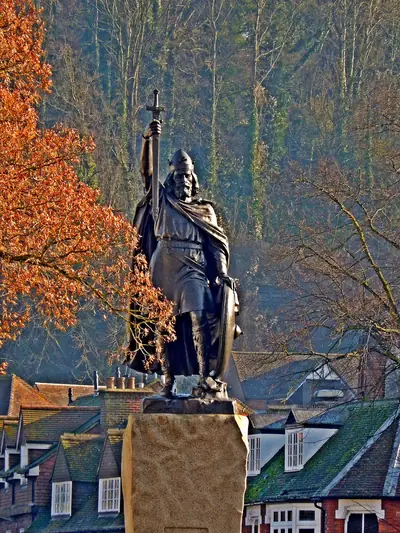
On The Broadway stands a bronze statue of Alfred the Great, the West Saxon king who shaped the idea of England. By the end of his reign in the late ninth century, Alfred was recognised as the first King of the Anglo-Saxons and is often considered the first English monarch.
The statue was commissioned in 1899 to mark 1,000 years since Alfred’s death and unveiled in 1901. Sculptor Hamo Thornycroft portrayed him as a thoughtful ruler rather than a warrior in battle: his sword is sheathed, one hand rests on its hilt and the other holds a scroll representing law and learning.
The setting is significant too. The Broadway continues the High Street through Winchester’s historic centre, close to the River Itchen, the Guildhall and the meeting point of Eastgate Street and Bridge Street.
The Old Minster
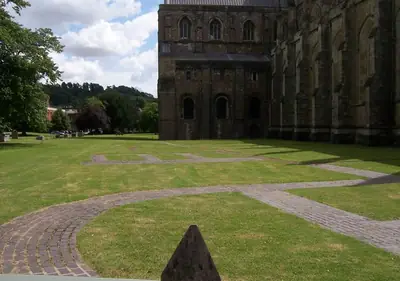
The outline of the Old Minster is marked in the grass beside Winchester Cathedral. This was the Anglo-Saxon cathedral of the dioceses of Wessex and later Winchester from 660 until 1093, and parts of the earlier building lie beneath the present Norman cathedral.
The West Saxon bishopric moved here from Dorchester-on-Thames around 660. In 901, the New Minster was built immediately beside it, so close that the singing from the two churches mingled. The Old Minster reached a height of splendour in the 970s, when Bishops Æthelwold and Alphege rebuilt it on a much larger scale as part of their monastic reforms.
Winchester College
Winchester College was founded in 1382 by William of Wykeham and remains the oldest public school in the United Kingdom still using its original buildings. Its historic core lies close to the cathedral and forms an important part of Winchester’s medieval landscape.
The college connects the city’s religious past with its long educational tradition. Together with the cathedral, it helps explain why Winchester remained an important centre of learning and ecclesiastical power long after its role as England’s political capital had diminished.
Other historic places around Winchester
Winchester’s wider history includes sites beyond the central streets. Merdon Castle, near Hursley, survives as the earthwork remains of a motte-and-bailey castle. Bishop’s Waltham Palace is a moated bishop’s palace whose remaining stone walls trace the footprint of a residence belonging to the Bishops of Winchester for centuries.
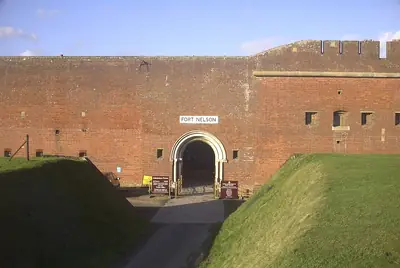
Oliver Cromwell’s Battery is an archaeological site in Winchester, while Fort Nelson and Fort Southwick form part of the historic defences on Portsdown Hill overlooking Portsmouth’s naval base. Fort Nelson is a preserved Victorian fort and houses the national collection of artillery, including weapons ranging from medieval cannons to Second World War anti-aircraft pieces.
The city’s riverside setting also adds a quieter dimension. The River Itchen, surrounding chalk downs and the nearby South Downs landscape provide open spaces alongside the dense concentration of historic buildings.
Explore Winchester with Neywo
A Winchester self-guided walking tour is a simple way to connect the city’s major sights without joining a group. Neywo offers two walking tours and one bus route in Winchester, with narration available in 11 languages:
- “Alfred’s Winchester: From the Mill to the Cathedral” — a 1.39 km walk lasting 77 minutes, with 9 narrated stops.
- “Rebels, Riflemen and the Round Table” — a 1.75 km walk lasting 66 minutes, with 7 narrated stops.
- “Winchester by Bus 4: From the High Street to the Cathedral” — a 9.3 km route lasting 40 minutes, with 7 narrated stops.
Download Neywo and explore Winchester at your own pace. The app tells the story of each place as you reach it, with no group and no schedule.
Places with an audio guide in Winchester
8 places in Winchester with a Neywo audio guide. Each one starts telling its story as you reach it.
Self-guided tours in Winchester
3 tours in Winchester, free in the Neywo app. Each stop tells its story as you reach it.
- Bus ride
Winchester by Bus 4: From the High Street to the Cathedral
Stagecoach route 4 is an ordinary city service that threads Winchester's historic core. Ride it from the High Street past the Corn Exchange and Chesil Street, then on to King Alfred's statue, Wolvesey Castle and the cathedral. Hop off at the City Museum to finish in the middle of the story.
Winchester · Corn Exchange · St Peter's Church, Chesil, Winchester · Statue of Alfred the Great · Wolvesey Castle · Winchester Cathedral …
Open this tour: Winchester by Bus 4: From the High Street to the Cathedral - Walk
Alfred's Winchester: From the Mill to the Cathedral
Follow the River Itchen from a thousand-year-old mill to the bronze king who founded England, then slip through the medieval gates of the Close. Ruined bishops' palaces, the oldest school in England and the longest medieval cathedral in the world, with Jane Austen resting in the nave.
Winchester City Mill · Statue of Alfred the Great · Wolvesey Castle · Winchester College · St Swithun-upon-Kingsgate Church · Prior's Gate …
Open this tour: Alfred's Winchester: From the Mill to the Cathedral - Walk
Rebels, Riflemen and the Round Table
Winchester was a royal capital before London. Start with Roman mosaics, stand before King Arthur's Round Table in Henry III's great hall, pass the regimental museums of Peninsula Barracks and the Westgate, and end at the field where Alfred the Great's abbey once stood.
Winchester City Museum · Winchester Castle great hall · HorsePower: The Museum of the King's Royal Hussars · Adjutant General's Corps Museum · Royal Green Jackets (Rifles) Museum · Westgate …
Open this tour: Rebels, Riflemen and the Round Table
Walk Winchester with Neywo
Neywo turns Winchester into a self-guided audio tour. Stories arrive as you reach the place they belong to, and the route reshapes when you wander off it.

