What to See in Worthing, United Kingdom: Free Audio Guide
Things to Do in Worthing: Historic Churches, Downland Views and Creative Culture
Looking for things to do in Worthing? This coastal town in England combines historic churches, a lively cultural scene, remarkable buildings and open downland landscapes. Its most distinctive sights range from the ancient earthworks of Cissbury Ring to a church containing a full-scale reproduction of Michelangelo’s Sistine Chapel ceiling. Neywo also has a free audio guide for Worthing, with 29 narrated places.
What to See in Worthing
The best way to explore Worthing is to combine its town-centre landmarks with the villages, churches and hills around it. These are some of the most notable places to include.
Cissbury Ring
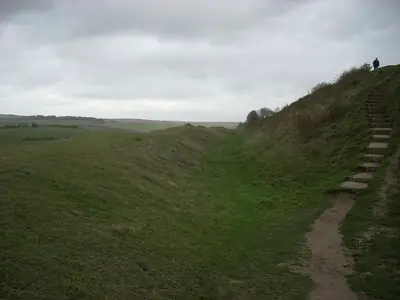
Cissbury Ring is one of the largest hill forts in Britain, crowning the South Downs just north of Worthing. The Iron Age enclosure surrounds the summit of a chalk ridge, with ramparts forming a wide oval nearly two kilometres across at the base.
The fort stands 184 metres above sea level, and the land falls away by 87 metres on every side. In clear weather, the views extend from the Channel coast inland across the Weald. The site was built more than two thousand years ago to protect a community and its livestock, then later reused as a flint mine and a Second World War lookout.
Walking the rampart circuit gives a strong sense of the scale of the earthworks and the effort involved in constructing this ancient stronghold.
Castle Goring
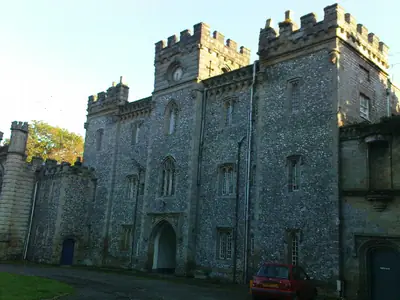
About four and a half miles northwest of Worthing town centre, Castle Goring sits in the West Sussex countryside. This Grade I listed country house is one of only two buildings in Worthing with that highest designation.
The house has also attracted architectural interest. Critic Ian Nairn described it as an especially revealing example of the uncertain tastes of the 1790s. In 1845, Mary Shelley, the poet’s widow, sold the property to Vice-Admiral Sir George Brooke-Pechell, who had already lived there as a tenant for two decades.
Worthing Museum and Art Gallery
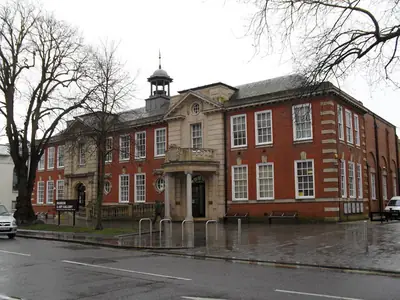
Worthing Museum and Art Gallery stands in the centre of town and is the largest museum in West Sussex. Its building was originally designed to accommodate both the town’s library and museum. The library section was funded by Andrew Carnegie, the Scottish-American philanthropist.
Nearby, Chapel Road leads to a small civic ensemble that includes Worthing Town Hall and the Assembly Hall. Worthing Town Hall has been the borough’s civic centre since 1933. Designed by Charles Cowles-Voysey, the neo-Georgian building replaced the Old Town Hall and is Grade II listed. The Assembly Hall was added in 1935 and serves as a theatre and concert hall.
Connaught Theatre
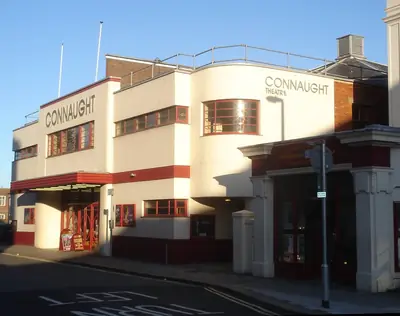
The Connaught Theatre is a Streamline Moderne building in the heart of Worthing. It opened as the Picturedrome cinema in 1914, was extended in 1935 and then became the home of the Connaught Theatre company.
Its history is unusual: rather than a theatre being converted into a cinema, a cinema was transformed into a theatre. Today, the venue operates as both a theatre and cinema, with two screens and seating for 512 people. Its programme includes touring West End productions, musicals, thrillers, dramas and children’s shows.
Christ Church, Worthing
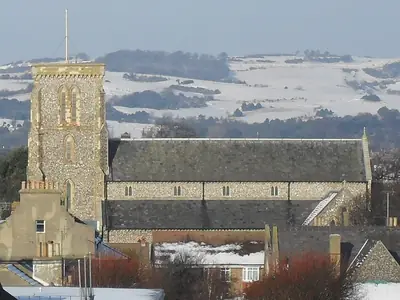
Christ Church is one of Worthing’s most prominent landmarks, with an 85-foot flint tower rising above the town centre. Its history reflects the social conditions of the early 1840s, when St Paul’s was the only Anglican option for ordinary working people but required worshippers to pay for a pew.
Between 1840 and 1843, local people raised money by subscription to build a church that would be free for everyone. The Bishop of Chichester, Ashurst Turner Gilbert, consecrated Christ Church in 1843. It began as a chapel of ease attached to St Mary’s in Broadwater, then became its own parish in 1855.
The building is now the second-oldest Church of England church still standing in Worthing town centre. Its tall Sussex flint tower makes it especially easy to recognise.
St Andrew’s Church, West Tarring
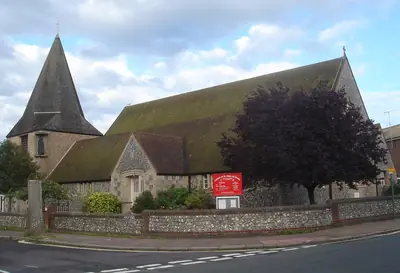
The tall spire of St Andrew’s Church has been a landmark above West Tarring since the 13th century. The parish was founded in the 11th century after being granted to the Archbishop of Canterbury, and it remained directly connected to Canterbury for many centuries.
Much of the present building dates from the 13th century. The spire is its most distinctive feature, but the church also has a more colourful past: during the 18th century, its tower was used as a lookout and storage base by smuggling gangs moving contraband along the Sussex coast.
St Mary’s Church, Goring-by-Sea
St Mary’s is the ancient parish church of the former village of Goring-by-Sea. Although its exterior is largely Victorian Gothic Revival, the church began as a late Norman building, and some original Norman details remain.
The current appearance is mainly the result of a major restoration carried out by architect Decimus Burton in 1837. Inside, a mural painted in 1954 by German artist Hans Feibusch adds an unexpected modern layer to the medieval church. Feibusch worked extensively across the Diocese of Chichester, although the mural caused controversy when it was first unveiled.
English Martyrs’ Catholic Church
English Martyrs’ Catholic Church in Goring-by-Sea looks modest from the outside, but its interior contains one of Worthing’s most remarkable artistic sights: the only known full-scale reproduction of Michelangelo’s Sistine Chapel ceiling anywhere in the world.
Bevans, a signwriter rather than a professional artist, created the work as an act of devotion. The reproduction covers the entire nave ceiling, including scenes from the Creation of Adam to the Last Judgment. Its scale and detail make the church an essential stop for anyone interested in art, regardless of religious background.
High Salvington Windmill
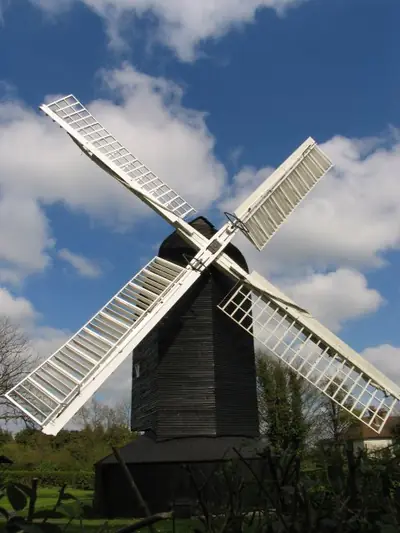
High Salvington Windmill stands on the South Downs above Worthing. Also known as Durrington Windmill, it is a post mill—the earliest type of European windmill, in which the entire body rotates around a central post to face the wind.
The Grade II listed mill stands 320 feet above sea level, where it can catch the breezes from the Channel. It is one of the few windmills in the country to have been fully restored to working order, and it can still be seen grinding grain.
Other churches and creative landmarks
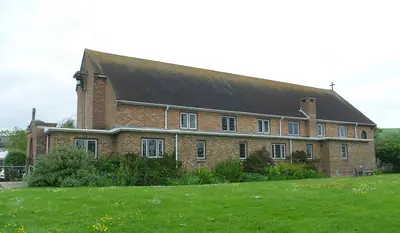
Worthing’s wider area includes several further places of local interest. All Saints serves the Findon Valley community, while the Church of St John the Divine and St Richard serve communities in Worthing and Maybridge. Holy Trinity Church is a historic parish church in the centre of town, and Queen Street Fellowship serves the community in Broadwater.
Northbrook College is another important local landmark. It began as the Worthing School of Art and Science, founded in or before 1890, and is now part of the Chichester College Group. It is the largest provider of higher education for the creative and cultural industries in West Sussex, with courses, apprenticeships, adult learning and community education across its campuses.
Explore Worthing with a self-guided walking tour
A Worthing self-guided walking tour lets you discover the town’s stories without joining a group or following a fixed timetable. Neywo’s free audio guide includes three walks:
- Worthing’s seaside heart: from Picturedrome to the Madonna row — 3.83 km, 105 minutes and 10 narrated stops.
- Tarring and Goring: village spires and a Sistine ceiling — 6.32 km, 120 minutes and 6 narrated stops.
- Cissbury to Salvington: hill fort, windmill and downland churches — 4.92 km, 98 minutes and 5 narrated stops.
The routes cover the Connaught Theatre, Worthing Museum and Art Gallery, Christ Church, St Andrew’s Church, West Tarring, St Mary’s Church, English Martyrs’ Catholic Church, Cissbury Ring and High Salvington Windmill, among other stops.
Download the free Worthing audio guide
Download Neywo and explore Worthing with 3 walking tours, covering 15 tour stops in total, while the city guide contains 29 narrated places. Narration is available in 11 languages. The app tells the story of each place as you reach it, at your own pace, with no group and no schedule.
Places with an audio guide in Worthing
8 places in Worthing with a Neywo audio guide. Each one starts telling its story as you reach it.
Self-guided tours in Worthing
2 tours in Worthing, free in the Neywo app. Each stop tells its story as you reach it.
- Walk
Worthing's seaside heart: from Picturedrome to the Madonna row
How a Sussex fishing village became a Regency resort, told through its buildings. See the 1930s Connaught Theatre that began life as a cinema, the Regency chapel that gave Chapel Road its name, a flint tower built so poor townspeople could worship free, and a Victorian church at the centre of the 'Worthing Madonna' scandal. It ends at St Botolph's, where a medieval ruin stands beside its Victorian replacement.
St George's Church, Worthing · Connaught Theatre · Worthing Tabernacle · Worthing Museum and Art Gallery · St Paul's Church, Worthing · Christ Church, Worthing …
Open this tour: Worthing's seaside heart: from Picturedrome to the Madonna row - Walk
Cissbury to Salvington: hill fort, windmill and downland churches
Climb onto the South Downs above Worthing. Start on the ramparts of Cissbury Ring, one of Britain's largest Iron Age hill forts, then drop through Salvington to a working post mill, the oldest type of European windmill. Finish with the church that vanished in the Civil War and was reborn in a tin tabernacle.
Cissbury Ring · All Saints · High Salvington Windmill · St Michael · St Symphorian's Church, Durrington
Open this tour: Cissbury to Salvington: hill fort, windmill and downland churches
Walk Worthing with Neywo
Neywo turns Worthing into a self-guided audio tour. Stories arrive as you reach the place they belong to, and the route reshapes when you wander off it.

