What to See in Minneapolis, United States: Free Audio Guide

Things to Do in Minneapolis: Museums, Architecture, and the Mississippi River
The best things to do in Minneapolis bring together industrial history, bold architecture, art, historic homes, and paths along the Mississippi River. The city grew around St. Anthony Falls and the flour mills that used its waterpower, while its neighborhoods now offer museums, cultural centers, churches, and distinctive examples of American architecture. Neywo has a free audio guide for Minneapolis with 161 narrated places.
What to See in Minneapolis
Mill City Museum and the flour-milling district
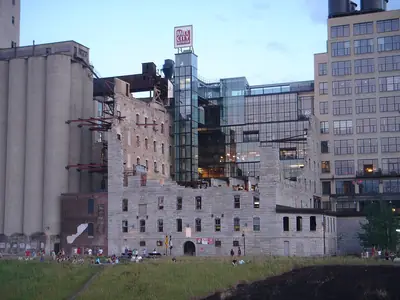
Mill City Museum occupies the preserved ruins of the Washburn “A” Mill beside the Mississippi River and Mill Ruins Park. Its exhibits connect flour, waterpower, industry, and the remains of one of Minneapolis’s most important mills.
The Washburn “A” Mill became the largest and most advanced flour mill in the world in 1880. Its success helped establish Minneapolis as the flour-milling capital of the world from 1880 to 1930. The mill closed in 1965, and a fire in 1991 left the complex in ruins. The Minnesota Historical Society later worked with architect Thomas Meyer to transform the remains into a museum.
Inside, preserved flour bins, milling machinery, and a rail corridor stand alongside modern design. The building’s glass curtain wall is etched with historic mill diagrams. The complex is listed on the National Register of Historic Places and forms part of the St. Anthony Falls Historic District.
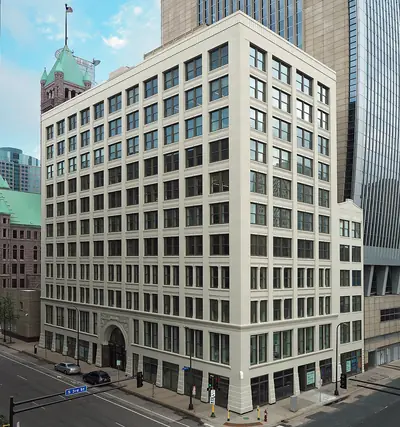
The nearby Flour Exchange Building offers another view of downtown Minneapolis’s commercial history. Construction began in 1892, but the project stopped after four floors had been completed during the Panic of 1893. Work later resumed, and the eleven-story building was completed in 1909. Designed by Long and Kees, it follows the Chicago school with a relatively straightforward appearance and limited historic decoration.
Weisman Art Museum and the University of Minnesota
The Weisman Art Museum stands at the University of Minnesota above the Mississippi River. Designed by Frank Gehry, its shimmering curves and sharp angles create one of the city’s most recognizable buildings. It was Gehry’s first museum design in the United States.
The museum began in 1934 as the University Gallery, originally occupying an upper floor of Northrop Auditorium. It moved into the current building in 1993 and was renamed for art collector and philanthropist Frederick R. Weisman. Its collection contains more than 20,000 works, including modern American art, traditional Korean furniture, and Native ceramics. Works by Marsden Hartley, Alfred Maurer, Charles Biederman, Roy Lichtenstein, and Georgia O’Keeffe are represented.
Minneapolis Institute of Art
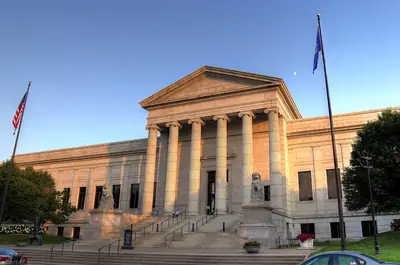
The Minneapolis Institute of Art, known as Mia, presents art from across the world and roughly 5,000 years of history. Its collection includes more than 100,000 works, with major areas devoted to African, contemporary, Asian, European, and American art. The museum is particularly noted for the strength of its Asian art collection.
Founded in 1883, Mia moved into its grand classical building in 1915. Later additions changed the character of the campus: a minimalist wing was added in 1974, followed by a design by Michael Graves in 2006. The result combines a neoclassical façade with striking modern forms. The museum occupies an eight-hectare campus formerly known as Morrison Park.
Purcell-Cutts House
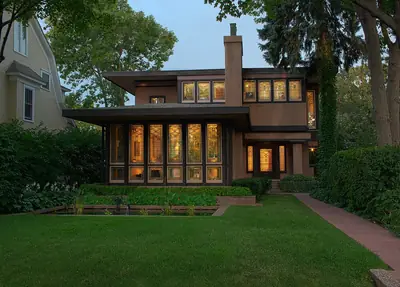
The Purcell-Cutts House has an important place in American architectural history. Designed in 1913 by Purcell, Feick and Elmslie for architect William Purcell and his family, it is a notable example of Prairie School design.
Its long, low form is matched by an unusual interior layout. Instead of dividing the home into separate Victorian rooms, the long, narrow floor plan creates a more open sequence of spaces. The house was originally known as the Edna S. Purcell House.
Midtown Greenway
The Midtown Greenway is a shared-use path that follows the former route of the Milwaukee Road railway. It stretches for 5.7 miles, or 9.2 kilometers, and runs east to west about one block north of Lake Street.
Because it is partially below grade and offers an almost automobile-free route, the Greenway serves cyclists, inline skaters, runners, and pedestrians. It is both a recreational path and an everyday route across Minneapolis.
Norway House
Norway House is a cultural and business center devoted to Norwegian heritage and Nordic culture in the Twin Cities. Established in 2015, it brings together cultural activities and connections between Norway and the United States.
A later expansion added offices, a café, an art gallery, and spaces for events and conferences. The center offers a way to explore Minneapolis’s Nordic cultural connections through a contemporary gathering place.
Historic churches and homes
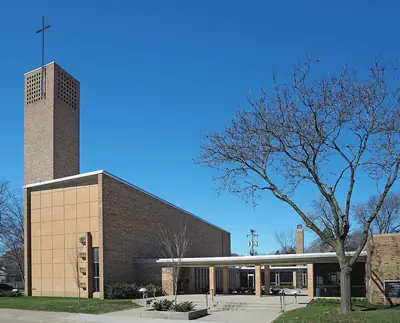
Christ Church Lutheran is known internationally for its architecture. Its sanctuary and chapel were completed in 1949, with an education wing added in 1962. Finnish-American architects Eliel Saarinen and Eero Saarinen designed the buildings, which form the architectural heart of the church.
In the Loring Hills mansion district, the Eugene J. Carpenter House—also known as 300 Clifton—reflects the changing architectural character of a historic Minneapolis residence. Built in 1887 by C. M. Douglas in the Queen Anne style, it has prominent porches and a turret at the southeast corner. It is also described as Georgian Revival in style.
The George R. Newell House, or Chateau LaSalle, is another grand historic home. Built for Sumner T. McKnight and sold almost immediately to George R. Newell, it has a dramatic exterior of rusticated Lake Superior sandstone. Its terrace, arched entrance porch, carved ornamental panels, and crested dormer give it a Romanesque Revival character.
Inside, oak and sycamore woodwork, Tiffany and Company lighting, and gold leaf scrollwork create a lavish Victorian interior. The house also connects to the history of the Newell family’s grocery business, which later became SuperValu.
The Elisha and Lizzie Morse Jr. House in the Whittier neighborhood was built in 1870. Its cupola has paired windows framed by shallow arches, giving the roofline an Italian Villa character. The wooden siding was cut with regular incisions to imitate blocks of stone, then painted with a mixture of paint and sand. In 1991, the house was moved from its original location after the former site was altered during construction of Interstate 35W.
Northwestern Knitting Company Factory
The Northwestern Knitting Company Factory tells the story of a major clothing manufacturer and the adaptive reuse of an industrial complex. George D. Munsing founded the company in 1888 and developed a way to cover wool fibers with silk and cotton, making the union suit more comfortable. The design was patented in 1891, and the company eventually became the world’s largest manufacturer of underwear.
Between 1904 and 1915, the company built five brick and concrete structures in the Sumner Glenwood neighborhood. Together, they covered 650,000 square feet and employed as many as 2,000 workers. The company changed its name to Munsingwear in 1919. The complex later became known as International Market Square, giving the former factory a new role.
East 46th Street and the Ford Parkway Bridge
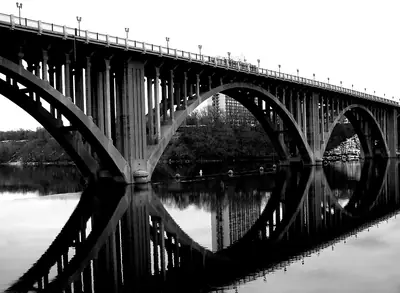
The Intercity Bridge, better known as the Ford Parkway Bridge, carries the route across the Mississippi River between Minneapolis and Saint Paul. It is also sometimes called the 46th Street Bridge.
Its reinforced concrete arch design is part of a group of monumental concrete rib arch bridges built along the high river bluffs of the Mississippi River. The bridge was originally built to serve Ford’s Twin Cities Assembly Plant and provide a commuting route between Minneapolis and the plant in Saint Paul.
It was redecked and widened in 1972 and 1973, then rebuilt from the arches upward in 2004. The bridge was listed on the National Register of Historic Places in 1989.
More historic buildings in central Minneapolis
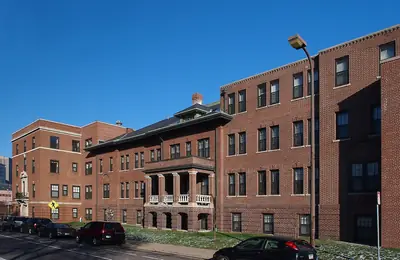
Several other buildings reveal the city’s changing uses and architectural styles. Abbott Hospital in the Stevens Square neighborhood was built in 1910, with additions continuing through 1958. It later became known as Abbott Apartments after the hospital closed in 1980.
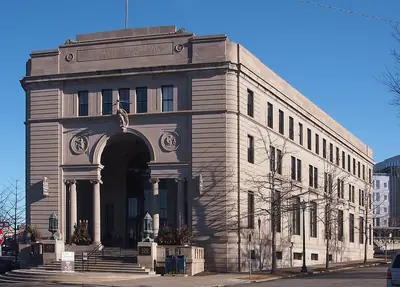
At 430 Oak Grove, the former Northwestern National Life Insurance Company Home Office reflects the Beaux-Arts style. Designed by Hewitt and Brown, it was also known as the Loring Park Office Building. The building was listed on the National Register of Historic Places on July 16, 2012, and now functions as a boutique apartment complex called 430 Oak Grove.
Explore Minneapolis with Neywo
Neywo offers a Minneapolis self-guided walking tour experience through four walking tours, one bus route, and one bike route. Across the city, the app covers 161 narrated places, and narration is available in 11 languages.
The walks include:
- Where Minneapolis Was Milled: Saint Anthony Falls — 3.22 km, 102 minutes, 10 stops.
- Skyscrapers and Stage Lights — 3.12 km, 99 minutes, 12 stops.
- Cathedrals, Mansions and the Spoon: Loring Park — 2.48 km, 93 minutes, 11 stops.
- Gophers, Gehry and the Shoe Tree: University of Minnesota — 2.47 km, 83 minutes, 10 stops.
You can also follow the E Line: Hennepin Avenue from Uptown to the Theatre District, a 5.2-kilometer, 22-minute bus route with 8 stops, or take the Riverfront Ride: Stone Arch Bridge and the Mill District, a 2.3-kilometer, 12-minute bike route with 7 stops.
The app tells the story of each place as you reach it, at your own pace, with no group and no schedule. Download Neywo and explore Minneapolis independently, from the riverfront and historic mills to university architecture, museums, and mansion-lined streets. For more destinations across the United States, continue discovering the country city by city.
Places with an audio guide in Minneapolis
8 places in Minneapolis with a Neywo audio guide. Each one starts telling its story as you reach it.
Self-guided tours in Minneapolis
6 tours in Minneapolis, free in the Neywo app. Each stop tells its story as you reach it.
- Bike ride
Riverfront Ride: Stone Arch Bridge and the Mill District
A short ride on the Central Riverfront trails of the Mississippi. Start at the grain elevator, roll past the Mill City Museum and across the Stone Arch Bridge, then loop through the falls district to the Third Avenue Bridge.
Ceresota Building · Mill City Museum · Stone Arch Bridge · Southeast Steam Plant · Saint Anthony Falls Laboratory · Ard Godfrey House …
Open this tour: Riverfront Ride: Stone Arch Bridge and the Mill District - Bus ride
E Line: Hennepin Avenue from Uptown to the Theatre District
Metro Transit's E Line runs along Hennepin Avenue, the spine of Minneapolis. Ride from the Uptown Theater north past the Walker Art Center and the Basilica of Saint Mary to the downtown theatre district at the old Pence Opera House site.
Uptown Theater · Hennepin Avenue United Methodist Church · Walker Art Center · Basilica of Saint Mary · Orpheum Theatre · Pantages Theatre …
Open this tour: E Line: Hennepin Avenue from Uptown to the Theatre District - Walk
Where Minneapolis Was Milled: Saint Anthony Falls
Minneapolis became the flour capital of the world on the power of one waterfall. Walk from the Flour Exchange and a mighty brick grain elevator through excavated mill ruins, past the Guthrie Theater, across the only stone arch bridge on the Mississippi, to the oldest wooden house in the city and its oldest church still in use.
Flour Exchange Building · Ceresota Building · Mill Ruins Park · Mill City Museum · Guthrie Theater · Stone Arch Bridge …
Open this tour: Where Minneapolis Was Milled: Saint Anthony Falls - Walk
Skyscrapers and Stage Lights
From the Richardsonian City Hall and the city's first skyscraper to the 57-storey IDS tower, via the grand theatres of Hennepin Avenue and the glowing halo of Capella Tower. See how ambition, vaudeville and Art Deco shaped downtown Minneapolis.
Minneapolis City Hall · Capella Tower · Lumber Exchange Building · Hennepin Center for the Arts · Pantages Theatre · Orpheum Theatre …
Open this tour: Skyscrapers and Stage Lights - Walk
Cathedrals, Mansions and the Spoon: Loring Park
Start at America's first basilica, drift past Gilded Age mansions built on lumber and grain fortunes, from the Beaux-Arts Semple House to the rare 1870 details of the Morse House, and finish at the Walker's sculpture garden and its giant cherry on a spoon.
Basilica of Saint Mary · Spoonbridge and Cherry · Walker Art Center · St. Mark's Episcopal Cathedral · Woman's Club of Minneapolis · Elbert L. Carpenter House …
Open this tour: Cathedrals, Mansions and the Spoon: Loring Park - Walk
Gophers, Gehry and the Shoe Tree: University of Minnesota
A campus walk from the university's archive library past a quirky tree full of shoes, Frank Gehry's gleaming museum, Cass Gilbert's grand Northrop Mall, the oldest surviving university building and The Barn.
Elmer L. Andersen Library · Shoe Tree · Weisman Art Museum · Northrop Mall Historic District · University of Minnesota · Walter Library …
Open this tour: Gophers, Gehry and the Shoe Tree: University of Minnesota
Walk Minneapolis with Neywo
Neywo turns Minneapolis into a self-guided audio tour. Stories arrive as you reach the place they belong to, and the route reshapes when you wander off it.

