Sioux Falls, United States: Self-Guided Walking Tour
Things to Do in Sioux Falls
Sioux Falls, South Dakota’s largest city, grew around the dramatic cascades of the Big Sioux River, a natural landmark that shaped its settlement, industry, and identity. The city blends Indigenous heritage, frontier history, and a vibrant cultural scene, making it a rewarding stop for travelers exploring the Upper Midwest. Neywo provides a free audio guide for Sioux Falls with 28 narrated places to enhance your self‑guided exploration.
Explore Sioux Falls
USS South Dakota (museum)
The USS South Dakota, a South Dakota‑class fast battleship commissioned in 1942 and known by hull number BB‑57, served as the lead ship of its class in the Pacific Theater of World War II. It saw action at Guadalcanal, the Battle of Santa Cruz, and the Second Naval Battle of Guadalcanal, where Japanese forces struck it more than two dozen times. After repairs, the ship continued to support carrier task forces during campaigns in the Gilbert and Marshall Islands, the Mariana and Palau Islands, and the Philippines, finishing the war at Iwo Jima and Okinawa.
Cherry Rock Park Bridge
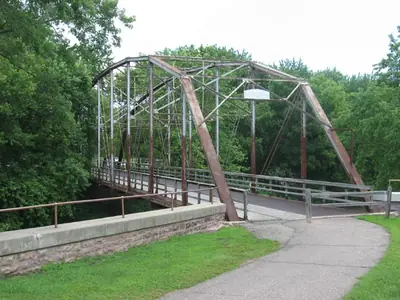
Completed in 1902 by the C. A. Grinde Company, the Cherry Rock Park Bridge originally carried horse‑drawn wagons and buggies over the Big Sioux River. Its structure combines a Parker Through Truss on the west end and a Pratt Pony Truss on the east, with a wooden plank deck that was replaced by a steel grate in 1960. In 1984 the bridge was converted for pedestrians and bicycles, and it rests on a foundation of Sioux quartzite once known as Cherry Rock, a ledge early residents used as a diving platform.
Eighth Street Bridge
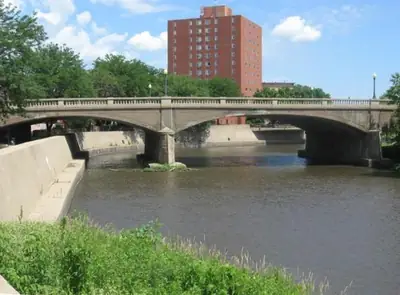
Built in 1912 by N. M. Stark and Company, the Eighth Street Bridge carries East Eighth Street over the Big Sioux River through three concrete deck arches. Restored in 1977 and listed on the National Register of Historic Places in 1993, its piers feature pointed cutwaters with conical caps, while the sidewalks are bordered by concrete railings with neoclassical balustrades. Each pier is topped by a fluted cast‑iron light stand with decorative consoles at its base.
Presentation Children’s Home
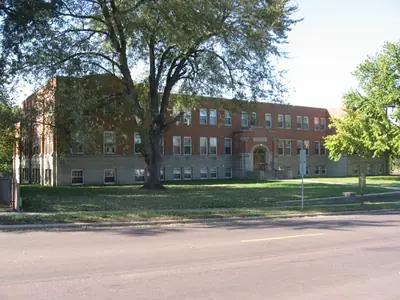
This historic building opened in 1940 to replace an earlier orphanage in Turton that had burned down. It functioned both as an orphanage and a school until it closed in 1966, providing care and education for children in Sioux Falls over a quarter‑century.
Old Minnehaha County Courthouse (Old Courthouse Museum)
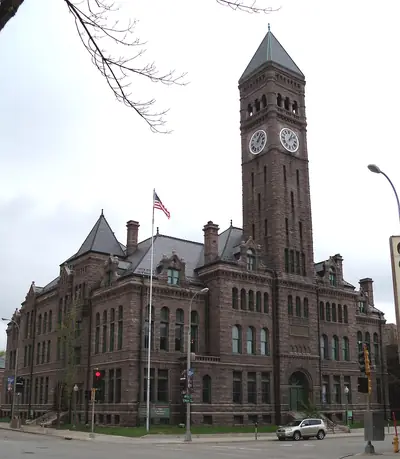
Constructed from locally quarried Sioux quartzite, the Old Minnehaha County Courthouse exemplifies Romanesque Revival design by architect Wallace L. Dow. Building began in 1889 and finished in 1893, featuring a tall clock tower, Roman‑arched doorways, arched windows on the second and third floors, rectangular first‑floor windows, and attic windows set into decorative dormers. It served as the seat of Minnehaha County government from 1890 to 1962, was saved from demolition in 1974, and now operates as a museum preserving granite pillars, hand‑carved woodwork, stained‑glass windows, and murals by a Norwegian artist.
Pettigrew Home & Museum
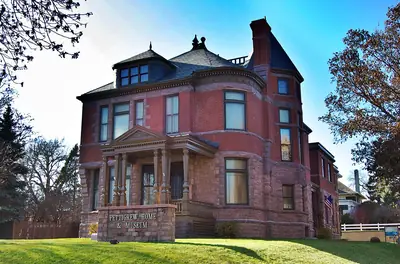
Located in the Cathedral Historic District, the Pettigrew Home was built in 1889 and later became the residence of Richard Franklin Pettigrew, South Dakota’s first United States senator. The house displays Queen Anne style with lavish Victorian details, elegant woodwork, and distinctive purple carpets on the staircases. Pettigrew’s personal papers and letters, long stored in the attic, have been archived and offer insight into his political and business activities. After his death in 1926 he donated the property to the city; today it is operated by Siouxland Heritage Museums, offers free admission year‑round, and provides guided tours focused on his contributions to Sioux Falls and South Dakota.
Washington Pavilion of Arts and Science
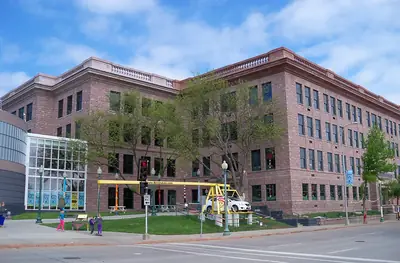
Housed in the former Washington High School, the Washington Pavilion opened in 1999 as a Neoclassical Sioux Quartzite building listed on the National Register. It contains two performing arts centers for Broadway shows, concerts, and recitals; the Wells Fargo CineDome, an immersive large‑format theater; a Visual Arts Center with seven galleries of permanent and rotating exhibitions; and the Kirby Science Discovery Center, a three‑story interactive space with exhibits on outer space, dinosaurs, and underground mining.
St. Joseph Cathedral
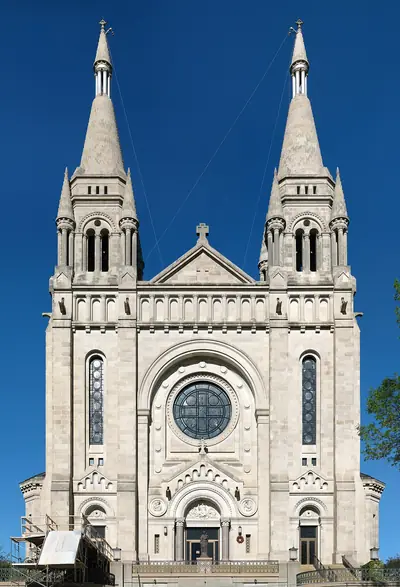
The twin spires of St. Joseph Cathedral have defined the Sioux Falls skyline for more than a century. As the seat of the Diocese of Sioux Falls, the cathedral blends Romanesque and French Renaissance‑inspired design, with walls of Sioux quartzite, stained‑glass windows, ornate moldings, and ceiling frescoes depicting the Nativity and the Annunciation. Its mighty pipe organ comprises 3,293 pipes, and much of the interior artwork was restored to original grandeur during a major renovation completed in 2011. The cathedral’s history traces back to 1881, when Saint Michael’s Church was established; after the diocese was formed in 1889, Saint Michael’s became the first cathedral, and the present building replaced it in 1915.
All Saints Historic District
This broad neighborhood encompasses more than 374 houses dating from the late nineteenth and early twentieth centuries across a 70‑acre area. Named after the All Saints School, a landmark contributing property, the district was listed on the National Register of Historic Places in 1984 and preserves a continuous sense of place through its historic homes.
Cathedral Historic District
Centered on the Cathedral of Saint Joseph, this district grew from the area once known as Nob Hill, where prominent pioneers, politicians, and businessmen settled in the late nineteenth and early twentieth centuries. The streetscape shows a mix of Queen Anne and Mediterranean Revival styles. Originally designated the Sioux Falls Historic District, it was listed on the National Register in 1974 with 223 contributing buildings and was enlarged in 2023.
Delbridge Museum of Natural History
The Delbridge Museum of Natural History invites visitors to explore at their own pace, offering a space where natural history specimens can be examined without a prescribed route.
Eastbank Art Gallery
Situated within the 8th & Railroad Center, the Eastbank Art Gallery occupies a building that began as the Wilson Terminal, a state‑of‑the‑art warehouse erected in 1930. Over the decades the property passed through owners such as All American Transport (1962), Texas Gas Transmission (1975), Tri‑State Electric, and Southeast Properties (1995), which renovated the space while retaining its industrial character. Today the gallery blends an industrial aesthetic with a creative atmosphere, featuring independent shops, handcrafted goods, local artwork, and distinctive places to eat.
Mary Jo Wegner Arboretum & East Sioux Falls Historic Site
Spanning 145 acres, this sanctuary combines native landscapes, gardens, and local history. Visitors can see traces of an earlier community, old stone quarries, building foundations, and the former Illinois Central Railroad line. A reconstructed L‑shaped schoolhouse stands on the site, alongside exhibits about the Sioux Falls Granite Company and its quarrying history. The arboretum includes themed gardens with native and imported plant species, walking trails through varied habitats, and vibrant plantings that shift with the seasons, complemented by the Mabel and Judy Jasper Educational Center, which adds historical and environmental displays for all ages.
Penmarch Place
Penmarch Place is a historic house whose character derives from the sense of history embedded in the building itself, offering a quiet glimpse into Sioux Falls’ residential past.
First Congregational Church
Dating from 1907 and added to the National Register in 1983, First Congregational Church rises two and a half stories with unequal towers marking its front corners. A tower‑like structure on the north facade contains the rear entrance, adding a strong vertical element. A two‑story educational wing was added in 1955 by Lucas, Craig and Whitwam; its west facade originally used glass, dark panels, and aluminum framing before being replaced to copy the Richardsonian Romanesque appearance of the original 1907 church, preserving a visual link between old and new.
Explore Sioux Falls with Neywo
Neywo’s free audio guide for Sioux Falls includes 28 narrated places that play automatically as you reach each site, letting you explore at your own pace with no group and no schedule. The guide offers two walking tours and one bike route: the “Pink Quartzite Downtown” walk covers 3.44 km in about 95 minutes with 10 stops, including the Federal Building, Washington Pavilion, Pettigrew Home & Museum, and St. Joseph Cathedral; the “The Falls and the Mill Ruins” walk spans 1.7 km in roughly 41 minutes with 4 stops at Eighth Street Bridge, Falls Park, Queen Bee Mill, and the Sioux Falls Light and Power Hydro Electric Plant; and the “Big Sioux River Greenway Ride” bike route travels 3.6 km in about 18 minutes with 3 stops at Falls Park, Eighth Street Bridge, and Cherry Rock Park Bridge. Download the app, choose a tour, and let the stories of Sioux Falls unfold step by step.
Places with an audio guide in Sioux Falls
8 places in Sioux Falls with a Neywo audio guide. Each one starts telling its story as you reach it.

Self-guided tours in Sioux Falls
3 tours in Sioux Falls, free in the Neywo app. Each stop tells its story as you reach it.
- Bike ride
Big Sioux River Greenway Ride
Start at Falls Park, the gateway to the 19-mile Big Sioux River Recreation Greenway, and ride the riverside trail south past the historic Eighth Street Bridge to the 1902 Cherry Rock Park Bridge, a steel truss that now carries only bikes and walkers.
Falls Park · Eighth Street Bridge · Cherry Rock Park Bridge
Open this tour: Big Sioux River Greenway Ride - Walk
Pink Quartzite Downtown
Sioux Falls was built from the rose-coloured quartzite of its own quarries, and this loop shows what that stone made: a Romanesque courthouse, a Carnegie library, a cathedral with twin spires and a Victorian senator's home. Along the way you pass a cinema from the 1920s and the bank the Dillinger gang robbed in 1934.
Federal Building and United States Courthouse · Sioux Falls State Theatre · Washington Pavillion of Arts & Science · First Congregational Church · Pettigrew Home & Museum · Cathedral Historic District …
Open this tour: Pink Quartzite Downtown - Walk
The Falls and the Mill Ruins
Follow the Big Sioux River from a 1912 concrete arch bridge to the triple waterfall that gave the city its name. Then see the ruins of the Queen Bee Mill and the brick hydroelectric plant that harnessed the river in Falls Park.
Eighth Street Bridge · Falls Park · Queen Bee Mill · Sioux Falls Light and Power Hydro Electric Plant
Open this tour: The Falls and the Mill Ruins
Walk Sioux Falls with Neywo
Neywo turns Sioux Falls into a self-guided audio tour. Stories arrive as you reach the place they belong to, and the route reshapes when you wander off it.

