What to See in Parkersburg, United States: Free Audio Guide
Things to Do in Parkersburg, West Virginia
The best things to do in Parkersburg, West Virginia, focus on the city’s industrial past, historic churches, distinctive architecture, and Ohio River setting. From the monumental Parkersburg Bridge to the former W. H. Smith Hardware Company Building, Parkersburg rewards visitors who explore its landmarks at street level. Neywo offers a free audio guide for Parkersburg with 11 narrated places.
Part of the history of the United States, Parkersburg is especially interesting for travellers who enjoy heritage buildings and self-guided city walks. Its landmarks range from nineteenth-century churches to a former vaudeville theatre and a house shaped by the tensions of the Civil War.
What to see in Parkersburg
Parkersburg Bridge
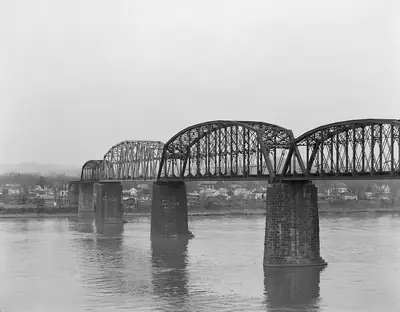
The Parkersburg Bridge, also known as the Sixth Street Railroad Bridge, crosses the Ohio River between Parkersburg and Belpre, Ohio. Built for the Baltimore and Ohio Railroad between May 1869 and January 1871, it was reportedly the longest bridge in the world when completed, measuring 7,140 feet, or 2,180 metres.
Its 46 spans rest on 53 piers built with about 50,000 cubic yards of stone. The bridge has been renewed several times: the approach spans were replaced between 1898 and 1900, the river spans between 1904 and 1905, and the steel structure was rebuilt from about 1914 to 1917. One channel span was replaced in 1972 after a barge carrying an empty gasoline tanker exploded beneath it.
Oil and Gas Museum
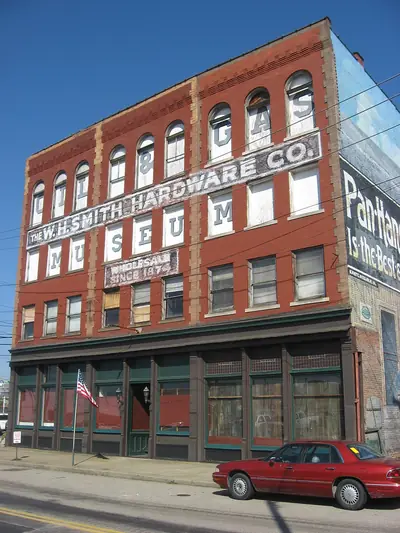
The Oil and Gas Museum occupies the historic W. H. Smith Hardware Company Building, a four-story masonry structure with Romanesque Revival details. Constructed in 1899 on the foundation of an earlier building from about 1874, it housed the W. H. Smith Hardware Company until the 1980s.
The building’s long rectangular form measures about 60 by 120 feet, with an additional outcrop measuring 18 by 12 feet. Today, the Oil and Gas Museum preserves Parkersburg’s connection with oil, gas, and industrial history.
Trinity Episcopal Church and Rectory
Trinity Episcopal Church is one of Parkersburg’s historic places of worship and belongs to the Episcopal Diocese of West Virginia. The adjoining Trinity Episcopal Church Rectory, at 430 Juliana Street, is connected to the church at 424 Juliana Street by a newer wing.
Built in 1863, the rectory is a two-and-a-half-story painted brick building in the Second Empire style. Its most striking feature is the concave-profile mansard roof. The rectory was listed on the National Register of Historic Places in 1982.
Henry Logan Memorial AME Church
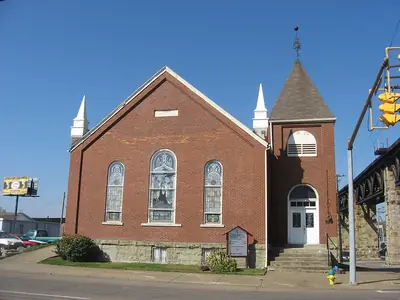
At Ann and 6th Streets, Henry Logan Memorial AME Church stands out for its brick and stone exterior. Built in 1891 in a vernacular Romanesque style, it has three round-arched stained-glass windows on the front façade and a square corner tower topped with a pyramidal roof.
The church was listed on the National Register of Historic Places in 1982, recognising its importance in Parkersburg and West Virginia history.
Smoot Theatre
The Smoot Theatre began as both a movie theatre and a vaudeville house. Built in 1926, it is made of brick and terra cotta, with a simple Classical-style front, a Greek key cornice, and a recessed second story framed by four fluted columns.
Its role in Parkersburg’s entertainment history earned it a place on the National Register of Historic Places in 1982.
St. Francis Xavier Church
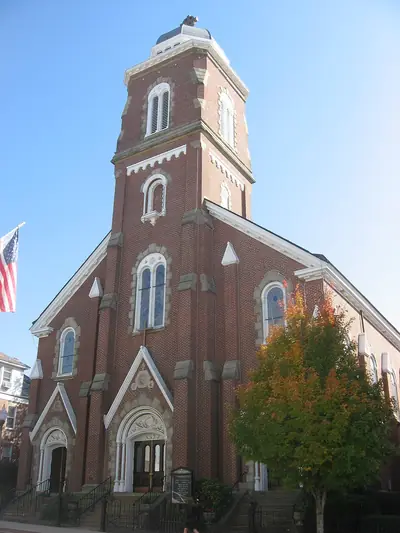
St. Francis Xavier Church, also known as Saint Francis Xavier Catholic Church, has stood at 532 Market Street since the nineteenth century. Built in 1869 and completed and dedicated on October 2, 1870, it is the oldest church building in Parkersburg.
It is also one of the four original churches of the Diocese of Wheeling, making it an important part of the city’s religious and architectural heritage.
First Baptist Church
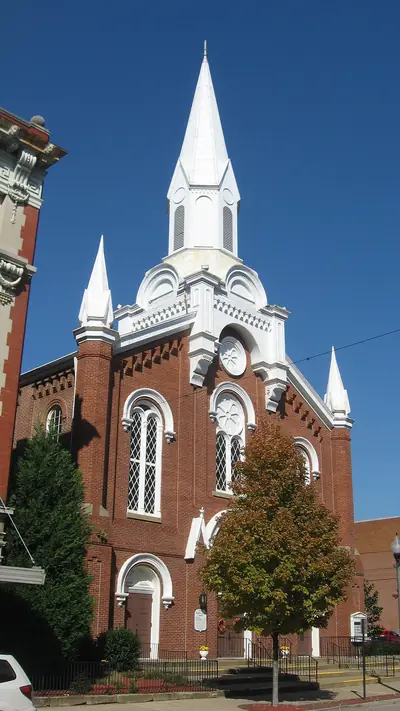
First Baptist Church occupies a historic site on Market Street. Its congregation was founded in 1817, and the first church on the site was built in 1837. The present building dates from 1871.
The two-story brick church has an Italianate design, a gable roof, an arched corbel table, a corner turret, and a central steeple. Several additions extend from the rear, but the steeple remains the building’s strongest feature on the streetscape.
First Presbyterian Church
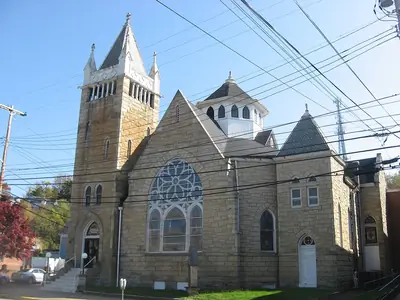
Built in 1894, First Presbyterian Church is a two-story brick and stone building combining Romanesque and Gothic Revival styles. Its corner bell tower gives it a particularly distinctive profile on Market Street.
The building has served under several names and is now home to St. Patrick’s Anglican Church. It is also known as Calvary Temple Evangelical Church and St. Patrick’s Priory Church.
Oakland
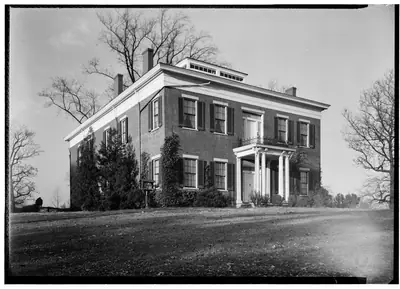
Oakland, also known as the James M. Stephenson House, is a red-brick Greek Revival house dating from 1840. The two-story, L-shaped building has a low hipped roof, a cupola, and a single-bay portico supported by paired, fluted wooden Doric columns.
The house also reflects the divided loyalties of the Civil War era. James M. Stephenson was a slaveholder who sympathised with the Confederacy, while his brother-in-law Arthur Boreman was a Unionist. Stephenson allowed Union Army Colonel James B. Steedman, who later became a general, to use a nearby grove, and Union cavalry occupied the mansion for a time, damaging its furnishings, home, and garden.
Bethel AME Church
Bethel African Methodist Episcopal Church was the oldest black church building in west-central West Virginia. Built in 1887 at 820 Clay Street, it was a two-story stucco building in a vernacular interpretation of the Gothic Revival style.
The church stood in a neighbourhood of late nineteenth-century wood-frame houses, one block from downtown, and was one of three black churches in Parkersburg. Its historic importance was recognised in 1998, when it was added to the National Register of Historic Places.
Actors Guild
Actors Guild is a movie theatre in Parkersburg and forms part of the city’s local cultural landscape. It provides a contrast to the historic Smoot Theatre, connecting the city’s older entertainment heritage with a contemporary venue.
Explore Parkersburg with a self-guided audio tour
Neywo turns a visit to Parkersburg into a flexible audio-guided experience. The app has one walking tour and one bus route, with narration available in 11 languages. Each story plays as you reach the place, at your own pace: there is no group and no schedule.
The Parkersburg: Railroad Bridge, Oil Heritage and Downtown Landmarks walking tour covers 3.54 km in 96 minutes and includes 9 narrated stops: Parkersburg Bridge, the W. H. Smith Hardware Company Building, Trinity Episcopal Church, Henry Logan Memorial AME Church, Smoot Theatre, St. Francis Xavier Church, First Baptist Church, First Presbyterian Church, and Oakland.
For a longer route, the Parkersburg’s Church Row by Easy Rider bus line covers 12.1 km in 52 minutes and has 4 stops: First Presbyterian Church, First Baptist Church, St. Francis Xavier Church, and Trinity Episcopal Church.
Download Neywo and explore Parkersburg while the app tells the story of each landmark as you reach it. Choose the walking tour or bus route, move at your own pace, and discover the city without a group or a fixed schedule.
Places with an audio guide in Parkersburg
8 places in Parkersburg with a Neywo audio guide. Each one starts telling its story as you reach it.
Self-guided tours in Parkersburg
2 tours in Parkersburg, free in the Neywo app. Each stop tells its story as you reach it.
- Bus ride
Broad Line: Parkersburg's Church Row by Easy Rider
Parkersburg's public Easy Rider route 2 runs along Broad Street through the old downtown, passing four of the city's historic churches in Gothic, Romanesque and Greek Revival styles. A cheap way to see Market Street's sacred skyline without climbing the hill on foot.
First Presbyterian Church · First Baptist Church · St. Francis Xavier Church · Trinity Episcopal Church
Open this tour: Broad Line: Parkersburg's Church Row by Easy Rider - Walk
Parkersburg: Railroad Bridge, Oil Heritage and Downtown Landmarks
Start at the Ohio River beside the old B&O railroad bridge, reportedly the longest in the world when finished in 1871. Walk through downtown past the Oil and Gas Museum in its Romanesque Revival hardware store, the 1926 Smoot vaudeville theatre and the oldest church in town, then follow Market Street's historic churches east to Oakland, an 1840 Greek Revival house with a tangled Civil War story.
Parkersburg Bridge · W.H. Smith Hardware Company Building · Trinity Episcopal Church · Henry Logan Memorial AME Church · Smoot Theatre · St. Francis Xavier Church …
Open this tour: Parkersburg: Railroad Bridge, Oil Heritage and Downtown Landmarks
Walk Parkersburg with Neywo
Neywo turns Parkersburg into a self-guided audio tour. Stories arrive as you reach the place they belong to, and the route reshapes when you wander off it.

