What to See in Koblenz, Germany: Free Audio Guide
Things to Do in Koblenz: What to See at the Rhine–Moselle Confluence
Koblenz is a historic German city where the Rhine and Moselle meet, bringing together river landscapes, medieval churches, grand residences and imposing fortifications. It is a rewarding place to explore on foot, especially if you want to see how Roman, ecclesiastical, Prussian and modern history overlap in one compact city. Neywo offers a free audio guide for Koblenz with 122 narrated places.
Part of Rhineland-Palatinate and the wider history of Germany, Koblenz is also a useful base for discovering the Rhine Valley. Its most important sights range from the old town and the riverfront to Ehrenbreitstein and the castles above the Rhine.
What to see in Koblenz
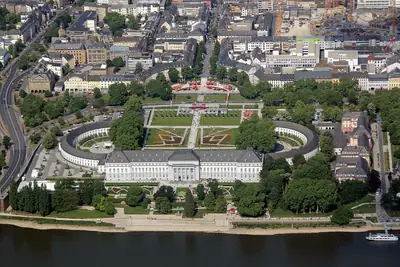
Electoral Palace Koblenz
The Electoral Palace, or Kurfürstliches Schloss, is one of Koblenz’s most important historic residences. Commissioned by Clemens Wenceslaus of Saxony, the last Archbishop and Elector of Trier, construction began in 1778. The completed palace became his residence and is considered one of the last residential palaces built in Germany immediately before the French Revolution.
Its elegant design belongs to the early French neoclassical tradition. The building later acquired a royal connection when the Prussian Crown Prince, later Emperor Wilhelm I, used it as his official residence for several years in the mid-nineteenth century. Today, the palace houses various federal government offices.
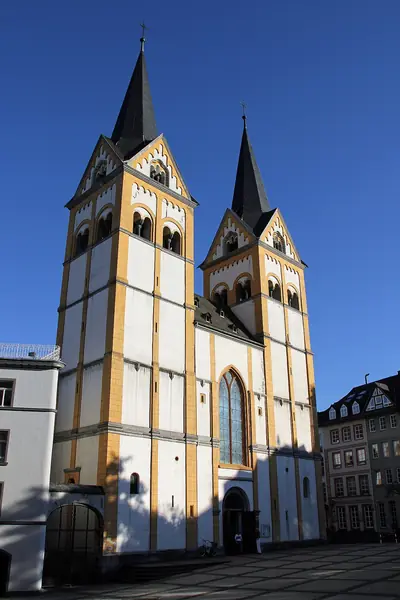
Florinskirche
At Florinsmarkt, Florinskirche contributes one of the defining silhouettes of Koblenz’s old town. The evangelical church was built around 1100 for the collegiate foundation of St. Florin, which was secularized in the early nineteenth century.
In 1820, the church was assigned to Koblenz’s Protestant congregation, becoming the city’s first Protestant church building. Its Romanesque architecture makes it an important example of medieval sacred architecture in the Middle Rhine region.
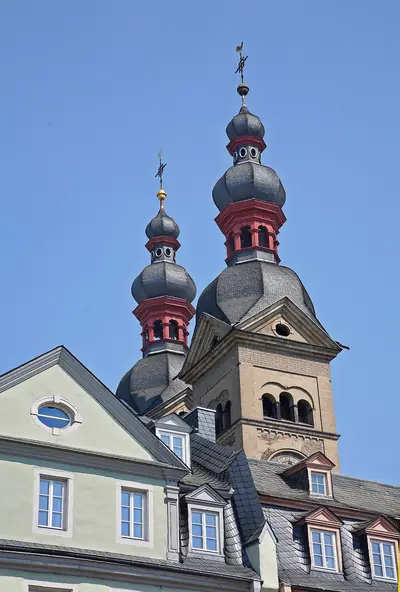
Koblenzer Liebfrauenkirche
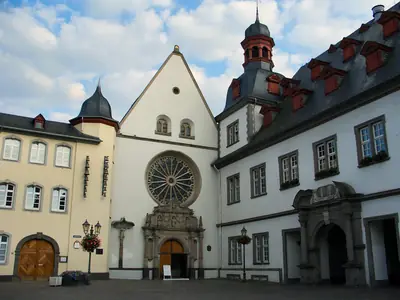
The Liebfrauenkirche rises from the highest point of Koblenz’s old town. Its twin towers, topped with distinctive onion-shaped domes, make it one of the city’s most recognizable landmarks.
The church stands on the site of a late Roman fort and an early Christian place of worship. Its origins reach back to the fifth century, while major rebuilding and enlargement took place in the twelfth and fifteenth centuries. The Gothic nave and choir contrast with the Baroque domes, completed in the seventeenth century.
Inside, Gothic arches, stained glass, sacred art and carved altars create a richly detailed space. The church was heavily damaged during the Second World War and rebuilt after 1945, preserving its historic character alongside modern touches.
St. Josef
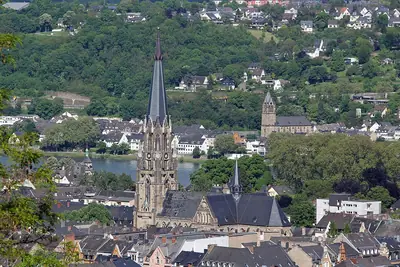
St. Josef is the Catholic parish church of Koblenz’s southern suburb. It was built during the city’s expansion at the end of the nineteenth century, when the growing population needed additional religious buildings.
The church’s Neo-Gothic tower rises 93 metres, making it the highest church tower in Koblenz and a prominent feature of the skyline. Since 2002, St. Josef has formed part of the UNESCO World Heritage cultural landscape of the Upper Middle Rhine Valley.
Christuskirche
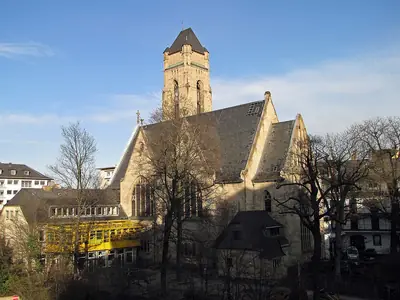
Completed in 1904, Christuskirche was the first new evangelical church built in Koblenz. Its history is closely connected with the city’s southern expansion, and it remains part of Koblenz’s Protestant heritage. Today, it belongs to the Koblenz church district of the Evangelical Church in the Rhineland.
Herz-Jesu-Kirche
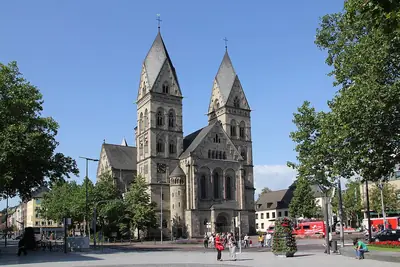
The Herz-Jesu-Kirche, or Church of the Sacred Heart of Jesus, is one of Koblenz’s architectural landmarks. Built between 1900 and 1903, the Catholic parish church was designed by the Munich architect Ludwig Becker.
Its architecture combines Romanesque Revival forms—round arches, substantial stone walls and balanced towers—with details influenced by Jugendstil, or Art Nouveau. Inside, stonework, stained glass and a high vaulted ceiling create a luminous interior. The church suffered severe damage during the Second World War and was carefully restored. It is still a place of worship and also hosts concerts, valued for its acoustics.
Ehrenbreitstein Fortress
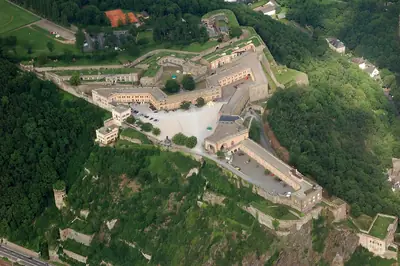
Across the Rhine, on a rocky plateau above the river and near the mouth of the Moselle, Ehrenbreitstein Fortress dominates the landscape. Its position allowed it to oversee the Rhine Valley, river crossings and important transport routes.
The site goes back to a castle built around the year 1000. A later Baroque residence served for a time as a home of the Electors of Trier, before French revolutionary troops destroyed it in 1801. Prussia built the present fortress between 1817 and 1828 as part of the wider Koblenz fortress system.
The massive walls, bastions, gates and defensive spaces reflect nineteenth-century military architecture. Known officially as Feste Ehrenbreitstein, the citadel was designed to protect the Middle Rhine and the transport infrastructure around Koblenz, including rail routes and river crossings. It served the Prussian army until 1918.
Jesuitenkirche and Jesuitenplatz
Jesuitenplatz is home to the Jesuit Church of St. John the Baptist, commonly known as the Jesuitenkirche or Citykirche. It stands beside the former Jesuit college, which now houses Koblenz City Hall.
The present church occupies the site of a seventeenth-century church destroyed in 1944. It is a branch church of the Catholic parish of St. Castor. Nearby, the former Cistercian convent known as the Zisterzienserinnenkloster in der Lehr, or in der Leer, recalls another part of Koblenz’s medieval religious history. The convent existed from 1244 until 1580.
Pegelhaus
The Pegelhaus is a distinctive octagonal building on the riverfront. Built between 1609 and 1611 under Elector Lothar von Metternich, it originally served as a Rhine crane, helping load and unload ships at the meeting point of the Rhine and Moselle.
The crane machinery was removed in 1839, and the building became a gauging station for measuring changing Rhine water levels. The gauge recorded here remains one of 22 official gauges used to regulate navigation along the Rhine. Carved flood marks on one wall record some of the river’s most dramatic rises, while a blue water-level clock continues to show the height of the river.
Mother of Beethoven House
In Ehrenbreitstein, the Mother of Beethoven House, or Mutter-Beethoven-Haus, marks the birthplace of Maria Magdalena Keverich, the mother of composer Ludwig van Beethoven. The historic house dates from the seventeenth century and has survived in Ehrenbreitstein’s historic centre.
Since 1975, it has housed a museum dedicated to Beethoven’s mother and her family. The current form of the exhibition dates from its reopening on May 12, 2001. Since 2002, the house has been part of the UNESCO World Heritage Upper Middle Rhine Valley.
Kurfürstliche Residenz in Ehrenbreitstein
The Kurfürstliche Residenz in Ehrenbreitstein, also known as the Dikasterialgebäude, is one of the surviving buildings associated with Schloss Philippsburg. The former palace stood below Ehrenbreitstein Fortress on the banks of the Rhine and served as the main residence of the Trier electors and archbishops from 1632 until 1786.
Built between 1626 and 1632, Schloss Philippsburg was one of the largest and most significant Baroque buildings on the Rhine. The French destruction of Ehrenbreitstein Fortress in 1801 badly damaged the palace, which was later demolished. The Pagerie, Dikasterialgebäude, Krummstall and Marstall are among the neighbouring buildings that survived.
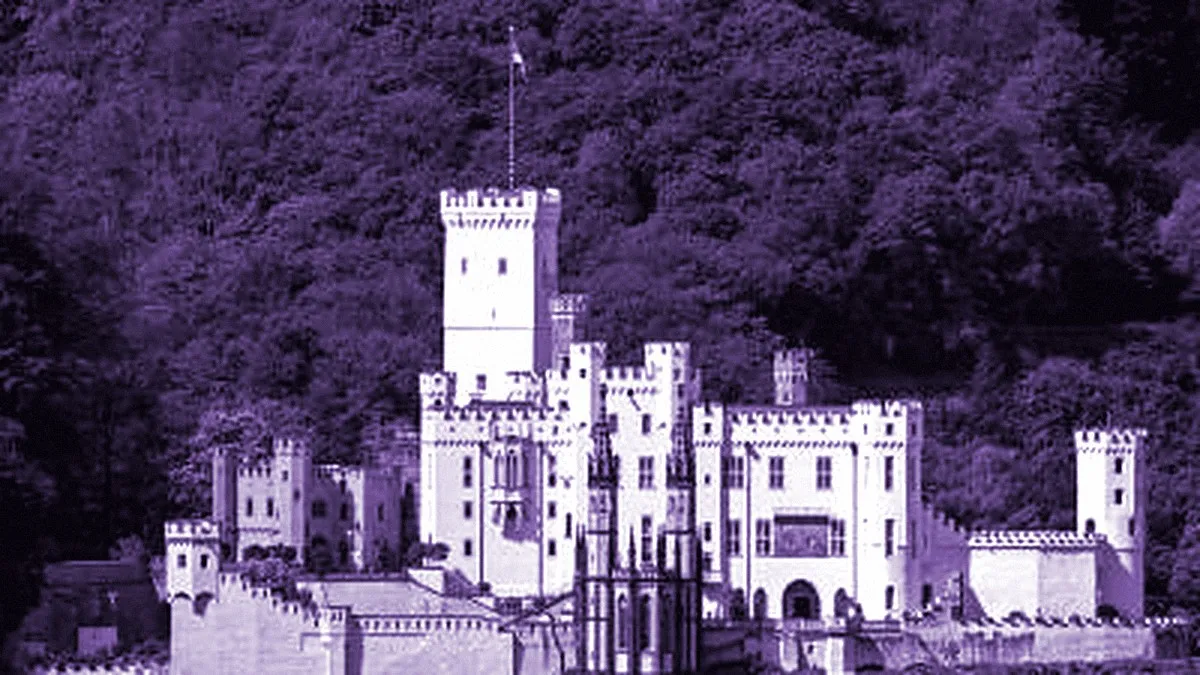
Stolzenfels Castle
Above the Rhine, Stolzenfels Castle combines medieval origins with nineteenth-century Romanticism. The site began as a thirteenth-century toll fortress belonging to the Electorate of Trier. Destroyed in 1689, it later lay in ruins until the ruined castle was given to the Prussian Crown Prince Frederick William in 1823.
Architect Karl Friedrich Schinkel transformed the remains into a Neo-Gothic palace. With turrets, battlements, steep roofs and warm sandstone walls, Stolzenfels became one of the outstanding works of Rhine Romanticism. Its interiors feature colourful murals, heraldic motifs and furnishings that evoke medieval chivalry while reflecting the life of a Prussian royal residence.
Theater Koblenz
Theater Koblenz stands on Deinhardplatz, close to the Electoral Palace. Its eighteenth-century building has a neoclassical façade and a 500-seat auditorium centred on a princely box decorated with optical illusions.
The theatre presents drama, music theatre, puppetry and ballet. Since 1970, Clemensbrunnen has stood in front of the building on Deinhardplatz. The monument commemorates its builder, Elector Clemens Wenceslas of Saxony.
Explore Koblenz with a self-guided audio tour
A Koblenz self-guided walking tour lets you discover the city without joining a group or following a fixed schedule. Neywo has three walking tours, one bus route and one bike route in Koblenz, with narration available in 11 languages.
The walks include:
- Where Koblenz Began: the Old Town Squares — 0.97 km, 83 minutes and 8 narrated stops.
- The German Corner: Where Rhine Meets Moselle — 1.7 km, 86 minutes and 7 narrated stops.
- Across the Rhine: Ehrenbreitstein — 1.1 km, 75 minutes and 7 narrated stops.
There is also Bus 15: Across the Rhine and Through the Old Town, a 9.2 km route lasting 39 minutes with 7 stops, and Koblenz Cycle Lanes: Rhine Bridges to the Belle Epoque Churches, a 5.8 km bike route lasting 29 minutes with 7 stops.
Download Neywo and explore Koblenz at your own pace. The app tells the story of each place as you reach it, with no group and no schedule.
Places with an audio guide in Koblenz
8 places in Koblenz with a Neywo audio guide. Each one starts telling its story as you reach it.
Self-guided tours in Koblenz
5 tours in Koblenz, free in the Neywo app. Each stop tells its story as you reach it.
- Bike ride
Koblenz Cycle Lanes: Rhine Bridges to the Belle Epoque Churches
A ride along signed cycle lanes from the Europabrucke area through the Romanesque Revival Herz-Jesu-Kirche and the Christuskirche to the Pfaffendorf bridge over the Rhine.
Evangelische Kirche · Maria Hilf · Europabrücke Koblenz · Herz-Jesu-Kirche · Christuskirche · Pfaffendorf Bridge …
Open this tour: Koblenz Cycle Lanes: Rhine Bridges to the Belle Epoque Churches - Bus ride
Bus 15: Across the Rhine and Through the Old Town
A local city line that runs from Pfaffendorf on the Rhine's right bank across the river into the centre, past the Mittelrhein Museum and the Old Castle by the Moselle, then up through Maria Hilf to Metternich. A cheap way to see how Koblenz spreads out from the confluence.
Pfaffendorf Bridge · Christuskirche · Mittelrhein-Museum · Old Castle (Koblenz) · Balduinbrücke · Maria Hilf …
Open this tour: Bus 15: Across the Rhine and Through the Old Town - Walk
Where Koblenz Began: the Old Town Squares
Start at the Jesuit church and the cheeky Schängel fountain, then climb to the twin onion domes of the Liebfrauenkirche. Florinsmarkt keeps four late-Gothic and Romanesque buildings side by side, and the walk ends at the old mint master's house and the riverside Old Castle.
Jesuitenkirche · Schängel · Koblenzer Liebfrauenkirche · Florinskirche · Schöffenhaus (Koblenz) · Altes Kaufhaus …
Open this tour: Where Koblenz Began: the Old Town Squares - Walk
The German Corner: Where Rhine Meets Moselle
From the elector's last palace to the tip of the Deutsches Eck, this riverfront walk follows the story of power and trade at the confluence. Pass the octagonal Pegelhaus crane house, Koblenz's oldest church and a Napoleonic fountain, and finish under the emperor's statue where the two rivers join.
Electoral Palace Koblenz · Pegelhaus in Koblenz · Basilica of St. Castor · Kastorbrunnen · St. Jakobus · Ludwig Museum im Deutschherrenhaus …
Open this tour: The German Corner: Where Rhine Meets Moselle - Walk
Across the Rhine: Ehrenbreitstein
Cross to the right bank, where Beethoven's mother was born and the electors of Trier once lived. Climb past the Helfenstein castle site to Ehrenbreitstein, the giant Prussian fortress that was never attacked and now looks down on the whole confluence.
Klosterkirche St. Franziskus, St. Philippus Ap. und Karl Borromäus · Mother of Beethoven House · Rhein-Museum Koblenz · Kurfürstliche Residenz in Ehrenbreitstein · Burg Helfenstein · Museum of Koblenz …
Open this tour: Across the Rhine: Ehrenbreitstein
Walk Koblenz with Neywo
Neywo turns Koblenz into a self-guided audio tour. Stories arrive as you reach the place they belong to, and the route reshapes when you wander off it.

