Potsdam, Germany: Self-Guided Walking Tour
Things to Do in Potsdam: Palaces, Parks and Prussian History
Potsdam is a German city known for royal palaces, remarkable gardens and sites connected with major moments in European history. The best things to do in Potsdam range from exploring Sanssouci and the Neuer Garten to discovering Russian, Dutch and Gothic influences across the city. Neywo offers a free audio guide for Potsdam with 243 narrated places.
What to See in Potsdam
Sanssouci Palace
Sanssouci Palace was Frederick the Great’s personal retreat, designed as an escape from court life. Its name means “without worries” in French, and its intimate scale reflects that purpose: the palace is a single-storey villa with ten principal rooms.
Frederick sketched the initial designs himself, creating the style later known as Frederician Rococo. Construction began in 1745 under Georg Wenzeslaus von Knobelsdorff, before Jan Bouman completed the palace in 1747. It stands above terraced vineyards, combining the king’s interest in architecture with his wish to create harmony between buildings and nature.
Inside, the Concert Room, where Frederick played the flute, the cedar-panelled Palace Library and the Marble Hall are among the most notable spaces.
Sanssouci Park
Sanssouci Park brings together nearly three hundred hectares of gardens and historic buildings. Its landscape combines two different approaches: Frederick the Great’s formal French pleasure garden and the later English-style landscape park commissioned by Frederick William IV and designed in part by Peter Joseph Lenné.
Near the palace, geometric lawns, clipped hedges, flower beds and rows of fruit trees create a carefully ordered setting. Other sections open into broad views, gentle slopes and naturalistic groups of trees. The park also contains the New Palace, the Picture Gallery, the New Chambers and other places connected with Potsdam’s royal past.
Sanssouci Picture Gallery
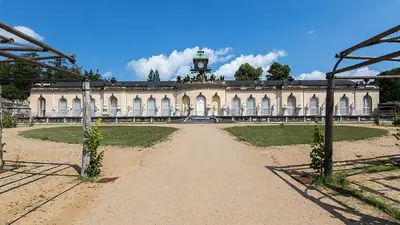
The Sanssouci Picture Gallery, or Bildergalerie, was built between 1755 and 1764 for Frederick II’s art collection. It is the oldest surviving museum built for a ruler in Germany.
The gallery stands east of Sanssouci Palace, opposite the New Chambers. Gold decoration, Italian marble and a domed ceiling give the interior a setting as elaborate as the collection it was created to house. The museum’s history also reflects the damage and disruption of the Second World War: paintings were moved to Rheinsberg Palace, many were lost, and a large group confiscated by the Soviet Union was returned in 1958.
New Chambers
The New Chambers stand on the western side of Sanssouci Palace, balancing the Picture Gallery on the opposite side. The building began in 1747 as an orangery for citrus trees and exotic plants. It was also used as a theatre, banquet hall and concert space.
Between 1771 and 1775, Georg Christian Unger transformed it into a guest palace. The redesign created four festival halls and a wing of guest rooms while retaining features of the earlier orangery, including French doors and ramps used to move potted orange trees.
New Palace
At the western edge of Sanssouci Park, the New Palace is the largest building in the complex. Frederick the Great ordered its construction in 1763, after the end of the Seven Years’ War, as a statement of Prussia’s strength rather than as a private residence.
The three-winged palace stretches for more than two hundred metres and is topped by a central dome. Its interiors include the Grotto Hall, decorated with shells, minerals and polished stones, as well as the two-storey Marble Hall and the Palace Theater. The scale and decoration make it a striking contrast to the more intimate Sanssouci Palace.
Neuer Garten and Marmorpalais
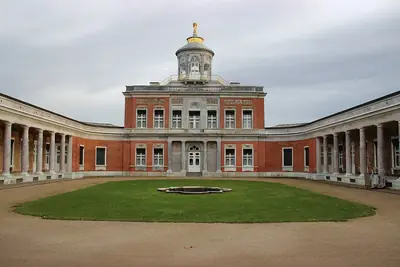
Neuer Garten offers a quieter royal landscape beside the Heiliger See, or Holy Lake. Its most elegant building is the Marmorpalais, the Marble Palace, which was created as Frederick William II’s private summer retreat.
Although the main structure is brick covered with pale stucco, its decorative details and later marble side wings explain the name. Carl von Gontard and Carl Gotthard Langhans designed the palace in the early Neoclassical style. Construction began in 1787, and the main building was largely complete by 1791.
Cecilienhof
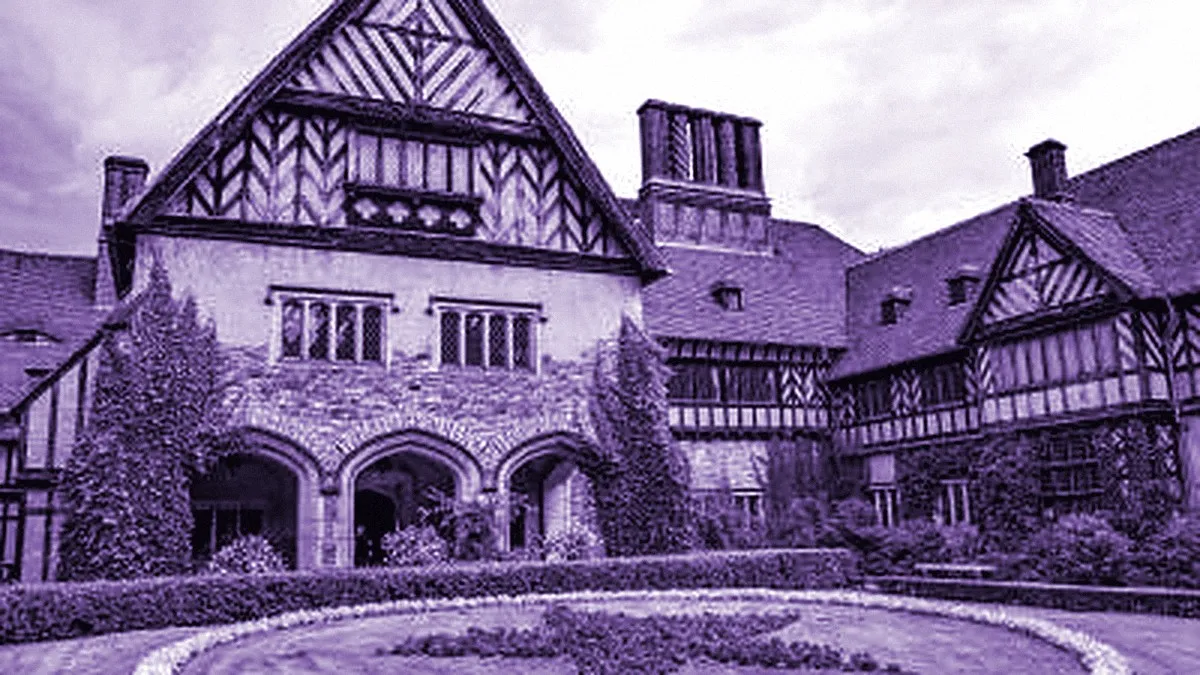
Cecilienhof has the appearance of an English Tudor manor house, but its importance reaches far beyond its modest exterior. Built between 1913 and 1917, it was the last palace constructed by the House of Hohenzollern.
The palace hosted the Potsdam Conference from 17 July to 2 August 1945. Leaders of the Soviet Union, the United Kingdom and the United States met there to make decisions that shaped the post-war world. A five-pointed Soviet star made from red flowers has marked the lawn in the Ehrenhof since the conference.
Cecilienhof and the surrounding palaces and parks have formed part of the Palaces and Parks of Potsdam and Berlin UNESCO World Heritage Site since 1990.
Babelsberg Palace and Flatow Tower
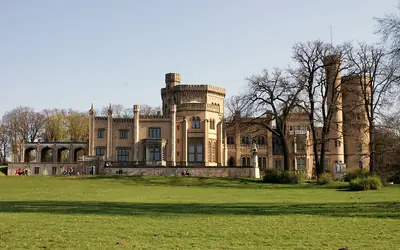
Babelsberg Palace stands in Babelsberg Park and is one of Potsdam’s most distinctive residences. Its English Tudor design was inspired by Windsor Castle. Karl Friedrich Schinkel designed the eastern section between 1834 and 1835, while Ludwig Persius planned the western complex between 1844 and 1849, with Heinrich Strack also continuing the work.
The palace is associated with several important moments in Prussian history, including Otto von Bismarck’s appointment as Prussian Minister President in 1862 and the signing of the Socialist Law in 1878.
Nearby, the 46-metre Flatow Tower rises above Babelsberg Park. Built between 1853 and 1856 under Kaiser Wilhelm I, it was designed by Heinrich Strack in a neo-Gothic style inspired by the medieval tower at Eschenheimer Gate in Frankfurt am Main. A platform at the top provides broad views across the park and surrounding landscape.
Alexandrowka
Museum Alexandrowka is a Russian colony established in 1826 by Frederick William III in honour of Tsar Alexander I. It was created as a home for twelve Russian singers and their families, who had belonged to a Russian military choir that performed at the Prussian court.
The Italian architect Carlo Rossi designed the village with Biedermeier houses, gardens and stables. Its layout centres on a Russian Orthodox church with golden cupolas, combining Russian traditions with Prussian planning. Alexandrowka has been a UNESCO World Heritage site since 1999.
Belvedere on the Pfingstberg
The Belvedere on the Pfingstberg is both a palace and a viewpoint. It stands on the 76-metre Pfingstberg, north of Neuer Garten, and offers broad views over Potsdam.
Its twin towers and Renaissance-inspired design combine Italian Renaissance, Roman and Greek influences. The building was constructed in two phases, from 1847 to 1852 and from 1860 to 1863. In the courtyard, a reflecting pool is surrounded by colonnaded terraces.
Potsdam’s Gates and Historic Places
Potsdam’s urban history is visible in its gates and historic streets. Nauener Tor, built in 1755, is an early example of English Gothic Revival architecture on the European continent. The gate was rebuilt in 1867, and tram tracks still pass through its archway.
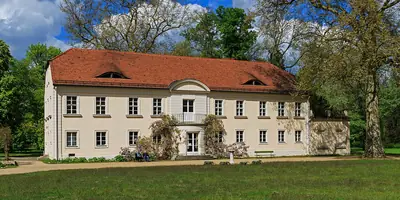
The city’s other places of interest include Lepsiushaus, a research centre devoted to genocide studies, and Schloss Sacrow, a classical palace beside the Havel River. In Babelsberg Park, the Theater wall and Norman Tower provide additional historic viewpoints.
For a broader city-centre route, explore the Germany destination and follow Potsdam’s rebuilt royal heart around the Alter Markt and Neuer Markt.
Explore Potsdam with Neywo
A Potsdam self-guided walking tour lets you explore the city without joining a group or following a fixed timetable. Neywo has seven walking tours, one bus route and one bike route in Potsdam:
- Sanssouci: 2.35 km, 119 minutes and 8 narrated stops.
- Neuer Garten: 2.51 km, 108 minutes and 8 narrated stops.
- Pfingstberg and Alexandrowka: 1.74 km, 113 minutes and 9 narrated stops.
- Alter Markt and Neuer Markt: 1.96 km, 107 minutes and 12 narrated stops.
- Dutch Quarter and Gates: 2.76 km, 111 minutes and 10 narrated stops.
- Babelsberg Park: 2.44 km, 117 minutes and 8 narrated stops.
- New Palace and the Western Park: 3.1 km, 107 minutes and 8 narrated stops.
- Bus 695: 4.5 km, 19 minutes and 9 narrated stops.
- From the New Palace to Alexandrowka by Cycle Lane: 8 km, 40 minutes and 4 narrated stops.
The app tells the story of each place as you reach it, at your own pace, with no group and no schedule. Narration is available in 11 languages. Download Neywo and explore Potsdam’s palaces, parks and historic neighbourhoods with the city’s stories accompanying your walk.
Places with an audio guide in Potsdam
8 places in Potsdam with a Neywo audio guide. Each one starts telling its story as you reach it.
Self-guided tours in Potsdam
9 tours in Potsdam, free in the Neywo app. Each stop tells its story as you reach it.
- Bike ride
From the New Palace to Alexandrowka by Cycle Lane
Cycling is restricted inside the royal parks, so follow the city's cycle lanes from the university at the New Palace through Nauener Vorstadt to the Jewish cemetery and the Russian colony of Alexandrowka. A calm ride past Potsdam's quieter side.
University of Potsdam · Rote Kaserne · Jewish Cemetery, Potsdam · Museum Alexandrowka
Open this tour: From the New Palace to Alexandrowka by Cycle Lane - Bus ride
Bus 695: Hauptbahnhof Gates to Sanssouci
A regular ViP city bus from the main station past the Film Museum, the Garrison Church, the old city gates and the Brandenburg Gate to Sanssouci Palace. A cheap hop through the heart of Potsdam to the park.
Filmmuseum Potsdam · Garrison Church · Neustädter Tor · Baptistenkirche · Brandenburg Gate · Jägertor …
Open this tour: Bus 695: Hauptbahnhof Gates to Sanssouci - Walk
Sanssouci: Frederick the Great's Palace Without Worries
Enter Frederick the Great's private park through the Obelisk Portal and walk the sunlit terraces to the little rococo palace he built to escape the court. See a grotto that waited a century for its water, the oldest museum built for a ruler in Germany, the miller's legendary windmill and a teahouse that mocks Europe's fashion for China.
Brandenburg Gate · Obeliskportal · Neptune Grotto · Sanssouci Picture Gallery · Historic Mill of Sanssouci · New Chambers …
Open this tour: Sanssouci: Frederick the Great's Palace Without Worries - Walk
Neuer Garten: Where the Potsdam Conference Divided Europe
Stroll the lakeside New Garden from the Palace Kitchen, built as a fake temple ruin, to the Marble Palace, the Pyramide and Cecilienhof, the Tudor-style palace where Truman, Churchill and Stalin met in 1945. End at the shell grotto on the Jungfernsee.
Parasol · Palace kitchen · Marmorpalais · Pyramide · Grünes Haus · Cecilienhof …
Open this tour: Neuer Garten: Where the Potsdam Conference Divided Europe - Walk
Pfingstberg and Alexandrowka: Russia in Prussia
Visit a Russian wooden village built for Prussia's king, an Orthodox church on the hill, and then climb the Pfingstberg to the Italian-style Belvedere with the best view in Potsdam. Finish at the villa of the pastor who documented the Armenian genocide.
Russische Kolonie 1 Potsdam · Museum Alexandrowka · Alexander Nevsky Memorial Church · Royal country house · Jewish Cemetery, Potsdam · Pomonatempel …
Open this tour: Pfingstberg and Alexandrowka: Russia in Prussia - Walk
Alter Markt and Neuer Markt: Potsdam's Rebuilt Royal Heart
Potsdam's royal centre was bombed in 1945 and rebuilt stone by stone. Walk from the reborn Garrison Church tower through the baroque Neuer Markt to the City Palace, Schinkel's domed St Nicholas' Church, the obelisk and the Palladian Old Town Hall, with the Barberini art museum on the square.
Garrison Church · Nikolaisaal · Filmmuseum Potsdam · New Synagogue Potsdam · Kabinetthaus · Neuer Markt …
Open this tour: Alter Markt and Neuer Markt: Potsdam's Rebuilt Royal Heart - Walk
Dutch Quarter and Gates: Brick Houses and Prussian City Walls
Wander the old Potsdam of soldier-kings: the red-brick Dutch Quarter built for immigrant craftsmen, the French church and the twin towers of St Peter and Paul, and three of the city's surviving gates, ending at Luisenplatz and the Brandenburg Gate side of town.
Platz der Einheit · French church · Peter and Paul Church · Brandenburger Straße · Jan Bouman Haus · Nauener Tor …
Open this tour: Dutch Quarter and Gates: Brick Houses and Prussian City Walls - Walk
Babelsberg Park: A Prince's Gothic Fairy-Tale
Follow the paths of Babelsberg Park above the Tiefer See to a neo-Gothic palace built for the future German emperor, with a medieval-looking court arcade, a castle-style steam pump house and a tiny castle on the shore. A romantic landscape park walk.
Babelsberg Palace · Voltaireterrasse · Porcelain terrace · Schlossküche Babelsberg · Small Castle · Gerichtslaube …
Open this tour: Babelsberg Park: A Prince's Gothic Fairy-Tale - Walk
New Palace and the Western Park: Frederick's Show of Power
Start at the huge New Palace, built after the Seven Years' War to show that Prussia was not broke, then stroll past its Communs, a palace theatre, ancient-style temples and the Dragon House to the Orangery Palace. The quiet western half of Sanssouci Park.
New Palace · Communs New Palace · Theatre in the New Palace · Antique Temple · Temple of Friendship · Dragon House …
Open this tour: New Palace and the Western Park: Frederick's Show of Power
Walk Potsdam with Neywo
Neywo turns Potsdam into a self-guided audio tour. Stories arrive as you reach the place they belong to, and the route reshapes when you wander off it.


More in Germany
Elsewhere in Germany
- Baden-BadenBaden-Württemberg
- BlaubeurenBaden-Württemberg
- Esslingen am NeckarBaden-Württemberg
- FreiburgBaden-Württemberg
- HeidelbergBaden-Württemberg
- KarlsruheBaden-Württemberg
- Kirchheim unter TeckBaden-Württemberg
- Leutkirch im AllgäuBaden-Württemberg
- StuttgartBaden-Württemberg
- TribergBaden-Württemberg
- AugsburgBavaria
- BambergBavaria