Things to Do in Mainz, Germany: Walking Guide
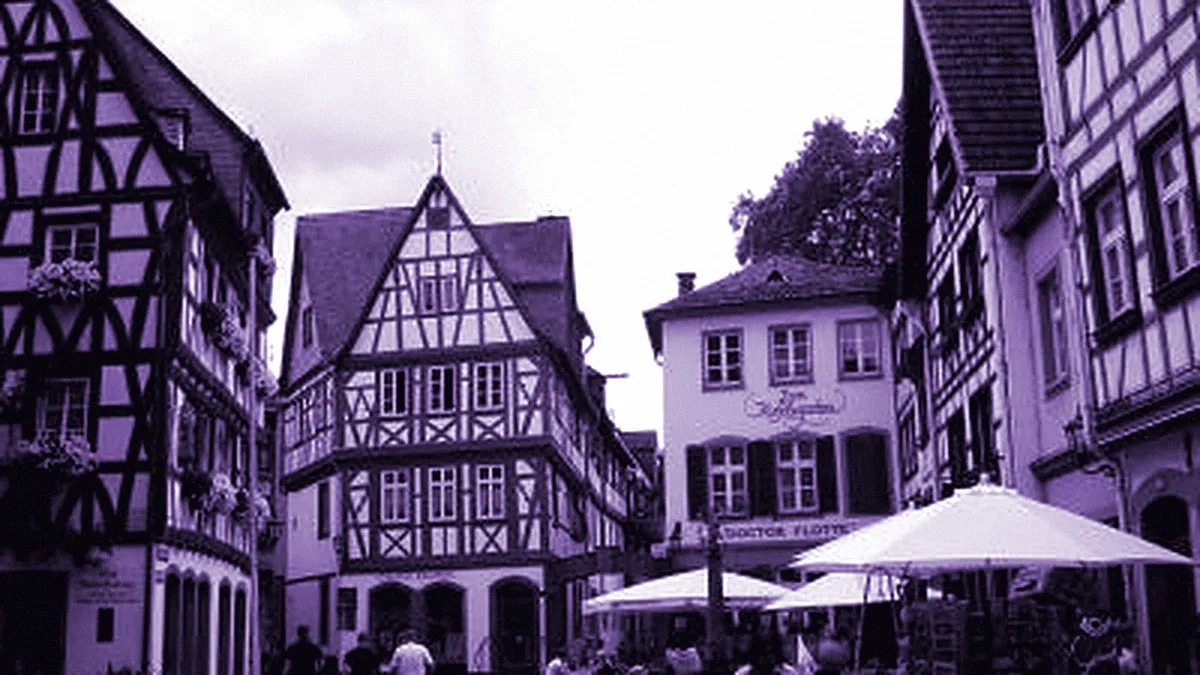
Things to do in Mainz: Roman History, Gutenberg and Carnival
Looking for things to do in Mainz? This historic city in Rhineland-Palatinate brings together Roman archaeology, a Romanesque cathedral, the legacy of Johannes Gutenberg, wine culture and one of Germany’s best-known carnival traditions. Neywo’s free Mainz audio guide covers 131 narrated places, so you can explore the city while hearing its stories at the locations where they happened.
Mainz is the capital of Rhineland-Palatinate, and its historic centre is especially rewarding on foot. The city’s museums, churches, fortifications and monuments reveal different layers of its past, from Roman Mogontiacum to the development of modern printing.
What to see in Mainz
Mainz Cathedral
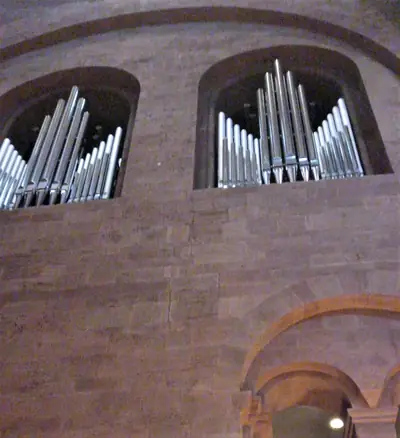
Mainz Cathedral, also known as the Mainzer Dom or St. Martin’s Cathedral, is one of the city’s defining landmarks. Its history reaches back to the late tenth century, when Archbishop Willigis ordered a new cathedral between 975 and 976. The building was badly damaged by fire on the day of its inauguration in 1009, but its main parts were completed by 1036.
The cathedral is centred on a three-aisled Romanesque basilica dedicated to Saint Martin of Tours. Its eastern choir is dedicated to Saint Stephen, while later Gothic and Baroque additions created the layered appearance visible today. The eastern chancel is the oldest part, with walls more than two metres thick. The cathedral has suffered seven major fires during its history, and its stone spire was rebuilt in 1767.
Gutenberg Museum
The Gutenberg Museum is devoted to books, writing and printing, and preserves the legacy of Johannes Gutenberg, who developed printing with movable type in Mainz. It is regarded as one of the oldest printing museums in the world.
Its collections include printing equipment and printed materials from many cultures. Highlights include a reconstructed printing press and two copies of the Gutenberg Bible. The museum also explores typography and book design through temporary exhibitions. Its current interim presentation, Gutenberg Museum MOVED, is being shown in renovated rooms at the Natural History Museum near Liebfrauenplatz, while a new museum building is planned opposite Mainz Cathedral.
Dom- und Diözesanmuseum
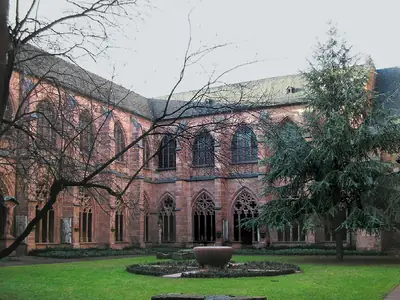
The Dom- und Diözesanmuseum Mainz occupies historic spaces beside the cathedral. Its collection spans two thousand years and includes artworks that once belonged to Mainz Cathedral or churches in the diocese.
The setting is a major part of the visit: the museum includes Staufian vaulted halls, a two-storey Late Gothic cloister and former chapter rooms. The former Nikolaus Chapel, a Late Gothic chapel, houses the cathedral treasury.
Alte Universität
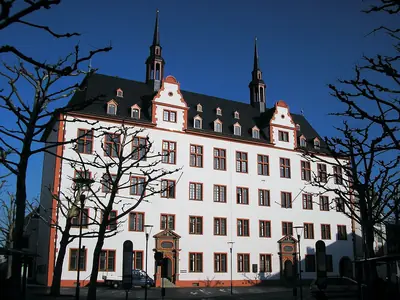
The Alte Universität, also known as the Domus Universitatis, is a Renaissance building created between 1615 and 1618. It housed the theological and philosophical faculties of the University of Mainz, as well as a Latin school run by the Jesuits.
The building reflects the close relationship between university education and Jesuit teaching in Mainz during this period.
Drususstein and the Roman city
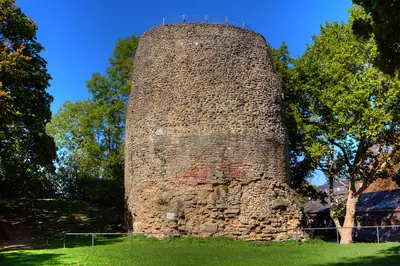
The nearly twenty-metre-high Drususstein is one of the most striking surviving traces of Roman Mogontiacum. It is widely understood as the remains of a cenotaph, or symbolic tomb, for the Roman general Drusus. Roman troops erected the monument in 9 BC after his death.
Drusus was the stepson of the emperor Augustus, and the monument became a place for memorial ceremonies and the imperial cult in Mogontiacum. It was originally covered in marble, although that covering was removed in the early Middle Ages.
Nearby, the Stadthistorisches Museum Mainz explores more than two thousand years of the city’s history from within the grounds of the citadel. Its exhibitions include permanent and special displays about Mainz’s development.
Arch of Dativius Victor
The Arch of Dativius Victor is one of Germany’s important reconstructed Roman monuments. Dating from the middle of the third century, it once formed the central passage through a columned hall in a public building in Mogontiacum.
Dativius Victor was a civic councillor, and an inscription records that his two sons commissioned the arch and adjoining portico after his death. The monument was dedicated to the imperial household and Jupiter. Vine branches decorated the pillars, while the inner curve of the vault originally included zodiac imagery. Fragments of the original arch were discovered in 1891, and the monument was reconstructed between 1978 and 1980 or 1981.
Landesmuseum Mainz
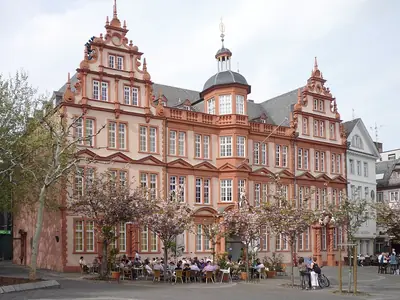
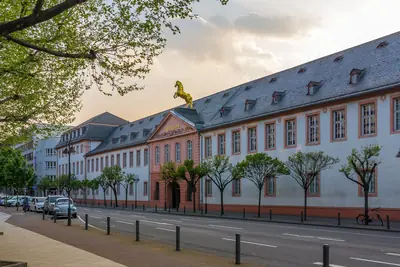
The Landesmuseum Mainz occupies the Golden-Ross-Kaserne, a former electoral stable complex named after the over-life-size gilded horse above its main entrance. The building was erected in 1766 and 1767.
Inside, the museum brings together art and cultural history from prehistory and the Roman period through the Middle Ages and Baroque, as well as Art Nouveau and twentieth-century art. Its collection began in 1803, when Jean-Antoine Chaptal, acting at Napoleon Bonaparte’s direction, donated thirty-six paintings to Mainz.
Fastnachtsmuseum and the Fastnachtsbrunnen
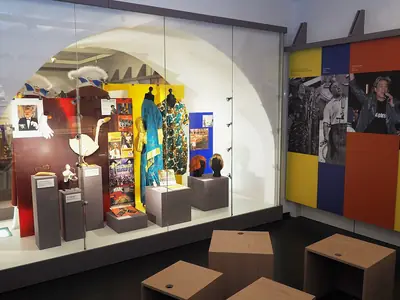
Mainz Carnival, or Fastnacht, is presented at the Fastnachtsmuseum through costumes, symbols, photographs, sounds and historical objects. The museum traces the tradition from 1837 to the present and opened in 2004 in the renovated Proviant-Magazin, a former military supply depot.
Among its exhibits are fool’s hats, medals, sceptres, guards’ uniforms, songbooks and parade memorabilia. Visitors can also see oversized papier-mâché heads known as Schwellköpp, figures that have appeared in the Rose Monday parade since 1927.
On Schillerplatz, the Fastnachtsbrunnen is a monument to this festive tradition. Unveiled in 1967 after three years of construction, the fountain expresses the spirit of Mainz’s season of fools.
Bassenheimer Hof
Close to the Osteiner Hof, the Bassenheimer Hof is an elegant aristocratic residence with a restrained French Baroque design. After its sale to the military authorities of the Mainz fortress in 1835, it served as a barracks until 1889. It later housed a Viennese café and a flag embroidery workshop.
Today, the building is used by the Ministry of the Interior and Sports of Rhineland-Palatinate. Although much of its original interior arrangement, garden and surrounding layout has disappeared, the palace remains a reminder of Mainz’s aristocratic past.
Kupferberg-Museum
The Kupferberg-Museum connects wine culture with the history and architecture of Mainz. It forms part of the Kupferberg sparkling wine cellars, founded in 1850 by Christian Adalbert Kupferberg.
Seven levels of vaulted cellars extend up to 50 metres underground. They include one of the world’s largest wooden barrels, with room for 100,000 litres of wine. The hill was already used by Roman soldiers in 12 BC, and excavations uncovered wine amphoras and jugs more than 2,000 years old.
The museum also holds a major collection of sparkling wine and champagne glasses, ranging from the Renaissance to the modern era. Another highlight is the Grape Hall, an Art Nouveau interior reconstructed from the Paris World Exhibition of 1900.
Kunsthalle Mainz
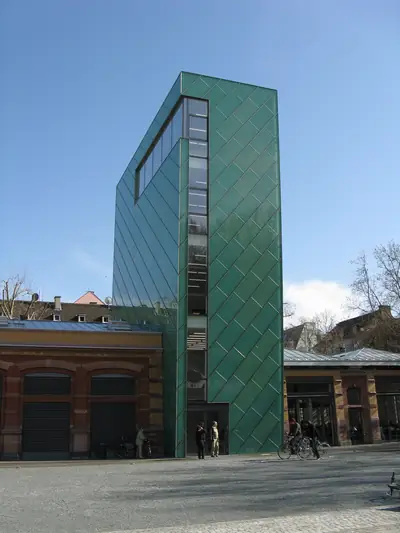
Kunsthalle Mainz occupies a former boiler and machine house in the historic customs port. The industrial building was designed by Eduard Kreyßig in 1887 and retains its long, single-storey brick structure.
A later renovation added a 21-metre tower leaning at an angle of seven degrees. Inside, the Kunsthalle presents temporary exhibitions of contemporary art, including solo and thematic shows, alongside workshops, guided tours, artist talks, discussions and lectures.
Museum of Ancient Seafaring
The Museum of Ancient Seafaring focuses on Roman military ships discovered in Mainz, together with full-size reconstructions and displays about ancient shipbuilding. The surviving remains of several late Roman ships were found during construction work near the Rhine in 1981 and 1982.
The centrepiece is a group of five Roman military ships from the fourth century. Their oak remains survived beneath layers of mud for around fifteen hundred years. The museum closed in July 2022 and is expected to reopen in late autumn 2026.
Natural History Museum Mainz and LEIZA
The Natural History Museum Mainz is the largest museum of its kind in Rhineland-Palatinate. Its collections cover biology and Earth sciences, with a focus on the region and its partner country, Rwanda. The museum is housed in the former Reichclara Monastery, founded in 1272.
Its fossils include primeval horses dating back 44 million years, as well as rare tracks made by dinosaurs and insects during the Permian Period on the Rhine. A group of three quaggas is another notable sight; only 23 such exhibits are represented worldwide.
The Leibniz Centre for Archaeology, or LEIZA, combines archaeological research with a museum. It developed from the Roman-Germanic Central Museum, founded in 1852, and took its present name on January 1, 2023.
A Mainz self-guided walking tour with Neywo
Neywo offers six walking tours in Mainz, one bus route and one bike route:
- Gutenberg’s Mainz: Cathedral, Market and the Printing Quarter — 2.06 km, 95 minutes and 12 narrated stops.
- Mogontiacum: Roman Mainz — 3.3 km, 93 minutes and 10 stops.
- Carnival, Wine and Electoral Palaces — 2.43 km, 92 minutes and 12 stops.
- Towers, Gates and the Old Walls — 2.02 km, 81 minutes and 11 stops.
- Neustadt: Station, Synagogue and Customs Harbour — 2.28 km, 77 minutes and 9 stops.
- Hidden Churches, Courts and Jewish Memory in the Old Town — 1.98 km, 73 minutes and 9 stops.
- Bus 60: Rhine Edge, Old Town and Mombach — 8 km, 34 minutes and 11 stops.
- Roman Theatre and the Western Cycle Lane — an 8.6 km bike route lasting 43 minutes, with 5 stops.
The app tells the story of each place as you reach it, at your own pace, with no group and no schedule. Narration is available in 11 languages. Download Neywo to explore Mainz independently, from Gutenberg’s printing legacy and the cathedral to Roman monuments, museums, carnival landmarks and the city’s historic streets.
If you are continuing through the region, you can also discover Trier, Koblenz or Bacharach, and explore more of Germany with Neywo.
Places with an audio guide in Mainz
8 places in Mainz with a Neywo audio guide. Each one starts telling its story as you reach it.
Self-guided tours in Mainz
8 tours in Mainz, free in the Neywo app. Each stop tells its story as you reach it.
- Bike ride
Roman Theatre and the Western Cycle Lane
Ride from Mainz's Roman theatre along an OSM-mapped cycle lane out to the Carthusian monastery, the Holy Cross church and the Dalheim monastery ruins on the edge of the city.
Roman theater at Mainz · Kartause Mainz · Catholic Church of the Holy Cross, Mainz · Kloster Dalheim · St. Johannes Evangelist
Open this tour: Roman Theatre and the Western Cycle Lane - Bus ride
Bus 60: Rhine Edge, Old Town and Mombach
MVG bus 60 links the Roman-era south of Mainz with the old town and the northern districts. Ride past the Archaeology Centre (LEIZA), the medieval Wood Tower and Fish Gate site, the old university and the carnival fountain in the heart of the city.
Weisenauer Synagogue Mainz · Leibniz-Zentrum für Archäologie · Kulturzentrum Mainz · Wood Tower · Fish gate · Jockel-Fuchs-Platz …
Open this tour: Bus 60: Rhine Edge, Old Town and Mombach - Walk
Gutenberg's Mainz: Cathedral, Market and the Printing Quarter
Follow the man who changed the world with movable type through the heart of Mainz. Visit the museum of the Gutenberg Bible, the ruined church where he is said to have been baptised, the thousand-year-old cathedral and the market square, and finish beneath Chagall's blue windows.
Gutenberg Museum · St. Christoph's Church, Mainz · Hof zum Gutenberg · Alte Universität · Heunensäule · Mainz Cathedral …
Open this tour: Gutenberg's Mainz: Cathedral, Market and the Printing Quarter - Walk
Mogontiacum: Roman Mainz
Before it was Mainz it was Mogontiacum, a legionary fortress and provincial capital on the Rhine. See a Roman arch, a hidden sanctuary of Isis under a shopping arcade, the museum of Roman stones and the largest Roman theatre north of the Alps.
Arch of Dativius Victor · The Big Jupiter column · Landesmuseum Mainz · Sanctuary of Isis and Magna Mater · Gau Gate · Fortress of Mainz …
Open this tour: Mogontiacum: Roman Mainz - Walk
Carnival, Wine and Electoral Palaces
A walk through the Mainz of the prince-archbishops and of Fastnacht. See Baroque noble courts, the carnival fountain and museum, the wine-drinker statue, the Rococo church of St Peter and the palaces where electors, a short-lived republic and Napoleon once held court.
Altmünster · Fastnachtsmuseum · Schoppenstecher-Standbild · Schönborner Hof · Unterhaus – Forum-Theater in Mainz · Fastnachtsbrunnen …
Open this tour: Carnival, Wine and Electoral Palaces - Walk
Towers, Gates and the Old Walls
Trace what is left of medieval and fortress Mainz along the Rhine side of the old town: the Iron Tower, the Wood Tower, the site of the Fish Gate, the oldest half-timbered house in the city and a classicist church built for Jesuits, ending in the citadel.
Jockel-Fuchs-Platz · Iron Tower · Liebfrauenplatz · Fish gate · Maria Mater Dolorosa, Mainz · St. Augustine's church (Mainz) …
Open this tour: Towers, Gates and the Old Walls - Walk
Neustadt: Station, Synagogue and Customs Harbour
Leave the 19th-century city extension behind the main station. See the station square, the church at the foot of the Boniface towers, the fragments of the Hauptsynagoge destroyed in 1938, a modern church of 1957 and the old customs harbour, now home to the Kunsthalle and the Nomade sculpture on the Rhine.
Mainz Central Station · Bahnhofplatz · Catholic St. Boniface Church, Mainz · Gartenfeldplatz · Hauptsynagoge Mainz · Katholische Pfarrkirche St. Joseph …
Open this tour: Neustadt: Station, Synagogue and Customs Harbour - Walk
Hidden Churches, Courts and Jewish Memory in the Old Town
Slip off the tourist route into the lanes around Ballplatz. A Gothic Carmelite church, a Gothic Antonite chapel, the site of a destroyed synagogue, the Romanesque tower of St Emmeran and the Renaissance courts of the Barons of Dalberg.
St. Gangolf · Karmeliterkirche · Antoniterkapelle · Former synagogue in Mainz · St. Emmeran, Mainz · Dominikanerkloster Mainz …
Open this tour: Hidden Churches, Courts and Jewish Memory in the Old Town
Walk Mainz with Neywo
Neywo turns Mainz into a self-guided audio tour. Stories arrive as you reach the place they belong to, and the route reshapes when you wander off it.

